Introduction
Most procurement teams at mid-market and PE-backed companies are running faster with fewer resources — managing supplier relationships, tracking spend, and fielding compliance demands while leadership expects measurable savings. The right strategic sourcing platform doesn't just organize that workload. It shifts the function from reactive to genuinely strategic.
At a functional level, these platforms consolidate supplier management, RFx workflows, spend analytics, and contract collaboration into a single operating environment. The challenge is that only 32% of procurement decision-makers report fully integrated procurement processes, per Amazon Business's 2024 State of Procurement Report.
That gap — between what these platforms promise and how most organizations actually use them — is where savings leakage lives.
What follows is a practical look at the platforms procurement teams are adopting in 2025–2026: what each does well, where each falls short, and how to match the right tool to your organization's size and sourcing maturity.
Key Takeaways
- Strategic sourcing platforms replace disconnected spreadsheets and email threads with unified, automated procurement workflows
- Leading platforms include Coupa, SAP Ariba, GEP SMART, Ivalua, and Zycus — each optimized for different environments
- AI-powered spend analytics, RFx automation, and supplier lifecycle management are table-stakes features — the differentiator is how well each platform fits your environment
- Platform ROI depends as much on the procurement talent operating it as on the software itself
- Mid-market and PE-backed companies should evaluate total cost of ownership, not just feature depth
What Is Strategic Sourcing and Why Do Platforms Matter?
Strategic sourcing is a data-driven, systematic approach to supplier evaluation and spend management that prioritizes long-term business value over short-term cost minimization — contrasting sharply with traditional, transactional purchasing focused purely on lowest price.
Without a dedicated platform, sourcing teams fall back on fragmented tools:
- Email threads to manage RFx events
- Spreadsheets for spend tracking and supplier comparisons
- Siloed supplier data scattered across business units
The operational cost is real. The Hackett Group found that procurement workload increased 8% in 2024 while operating budgets grew only 1.6% — a 6.4% efficiency gap that manual processes cannot close.
The consequences are predictable: savings leakage, poor contract compliance, slow sourcing cycles, and limited visibility into where money is actually going.
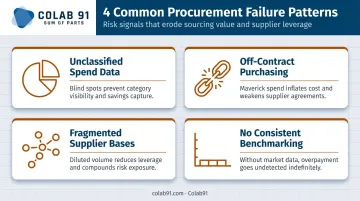
Colab91's procurement diagnostic work with mid-market and PE-backed clients consistently surfaces the same failure patterns:
- Unclassified spend data with no category structure
- Off-contract purchasing that erodes negotiated savings
- Fragmented supplier bases across business units
- No consistent benchmarking against market pricing
For procurement teams at this stage, the decision has shifted from whether to adopt a platform to which platform fits your sourcing maturity, ERP ecosystem, and team structure.
Top Strategic Sourcing Platforms for Procurement Teams
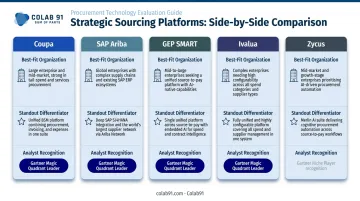
These platforms were selected based on market presence, feature depth, AI capability, supplier management strength, and fit across enterprise and mid-market procurement environments.
Coupa
Coupa is one of the most widely deployed spend management platforms globally, serving large enterprises across manufacturing, healthcare, financial services, and retail with a unified source-to-pay suite.
Its AI sourcing engine draws on $10 trillion in transactional data from 10M+ buyers and suppliers, a community intelligence layer that enables benchmark pricing and supplier insights unavailable on most competing platforms. Coupa connects sourcing events directly to contracts and purchasing, reducing value leakage between negotiation and execution.
Coupa was named a Leader in the 2026 Gartner Magic Quadrant for Source-to-Pay Suites for the third consecutive year, positioned highest for Ability to Execute among 13 providers.
| Attribute | Details |
|---|---|
| Best For | Enterprise procurement teams focused on spend visibility, governance, and source-to-pay integration |
| Key Features | AI sourcing insights, spend analytics, supplier risk management, contract collaboration, procurement automation |
| Pricing | Custom enterprise pricing; contact Coupa for a quote |
SAP Ariba
SAP Ariba is the go-to platform for large enterprises operating within SAP ERP environments. It brings together supplier discovery, RFx management, contract lifecycle management, and spend analysis in one ecosystem.
Deep native integration with SAP S/4HANA significantly reduces implementation complexity and data synchronization overhead for SAP-centric organizations. The SAP Business Network (formerly Ariba Network) supports over $6 trillion in annual transactions and connects buyers to millions of suppliers across 190+ countries. SAP was also named a Leader in the 2026 Gartner Magic Quadrant for Source-to-Pay Suites.
| Attribute | Details |
|---|---|
| Best For | SAP-centric enterprise procurement ecosystems requiring native ERP integration |
| Key Features | RFx automation, supplier lifecycle management, spend visibility, contract collaboration, supplier risk monitoring |
| Pricing | Enterprise subscription pricing; quote-based |
GEP SMART
GEP SMART is a unified, cloud-native platform that combines sourcing, procurement, supplier management, and spend analytics. It's widely used by Fortune 500 companies and PE-backed organizations undergoing procurement transformation.
The GEP Quantum Intelligence AI engine surfaces savings opportunities, automates sourcing wave triggers, and provides pre-populated contract tools, reducing manual workload across the sourcing cycle. GEP SMART's unified architecture (rather than a stitched-together suite) gives procurement leaders consistent data visibility across all sourcing and contract activities.
GEP has been named a Leader in both the 2025 and 2026 Gartner Magic Quadrants for Source-to-Pay Suites.
| Attribute | Details |
|---|---|
| Best For | Organizations seeking a single, unified platform for end-to-end procurement transformation |
| Key Features | AI sourcing analytics, supplier collaboration, savings tracking, spend management, procurement automation |
| Pricing | Enterprise pricing model; contact GEP for a quote |
Ivalua
Ivalua is a highly configurable source-to-pay platform designed for organizations with complex, non-standard procurement workflows. It serves mid-to-large enterprises across aerospace, pharmaceuticals, financial services, and healthcare.
Workflow configurability is the core differentiator here: procurement teams can tailor supplier onboarding, RFx templates, scoring models, and approval flows through a no-code/low-code "Design Mode," without heavy custom coding. Ivalua's advanced supplier data management makes it well-suited for organizations with high supplier complexity.
A Credit Agricole deployment on Ivalua onboarded 59,000+ suppliers and produced an €80M spend reduction, a useful real-world benchmark for what full-scale deployment can deliver.
| Attribute | Details |
|---|---|
| Best For | Mid-to-large enterprises requiring highly customizable sourcing workflows and deep supplier data management |
| Key Features | Supplier onboarding, RFx management, spend analysis, workflow customization, supplier risk monitoring |
| Pricing | Custom enterprise pricing; quote-based |
Zycus
Zycus is a procurement technology platform with a strong focus on AI-powered automation, offering a full source-to-pay suite including its flagship eSourcing module, iSource. It serves enterprise procurement teams across manufacturing, retail, and healthcare.
The Merlin Agentic AI platform handles complex multi-round negotiations, surrogate bidding (buyers placing bids on behalf of suppliers), and conditional workflows that compress sourcing cycle times. Zycus was named a Leader in the 2025 IDC MarketScape for Worldwide AI-Enabled Source-to-Pay Applications and received perfect scores for Vision and Innovation from Forrester.
| Attribute | Details |
|---|---|
| Best For | Enterprise procurement teams prioritizing AI-driven sourcing automation and high-volume, complex sourcing events |
| Key Features | AI sourcing assistant, spend analytics, supplier evaluation, contract collaboration, multi-round RFx events |
| Pricing | Subscription-based pricing; contact Zycus for enterprise quote |
Key Features to Look for in a Strategic Sourcing Platform
When evaluating platforms, five capabilities separate functional tools from genuine performance drivers.
AI-Powered Spend Analytics
The best platforms classify spend automatically, surface savings opportunities, score supplier bids, and flag compliance exceptions without manual intervention. Deloitte notes that GenAI can support spend cube analysis, simulate sourcing scenarios, and reduce "swivel chair" manual interventions throughout the sourcing cycle.
When evaluating vendors, ask specifically how their AI improves sourcing outcomes — not just workflow efficiency. That distinction separates tools that accelerate decisions from tools that simply digitize paperwork.
RFx Automation and Sourcing Event Management
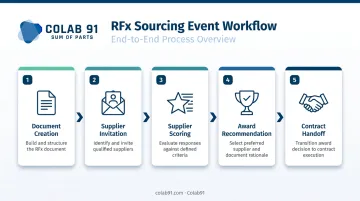
The platform should support end-to-end RFI, RFP, and RFQ workflows — from document creation and supplier invitation through to scoring, award recommendation, and contract handoff. Key capabilities to verify:
- Pre-built templates for common categories
- Automated supplier scoring with configurable weighting
- Multi-round event support
- Direct handoff to contract management
Supplier Lifecycle Management
Beyond a vendor list, a strong platform centralizes supplier onboarding, risk assessments, performance KPIs, and relationship history in a single supplier profile. This is especially critical for organizations managing large, diverse supplier bases across multiple categories — a challenge Colab91's clients across healthcare, manufacturing, and retail consistently encounter.
ERP and Tech Stack Integration
Evaluate pre-built connectors for your ERP (SAP, Oracle, Workday), P2P systems, and contract management tools — and verify how real-time the data sync actually is. Poor integration recreates the same fragmentation the platform was meant to solve. Confirm support for:
- ERP connectors (SAP, Oracle, Workday)
- P2P and invoice management systems
- Contract lifecycle management tools
- Real-time vs. batch data sync cadence
Savings Tracking and Procurement Governance
A platform should close the loop between sourced savings and realized savings — tracking whether negotiated prices are being captured at the purchase order and invoice level. Value leakage most often occurs here, at the gap between what was negotiated and what was actually paid — and most platforms underdeliver on this specific capability.
How We Chose These Platforms
These platforms were assessed based on depth of sourcing functionality, AI and automation capabilities, supplier management maturity, ERP integration breadth, and suitability across enterprise and mid-market procurement environments.
Colab91's leadership team — with 16+ years of hands-on experience running strategic sourcing programs for clients including Carlyle Group, TPG, Pediatric Associates, Kindred Healthcare, and Fortune 100 firms — informed the practical evaluation criteria used here. The team has implemented and advised on Coupa, Ariba, Ivalua, GEP SMART, and other platforms firsthand — bringing implementation-level familiarity that vendor demos and analyst rankings rarely reflect.
Common Platform Selection Mistakes
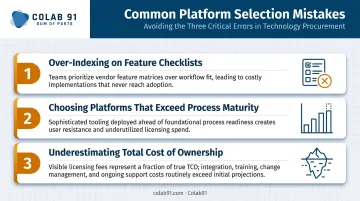
Three errors consistently constrain platform ROI before go-live:
Over-indexing on feature checklists rather than evaluating adoption readiness and implementation complexity. A platform that does everything but gets used by 30% of the team delivers a fraction of expected value.
Choosing enterprise-grade platforms that exceed current process maturity. Mid-market companies that lack structured category management, spend taxonomies, or sourcing workflows will struggle to operationalize a full suite .
Underestimating total cost of ownership. Licensing fees are often the smallest component. A Forrester TEI study on Ivalua found that a composite implementation carried $6.5M in three-year risk-adjusted costs — including $2.2M in professional services and $2.0M in training alone. Platform ROI timelines extend significantly when these costs are underestimated upfront.
Conclusion
Choosing the right strategic sourcing platform is a long-term operating decision, not just a software purchase. The platform must align with your sourcing maturity, ERP ecosystem, supplier complexity, and the procurement team's capacity to actually operate it at scale.
For mid-market and PE-backed companies in particular, talent and domain expertise — not the software itself — determine whether a platform delivers ROI. Technology provides visibility and workflow automation; the savings come from category expertise, supplier negotiation, and continuous optimization that people execute.
This is where Colab91's model closes the gap. Colab91 builds dedicated India-based procurement and analytics teams that operate alongside whichever sourcing platform a client has deployed. The team handles the work that actually generates savings:
- Running sourcing events and RFx processes end-to-end
- Managing supplier relationships and performance tracking
- Tracking realized savings against targets
- Providing continuous category management between sourcing cycles
It's the operating model that makes the platform investment work.
If your team is evaluating platforms, implementing one, or trying to get more out of an existing deployment, Colab91's procurement and analytics experts can help you build the operating model to match. Reach out at contact@colab91.com to start the conversation.
Frequently Asked Questions
What are the leading strategic sourcing platforms for procurement teams?
The leading platforms in 2025–2026 include Coupa, SAP Ariba, GEP SMART, Ivalua, and Zycus. The best choice depends on your ERP environment, sourcing complexity, and organizational size — SAP Ariba suits SAP-native enterprises, while Ivalua and GEP SMART fit organizations that prioritize configurability or unified architecture.
What is strategic sourcing in procurement?
Strategic sourcing is a data-driven approach to supplier evaluation and spend management focused on maximizing long-term business value beyond the lowest purchase price. It weighs total cost of ownership, supplier quality, risk, resilience, and alignment with broader organizational goals.
What are the 10 C's of sourcing?
Carter's 10 Cs is a supplier evaluation framework that assesses vendors across Competency, Capacity, Commitment, Control, Cash, Cost, Consistency, Culture, Clean, and Communication. It's used in strategic sourcing to evaluate suppliers across multiple dimensions beyond price alone.
What is the difference between strategic sourcing and tactical sourcing?
Tactical sourcing is transactional and focused on immediate purchasing needs at low cost. Strategic sourcing is a longer-term process that evaluates suppliers against broader business goals, including quality, risk, innovation potential, and total cost of ownership.
How long does it take to implement a strategic sourcing platform?
Timelines range from a few months for focused module rollouts to 2+ years for full enterprise deployments. A Forrester study on Ivalua found this exact spread, with ERP complexity, data readiness, and change management as the primary drivers.
Which strategic sourcing platform is best for mid-market companies?
Mid-market organizations typically benefit from platforms with strong usability and faster time-to-value, such as Ivalua or GEP SMART. Platform fit should be weighed against implementation support and total cost of ownership, not feature depth alone.