Introduction
Unmanaged purchasing is rarely dramatic. It doesn't appear as a single rogue transaction. It builds up incrementally - across dozens of departments, hundreds of vendors, and thousands of low-visibility decisions made by employees who weren't trying to break policy. They were just trying to get something done faster.
The financial consequences compound quickly. According to a World Commerce & Contracting/KPMG report, contracts suffer more than 9% value leakage - with 4.2% of contract value spent on avoidable post-award management alone. For a mid-market company with $200M in annual spend, that's a material number. For a PE-backed portfolio company under margin pressure, it's the difference between hitting EBITDA targets and missing them.
The good news: maverick spend is preventable. It persists not because purchasing is inherently chaotic, but because governance gaps, process friction, and poor visibility make non-compliant purchasing the path of least resistance.
This article examines maverick spend from three angles: upstream decisions, real-time management, and structural context - with practical, automation-oriented strategies for each.
Key Takeaways
- Maverick spend accumulates through hundreds of small, off-contract purchases concentrated in indirect and tail spend categories
- Process friction - not bad intent - is the primary driver; employees bypass approved channels because those channels are slower
- Reducing maverick spend starts upstream: clearer policies, pre-approved catalogs, tiered approvals, and supplier rationalization
- Real-time tools like automated workflows, spend analytics, and 3-way invoice matching close compliance gaps as they form
- Long-term control requires structural investment: indirect spend governance, data quality, and dedicated analytics capacity
How Maverick Spend Quietly Accumulates
How Maverick Spend Accumulates Undetected
Maverick spend doesn't show up in a single line item. It builds through patterns: a facilities manager with a preferred local vendor, an IT team running unapproved software subscriptions, a regional office that reorders supplies from whoever delivers fastest.
None of these decisions feel significant in isolation. Consolidated across a mid-size organization, they can represent 10–20% of addressable spend with no contract coverage and no visibility.
Where It Concentrates
The accumulation is most pronounced in indirect and tail spend categories. According to CIPS, the bottom 20% of organizational spend typically accounts for 80% of suppliers - and much of it sits outside formal procurement control or contract coverage. Office supplies, facilities maintenance, IT subscriptions, professional services, and one-off purchases rarely have a named category owner. Procurement's attention goes to direct spend, capital expenditure, and high-value contracts. Indirect categories get managed by whoever needs them most urgently.
Professional services illustrate the exposure well: Ardent Partners research found that professional services spending comprises 45–65% of total non-employee spending, yet less than 32% of that spend is actively managed.
When It Becomes Visible
The true scale of maverick spend surfaces at a forcing event: a budget audit, a financial due diligence process, or an ERP migration. When spend data is finally consolidated, organizations often discover that a significant portion of what they've been paying doesn't trace back to a purchase order, a contract, or an approved vendor.
For PE-backed companies with lean procurement teams, that discovery most often surfaces during sell-side due diligence or a value creation review - precisely when unmanaged spend undermines EBITDA credibility.
Key Cost Drivers Behind Maverick Spend
Diagnosing maverick spend requires understanding why it happens, not just where it happens. Three drivers account for most of it.
Process Friction
When the approved procurement channel takes longer than calling a known vendor directly, most employees choose the direct call. This isn't defiance - it's rational behavior in a system that hasn't made compliance the easiest option.
The contracting process compounds this. World Commerce & Contracting/KPMG research puts the scale of the problem in sharp focus:
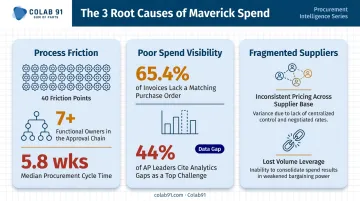
- ~40 distinct friction points in a typical contracting process
- 7+ functional owners involved in a single contracting lifecycle
- 5.8-week median bid-to-contract cycle time for simple agreements, with worst-performers exceeding 10 weeks
When accessing a contracted supplier takes that long, employees don't wait.
Poor Spend Visibility
Procurement teams can't address what they can't see. Without clean, categorized, real-time spend data, off-contract purchasing becomes invisible until it's too late to intercept. The Ardent Partners 2025 State of ePayables report found that only 65.4% of invoices are linked to a purchase order on average - meaning roughly one-third of invoices flow through with no upstream procurement visibility at all.
44% of AP leaders also cite improving reporting and data analytics as a top priority, a gap that remains widespread across AP functions.
Fragmented Supplier Relationships
When preferred vendor agreements exist but aren't easily accessible - or when the approved vendor list doesn't cover what a department actually needs - buyers default to whoever is easiest to reach. Fragmented supplier relationships mean fragmented pricing, inconsistent terms, and lost negotiation leverage. The underlying problem is a supplier strategy that hasn't kept pace with how departments actually buy.
Cost-Reduction Strategies for Maverick Spend
Strategies vary significantly depending on where the root cause sits. Applying the right intervention at the wrong level - adding approval workflows when the real problem is an incomplete vendor catalog, for instance - produces friction without results. The three strategy sets below are organized by where they intervene.
Strategies That Reduce Costs by Changing Decisions
These approaches target the upstream choices that determine whether a purchase becomes compliant before any transaction occurs.
1. Formalize procurement policy with explicit scope
Policies that are vague, buried in an intranet, or rarely enforced are functionally nonexistent. Effective policy defines:
- Who is authorized to buy, and in what categories
- Which vendors are approved and under what conditions
- What spend thresholds trigger formal procurement involvement
- What happens when someone buys outside the policy
2. Build pre-approved vendor catalogs
When employees can search, select, and order from a curated catalog of pre-negotiated products and services, the incentive to go off-contract collapses. Catalog gaps - categories or items not covered - become the primary reason employees bypass the system. Coverage matters as much as curation.
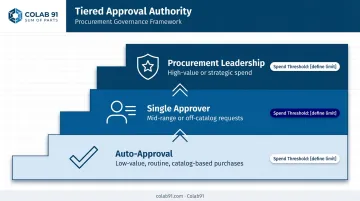
3. Establish tiered approval authority
Not every purchase needs multi-level review. Poorly calibrated thresholds that require approval for a $50 supply order create the exact bottlenecks that drive workaround behavior. A well-designed tiered model:
- Auto-approves low-value, routine, catalog-based purchases
- Routes mid-range or off-catalog requests to a single approver
- Escalates high-value or strategic spend to procurement leadership
4. Rationalize the supplier base through strategic sourcing
Consolidating fragmented vendor relationships into a smaller set of preferred, contracted suppliers improves pricing leverage and eliminates the ambiguity that leads buyers to default to whoever's easiest to reach. Kearney's cross-portfolio spend analysis work has identified approximately 6% savings potential through supplier consolidation and renegotiation in PE portfolio contexts - a meaningful return for companies that haven't applied this lens systematically.
Strategies That Reduce Costs by Changing How Maverick Spend Is Managed
These approaches improve real-time control and spend visibility while purchasing is actively occurring.
Automate purchase requisition and approval workflows
Configurable routing rules that escalate based on spend amount, category, or budget availability eliminate the bottlenecks that make workarounds attractive. Mobile-accessible approval tools remove the delay justification entirely. When an approver can act from their phone in two minutes, "waiting on approval" stops being a credible reason to go off-contract.
Key routing triggers to configure:
- Spend amount relative to category threshold
- On-catalog vs. off-catalog status
- Available budget in the requesting cost center
- Vendor contract status (preferred, approved, or unapproved)
Deploy real-time spend analytics
Visibility into spend by vendor, category, department, and buyer enables procurement teams to intervene before isolated incidents become systemic leakage. Best-in-class procurement organizations achieve 91.7% spend under management, compared to significantly lower rates among average performers - the gap is largely attributable to visibility and control infrastructure, not procurement team size.
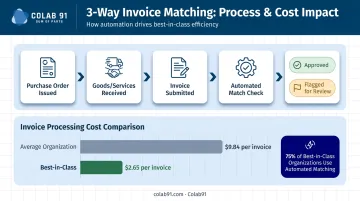
Implement 3-way invoice matching
Invoices that don't correspond to an approved purchase order or a received goods/services confirmation should flag automatically for review. This layer of control catches maverick spend that slipped through earlier checkpoints. 75% of best-in-class AP organizations use two- or three-way matching capabilities. Average organizations process invoices at $9.84 each - best-in-class teams process the same invoice for $2.65, partly because matching automation reduces exception handling.
Integrate contract management into the purchasing workflow
When contract terms aren't visible at the point of purchase, buyers default to market rates rather than contracted prices. Automated contract visibility - surfacing negotiated terms when a relevant vendor or category is selected - closes this gap without requiring buyers to go looking for it.
Strategies That Reduce Costs by Addressing Structural Root Causes
These approaches address the environmental conditions that allow maverick spend to persist regardless of policy quality or tooling.
Govern indirect spend with the same rigor as direct procurement
Indirect categories - the ones that account for the majority of supplier relationships - are rarely assigned a formal category owner. Treating them as low-priority creates the structural conditions for persistent maverick spend. Assigning category ownership, establishing spend baselines, and setting compliance targets for indirect categories closes the governance gap that most organizations ignore.
Invest in spend data quality before automating
Automation applied to poorly categorized or incomplete spend data produces unreliable outputs. Organizations that deploy analytics or workflow tools without first auditing and classifying their spend data often find that the systems surface noise rather than insight. Clean, consistently classified spend data is a prerequisite - not an outcome - of effective procurement automation.
Build cross-functional procurement governance
Maverick spend thrives in organizational silos where no single team owns category compliance. A governance model that distributes accountability across finance, operations, and department heads reduces the structural conditions that produce workarounds. When a business unit head has a stake in their category's compliance rate, the dynamic shifts.
Access dedicated procurement analytics capacity
For mid-market and PE-backed companies, maintaining ongoing spend analysis, supplier performance tracking, and compliance monitoring requires specialized capacity that lean in-house teams can't sustain. Building a full onshore analytics function is expensive and slow to staff.
Colab91 addresses this directly - establishing dedicated offshore procurement and analytics capability centers for mid-market and PE-backed organizations. The model delivers the analytical depth of a mature procurement function without proportional onshore headcount. Colab91's leadership has spent two decades building and scaling these models for clients including Carlyle Group, TPG, and PE-backed healthcare organizations.

Conclusion
Reducing maverick spend requires tracing it to its source. That diagnosis usually points to one of three places:
- Decision gap - employees don't know the policy or the approved vendors
- Visibility gap - procurement can't see off-contract spending until it's already happened
- Structural gap - indirect categories have no owner, and spend data is too fragmented to analyze
The most common mistake is applying controls to a broken process: adding approval steps that create friction without fixing the underlying system design. The strategies that work address the right level of the problem, combine upstream policy changes with real-time automation, and are sustained by analytical capacity that doesn't erode when procurement headcount turns over.
That last point matters more than most organizations realize. Companies that treat maverick spend reduction as a one-time project consistently see gains erode. Organizations that build it into ongoing procurement governance - with the right data infrastructure, cross-functional ownership, and dedicated analytics capacity - tend to see compliance rates hold, contract utilization improve, and off-contract spend stay structurally low over time.
Frequently Asked Questions
What is the difference between maverick spend and tail spend?
Maverick spend is defined by process non-compliance - purchases made outside approved channels, regardless of value. Tail spend refers to the large volume of low-value transactions that represent a small percentage of total spend. The two frequently overlap - tail spend categories are where maverick behavior is most common - but they're distinct problems that require different interventions.
What strategies do you use for cost reduction in procurement?
The three core levers are:
- Upstream decisions: policy clarity, vendor catalogs, supplier rationalization
- Real-time management: workflow automation, spend analytics, invoice matching
- Structural context: indirect spend governance, spend data quality, dedicated analytics capacity
Effective programs address all three simultaneously rather than treating them as alternatives.
How much does maverick spend typically cost organizations?
World Commerce & Contracting/KPMG data shows contracts suffer more than 9% value leakage, with the average organization able to improve margins by nearly 3% through reductions in contract-management operating costs alone. Direct cost is compounded by lost negotiation leverage, compliance risk, and administrative burden.
What procurement processes should be automated first to reduce maverick spend?
Prioritize purchase requisition and approval workflow automation first - it intercepts maverick spend at the point of transaction. Follow that with automated invoice processing and 3-way matching, which catches what slipped through at the point of payment.
How do you measure whether maverick spend reduction efforts are working?
Track four metrics:
- PO compliance rate: percentage of purchases routed through approved channels
- Off-contract spend: as a share of total spend
- Approval cycle time: average time from request to authorization
- Vendor consolidation ratio: reduction in active supplier count
Improving across all four indicates the program is working at multiple levels.
Can mid-market or PE-backed companies realistically implement procurement automation?
Increasingly, yes. Adoption of automated approval routing has reached 70% across AP organizations according to Ardent Partners' 2025 data. Companies without large internal procurement teams can access the necessary analytics and governance capacity through dedicated offshore capability centers - building specialized procurement and analytics teams that function as a strategic extension of the in-house function rather than a temporary fix.