Introduction
Choosing the wrong offshore engagement model costs more than money - it costs time, continuity, and institutional knowledge. Mid-market and PE-backed companies often discover this after the fact: a Time & Material (T&M) engagement stretches past its original scope, costs spiral beyond any forecast, and the offshore team rotates to another client when the cycle ends.
The decision between a Dedicated Team Model and T&M comes down to what kind of offshore relationship your business actually needs. A one-time vendor benchmarking project has very different requirements than a recurring spend analytics function - one that needs deep familiarity with your categories, suppliers, and internal stakeholders.
This article breaks down both models side by side: definitions, cost structures, trade-offs, and use cases, with a clear decision guide for companies building offshore capability teams in procurement, analytics, or finance operations.
Key Takeaways
- Dedicated Team Model: Full-time, single-client offshore team on a fixed monthly fee, designed for ongoing functions where domain knowledge compounds over time.
- T&M Model: Pay for actual hours worked; best for short-term, defined, or exploratory engagements.
- The right model depends on scope clarity, project duration, and whether deep domain knowledge needs to compound over time.
| Factor | Dedicated Team Model | Time & Material (T&M) |
|---|---|---|
| Cost Structure | Fixed monthly fee | Variable (hours × rate) |
| Team Commitment | Exclusive, full-time | Shared across projects |
| Flexibility | Structured with room to scale | High scope flexibility |
| Best For | Ongoing operational functions | Short-term, defined projects |
| Client Oversight | Embedded, integrated | Active time-tracking required |
| Scalability | Designed to grow over time | Limited by engagement terms |
What Is the Dedicated Team Model?
The Dedicated Team Model is a long-term engagement structure where a team of professionals is exclusively assigned to a single client. "Dedicated" means exactly that - full-time, single-client focus, not shared across multiple engagements. The team functions as an extension of the client's operations rather than an external vendor responding to tickets.
Cost Structure and Predictability
Clients typically pay a monthly fee that covers team salaries and a management or service fee. The upfront commitment is higher than a T&M engagement, but the billing is predictable - which matters significantly for PE-backed companies that need clean cost reporting at the portfolio level.
Cost transparency varies by provider. Clarify during the engagement design phase exactly what the fee covers - salaries, infrastructure, management layer - and what triggers additional cost.
Why Knowledge Depth Changes Everything
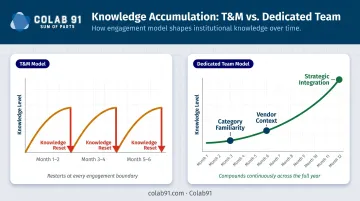
The real advantage of a dedicated model isn't just cost predictability - it's the institutional knowledge that builds over time. A team working exclusively on your spend categories, your vendor base, and your internal processes gets progressively faster and more accurate, without the reset that comes with onboarding new resources every engagement cycle.
That compounding effect is especially significant in functions like procurement analytics, strategic sourcing, and financial operations, where context lost during a handoff can set a program back by months.
Use Cases: Where the Dedicated Model Fits
The dedicated model works best when:
- The function is ongoing and evolving, not a one-time output
- Knowledge retention directly affects output quality (e.g., vendor management, spend analytics, financial reporting)
- The client wants to scale the team as functions grow
- Predictable cost reporting is needed for PE-level oversight
Colab91 builds India-based dedicated capability teams structured exactly this way - not as task-execution units, but as strategic hubs for global operations. The model blends onshore expertise (client-facing direction, domain guidance) with offshore delivery, so the India team integrates with the client's culture rather than operating in isolation.
What Is the Time & Material (T&M) Model?
The Time & Material model is a billing structure where clients pay for actual hours worked and resources consumed. As defined under FAR 16.601, T&M contracts cover direct labor hours at specified fixed hourly rates plus actual material costs - with rates that include wages, overhead, general and administrative expenses, and profit.
There's no fixed scope lock-in. Work is scoped at a high level and billed periodically against tracked time.
The Cost Risk Hidden in the Structure
Pay-for-what-you-use billing looks simple on paper. The problem is structural: FAR 16.601 explicitly acknowledges that T&M provides no positive incentive for the contractor to control costs or labor efficiency. The buyer absorbs the risk when scope expands or oversight lapses - and in offshore professional services engagements, scope is rarely clean from day one.
Where T&M Works Well
In the right context, T&M has clear advantages:
- Fast project start - no exhaustive upfront planning required
- Scope flexibility - requirements can shift mid-engagement without contract renegotiation
- Pay-as-you-go logic - suited for experimental or short-duration work
- Low initial commitment - appropriate for pilot programs or feasibility tests
Use Cases: Where T&M Fits (and Where It Doesn't)
T&M is a reasonable choice for:
- One-time assessments or vendor benchmarking
- Pilot programs to test offshore feasibility
- Early-stage projects where requirements aren't stable enough for long-term commitment
Where it breaks down is in recurring functions. Apply T&M to ongoing analytics or sourcing support, and every engagement cycle carries a hidden onboarding cost - the team needs to re-learn the client's categories, data environment, and stakeholder preferences.
Deliverable quality becomes inconsistent across cycles, and the cumulative cost of repeated ramp-ups often exceeds what a dedicated team would have cost over the same period.
Dedicated Team Model vs T&M: Head-to-Head Comparison
Neither model is universally better. The right choice depends on five factors:
- Scope stability
- Cost predictability needs
- Timeline length
- Desired client control
- Strategic importance of accumulated domain knowledge
Cost in Practice
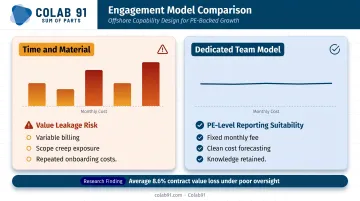
Under T&M, costs are variable and tied to hours. For a bounded 6-to-8-week project with a clear deliverable, that's manageable. For a multi-month engagement with evolving scope, it becomes difficult to forecast - and budget overruns compound quickly.
Under the Dedicated Team Model, monthly costs are fixed and easier to plan against. The commitment is longer-term, but the predictability is higher and more consistent. For PE portfolio companies managing multiple cost centers, that predictability maps directly to cleaner board reporting and cost center management.
According to WorldCC's 2025 contract management research, the average business loses 8.6% of annual contract value through poor contract management - with the worst performers losing 15% or more. T&M contracts, without strong oversight mechanisms, are particularly exposed to this kind of value leakage.
Team Continuity and Knowledge Retention
T&M teams typically work across multiple clients simultaneously. Each new engagement cycle brings context loss - the team needs to relearn your data structures, your vendor relationships, your internal terminology. For a function like strategic sourcing or spend analytics, that reset is expensive in time and output quality.
Dedicated teams build compounding knowledge. Month three looks different from month one, and month twelve looks different from month six. The team gets faster, catches nuances earlier, and requires less client-side management overhead over time.
Flexibility vs. Stability: The Real Trade-off
| T&M | Dedicated Team | |
|---|---|---|
| Scope flexibility | High | Moderate (scalable within structure) |
| Cost predictability | Low | High |
| Knowledge accumulation | Resets each cycle | Compounds over time |
| PE reporting suitability | Difficult | Clean and foreseeable |
| Best timeline | Weeks to a few months | 6 months and beyond |
Decision Guide
Choose T&M if:
- The project has a clear end date and defined deliverable
- You're piloting offshore feasibility before committing
- Short-duration analytical work with a single output (not recurring)
Choose the Dedicated Team Model if:
- The function is recurring (not project-bound)
- Cost predictability matters for PE-level reporting
- You need deep process ownership and domain knowledge retention
- You plan to scale the team as functions grow
Real-World Application: How the Pattern Actually Plays Out
Here's a scenario that's more common than most companies expect.
A mid-market company engages an offshore vendor on T&M for a spend analytics project - maybe a 10-week category assessment. The work is useful. Leadership wants to expand the scope. Another T&M cycle starts, with a different team configuration. The new resources spend weeks re-learning the same supplier data the previous team had mapped. Costs accumulate. Output quality varies.
This is the pattern that dedicated teams are specifically designed to avoid.
Colab91's founding partners built their track record doing exactly this kind of transition at scale. At Impendi (subsequently acquired by Accenture), Madhur Kabra and Vijender Kapoor designed and scaled an India-based multifunctional organization to over 100 practitioners, serving PE clients including Carlyle Group, TPG, Elliott, and BC Partners across strategic sourcing, analytics, and process transformation.
What made that model work was the dedicated structure: the India team became progressively more embedded in each client's operations rather than rotating across engagements.
Colab91 now applies that same model for mid-market and PE-backed companies, building India capability centers that function as strategic hubs rather than project-based vendor relationships.
Advisors like Erika Jung, former CPO at Pediatric Associates (a TPG portfolio company), bring PE-side perspective on how these teams should be structured to meet portfolio-level reporting and cost governance requirements.
The difference between T&M and dedicated teams isn't just cost structure - it's whether institutional knowledge accumulates or resets with every new engagement. If you're assessing which model fits your offshore talent strategy, connect with the Colab91 team for a direct conversation.
Conclusion
The choice between T&M and a dedicated team model turns on one question: is this work transactional or strategic? T&M gives you the flexibility to test offshore feasibility without a long-term commitment. The dedicated model gives you the stability and domain depth to build a function that improves over time.
For mid-market and PE-backed companies building offshore capability in procurement, analytics, or finance operations, the dedicated model typically delivers stronger returns over a 6-to-12-month horizon:
- Domain knowledge compounds as the team learns your business
- Integration deepens as the offshore team aligns with onshore workflows
- Costs become predictable, removing budget variability
- The offshore function shifts from a cost-reduction lever to a genuine operational asset
Frequently Asked Questions
What is the difference between a dedicated team model and staff augmentation?
Staff augmentation adds individual contractors to supplement an existing in-house team. The dedicated team model provides a fully structured, standalone team working exclusively on the client's work - typically with its own management layer, long-term continuity, and domain specialization rather than just headcount.
What is the difference between Time & Material and fixed-price contracts?
T&M bills for actual hours and resources used - flexible but variable cost. Fixed-price contracts lock the total cost and scope upfront - predictable but rigid. Neither is the same as the dedicated team model, which is a relationship structure designed for ongoing work rather than a single-project pricing mechanism.
When should a mid-market company choose the dedicated team model over T&M?
The dedicated model fits best when:
- Work is ongoing rather than project-bound
- Cost predictability matters for PE reporting
- Deep domain knowledge - in procurement, analytics, or similar functions - is essential to output quality
Is the dedicated team model more expensive than T&M?
The monthly commitment is higher, but extended T&M engagements frequently accumulate greater total costs due to repeated onboarding, knowledge gaps, and billing variability. Over a 6-to-12-month horizon, dedicated teams are more cost-efficient for recurring functions.
Can you switch from a T&M engagement to a dedicated team model?
Yes - and many companies follow this path. Most start with T&M to validate offshore feasibility, then transition to a dedicated team structure once the function matures and the need for continuity, scalability, and predictable cost governance becomes clear.