Introduction
Boards want AI investment. Finance wants cost reduction. CIOs must deliver both at once — and that only works if hidden waste is found and redirected before the next budget cycle.
Digital budgets jumped from 7.5% of revenue in 2024 to 13.7% in 2025, according to Deloitte's 2025 Tech Value Survey. That's not a gradual shift — it's a structural change in how organizations fund technology. Yet most CIOs are still managing spend through annual budget cycles, quarterly reviews, and reactive reporting rather than active governance.
Enterprise spend management is discussed constantly but practiced poorly. Most CIOs govern top-line IT budget allocation while fragmented spend across SaaS subscriptions, cloud infrastructure, vendor contracts, and departmental purchasing continues outside controlled channels.
This guide covers:
- What enterprise spend management actually means for CIOs
- Why it belongs in the CIO's mandate, not just finance or procurement
- The four spend categories that demand immediate attention
- How to build the governance capability to act on what you find
Key Takeaways
- Enterprise spend management is a governance discipline, not a reporting function — it controls spend before it happens, not after.
- SaaS rationalization, cloud cost governance, and vendor consolidation consistently deliver recoverable budget within 90 days.
- Shadow IT and ungoverned AI tool adoption are active spend, security, and compliance risks — not just visibility problems.
- Only the CIO can build a unified spend data layer across IT, finance, and procurement.
- Offshore procurement analytics capability centers give mid-market CIOs domain expertise without onshore headcount costs.
What Is Enterprise Spend Management?
Enterprise spend management is the process by which an organization establishes visibility into, governance over, and optimization of all business expenditures — covering procurement, vendor contracts, SaaS subscriptions, cloud infrastructure, and employee expenses — through unified data, policy enforcement, and cross-functional ownership.
Done well, it delivers four concrete outcomes:
- Maximizes the value of every dollar spent across all purchasing channels
- Eliminates waste from redundant or underused resources
- Enforces purchasing policy at the point of spend — not after month-end close
- Redirects recovered budget toward strategic priorities
Three adjacent concepts are often confused with it:
- IT budget management allocates funds top-down at the planning stage but doesn't govern in-year purchasing behavior
- Basic expense tracking records what was spent after the fact — useful for accounting, not for control
- Procurement management covers vendor sourcing and contracting but not the full spend lifecycle across all purchasing channels
Enterprise spend management spans all three — and for CIOs, it's the operating framework that turns fragmented financial data into actionable decisions.
Why CIOs Must Own Enterprise Spend Management
Finance sees invoices. Procurement sees contracts. IT sees licenses. No single function sees all three simultaneously — and that gap is where waste, risk, and misaligned spend accumulate.
CIOs sit at the intersection of technology purchasing decisions, data infrastructure, and business process design. That position makes them capable of governing the full technology spend lifecycle in a way that CFOs cannot from the finance layer alone.
The Board Pressure Is Real
The expectations are direct: reduce IT operating costs, fund AI and automation investments, and demonstrate measurable ROI — all within the same budget cycle. That math requires uncovering hidden waste at scale. Visibility without governance produces reports. Governance is what turns those reports into realized savings.
Shadow IT Is a Spend Problem, Not Just a Security Problem
Technology purchased or deployed outside governed channels creates duplicate tools, unused licenses, and unassessed third-party data flows. Solving shadow IT means embedding spend governance into purchasing workflows — not just auditing after the fact. That requires:
- Approval gates that intercept purchases before they occur
- Vendor catalog requirements that channel buying toward governed suppliers
- Card-level restrictions that block out-of-policy transactions at the source
PE-Backed Companies Face Compressed Timelines
For PE-backed companies, value creation timelines are short. McKinsey research shows funds prioritizing operational value creation achieve 2–3 percentage points higher IRR than peers, and the value creation plan is typically executed within the first 100 days.
Fragmented spend data is one of the most common obstacles to hitting those early targets. If you can't see where money is going, you can't demonstrate savings progress to the sponsor.
The CIO as Data Layer Owner
When spend management lives only in finance or procurement, data stays siloed by function. The CIO is the only leader with the technical authority and organizational position to build the unified data layer that connects those silos — giving leadership a single source of truth for spend decisions across every function.
Key Spend Categories That Demand CIO Governance
Enterprise spend is fragmented across corporate cards, direct invoices, procurement systems, and departmental budgets. Trying to govern everything simultaneously produces paralysis. The right approach is sequencing by category impact — starting where recoverable savings are fastest.
SaaS License Governance
SaaS is typically the fastest and most controllable spend lever. According to Zylo's 2025 SaaS Management Index, organizations waste an average of $21M annually on unused SaaS licenses — up 14.2% year-over-year — across more than 40 million licenses and $40 billion in SaaS spend.
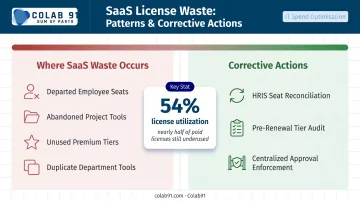
The waste patterns are consistent across companies:
- Seats bought for employees who have since departed
- Project-specific tools that were never cancelled
- Premium license tiers paying for features no one uses
- Duplicate tools across departments solving the same problem
The corrective actions are equally consistent:
- Flag inactive seats against current headcount from HRIS
- Audit tier usage before renewals to right-size license levels
- Enforce centralized approval before any new subscription begins
SaaS license utilization improved from 47% in 2024 to 54% in 2025 (Zylo, 2026 SaaS Management Index) — but that still means nearly half of paid licenses are underused.
Cloud Cost Governance
Cloud waste isn't primarily a technical problem. It's an organizational one.
Flexera's 2025 State of the Cloud Report found that respondents estimate 27% of cloud spend is wasted — driven by:
- Idle resources left running after project completion
- Oversized instances provisioned for peak loads that never materialize
- Under-optimized configurations with no assigned owner
Cloud budgets typically sit with infrastructure teams while consumption decisions happen in engineering and product, creating an accountability gap.
The FinOps model addresses this directly. Chargeback structures assign cloud expenses to the business unit or product team generating them; showback structures make consumption visible without full P&L allocation. Either approach shifts cloud spend from invisible infrastructure cost to owned business cost — which changes behavior.
**98% of FinOps practitioners now manage AI spend** (FinOps Foundation, 2026 State of FinOps), up from 63% the prior year. AI infrastructure is moving into the FinOps scope fast, which means the governance model needs to extend beyond traditional compute and storage.
Vendor Consolidation
Each vendor relationship carries three costs most CIOs undercount:
- Licensing cost — the direct spend, often duplicated across departments
- Security assessment burden — every third-party integration is an audit obligation
- Contract management overhead — renewals, negotiations, and compliance tracking per vendor
Rationalizing from multiple overlapping tools to fewer strategic vendors reduces all three simultaneously. Fewer vendors means lower spend, a smaller attack surface for security and compliance risk, and fewer renewal cycles to manage annually. The consolidation exercise also tends to surface duplicate capabilities purchased by different departments — a common output of years of ungoverned decentralized purchasing.
AI Tool and Agent Proliferation
This is the fastest-growing governance gap. AI licenses and agent deployments are being adopted across business units at a pace that outstrips any centralized tracking. Gartner predicts over 40% of agentic AI projects will be canceled by end of 2027 due to escalating costs, unclear business value, or inadequate risk controls.
MIT NANDA research found that despite $30–$40 billion in enterprise GenAI investment, 95% of organizations were getting zero return. Financial governance was absent before scaling began — and the returns reflect it.
The same discipline applied to SaaS must now extend to AI tools: usage tracking against purchased licenses, governance of agent deployments across business units, and a specific review of whether bundled AI features in existing vendor renewals are actually being used before those renewals are signed.
Where Enterprise Spend Management Programs Break Down
Most spend management programs fail for the same structural reason: they are treated as finance reporting functions rather than governance disciplines. Producing a spend dashboard after money is spent does not change purchasing behavior next week. The program creates value only when policy enforcement operates at the point of purchase — not at month-end close.
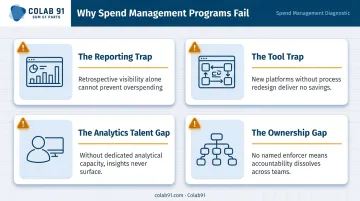
The four most common failure modes:
The reporting trap: Visibility into last month's spend tells you what happened — it gives you no mechanism to prevent an out-of-policy purchase tomorrow. Control requires preventive mechanisms embedded in the purchasing process itself, not retrospective dashboards.
The tool trap: Deploying a spend management platform without redesigning approval workflows, data ownership, or vendor catalog structures. Tools amplify existing process quality — good or bad. A platform layered onto a fragmented process produces faster fragmentation, not governance.
The analytics talent gap: Spend management requires continuous data analysis, supplier benchmarking, and category-level insight — not a one-time setup. Deloitte's 2025 Global CPO Survey found 34% of procurement leaders rank talent gaps among the top barriers to value delivery. Without dedicated analytical capacity, even well-implemented platforms produce data that no one acts on.
The ownership gap: When spend management is nobody's primary job, it becomes everybody's lowest priority. Cross-functional accountability requires a named owner with authority to enforce policy — not just observe it.
How to Build Spend Management Capability as a CIO
Start With the Data Layer
The foundational requirement is a unified spend data layer that pulls from ERP, procurement systems, HRIS, and vendor management into a single model. This isn't about selecting a platform first — it's about making strategic decisions possible by having complete spend data in one place.
Operationally, this means automated GL coding that eliminates manual categorization errors, real-time vendor spend aggregation that shows current liability (not last quarter's invoices), and employee lifecycle integration so that headcount changes trigger automatic license and access reviews.
Sequence for Speed
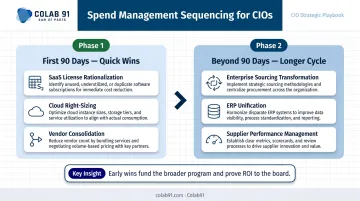
Don't try to govern everything simultaneously. Sequence by impact:
First 90 days (quick wins):
- SaaS license rationalization — flag inactive seats, compare to HRIS headcount, cancel unused subscriptions
- Cloud right-sizing — identify idle resources and oversized instances, implement showback for business unit accountability
- Vendor consolidation — audit overlapping tools, consolidate renewals, eliminate duplicate categories
Beyond 90 days (longer-cycle):
- Enterprise-wide sourcing transformation
- ERP unification or integration
- Supplier performance management programs
Early wins matter for two reasons: they produce recoverable budget that funds the broader program, and they demonstrate ROI to the CFO and board before anyone questions whether the program is worth continuing.
Address the Talent Constraint Directly
The analytics workload required for effective spend management is substantial. It spans:
- Spend data cleansing — normalizing messy GL and ERP outputs into usable category hierarchies
- Category benchmarking — comparing supplier rates against market data to identify overpayment
- Supplier performance analysis — tracking delivery, quality, and risk metrics across the vendor base
- Savings tracking — maintaining auditable records of realized versus projected savings
Most mid-market and PE-backed companies cannot justify the cost of a large in-house procurement analytics team to cover this workload.
An offshore capability center model closes this gap. Firms like Colab91 build India-based capability centers specifically for mid-market and PE-backed companies, combining procurement domain expertise with analytics delivery at 40–60% of equivalent onshore headcount cost. Colab91's Savings Opportunity Assessment, for example, completes within 4–6 weeks and typically identifies 5–15% of addressable spend in recoverable savings — providing the rapid diagnostic output CIOs need before committing to a longer-term program.
The model works because procurement analytics is a specialized discipline. Domain expertise in SaaS spend, vendor benchmarking, and category strategy requires category-trained analysts, not generalist BI resources.
Metrics to Report Spend Management ROI to the Board
Most CIOs over-report metrics and under-explain what they mean. The board doesn't need 15 KPIs — it needs two or three headline numbers that show directional progress, paired with a clear narrative on what savings are being redirected toward.
Three metrics that translate directly into board language:
| Metric | What It Measures | Why Boards Care |
|---|---|---|
| Spend under management | % of total organizational spend flowing through governed channels | Every dollar outside this number is invisible to policy enforcement |
| Run vs. change ratio | Share of IT budget maintaining existing operations vs. funding new capabilities | Shows whether spend management is creating investment headroom |
| SaaS and cloud utilization rate | Ratio of paid licenses and provisioned capacity to actual usage | Directly measures waste in the two fastest-growing spend categories |
Each of these ties directly to financial outcomes CFOs already track:
- Cost savings recovered and redirected to AI or transformation initiatives
- Reduction in vendor count (shows simplification trajectory, not just cost)
- Processing cost per transaction as a measure of automation ROI across the spend lifecycle
The most common reporting failure isn't the wrong metrics — it's metrics without narrative. If spend under management is trending toward 90% and SaaS utilization waste has declined quarter-over-quarter, state that plainly, then explain what it freed up for reinvestment. That's the conversation boards want to have.
Frequently Asked Questions
What is enterprise spend management?
Enterprise spend management is the process of gaining visibility, governance, and optimization across all organizational expenditures — covering procurement, SaaS, cloud, vendor contracts, and employee expenses. It differs from basic expense tracking in that it focuses on controlling spend before it occurs, not just recording it afterward.
How is enterprise spend management different from IT budget management?
IT budget management allocates funds at the planning stage — top-down, annually. Enterprise spend management governs how money is actually spent throughout the year across all purchasing channels. Budget management sets the limits; spend management enforces them in practice.
Which spend categories should a CIO prioritize first?
SaaS license rationalization, cloud cost right-sizing, and vendor consolidation consistently deliver the fastest recoverable savings — typically within 90 days. Start here before moving to longer-cycle initiatives like enterprise-wide sourcing transformation, where payback timelines extend to 12–18 months.
What metrics should CIOs use to report spend management success to the board?
Focus on spend under management (percentage of total spend in governed channels), run vs. change ratio (showing whether spend management is freeing up investment budget), and SaaS and cloud utilization rates. Pair these metrics with a narrative on savings redirected toward strategic priorities — without that context, the numbers alone rarely land with a board audience.
How can mid-market companies build spend management capability without a large internal team?
Procurement analytics, supplier benchmarking, and spend data work require dedicated capacity that most mid-market companies can't build in-house at reasonable cost. Offshore capability centers specializing in procurement and analytics — such as the model Colab91 operates for mid-market and PE-backed companies — provide domain expertise and analytical depth at a fraction of onshore headcount cost.