A Bain survey of 300 chief procurement officers found that nearly 80% of companies say their procurement capabilities aren't consistently mature enough to meet business requirements. That's not a talent problem - it's a structural one.
The procurement maturity model exists to solve exactly this. It gives organizations a structured way to benchmark where their procurement function stands today - across strategy, people, process, and technology - and build a clear roadmap toward higher-value, more strategic procurement.
This article covers the four stages of procurement maturity, how to run a proper assessment, and the strategies that actually move organizations forward.
Key Takeaways
- A procurement maturity model benchmarks how advanced your procurement function is across strategy, people, processes, and technology
- Most organizations move through 4 stages - from reactive, transactional purchasing to AI-driven, innovation-led procurement
- Advancing maturity delivers value beyond cost savings - stronger supplier relationships, better risk management, and measurable EBITDA impact
- A structured assessment across six pillars identifies where you stand and what to prioritize
- For mid-market and PE-backed companies, structured offshore capability is the most direct path to closing maturity gaps quickly
What Is a Procurement Maturity Model?
A procurement maturity model is a structured framework for assessing how developed an organization's procurement function is - measuring professionalism, governance, capability, technology adoption, and strategic contribution against defined benchmarks.
At low maturity, procurement is purely reactive: manual processes, limited spend visibility, no supplier strategy. At high maturity, it functions as a strategic business partner, actively shaping supplier relationships, ESG outcomes, and cost performance across the enterprise. Most organizations sit somewhere in between - and few have a clear picture of where.
The model's real value is what it surfaces: specific capability gaps, prioritized improvement areas, and a sequenced path to move from where you are to where you need to be.
The Three Pillars: People, Process, and Technology
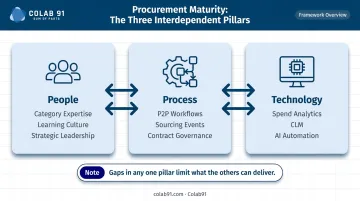
Every maturity model rests on three interdependent pillars:
- People: Category managers with domain depth, a continuous learning culture, and procurement leadership aligned to business strategy
- Process: Standardized procure-to-pay (P2P) workflows, structured sourcing events, supplier segmentation, and contract governance
- Technology: Spend analytics platforms, contract lifecycle management (CLM), sourcing tools, and AI-driven automation
The most common trap organizations fall into: investing in technology before fixing their process foundation or upskilling their people. A sophisticated analytics platform doesn't help if the underlying spend data is incomplete and uncategorized.
Sustainable maturity means advancing all three pillars in parallel. Gaps in any one area limit what the others can deliver.
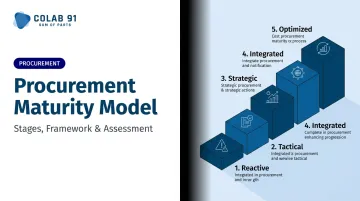
The 4 Stages of Procurement Maturity
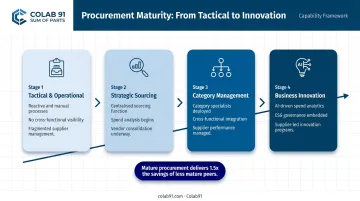
The model maps a progression from purely tactical to fully strategic procurement. Some frameworks split the first level into "Tactical" and "Operational" sub-levels, though both describe the same underlying journey. Identifying your current stage tells you exactly where to focus investment - and what capabilities to build next.
Stage 1: Tactical and Operational Procurement
Characteristics:
- Reactive purchasing driven by immediate needs
- Manual workflows - email approvals, spreadsheet tracking
- No supplier strategy or segmentation
- Limited spend visibility across the organization
- Procurement seen as a cost-processing function, not a strategic one
Key challenge: Maverick spending goes unchecked because there's no data infrastructure to catch it. Decision-making is slow, and savings opportunities are consistently missed.
Goal at this stage: Build basic structure. Standardize P2P workflows, centralize spend data, and establish foundational supplier records.
Stage 2: Strategic Sourcing
Characteristics:
- Centralized sourcing begins with structured RFQ processes
- Spend data is collected and used for cost savings analysis
- Supplier performance is tracked periodically
- Procurement starts contributing to budget planning discussions
Key challenge: Tools remain siloed. Spend data exists but lives in multiple systems, making integrated reporting and cross-category analysis difficult.
Goal at this stage: Shift from transactional to data-driven supplier management. Establish category spend baselines and begin formal supplier scorecards.
Stage 3: Category Management Procurement
Characteristics:
- Procurement organizes around spend categories - IT, logistics, marketing, facilities
- Dedicated category managers own sourcing strategy within their domains
- Advanced analytics tools support cross-category decision-making
- Cross-functional collaboration with finance and operations strengthens significantly
Key challenge: Balancing global category standards with local market responsiveness - particularly for multi-site or multi-geography organizations.
Goal at this stage: Integrate procurement into enterprise planning. Move from reactive cost reduction to proactive long-term value creation.
Stage 4: Business Innovation Procurement
Characteristics:
- AI-driven spend analytics and predictive demand forecasting
- Supplier innovation partnerships and joint value creation programs
- ESG performance tracking embedded in supplier governance
- Closed-loop budgeting connects procurement savings directly to company financial outcomes
The financial case for reaching this stage is well-documented. According to Bain, mature procurement organizations realize 1.5 times the savings of less mature peers. The edge comes from superior data, stronger supplier relationships, and tighter governance - not just harder negotiating.
Goal at this stage: Make procurement a measurable driver of growth, risk reduction, and competitive differentiation.
How to Run a Procurement Maturity Assessment
A procurement maturity assessment is a diagnostic study - not an audit. The goal is an honest picture of current capabilities and a prioritized roadmap for improvement, not a blame exercise.
The difference between a useful assessment and a box-checking exercise comes down to structure. Subjective self-reporting ("we think we're pretty good at sourcing") produces unreliable results. A structured assessment across defined pillars, benchmarked against external standards, produces something you can actually act on.
The 6 Core Assessment Pillars
| Pillar | What "Good" Looks Like |
|---|---|
| Strategy Alignment & Governance | Procurement strategy linked to business objectives; executive sponsorship in place |
| People & Capability | Category expertise, training programs, clear career pathways |
| Process Excellence | Standardized P2P workflows, sourcing event discipline, contract compliance |
| Systems Enablement | Integrated spend analytics, e-sourcing tools, contract management platform |
| Performance & Improvement Metrics | KPIs beyond cost savings: cycle time, spend under management, supplier scorecards |
| Risk & Compliance | Supplier risk assessments, regulatory compliance tracking, business continuity planning |
Scoring and Benchmarking
Most practitioner frameworks - including CIPS's Procurement Excellence Programme, Gartner's Sourcing and Procurement Score for CPOs, and the Hackett Group's benchmarking service - score capability across these dimensions and benchmark results against peers or world-class standards.
Hackett's Digital World Class benchmarks show that top-performing procurement functions cost 21% less to operate, use 24% less labor, run with 32% fewer FTEs, and achieve 2.6x higher ROI from technology investments compared to typical peers. These benchmarks make maturity gaps concrete and financial.
Turning Assessment Results Into a Roadmap
Once you have scored results across the six pillars:
- Start with the highest-impact gaps, not the easiest ones to fix
- Set phased timelines that prioritize foundational fixes (process and data) before advanced investments like AI or predictive analytics
- Align the roadmap to the broader business mandate - cost reduction, growth, and M&A integration each point to different priorities
- Build in re-assessment cycles annually, or after major changes like acquisitions or leadership transitions
For mid-market and PE-backed companies, assessments frequently surface the same pattern: strong individual sourcing talent, but weak process infrastructure and limited technology adoption. That gap makes team structure decisions - what to build in-house versus offshore - often the most consequential output of the entire exercise.
Strategies to Advance Your Procurement Maturity
Advancing maturity isn't about copying what large enterprises do. The right investments depend on where you are today and what your business actually needs from procurement.
Know Your Strategic Archetype First
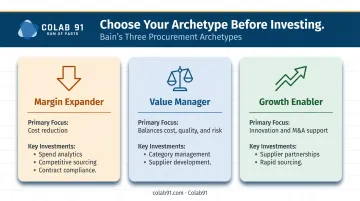
Bain identifies three procurement archetypes. The capabilities you build should reflect which one fits your business:
- Margin expander - Procurement's primary job is cost reduction; invest in spend analytics, competitive sourcing, and contract compliance
- Value manager - Procurement balances cost with quality, risk, and supplier relationships; invest in category management and supplier development
- Growth enabler - Procurement supports new market entry, product innovation, and M&A; invest in supplier partnerships and rapid sourcing capabilities
Building category management infrastructure when your business just needs basic spend control is a waste. The archetype question comes first.
Invest in Technology Sequentially
A common mistake: implementing AI-driven automation before basic spend data is clean and categorized. The right sequence:
- Stages 1–2: Spend visibility tools, e-procurement platforms, basic P2P automation
- Stages 2–3: Strategic sourcing platforms, contract lifecycle management, supplier performance tracking
- Stages 3–4: Predictive analytics, AI-driven demand forecasting, closed-loop savings tracking
Build KPIs That Match Your Maturity Stage
Beyond cost savings, mature procurement functions track:
- Spend under management - CPO Rising reports the average is now 71% of total enterprise spend, with each additional dollar managed yielding 6–12% savings during initial contract periods
- Contract compliance rates
- Supplier performance scores
- Procurement cycle time
- ESG and innovation contribution (at Stage 3–4)
Close the Savings Loop
Many procurement teams identify savings but can't prove where those savings land in the P&L. Mature organizations install closed-loop budgeting: procurement savings targets are connected to specific financial outcomes, tracked through the fiscal year, and reported to finance leadership with the same rigor as revenue.
Without this governance layer, identified savings get absorbed into departmental budgets, headcount decisions go uninformed, and procurement gets measured on activity rather than outcomes.
How Colab91 Can Help Accelerate Procurement Maturity
For mid-market and PE-backed companies, the challenge is rarely awareness - most procurement leaders know what a mature function looks like. The gap is execution capacity: the time, talent, and structure needed to get there within a meaningful window.
Colab91 was built specifically for this problem. The founding team spent two decades scaling procurement and analytics organizations for leading private equity sponsors, including Carlyle Group, TPG, Elliott, and BC Partners. At Impendi - later acquired by Accenture - they built and scaled a multifunctional India-based organization to 100+ practitioners, delivering procurement transformation for PE portfolio companies across healthcare, industrials, and services.

The "Sum of Parts" Model
Rather than replacing in-house procurement talent, Colab91 builds dedicated India-based capability centers that augment existing teams. This means adding sourcing analysts, spend analytics practitioners, and category management specialists without the overhead of full-time senior hires onshore.
The practical result: companies can build the depth needed to move from Stage 1–2 to Stage 3–4 procurement maturity without a multi-year organic hiring campaign.
Each capability center is designed around the client's specific maturity gaps and strategic archetype. Core coverage areas include:
- Spend analysis and category intelligence
- Strategic sourcing support
- Supplier performance tracking
- Contract management
The offshore team operates as a genuine extension of the client's procurement function, not a separate vendor relationship.
For PE-backed companies, this model aligns directly with the value creation timeline. Procurement transformation that would otherwise take years to staff organically can be stood up in months through a structured offshore model - making procurement a credible lever within the hold period, not a back-burner initiative.
Frequently Asked Questions
What is a procurement maturity assessment?
A procurement maturity assessment is a structured diagnostic that benchmarks your procurement function across pillars like strategy, people, process, technology, and performance against defined standards. The goal is to identify specific capability gaps and build a prioritized improvement roadmap - scoring is a means, not the end.
What are the 5 levels of procurement maturity?
The 5-level model splits the standard framework's first stage into "Tactical" and "Operational" sub-levels, then progresses through Strategic Sourcing, Category Management, and Innovative/Transformational Procurement. Both models describe the same progression; the 5-level version adds granularity at the early stages where most organizations actually operate.
What are the 3 pillars of a procurement maturity model?
People (skills, training, leadership), Process (standardized workflows, P2P, sourcing events), and Technology (spend analytics, contract tools, AI automation) form the three foundational pillars. Advancing one pillar in isolation rarely holds - technology investments, for instance, stall when the underlying process discipline isn't there to support them.
What tools are used to assess procurement maturity?
Established frameworks include CIPS's Procurement Excellence Programme, Gartner's Sourcing and Procurement Score for CPOs, and the Hackett Group's benchmarking service - each using scored assessments across capability dimensions. The most actionable ones go beyond a score to produce a prioritized investment roadmap with concrete next steps.
Why is procurement maturity especially important for PE-backed companies?
PE-backed companies operate under tight value creation timelines, making procurement maturity a direct lever for EBITDA improvement. McKinsey has noted that digital procurement transformations feature in 100-day plans because they can deliver measurable cost savings and stronger supplier contracts within the hold period.
What KPIs should I track to measure procurement maturity progress?
Start with spend under management percentage, contract compliance rate, and procurement cycle time. As maturity advances, add supplier performance scores, savings-to-P&L tracking, and category coverage ratios. At Stage 3–4, ESG metrics and innovation contribution from supplier partnerships become relevant additions to the scorecard.