
Introduction
Scaling operations while keeping costs in check is one of the hardest problems facing mid-market and PE-backed companies right now. Procurement talent is expensive - the median US wage for purchasing managers and buyers sits at $79,830, financial analysts at $101,910.
Meanwhile, McKinsey's 2024 PE analysis confirms that funds focused on operational efficiency generate 2 to 3 percentage points higher IRR than peers. The pressure to build capability fast - without bloating headcount - is real.
The dedicated team model offers a direct response to that pressure. Companies can build fully integrated offshore teams - in procurement, analytics, finance operations - without the overhead of traditional hiring. It's a model that has moved well beyond its software development roots.
This guide breaks down what the dedicated team model is, its core benefits, how it compares to alternatives, when it's the right fit, and how to make it work.
Key Takeaways
- A dedicated team works exclusively for one client long-term - the vendor manages admin, the client directs the work.
- Key benefits: access to specialized talent, cost efficiency, faster deployment, and scalability.
- Unlike staff augmentation, it's a fully integrated team, not individual contractors plugged into an existing structure.
- Best suited for long-term, evolving engagements with persistent capability gaps.
- Success depends on clear KPIs from day one and treating the team as a genuine extension of your business.
What Is the Dedicated Team Model?
The dedicated team model is an outsourcing arrangement where an external vendor provides a team of professionals who work exclusively on one client's business - long-term, fully integrated into that client's workflows and reporting structure.
Four Defining Characteristics
| Characteristic | What It Means |
|---|---|
| Exclusive focus | Team members don't split time across clients |
| Long-term orientation | Engagements span months to years, not weeks |
| Shared accountability | The team operates with ownership, not just task completion |
| Flexible structure | Headcount and composition adjust as needs evolve |
How It Works Operationally
The division of responsibility is clean: the vendor handles recruitment, HR administration, payroll, and infrastructure. The client owns day-to-day priorities, task direction, and business strategy. This gives companies the control they'd have over an internal team without the overhead of building one.
Colab91, for example, structures engagements this way: recruiting and managing India-based domain experts in procurement and analytics while clients retain full strategic control over the work.
Beyond Software Development
The model's roots are in tech, but its application has expanded well beyond it. Today it's equally relevant for business-critical functions:
- Procurement operations and strategic sourcing
- Spend analytics and finance transformation
- Data and technology services
For mid-market companies and PE-backed businesses, it's often the fastest path to building specialized offshore capability without standing up a full GCC.
Pricing typically follows a monthly retainer covering team member compensation plus the vendor's service fee - no separate invoices for office space, equipment, or HR management.
Key Benefits of the Dedicated Team Model
Access to Deep, Specialized Talent
Finding qualified procurement analysts or finance operations professionals onshore is increasingly difficult. The US has 942,500 annual openings across business and financial occupations, creating sustained competition for experienced hires.
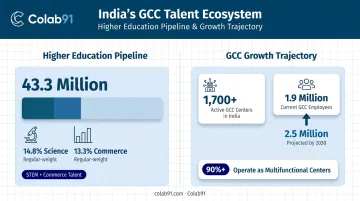
India offers a different picture. India's AISHE 2021-22 data reports 43.3 million students enrolled in higher education, with 14.8% in Science and 13.3% in Commerce disciplines - the precise pipeline for analytics, finance, and procurement roles. NASSCOM's 2024 GCC Landscape Report puts India's GCC ecosystem at 1,700+ centers and 1.9 million employees, growing toward 2.5 million by 2030.
The depth matters as much as the volume. Over 90% of India's GCCs now operate as multifunctional centers - not single-process back offices - reflecting how far the ecosystem has evolved beyond basic outsourcing.
Cost Efficiency Without Quality Trade-offs
Cost reduction remains a primary outsourcing driver, but Deloitte's 2024 Global Outsourcing Survey - based on 500+ business and technology leaders - shows that access to skilled talent and operational agility have become equally important motivators.
US wages in business operations continue climbing - BLS Employment Cost Index data shows private-industry wages rose 3.4% in the 12 months ending March 2026. For mid-market companies building out analytical capacity or a procurement function, that increase compounds quickly across a team.
India-based dedicated teams reduce costs directly without sacrificing domain expertise, particularly when the partner brings sector-specific recruiting depth rather than general hiring capacity.
Faster Deployment Than Traditional Hiring
Building a procurement analytics team from scratch onshore means competing in a market with nearly 58,700 annual openings for purchasing roles and 29,900 for financial analysts. Each hire takes months - role definition, sourcing, interviewing, offers, notice periods, onboarding.
Experienced offshore partners with established talent pipelines compress this significantly. Key factors that determine deployment speed include:
- Domain-specific recruiting depth (not just general hiring volume)
- Pre-built onboarding frameworks for procurement and analytics roles
- Existing management infrastructure that can absorb new team members quickly
Scalability Aligned with Business Cycles
This benefit matters especially for PE-backed companies. Deal activity, integration timelines, and portfolio company priorities shift constantly. A dedicated team model allows headcount to flex without the legal and financial friction of expanding or contracting a permanent workforce.
The broader provider-supported GCC market reflects this demand - Everest Group projects it growing at roughly 25% CAGR to nearly $40 billion by 2027, driven in part by organizations needing flexible offshore capability without building it entirely alone.
Long-Term Knowledge Retention
Unlike project-based outsourcing, a dedicated team accumulates institutional knowledge over time. For procurement analytics specifically, this compounds in real ways: a team that has spent 18 months inside a client's spend data, supplier relationships, and category structure is very difficult to replace.
Colab91's "Sum of Parts" approach is built on this logic. India-based teams start delivering value quickly, then progressively deepen their understanding of the client's business - moving from execution unit to strategic hub over time.
Dedicated Team Model vs. Other Engagement Models
Comparison Framework
| Dimension | Staff Augmentation | Fixed-Price / Project | Dedicated Team | Build In-House |
|---|---|---|---|---|
| Cost | Variable, per contractor | Fixed per project | Monthly retainer | Highest (fully loaded) |
| Client control | Moderate | Low | High | Highest |
| Flexibility | High short-term | Low | High long-term | Low |
| Speed to deploy | Fast (individuals) | Fast (scoped) | Fast (via experienced partner) | Slowest |
| Best use case | Short-term skill gaps | One-time deliverables | Ongoing strategic functions | Core, permanent capability |
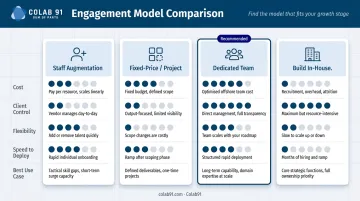
Staff Augmentation vs. Dedicated Team
Staff augmentation fills a specific skill gap by adding individual contractors to an existing team - temporarily, with limited integration. The dedicated team model builds a standalone unit with its own structure, long-term mandate, and full alignment to the client's operating model.
If you need one analyst for a 3-month project, augmentation works. If you're building a procurement capability center, it doesn't.
Fixed-Price Outsourcing vs. Dedicated Team
Fixed-price works when scope is narrow and requirements are stable. The dedicated team model is built for exactly the opposite: ongoing collaboration where priorities shift and work deepens over time. Forcing an evolving function into a fixed-price structure creates friction every time requirements change.
Building In-House vs. Dedicated Team
In-house hiring delivers maximum control, but at maximum cost and time. Recruiting, onboarding, benefits, office space, HR infrastructure - for a mid-market company building a 5-person analytics team, that adds up fast. Reaching full productivity can take 12+ months and significant capital.
The dedicated team model offloads that infrastructure burden while preserving client direction over the actual work.
When the Dedicated Team Model Works Best (and When It Doesn't)
Right Fit Scenarios
The model delivers strongest results when:
- The engagement is long-term with scope that will evolve - building a procurement capability center, not completing a one-time sourcing project
- A persistent capability gap exists - specialized analytics or sourcing skills that are genuinely hard to hire onshore at a reasonable cost
- The company needs to scale without proportional headcount growth - common in PE portfolio companies where EBITDA margin matters more than FTE counts
- Offshore talent strategy is intentional, not reactive - the company treats the dedicated team as part of its operating model, not a temporary fix
- Gartner's 2024 CFO survey of 251 CFOs ranked metrics, analytics, and reporting as the top priority for 2025 - making dedicated offshore analytics teams a natural fit for companies serious about that agenda
When to Avoid It
Three scenarios where the model will create more problems than it solves:
- The project has a clearly defined deliverable and finite timeline - use fixed-price outsourcing instead
- Internal management bandwidth is thin - dedicated teams require active direction from the client; without it, performance drifts
- The function's scope isn't defined yet - launching a dedicated team before knowing what it should do creates misalignment that's hard to unwind later
Best Practices for Building and Managing a Dedicated Team
Define Success Metrics Before Deployment
Ambiguity at the start is expensive. Before the team is operational, establish:
- KPIs for each function - what does good output look like for a spend analyst or sourcing specialist on your team?
- Reporting cadence - weekly syncs, monthly business reviews, or both?
- Escalation paths - who does the team go to when priorities conflict?
- Decision rights - what can the team resolve independently, and what requires client approval?
These aren't bureaucratic formalities. They're the operating system for a team working across time zones without daily in-person contact.
Integrate the Team as a True Extension of the Business
The most successful dedicated team engagements reject the vendor mentality from the start. Treat the offshore team as colleagues:
- Include them in relevant planning discussions, not just execution tasks
- Share business context - why decisions are being made, not just what to do
- Give them access to the same tools, data, and processes their onshore counterparts use
- Recognize performance and build career development into the relationship
Colab91 applies this directly. Team members are domain specialists embedded in client workflows and culture - not contractors sitting at arm's length waiting for task lists.
Evolve the Relationship from Execution to Strategy
Dedicated team engagements typically mature through recognizable stages:
- Execution alignment - learning workflows, building trust, delivering consistently
- Collaborative partnership - contributing ideas, flagging issues proactively, operating with less direction
- Strategic hub - driving insights, contributing to business outcomes, influencing decisions
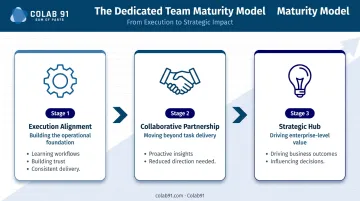
The companies that extract the most value from this model invest in the relationship as it matures. Colab91's founding team lived this progression firsthand, scaling Impendi's India operations from the ground up to 100+ practitioners serving clients like Carlyle Group and TPG. That operational experience now shapes how they design and manage dedicated team engagements for mid-market clients.
Frequently Asked Questions
What is a dedicated team model?
It's an outsourcing arrangement where an external team works exclusively for one client on a long-term basis. The vendor manages HR, payroll, and infrastructure; the client directs the day-to-day work and business priorities. The team operates as a functional extension of the client's organization - with aligned goals, shared tools, and direct accountability to client leadership.
What is the difference between dedicated team and staff augmentation?
Staff augmentation adds individual contractors to supplement an existing team for short-term or specific needs. A dedicated team is a fully structured, exclusive unit built for ongoing strategic work with deeper integration, a longer time horizon, and its own operating structure.
When is the dedicated team model the right choice for my business?
It's the right fit for PE-backed companies and mid-market businesses that need to build operational capability - in procurement, analytics, or finance - between deals or across portfolio companies. More broadly, if you have a persistent capability gap in a specialized domain that's expensive to fill onshore and needs to scale over time, a dedicated team is the more durable solution than contract staffing.
How quickly can a dedicated team be built and operational?
With a partner who has an established domain-specific talent network, initial team members can typically be deployed within 4–8 weeks. That's compared to a traditional in-house hiring cycle, which often runs 3–6 months per role - longer for specialized functions like procurement or analytics.
How do you measure the performance of a dedicated team?
Through KPIs defined before deployment - output quality, turnaround times, process efficiency metrics, or business outcomes depending on the function. Monthly review cadences are standard practice, with quarterly check-ins to evaluate strategic alignment as the team scales.