Introduction
Most CFOs and CPOs at mid-market and PE-backed companies share the same frustration: spend data lives in too many places at once. ERP exports land in spreadsheets. Supplier portals hold contract data that never syncs with accounts payable. Procurement teams piece together reports from fragmented sources — and by the time the picture is clear, it's already outdated.
The result is a function that operates in permanent catch-up mode. Purchases happen, invoices clear, and anomalies surface during audits rather than before they escalate.
AI is changing this dynamic. Not by automating existing reports faster, but by making real-time, comprehensive spend visibility operationally achievable for the first time — turning procurement from a reactive compliance function into a proactive driver of measurable savings. This article breaks down how AI-powered spend management works, where the real gains come from, and what mid-market and PE-backed teams need to get right to capture them.
Key Takeaways
- AI-powered spend management replaces fragmented, lagging reports with a live, unified view of all organizational spend
- Clean, consolidated data is the prerequisite — AI layered onto poor data produces noise, not insight
- The highest-value AI applications include automated classification, anomaly detection, supplier risk scoring, and contract optimization
- ROI spans hard savings, recovered leakage, and hours freed from manual reconciliation — track all three to capture the full picture
- Mid-market and PE-backed companies can access full AI spend management capabilities by pairing the right technology with external domain expertise
Why Traditional Spend Management Falls Short
Most procurement teams are managing less of their organization's spend than they think.
According to CPO Rising/Ardent Partners' 2025 research, procurement teams manage an average of 71% of total enterprise spend — meaning roughly 29 cents of every dollar flows outside managed channels. That's the industry average after years of improvement. For lean mid-market teams, the number is often worse.
The Compounding Effects of Unmanaged Spend
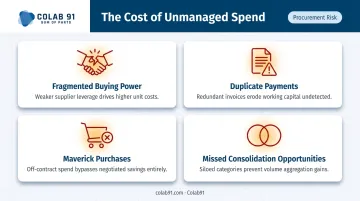
Each percentage point of unmanaged spend compounds into real financial exposure:
- Fragmented buying power — teams negotiate individually rather than leveraging consolidated volume
- Duplicate payments — invoices processed across disconnected systems without cross-referencing
- Maverick purchases — off-contract buying that bypasses preferred supplier pricing
- Missed consolidation opportunities — supplier overlap that goes undetected until a manual audit
These problems hit mid-market companies hardest. A lean three-person procurement team can only manually review so much data. The rest falls through the cracks.
Understanding Spend Under Management (SUM)
Spend under management (SUM) is the clearest diagnostic available: total managed spend divided by total organizational spend, expressed as a percentage.
A low SUM signals fragmented negotiating leverage, elevated compliance exposure, and categories paying above-contract rates. The financial case is direct: each additional dollar brought under procurement management yields 6% to 12% savings during the initial contract period.
For any mid-market P&L, that's a meaningful number.
How AI Transforms Spend Management: Core Capabilities
AI doesn't speed up existing workflows. It changes what those workflows can actually accomplish, specifically by processing volumes of structured and unstructured spend data at a speed and accuracy no manual team can match.
Automated Spend Classification and Visibility
The starting point for any AI spend management system is spend classification. Machine learning algorithms automatically cleanse, deduplicate, and categorize spend data using natural language processing and pattern recognition — applying standard taxonomies like UNSPSC or client-specific category structures without manual effort.
This matters because most organizations' raw spend data is a mess. Vendor names appear seventeen different ways. Line-item descriptions are inconsistent. ERP data doesn't match what's in the supplier portal. AI classification resolves these inconsistencies systematically, creating a reliable, consolidated view of all organizational spend. For many companies, that's the first time they've had one.
Once spend is properly classified, the downstream benefits follow quickly:
- Supplier consolidation opportunities become visible by category
- Pricing benchmarks by category become calculable
- True spend under management can be measured accurately
- Off-contract spend surfaces as a quantified number, not a vague concern
Colab91's spend analytics platform applies this approach directly: cleansing and classifying to UNSPSC or client-specific taxonomies, then enriching spend data with supplier diversity ratings, ESG scores, risk profiles, and contract terms. The result is continuous savings identification — not a once-a-year exercise.
Real-Time Policy Enforcement and Anomaly Detection
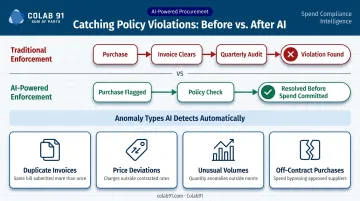
Traditional policy enforcement is retrospective. A purchase is made, an invoice clears, and a violation surfaces in the next quarterly audit. By then, the money is gone.
AI moves enforcement to the point of purchase — flagging out-of-policy transactions, unapproved vendors, and limit breaches before spend is committed. ML models learn normal spending patterns for each category, supplier, and business unit, then surface outliers automatically:
- Duplicate invoices across payment runs
- Sudden price deviations from established baselines
- Unusual transaction volumes for a given period or vendor
- Off-contract purchases in categories with preferred suppliers
APQC cross-industry benchmarking data shows that bottom-performing organizations process only 88% of disbursements error-free on the first pass — meaning 12% of payments require correction, investigation, or recovery. AI anomaly detection targets exactly this failure rate.
That error rate carries real consequences for PE-backed portfolio companies. Financial discipline and audit-readiness connect directly to investor reporting and deal readiness — not just operational hygiene.
The Data Foundation: Why Clean, Unified Data Comes First
Here's the uncomfortable truth about AI in spend management: the tool is rarely the problem.
Organizations that layer AI onto fragmented, inconsistent, or incomplete spend data produce unreliable outputs. Data readiness — not tool selection — is the most common failure point in AI spend management implementations.
What a Reliable Data Foundation Requires
A functional spend intelligence foundation consolidates data from all relevant sources into a single, durable layer:
- ERP systems and general ledger
- Procurement platforms and purchasing portals
- Accounts payable and invoice processing systems
- Supplier portals and contract management systems
Within that consolidated layer, consistent naming conventions, entity resolution logic, and classification taxonomies must be applied. Entity resolution (recognizing that "ABC Manufacturing Inc.," "ABC Mfg," and "ABC Manufacturing" are the same supplier) is unglamorous work, but without it, spend by supplier is meaningless.
A 2024 Deloitte survey of 100 CPOs at companies with $1B+ in revenue confirmed that AI-based procurement analytics require accurate, comprehensive underlying data — and that data quality failures precede most AI initiative failures. McKinsey further estimates that procurement functions use less than 20% of the data available to them to support decision-making, which points to both the problem and the opportunity.
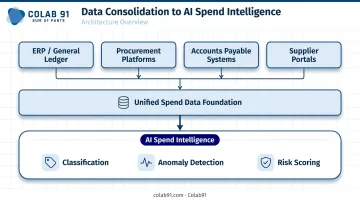
Colab91 treats this unified, durable data layer as the explicit prerequisite for any spend intelligence work — built first, not retrofitted after the AI tools are already in place.
Why Data Quality Can't Be a One-Time Fix
A one-time data cleanse degrades quickly as new suppliers are onboarded, systems change, and business units add spending channels. Organizations need repeatable processes — ideally supported by a dedicated analytics team — to maintain data quality and refresh classifications over time.
A clean, unified spend data layer also creates a single version of the truth that aligns procurement, finance, and operations. This matters most during M&A integration or rapid portfolio company scaling, where multiple fragmented data environments need to be collapsed into a coherent picture within weeks.
High-Value AI Use Cases in Strategic Spend Management
Predictive Demand and Price Forecasting
AI-powered analytics combine historical spend data with external signals — commodity price indices, FX rates, logistics costs — to forecast cost trends and optimize procurement timing. The shift is from reactive buying to strategic purchasing: acting before price increases or supply constraints hit, not after.
McKinsey reported that AI agents helped one tech company identify 12% to 20% savings opportunities in contact center operations by integrating spend and market data to simulate demand evolution. In a manufacturing context, the same logic applies to direct materials: knowing when to lock in pricing versus when to buy spot is worth significant margin.
Supplier Risk Scoring and Performance Management
Supply chain disruptions lasting one month or longer occur every 3.7 years on average and can cost the average organization 45% of one year's profits over a decade, according to McKinsey. The real exposure is failing to see them coming.
AI supplier risk scoring aggregates structured and unstructured data — financial filings, credit scores, ESG ratings, sanctions screening, geographic concentration risk — to generate continuous risk scores by supplier. Colab91's Supplier Risk Management platform connects these scores directly to spend amounts, giving procurement teams a risk-weighted exposure view: not just which suppliers are risky, but how much spend is concentrated with them.
Category and Contract Optimization
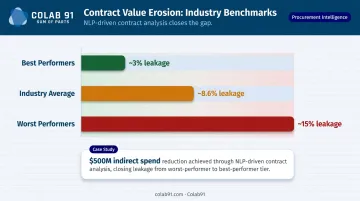
World Commerce & Contracting reports that average contract value erosion is 8.6% — meaning organizations lose nearly nine cents of every contracted dollar to leakage, compliance gaps, and missed terms. Best performers lose about 3%; worst performers lose around 15%.
NLP models analyze contract language to surface unfavorable pricing clauses, upcoming renewal deadlines, and compliance gaps before they become losses. At scale, the results are concrete:
- A pharmaceutical company using AI for invoice-to-contract compliance cut leakage by 4%, per McKinsey
- A global retail chain using AI-assisted category analysis reduced indirect spend by 11%, saving $500M
Continuous Spend Optimization Through Recommendation Engines
The highest-maturity AI application in spend management is a continuous recommendation engine — one that monitors spend data and surfaces opportunities as they emerge: supplier consolidation candidates, contract rebundling options, substitute materials, and payment term optimization.
Quarterly category reviews can't match this cadence. By the time a report flags an issue, the window may have already closed. Continuous monitoring integrated directly into category manager dashboards means insights reach decision-makers when they're still actionable.
Measuring ROI and Making the Business Case
Standard ROI calculations undercount AI's value in spend management. The full return spans three dimensions, and a credible business case requires all of them.
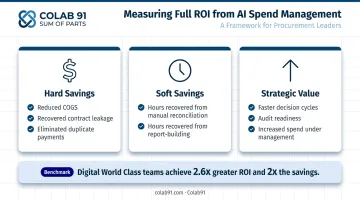
| ROI Dimension | What to Measure |
|---|---|
| Hard savings | Reduced cost of goods, recovered contract leakage, eliminated duplicate payments |
| Soft savings | Hours recovered from manual reconciliation and report-building |
| Strategic value | Faster decision cycles, improved audit readiness, increased spend under management |
Primary KPIs to Track
- Spend under management (%): track baseline versus target each quarter
- Cost savings realized versus pre-implementation baseline by category
- Off-contract spend reduction: measure both dollar volume and percentage of total
- Invoice processing cycle time — Ardent Partners benchmarks show Best-in-Class organizations process invoices in 3.1 days versus 17.4 days for others
- Anomaly detection accuracy rates — precision and recall on flagged transactions
The Hackett Group's 2025 research found that Digital World Class procurement teams using generative AI achieve 2.6x greater ROI, 2x the savings, and 58% faster cycle times than peers — providing a credible benchmark for what's achievable with sustained investment.
Proving ROI Early
The most practical approach for mid-market organizations is to start with a pilot in a high-volume, well-defined spend category. Set a clear baseline upfront, measure results within 90 days, and use that proof to build the case for company-wide adoption before scaling.
Colab91's Savings Opportunity Assessment completes within 4-6 weeks and typically identifies 5-15% of addressable spend as quantifiable savings — giving organizations a concrete baseline from which to measure before committing to full-scale AI spend management programs.
Building AI Spend Management Capabilities for Mid-Market and PE-Backed Companies
Most mid-market and PE-backed companies face the same resource reality: the in-house data science, procurement analytics, and technology talent needed to independently build and sustain AI spend management doesn't exist on their payroll. And more than half of hiring managers globally struggled to find skilled procurement talent in the past year, according to CIPS/Hays 2025 data.
The Capability Components Required
Technology is only one piece. Full AI spend management requires:
- Domain expertise in spend classification and category management — knowing what the data means, not just how to process it
- Data engineering to build and maintain the unified data layer continuously
- Analytics talent to interpret AI-generated insights and translate them into sourcing decisions
- Change management to drive adoption across finance and procurement teams so insights actually get used
Building all four in-house from scratch takes 12-18 months minimum, assuming hiring succeeds. For PE-backed companies on 100-day integration timelines, that's not a viable path.
How Colab91's "Sum of Parts" Model Addresses This Gap
Colab91's model combines offshore efficiency with deep domain expertise in procurement and analytics — specifically built for mid-market and PE-backed companies that need the full stack without building it themselves.
The India-based capability centers cover the complete capability set:
- Data engineering: pipelines, data warehousing, ETL/ELT, and the unified spend data layer
- Spend analytics: continuous classification, enrichment, vendor consolidation, off-contract spend identification, and price benchmarking
- Category management support: strategic sourcing, supplier negotiation, and ongoing category execution
- Supplier risk management: continuous monitoring with D&B data, OFAC screening, ESG risk, and real-time alerting
Colab91's leadership team previously scaled a multifunctional organization to 100+ practitioners at Impendi (acquired by Accenture), serving Carlyle Group, TPG, Elliott, and BC Partners — the same PE sponsors whose portfolio companies now need these capabilities at the portfolio company level. That experience is already operational and field-tested.
Hiring an equivalent in-house team takes longer, costs more, and carries significant attrition risk. CIPS/Hays data shows more than one third of procurement employees worldwide expect to move jobs within the next year — making sustained in-house capability a moving target.
Frequently Asked Questions
What is AI spend management and how does it differ from traditional spend management?
AI spend management is automated, real-time, and predictive — operating across all spend categories simultaneously using machine learning and NLP. Traditional spend management is periodic, manual, and reactive, limited to what teams have bandwidth to review. The core difference is that AI surfaces what humans can't see, not just faster summaries of what they already know.
What is "spend under management" and why does it matter?
Spend under management (SUM) is the proportion of total organizational spend flowing through approved contracts and channels. A low SUM means lost negotiating leverage, missed savings, and elevated compliance risk. Every dollar outside managed channels is a dollar the organization failed to negotiate.
How does AI help detect and reduce maverick or unmanaged spend?
ML anomaly detection flags off-contract purchases and policy violations in real time. Spend classification then identifies which categories carry the highest concentration of unmanaged spend, enabling targeted intervention. Together, these capabilities shift enforcement from quarterly audits to point-of-purchase visibility.
What data does an organization need before implementing AI in spend management?
The minimum requirements are consolidated, cleansed spend data from ERP and procurement systems, consistent supplier naming conventions, and reliable category taxonomies. Data readiness is a more common implementation barrier than tool selection. Organizations that skip this step find AI amplifies data problems rather than solving them.
How long does it typically take to see ROI from AI spend management investments?
Well-scoped pilots in high-volume spend categories can demonstrate measurable savings within 90 days. Colab91's Savings Opportunity Assessment delivers a quantified savings roadmap in 4-6 weeks, giving organizations a validated baseline for broader investment decisions.
Can mid-market companies realistically implement AI-driven spend management without a large in-house team?
Yes — by combining the right technology platform with external domain expertise and offshore analytics support. Attempting to hire a full data science and procurement analytics organization from scratch takes longer and carries real talent risk, particularly given current procurement talent shortages.