Introduction
Procurement and finance leaders are being asked to do something genuinely difficult: cut costs, reduce supplier risk, and improve visibility - with teams and budgets that haven't kept pace with the workload. The Hackett Group's 2025 research puts a number on this tension: procurement workloads are projected to rise 10% while budgets grow just 1%, creating a 9% efficiency gap that manual processes simply cannot close.
Spend intelligence is how leading organizations are responding. Not the traditional quarterly spend cube built from a single ERP export, but a continuous, AI-driven function. One that unifies fragmented data, classifies spend in real time, flags risk before it becomes loss, and turns procurement from a reporting function into a strategic one.
Five major trends are accelerating this shift. Each one matters independently. Together, they're rewriting what procurement capability looks like at mid-market and PE-backed companies - organizations where smarter spend intelligence translates directly into margin improvement and competitive positioning.
Key Takeaways
- AI is replacing backward-looking spend analysis with real-time, predictive, and increasingly autonomous intelligence
- Five trends are reshaping the field: AI-powered classification, agentic AI, predictive intelligence, unified data layers, and ESG integration
- The biggest barrier to adoption is fragmented, low-quality data - not the technology itself
- Mid-market and PE-backed companies face unique scaling challenges, yet stand to gain the most from acting early
- Early movers build compounding advantages in cost control and visibility - gaps that widen for every year spent waiting
Trend 1: AI-Powered Spend Classification and Real-Time Visibility
From Quarterly Snapshots to Continuous Intelligence
Traditional spend analysis had a fundamental problem: by the time the data was cleansed, categorized, and reviewed, the decisions had already been made. AI classification changes the timeline entirely.
Machine learning and NLP models now automatically cleanse, deduplicate, and categorize spend data pulled from fragmented sources - ERPs, AP systems, procurement portals, spreadsheets - into consistent taxonomies without manual intervention. The result is continuous, near-real-time visibility into where money is going, who it's going to, and whether it's on-contract.
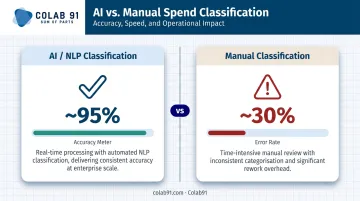
The accuracy gap between AI and manual classification is substantial. A 2025 Journal of Purchasing and Supply Management study found AI/NLP spend classification achieving around 95% accuracy, compared to manual codification error rates of approximately 30%. At that error rate gap, manual classification isn't a slower version of the same job - it's a structurally different (and less trustworthy) process.
Why Spend Under Management Rates Matter
Accuracy in classification directly affects how much of an organization's spend is actually managed. According to Ardent Partners/CPO Rising's 2025 research, average spend under management (SUM) sits at roughly 71% - meaning roughly 29% of spend is effectively invisible to procurement teams. Each additional dollar brought under management typically captures 6%–12% in savings during the initial contract period.
That unmanaged portion isn't just a missed savings opportunity. It's fragmented buying power, maverick spend, and supplier relationships no one is actively managing.
Anomaly Detection as a Real-Time Control Layer
AI systems also flag anomalies as they occur, not after the fact:
- Off-contract purchases routed to unapproved suppliers
- Duplicate invoices submitted across billing cycles
- Sudden supplier price increases outside agreed parameters
- Policy violations before they become audit findings
Procurement teams move from discovering problems in month-end reports to intercepting them while there's still time to act. That shift - from retrospective audit to real-time control - is where AI classification creates its most immediate operational value.
Trend 2: Agentic AI - The Move Toward Autonomous Procurement Workflows
What Agentic AI Actually Does
There's an important distinction between analytics tools that surface data and AI agents that act on it. Agentic AI belongs to the second category.
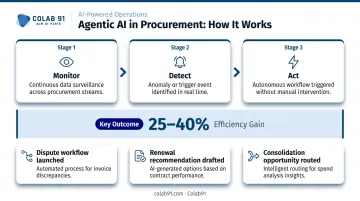
An AI agent doesn't wait to be asked. It monitors, detects, and acts - without a human prompt triggering each step. In practice, that looks like:
- Detecting an overcharge and launching a dispute workflow
- Flagging a contract approaching expiry and drafting a renewal recommendation
- Identifying a supplier consolidation opportunity and routing it to the relevant category manager
Gartner identified autonomous AI agents and agentic reasoning as key advancements shaping procurement's future. McKinsey estimates agentic AI could increase procurement efficiency by 25% to 40% by shifting transactional work away from human teams.
Why This Matters More for Mid-Market Companies
Enterprise procurement teams have something mid-market organizations don't: large analyst benches capable of handling manual data work at scale. A mid-market procurement team of three to five people cannot realistically maintain continuous spend monitoring, contract compliance tracking, and supplier risk scoring simultaneously.
Agentic AI effectively expands what a small team can cover. The agents handle continuous monitoring and exception-handling; the humans handle strategy, supplier relationships, and decisions that require judgment.
Agents currently deployed in procurement typically cover:
- Spend anomaly monitoring and escalation
- Contract compliance and expiry tracking
- Supplier risk scoring updates
- Savings verification against negotiated agreements
The Natural Language Layer
On top of agentic workflows, a natural language query layer is emerging. Procurement leaders can now ask complex analytical questions in plain language - "show me IT consulting spend trends over the last six quarters and identify the top cost drivers" - and receive answers in seconds. Work that previously required a data analyst and several days now takes minutes.
Trend 3: Predictive and Prescriptive Intelligence for Strategic Cost Management
Traditional spend analysis is backward-looking. Predictive intelligence closes that gap by surfacing cost trends before they reach the purchase order - and prescriptive intelligence takes it further, recommending what to do about them.
From Descriptive to Forward-Looking
AI models now combine internal spending patterns with external data feeds - commodity prices, FX rates, logistics indices, supplier financial health signals - to forecast cost trends before they hit purchase orders. KPMG's 2024 Global Procurement Survey of 400 senior procurement professionals ranked predictive analytics and GenAI as the top two technologies expected to affect procurement over the next 12 to 18 months.
In practice, this means:
- Buyers can lock in rates before commodity prices rise rather than reacting afterward
- Procurement timing aligns with production schedules, reducing costly spot buys
- Demand forecasts drive smarter safety stock decisions, freeing working capital
Prescriptive Intelligence: Modeling Trade-Offs Before Committing
Beyond prediction, AI now simulates "what-if" scenarios. What's the total cost of ownership impact of switching from a primary supplier to a secondary? The same models can run scenarios across order volume changes, category consolidations, and supplier risk exposure - often in minutes rather than weeks.
These simulations give category managers sharper negotiation strategies and faster trade-off analysis - without requiring weeks of analyst time to build the model.
For PE-backed companies, this capability is especially valuable. Procurement savings flow straight to EBITDA. A category manager who enters a negotiation with modeled consolidation scenarios - not just historical reports - can defend positions with numbers, not instinct. That difference shows up in the deal.
Trend 4: Unified Data Layers and Supplier Risk Intelligence
The Data Quality Problem No One Talks About Enough
AI spend intelligence fails when the underlying data is fragmented, inconsistently named, or siloed across systems. This isn't an edge case - it's the most common reason AI procurement projects underdeliver.
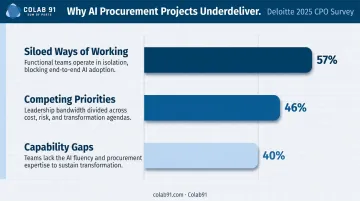
Deloitte's 2025 Global CPO Survey identified siloed ways of working (57% of respondents), competing priorities (46%), and organizational or technology capability gaps (40%) as the primary execution barriers for procurement transformation. Mid-market companies typically face the most fragmented data environments - multiple ERPs, disconnected AP systems, and spend data spread across spreadsheets and supplier portals with no common taxonomy.
What a Unified Data Layer Looks Like
The goal is a single platform that:
- Ingests data from all ERPs, AP systems, contract repositories, and supplier databases
- Normalizes supplier identities across sources (the same supplier appearing under three different name formats, for example)
- Enriches records with external risk and compliance data
- Maintains consistent taxonomy over time as the business changes
This is the architecture Colab91's AI-powered systems of intelligence are built toward - unified, durable data layers that AI can learn from, not just store. That foundation matters most for mid-market organizations, where in-house data engineering capacity is limited. Offshore analytics capability centers can accelerate the build without requiring enterprise-scale headcount.
Supplier Risk Intelligence Built Into the Layer
With a unified data layer in place, supplier risk intelligence becomes continuous rather than periodic. AI aggregates structured and unstructured data - financial reports, logistics performance records, news signals, ESG ratings - to generate real-time supplier risk scores. The system predicts disruptions like financial instability or delivery failures before they hit your supply chain.
Deloitte's 2025 survey found 64% of CPOs prioritizing greater supply chain visibility as a core risk management objective. Reactive supplier monitoring is no longer acceptable.
Trend 5: ESG and Supplier Diversity Intelligence Going Mainstream
From Reporting Exercise to Active Decision Input
ESG is moving out of the sustainability report and into procurement decision workflows. Carbon emissions - particularly Scope 3 - supplier diversity, and ethical sourcing compliance are being embedded directly into spend intelligence platforms.
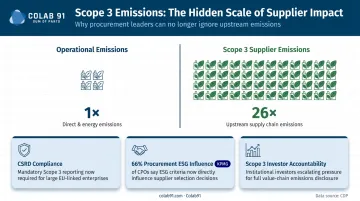
The scale of the Scope 3 challenge explains the urgency. CDP data shows that Scope 3 emissions are on average 26 times a company's operational emissions. For most organizations, that means the majority of their carbon footprint sits with suppliers - and can only be managed through procurement decisions.
Regulatory pressure is accelerating adoption across several fronts:
- CSRD compliance: Companies subject to the EU's Corporate Sustainability Reporting Directive must report value-chain emissions under European Sustainability Reporting Standards
- Procurement influence: KPMG's 2024 survey found 66% of procurement respondents said regulatory and ESG demands heavily influence strategic sourcing
- Scope 3 accountability: Regulators and investors are increasingly treating supplier emissions as a direct organizational liability
The PE Angle
For PE-backed companies, ESG performance now directly affects cost of capital, investor confidence, and exit valuations. Spend intelligence platforms that surface ESG data alongside cost data give portfolio companies a measurable advantage in fundraising and M&A processes - demonstrating operational maturity that resonates with acquirers and LPs alike.
What's Driving These Trends - and How They're Reshaping Procurement
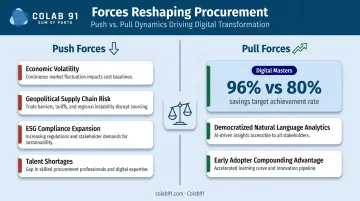
Push and Pull Forces
Several forces are making the status quo untenable:
Push forces (compelling adoption):
- Economic volatility, inflation, and tariff disruptions squeezing margins
- Geopolitical supply chain risk demanding faster supplier risk responses
- ESG and regulatory compliance requirements expanding scope
- Talent shortages making manual procurement analysis unsustainable
Pull forces (attracting investment):
- Documented ROI: Deloitte's 2025 CPO Survey found Digital Masters met or exceeded cost savings targets at 96% versus 80% for followers
- Natural language interfaces democratizing advanced analytics beyond specialist teams
- Early adopter advantage compounding over time as laggards fall further behind
Operational and Workforce Impact
Procurement workflows are being restructured around AI-generated insights rather than analyst-built reports. Exception-handling, compliance monitoring, and savings tracking are increasingly automated - reducing cycle times and the cost-to-serve for procurement functions.
64% of procurement leaders expect AI and GenAI to transform their roles within five years, according to Hackett Group research. Routine analytical tasks shift to AI; practitioners redirect their focus toward strategy, supplier relationships, and complex negotiations where human judgment creates real differentiation.
The organizations capturing this shift most effectively are those pairing AI tools with specialized domain talent in dedicated analytics capability centers - rather than trying to hire their way to the same output.
Colab91's model blends onshore expertise with India-based procurement and analytics specialists, giving mid-market clients the analytical output of a much larger team without the overhead of building it entirely in-house. That approach is informed by the leadership team's experience scaling Impendi's India operations to 100+ practitioners for clients including Carlyle Group, TPG, and BC Partners - the same PE portfolio context where these capability centers deliver the clearest return.
Future Signals for AI Spend Intelligence
The field is moving faster than most procurement roadmaps assume. Several developments in the next one to three years are worth tracking:
Near-term signals:
- Fully autonomous tail spend management, where AI handles the full sourcing cycle for low-complexity categories without human initiation
- AI agents that self-trigger sourcing events when contract thresholds or risk scores are breached
- Cross-portfolio spend aggregation tools for PE sponsors managing multiple companies simultaneously
Technologies to watch:
- Large language models (LLMs) embedded natively into spend platforms, enabling conversational analytics without specialist data skills
- Semantic data layers that allow AI to understand procurement context - not just transaction data - improving classification and recommendation quality
- No-code agent-building tools letting non-technical procurement teams deploy custom workflows without engineering support
These signals come with a grounding context: Gartner moved GenAI for procurement into the Trough of Disillusionment in July 2025, following its Peak of Inflated Expectations in 2024. This doesn't signal retreat - it signals maturation. Organizations should expect harder questions around data governance, ROI measurement, and implementation quality as the technology matures. That scrutiny is healthy, and it rewards organizations that invested in data foundations first.
For mid-market and PE-backed companies, the timing matters. Enterprise competitors are already scaling AI-powered spend infrastructure, and the cost gap between building now versus later only widens. Organizations that move - whether through technology investment, offshore analytics teams, or both - will enter the next cycle with visibility and cost control their slower peers lack. Waiting is a cost too, just a less visible one.
Frequently Asked Questions
What is spend intelligence, and how is it different from spend analytics?
Spend analytics examines historical expenditure data to identify patterns and trends. Spend intelligence is broader: an AI-enabled function that adds real-time visibility, predictive insights, supplier risk monitoring, and automated action, turning data into a continuous, forward-looking strategic input rather than a periodic report.
How does AI improve spend classification accuracy in procurement?
ML models trained on historical invoice and transaction data learn to recognize patterns (keywords, supplier attributes, transaction structures) and apply consistent taxonomy classifications automatically. The result is roughly 95% accuracy, compared to manual error rates around 30%.
What is agentic AI in procurement and why does it matter?
Agentic AI refers to systems that don't just surface data but take autonomous action, such as launching dispute workflows, flagging contract expiries, and routing consolidation opportunities to category managers. This shifts procurement teams from reactive firefighting to proactive value creation - a meaningful advantage for mid-market teams with limited analyst capacity.
What are the biggest barriers to implementing AI spend intelligence at mid-market companies?
Three barriers consistently surface: fragmented data across multiple ERP systems, limited in-house AI and analytics talent, and unclear ownership of the spend intelligence function. The right combination of AI-powered platforms and specialized offshore capability teams can address all three.
How do PE-backed companies use AI spend intelligence to drive portfolio value?
PE sponsors use AI spend intelligence to accelerate procurement cost savings that directly improve EBITDA, identify supplier consolidation opportunities across portfolio companies, and build ESG-compliant supply chains that support stronger exit valuations - making it a direct deal thesis execution tool.