The pressure on life sciences procurement leaders has never been sharper. They're expected to cut costs, accelerate innovation timelines, and maintain airtight compliance simultaneously — demands that routinely pull against each other. The organization pushing for a cheaper API supplier and the regulatory team requiring re-validation before any switch can't both win without a strategy that accounts for both.
This article covers what makes life sciences procurement genuinely different, the challenges procurement leaders face today, proven best practices, emerging technology trends, and how mid-market and PE-backed organizations can build the capabilities they need without overhauling their entire team structure.
Key Takeaways
- Life sciences procurement operates under regulatory, patient safety, and innovation pressures that have no equivalent in general procurement
- Supplier concentration risk, cold chain complexity, and data silos are among the most consequential challenges procurement teams face
- Effective strategies prioritize supplier partnerships, risk tiering, total cost of ownership, and cross-functional integration over unit price
- AI-driven analytics, blockchain traceability, and ESG-aligned sourcing are reshaping what best-in-class looks like
- Mid-market and PE-backed life sciences companies can close procurement capability gaps with a blended onshore-offshore delivery model
What Makes Life Sciences Procurement Uniquely Complex
Regulatory Frameworks That Reach Into Every Sourcing Decision
Every procurement decision in life sciences carries a compliance dimension. FDA regulations under 21 CFR Part 211 require written procedures covering each stage of component handling — receipt, identification, storage, sampling, and testing — with every lot assigned a distinctive code and status control. Under 21 CFR 820.50, medical device manufacturers must evaluate and select suppliers based on documented quality criteria and require supplier change notification. EMA GMP/GDP guidance adds another layer for any organization operating in European markets.
Non-compliance isn't a theoretical risk. In 2018, FDA issued a warning letter to Zhejiang Huahai after finding the firm failed to investigate an NDMA impurity in valsartan API — a process change originally made to lower costs had introduced a mutagenic (cancer-linked) contaminant. The firm was placed on Import Alert 66-40. A single sourcing decision, years earlier, cascaded into one of the largest drug recalls in recent memory. That kind of downstream exposure makes supplier qualification — not just supplier selection — the real regulatory battleground.
A Supplier Landscape That Offers Very Little Flexibility
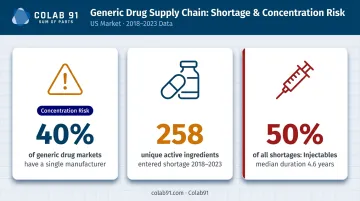
The supplier pool for many life sciences categories is narrow by nature. According to a 2025 National Academies analysis, 40% of generic drug markets have a single manufacturer. As of 2024, only 24% of API manufacturing facilities for US-marketed drugs were domestic — the rest spread across overseas locations, with some critical molecules sourced exclusively from one country.
Switching suppliers mid-process is not a standard procurement move. In regulated environments, it often triggers full re-validation — a costly, time-consuming process that can take months. This reality fundamentally changes supplier selection logic: getting it right the first time matters far more than it does in other sectors.
Innovation Cycles That Outpace Supply Markets
Cell and gene therapy, mRNA platforms, and precision medicine are advancing faster than established supply markets can keep up. BioPhorum has documented how the proliferation of single-use systems has increased raw material lead times due to global supply constraints and lack of standardization. When Cytiva discontinued the Sepax 2 as a certified medical device in 2022, cell therapy labs had to identify alternatives for a processing system with limited substitutes — a sourcing challenge that didn't exist five years earlier.
In these categories, procurement teams aren't just managing supply risk — they're helping define what a viable supplier even looks like, often before regulatory pathways or qualified alternatives exist at scale.
The Biggest Challenges Facing Life Sciences Procurement Leaders
Supplier Concentration and Single-Source Dependency
When there's only one or two qualified suppliers globally for a critical input, the entire development or manufacturing pipeline sits behind a single point of failure. Between 2018 and 2023, 258 unique active ingredients entered national shortage — injectables accounted for 50% of all shortages and lasted a median of 4.6 years. USP's Medicine Supply Map identified that 100% of new injectable drug shortages in 2024 had been flagged high-risk by the platform before the shortage materialized.
Supplier mapping — understanding not just Tier 1 but Tier 2 suppliers and their geographies — is the foundation of any serious risk mitigation strategy.
Cold Chain Complexity and Temperature Excursions
Biologics, vaccines, and temperature-sensitive materials require cold chain integrity across international borders, customs processes, and multiple handoffs. A 2021 peer-reviewed review found that 76% of 45 reviewed providers exposed vaccines to inappropriate temperatures for at least 5 cumulative hours over a two-week period. Approximately 80% of diabetic and arthritic patients expose biologics to inappropriate temperatures. WHO-linked data cited by IQVIA puts global vaccine waste from cold chain failures above 50%.
Selecting cold chain logistics providers demands the same rigor as selecting API suppliers — carrier qualification, temperature monitoring systems, and contingency protocols all matter.
Balancing Cost Pressure Against Non-Negotiable Quality
Manufacturing and quality issues caused 62% of drug shortages between 2013 and 2017. McKinsey research indicates that digitizing pharmaceutical QC alone can reduce overall QC costs by more than 50% and cut lead times by 60–70% — confirming that the financial cost of quality failures is substantial and largely preventable.
The pressure to find cheaper suppliers is real, but in a sector where a quality rejection can halt production, the "cheapest supplier" metric is misleading. Total cost of ownership is the only financially rational framework — one that accounts for:
- Rejection rates and rework costs
- Remediation and re-validation expenses
- Delivery reliability and lead time variability
Data Silos and Reactive Decision-Making
R&D, manufacturing, regulatory, and procurement teams typically operate in separate systems. The result: procurement lacks real-time visibility into demand forecasts, supplier performance metrics, and spend data until problems are already in progress. Without shared data infrastructure, procurement defaults to firefighting rather than proactive risk management.
Best Practices for a High-Performance Life Sciences Procurement Strategy
Treat Suppliers as Strategic Partners, Not Transactional Vendors
Because the supplier pool is constrained and re-qualification costs are high, the relationship model matters. Procurement teams that share demand forecasts, co-develop quality protocols, and build joint risk mitigation plans with critical suppliers get something valuable in return: suppliers who understand their regulatory environment and act as an extension of their compliance function.
McKinsey's research on pharma R&D–supplier partnerships notes potential benefits include favorable terms, minimized disruption risk, and improved supplier performance — particularly relevant as CRO/CDMO spend grew 12–13% annually from 2014 to 2022, faster than overall R&D spending.
Embed Procurement Early in R&D and Clinical Planning
R&D teams routinely commit to novel materials or CROs before procurement has assessed sourcing feasibility, lead times, or regulatory qualification requirements. By the time procurement is involved, the deadline is already critical and optionality is gone.
Embedding procurement at the stage-gate review level — before commitments are made — allows for proactive supplier identification, budget alignment, and risk assessment while there's still time to act on them.
Build a Risk-Tiered Supplier Management Framework
Not all suppliers warrant the same level of oversight. A structured approach:
- Tier 1 (Critical/Single-Source): Frequent audits, safety stock, contingency sourcing plans, quarterly scorecard reviews
- Tier 2 (Important/Limited Alternatives): Annual audits, performance monitoring, qualified backup identified
- Tier 3 (Commodity/Multiple Alternatives): Periodic reviews, automated spend monitoring
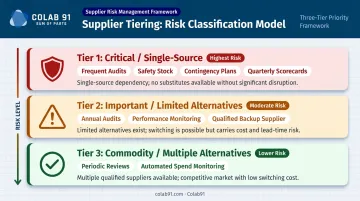
Supplier scorecards anchored to on-time delivery, quality rejection rates, audit pass rates, and regulatory compliance history provide the evidence base for supplier relationship conversations and contract decisions. Tracking Tier 2 supplier risk at this level — geopolitical exposure, financial health, single-source key starting materials — is what distinguishes procurement organizations that anticipate disruptions from those that respond to them.
Adopt Total Cost of Ownership Over Unit Price
In life sciences, hidden costs are often larger than the price differential that made a supplier attractive:
- Higher rejection rates requiring rework
- Documentation non-compliance requiring remediation
- Late deliveries disrupting clinical timelines
- Regulatory disqualification triggering re-validation
TCO analysis surfaces these costs before contract award. A supplier that's 8% cheaper on unit price but carries a 15% quality rejection rate isn't a savings — it's a liability.
Automate Compliance Documentation and Approval Workflows
Manual compliance tracking across a large, global supplier base is error-prone and audit-risky. Digital procurement tools address this directly by:
- Automating supplier qualification tracking and audit trail maintenance
- Routing approvals and flagging compliance exceptions in real time
- Freeing procurement professionals to focus on strategic sourcing rather than manual record-keeping
Integrate Procurement with R&D, Manufacturing, and Finance
Best-in-class life sciences procurement operates from shared data infrastructure. Unified spend visibility, demand forecasts, and supplier performance dashboards accessible across procurement, R&D, manufacturing, and finance enable proactive decisions. With the average cost to develop a new drug reaching $2.3 billion in 2022, late or uninformed procurement decisions carry real financial consequences.
That cross-functional alignment compounds further when paired with the right tools. McKinsey notes that generative AI can accelerate contract scrutiny and value-at-stake assessment by up to 80% in R&D supplier partnership workflows — a meaningful force multiplier for teams already working from integrated data.
Innovation Trends Reshaping Life Sciences Procurement
AI and Predictive Analytics
AI is being applied to demand forecasting, supplier risk scoring, contract compliance monitoring, and spend consolidation across fragmented supplier bases. McKinsey describes procurement category-management agents that track raw material supply and commodity prices, alongside supplier-management agents that monitor performance metrics and detect service-level declines.
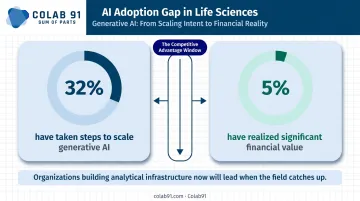
A 2024 McKinsey survey found that 32% of pharma and medtech leaders had taken steps to scale generative AI, but only 5% had realized it as a competitive differentiator generating significant financial value. That gap is where the near-term advantage sits: organizations that build the analytical infrastructure now, before the technology matures into standard practice, will be better positioned when the field catches up.
Blockchain and Digital Traceability
The FDA's Drug Supply Chain Security Act (DSCSA) enhanced requirements went into effect in November 2023. Trading partners must now exchange transaction data — NDC, serial number, lot number, and expiration date — electronically at the package level. An FDA DSCSA pilot reported 100% accuracy in master-data retrieval across simulated supply chain participants.
For procurement teams, blockchain's value extends beyond compliance. An immutable audit trail for API provenance and cold chain documentation cuts manual record-keeping while improving trust across complex multi-tier supply chains.
Sustainable and ESG-Aligned Procurement
McKinsey reports that approximately 75% of pharmaceutical value-chain emissions are Scope 3, with 50% of total pharma emissions coming from upstream purchased goods and services. Supplier emissions footprint is now a selection criterion for more than 90% of leading life sciences companies.
The PSCI Principles v3.0, approved in May 2023, give procurement teams a structured framework for supplier ESG assessment across five domains:
- Ethics — anti-corruption, fair business practices
- Human rights and labor — working conditions, freedom of association
- Health and safety — occupational standards, incident reporting
- Environment — emissions, waste, water stewardship
- Governance — management systems, accountability structures
For institutional partners and investors, ESG performance is shifting from a reputational signal to a hard qualification gate — meaning supplier selection criteria now need to reflect it explicitly.
Building Procurement Capability for Mid-Market and PE-Backed Life Sciences Companies
Mid-market and PE-backed life sciences companies face a specific challenge: unlike large pharma with dedicated category management teams and mature data infrastructure, they typically run lean procurement functions without the domain expertise or analytical capacity to execute sophisticated sourcing strategies. Meanwhile, PE sponsors expect rapid cost improvement and operational efficiency, often within the first 100 days post-acquisition.
PwC found that approximately 80% of pharma and life sciences executives were not achieving expected results from advanced supply-chain technology investments — a gap that reflects not just tool selection issues but underlying capability shortfalls.
The Augmentation Model
Hiring a fully built-out internal procurement team is slow and expensive. A faster path: a small onshore strategic leadership layer paired with offshore procurement delivery teams that bring deep domain expertise in spend analytics, strategic sourcing, and supplier management.
This is the model Colab91 has built for mid-market and PE-backed organizations. Rather than replacing internal teams, Colab91 builds dedicated India-based offshore capability centers that function as extensions of the client's procurement function.
These centers handle spend analytics, category intelligence, contract compliance tracking, and supplier qualification support, while onshore leadership manages relationships and strategic decisions.
The team has previously scaled similar models for clients including Amneal, Kindred Healthcare, and Pediatric Associates (a TPG portfolio company).
Erika Jung, a Colab91 advisor and former CPO at Pediatric Associates, brings direct experience leading procurement transformation at PE-backed healthcare platforms. That kind of domain knowledge is what makes offshore delivery effective, not just cost-efficient.
What Offshore Procurement Teams Deliver in Life Sciences Contexts
These functions don't require physical proximity to the client — but they do require real domain expertise. Specific functions well-suited to offshore delivery:
- Spend analytics across direct and indirect categories — API spend, lab supplies, clinical services, facilities
- Supplier risk monitoring — continuous tracking of financial health, regulatory risk, geographic concentration, and compliance status
- Category intelligence — benchmarking, market intelligence, and opportunity identification across pharma/biotech categories
- Contract compliance tracking — monitoring adherence, flagging leakage, maintaining audit-ready documentation
- Sourcing event support — RFI/RFP/RFQ management, supplier qualification, and onboarding support
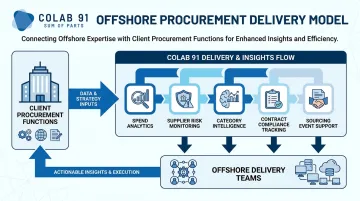
Delivering these functions from an offshore hub frees onshore leaders to focus on supplier relationships, cross-functional integration, and strategic decisions. That's exactly where their time creates the most value.
Frequently Asked Questions
What is life sciences procurement and why is it different from standard procurement?
Life sciences procurement covers the sourcing of materials, services, and equipment for pharmaceutical, biotech, and medical device organizations. Regulatory compliance requirements under FDA, GMP, and GLP frameworks, patient safety stakes, and a highly constrained supplier landscape make it fundamentally more complex and higher-risk than procurement in most other industries.
How does regulatory compliance affect procurement in life sciences?
Regulations such as FDA requirements, GMP, GLP, and 21 CFR Part 11 require procurement teams to maintain detailed supplier qualification records, conduct regular audits, and document every sourcing decision. Non-compliant sourcing can trigger product recalls, failed regulatory audits, or in severe cases, disqualification of entire product batches.
What is the difference between direct and indirect procurement in life sciences?
Direct procurement covers APIs, reagents, packaging, and clinical trial materials — items that go directly into the product or trial and carry the strictest regulatory requirements. Indirect procurement covers IT services, facility management, CROs, and marketing, with different compliance profiles and more sourcing flexibility.
How can mid-market life sciences companies build strong procurement capabilities without large in-house teams?
The most practical path is augmenting a small internal team with offshore domain experts in spend analytics and strategic sourcing. This approach provides access to specialized procurement capability at speed and scale without the cost and time required to build a fully in-house function from scratch.
What role does technology play in modernizing life sciences procurement?
Digital procurement platforms, AI-powered spend analytics, and automated compliance tracking reduce manual workload, improve supply chain visibility, and shift procurement from reactive problem-solving to proactive risk management. The gap in most organizations isn't technology availability — it's the analytical capacity to use it effectively.
How should life sciences companies measure procurement performance?
Strong procurement performance in life sciences spans cost, quality, and compliance. Key metrics to track:
- Supplier on-time delivery rate
- Quality rejection rate
- Percentage of spend under management
- Compliance audit pass rate
- Cost savings versus baseline
- Supplier qualification coverage
In life sciences, these metrics signal procurement maturity — not just cost control.