Introduction
Most M&A deals underdeliver. Roland Berger estimates that 60–80% of deals fail to generate expected value during post-merger integration — and procurement is one of the biggest missed opportunities in that gap.
While leadership teams focus on cultural alignment and IT consolidation, external third-party spend — often the largest cost bucket in any organization — goes largely untouched. The window to act is real: supplier contracts are in flux, relationships are renegotiable, and category structures haven't yet hardened. Once the integration settles, that leverage is gone.
This guide walks procurement leaders, CPOs, CFOs, and PE sponsors through a structured, phased approach to post-merger procurement integration — covering how to map spend, prioritize categories, sequence supplier negotiations, and build the operating model that sustains savings beyond the first 100 days.
Key Takeaways
- Procurement can contribute one-third or more of total M&A synergies, but only when engaged early and given strategic ownership
- A phased 90-day approach (spend consolidation, supplier rationalization, contract harmonization) is the proven path to capturing value fast
- The optimal synergy capture window is within 12 months of deal close; delayed action lets costs normalize
- Most mid-market and PE-backed integration teams lack the analytics horsepower and category expertise to close the procurement gap on their own
Why Procurement Is the Hidden Value Driver in Post-Merger Integration
Finance and operations typically dominate the post-close agenda. Procurement rarely gets a seat at the table early — which is why it's one of the most consistently overlooked sources of cost savings in any integration.
That's a costly oversight. In most organizations, external third-party spend is the single largest controllable cost. Procurement has direct influence over it.
The Synergy Numbers Are Clear
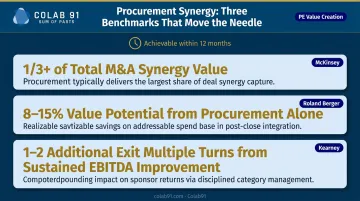
McKinsey's 2023 M&A research puts procurement's contribution at a third or more of total synergy value, with most of that achievable within 12 months of deal close. Roland Berger's 2025 analysis identifies 8–15% value potential from procurement alone in post-merger scenarios.
For PE-backed companies, that math translates directly to EBITDA. Kearney notes that companies demonstrating 12–18 months of sustained EBITDA improvement can command one to two additional multiple turns at exit. That makes procurement-driven cost savings one of the highest-leverage actions a PE sponsor can take in the first 100 days.
The Window Closes Fast
Supplier relationships are most malleable immediately after a deal closes. Contracts are up for discussion. Category structures haven't been locked in. That's the moment to negotiate from combined spend volume.
Wait six months, and suppliers have adjusted to the new normal. Wait a year, and the merged entity's costs have been effectively ratified.
Why Procurement Gets Deprioritized Anyway
Post-close, most organizations prioritize:
- Cultural integration and leadership alignment
- IT system consolidation
- Legal entity restructuring
- Employee communications
Procurement ends up without a clear mandate, without dedicated integration resources, and without a seat at the table where supplier and contract decisions are already being made. Those decisions get made anyway — just without procurement's input.
Building Your Post-Merger Procurement Strategy: Phase by Phase
The organizations that capture the most procurement synergy don't start on Day 1 — they start before the deal closes.
Pre-Close Preparation
The most effective integrations begin during due diligence. A clean-team model — where select procurement leaders access sensitive data under confidentiality protocols — allows teams to assess the target's supplier base, contract obligations, spend patterns, and category overlaps before Day 1.
McKinsey's research on pre-close procurement preparation shows that accelerating synergy capture by just three months allows a company to report roughly 25% of total savings earlier. In one documented case, aligning demand-management policies before close accelerated savings of approximately 10% of procurement spend by six months.
Key pre-close outputs to prepare:
- Preliminary spend map of both entities by category and supplier
- High-priority categories flagged for immediate renegotiation
- Supplier risk register identifying concentration, financial, and compliance risks
- Inventory of directed buys, regulatory constraints, and contractual limitations that will restrict flexibility post-close
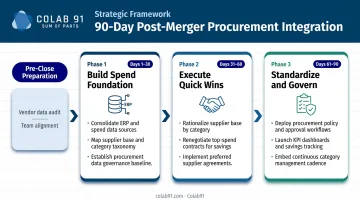
Days 1–30: Establish a Unified Spend Foundation
The first 30 days are about data, not action. Before any supplier negotiation or rationalization move can be made credibly, the team needs a complete, accurate view of what the combined entity spends — across every system, every entity, every category.
That means consolidating procurement data from all legacy ERP and P2P platforms into a single spend cube, cleansing it, and applying a consistent taxonomy across both organizations.
Without this foundation, synergy targets are guesswork. Teams either set conservative targets and leave value on the table, or set aggressive ones and erode credibility when they can't deliver.
This is precisely the gap Colab91's AI-powered spend analytics platform addresses. It ingests data from multiple fragmented ERP environments, then cleanses and classifies spend to UNSPSC or client-specific taxonomies. Each record is enriched with supplier risk profiles, ESG attributes, contract terms, and addressable spend modeling — reducing a process that would otherwise take 3–4 months manually to 3–4 weeks.
Days 31–60: Prioritize and Execute Quick Wins
With a reliable spend baseline in place, the integration moves to execution. This phase has a clear agenda:
- Launch supplier rationalization for overlapping vendor relationships across high-overlap categories
- Initiate renegotiations using combined spend volume as leverage — suppliers want the full NewCo relationship
- Align payment terms across both legacy entities to normalize working capital
- Consolidate tail spend where the administrative overhead of managing small vendors exceeds their strategic value
Visible wins in this window matter beyond the savings themselves. Early results build executive confidence, validate the procurement team's mandate, and create momentum for the harder integration work ahead.
Days 61–90: Standardize, Govern, and Track
This phase shifts from execution to institutionalization. Savings captured without a tracking mechanism don't make it into the synergy bridge — and in a PE-backed environment, that's a reporting failure, not just an operational one.
Priorities in this window:
- Establish standardized sourcing processes and approval workflows for the merged entity
- Build category governance structures that define ownership, decision rights, and review cadence
- Stand up a synergy tracking system that reports realized savings against targets on a weekly or monthly basis
- Deliver board-ready procurement reporting that maps actual savings to the deal model
The Four Key Cost-Savings Levers in Post-Merger Procurement
Supplier Rationalization
Every merger creates duplicate supplier relationships. Two legacy organizations rarely share the same vendor for the same category — which means the combined entity is paying management overhead for relationships that could be consolidated.
A structured rationalization process segments the supplier base into three clusters:
- Strategic suppliers — C-suite relationships requiring alignment before changes are made
- Mid-tier suppliers — primary targets for early synergy through volume consolidation
- Tail-end suppliers — candidates for rapid consolidation or elimination
The goal is to concentrate volume with vendors that offer the best combination of pricing, reliability, risk profile, and strategic fit — then use that concentration as negotiating leverage.
Contract Renegotiation Using Combined Spend Power
The merged entity is a more attractive customer than either legacy company was alone. Suppliers know this — and procurement teams should use it.
The most effective renegotiations in this window are built on fact-based dossiers that reflect the full NewCo spend in each category. That means combined volume by supplier, pricing from both legacy entities, contract expiration dates, and market benchmarks. Walking into a renegotiation without this data is walking in without leverage.
McKinsey documented one case where combined spend leverage generated nearly 10% savings on marketing agency costs — a category most organizations treat as non-negotiable. That same dynamic applies across categories where price disparity between the two legacy entities has gone unexamined.
Price Alignment Across Both Organizations
In nearly every merger, the two legacy companies are paying different prices for the same goods and services. Sometimes the gap is marginal. Sometimes it's not — McKinsey reported a healthcare merger where two entities were paying prices 30% apart for the same commodity.
Price alignment is straightforward in principle: identify disparities, then apply the best available pricing universally across the merged entity. The challenge is the data work required to surface those disparities accurately. A clean spend baseline in the first 30 days is non-negotiable — without it, price gaps stay invisible and savings opportunities expire.
Key inputs for a reliable price alignment analysis include:
- Combined line-item spend data from both ERP environments
- Supplier-level pricing from each legacy entity, matched by SKU or service description
- Market benchmarks to validate whether "best" pricing is genuinely competitive
- Contract expiration mapping to sequence renegotiation conversations
Spend Analytics and AI-Powered Category Intelligence
Teams that move fast in post-merger procurement integration don't do it with spreadsheets. Roland Berger's 2025 research found that GenAI-powered spend cube harmonization and negotiation dossier preparation can reduce preparation time by up to 80% — a meaningful acceleration when the synergy window is measured in months, not years.
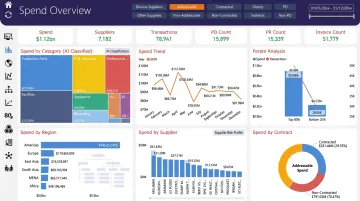
For mid-market and PE-backed companies with fragmented ERP environments across two merged entities, this is where Colab91's model adds direct leverage. Our offshore analytics delivery — combining AI-powered spend classification, dedicated India-based procurement analysts, and continuous intelligence output — gives lean procurement teams the analytical depth of a large enterprise function without the overhead.
Savings opportunity assessments are typically completed within 4–6 weeks, with category-level opportunity sizing and supplier rationalization priorities already built in.
Common Pitfalls That Derail Post-Merger Procurement Integration
Delayed Procurement Involvement
When procurement is brought in only after the deal closes — and other functions are already underway — critical decisions on supplier continuity, contract transitions, and organizational structure have already been made without procurement input. The negotiating window compresses, and some opportunities disappear entirely. Roland Berger identifies this as one of the primary failure modes in post-merger integration — the fix is structural: procurement needs a seat in the deal team, not a briefing after signing.
Fragmented or Inaccurate Spend Data
Teams that lack a reliable consolidated spend baseline tend to set either overly conservative synergy targets — leaving value on the table — or unrealistic ones that erode credibility with the executive team and PE sponsor when delivery falls short.
McKinsey puts it plainly: a combined spend baseline and common taxonomy are mandatory prerequisites for accurate procurement synergy work. Without them, every downstream decision is built on a flawed foundation.
Underestimating Change Management
Procurement integration doesn't happen in a silo — it cuts across functions where misalignment compounds quickly. Cross-functional dependencies include:
- Supplier negotiations that require legal sign-off before commitments can be made
- New payment terms that need finance alignment before rollout
- Process changes that require buy-in from acquired-company leaders protective of existing relationships
McKinsey's 2023 research identifies C-suite support as the single most important determinant of procurement transformation success — and notes that procurement and business-unit leaders need joint accountability for savings targets. Without that cross-functional alignment, negotiations stall, timelines slip, and synergy commitments go unmet.
Scaling Procurement Capacity for the Integration Sprint
Post-merger procurement integration is the most resource-intensive procurement exercise most organizations will ever undertake. It demands spend analytics horsepower, category expertise across every major spend category, project management bandwidth, and supplier negotiation capacity — all simultaneously, in a compressed window.
Most mid-market procurement teams enter an integration already stretched. The gap between what the sprint demands and what's available internally is rarely small.
The two traditional options both have real limitations:
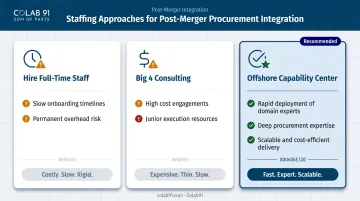
- Hiring full-time staff takes time to source and onboard — time the integration window doesn't allow. Once the sprint is complete, that headcount becomes permanent overhead
- Big 4 consulting firms are expensive, frequently deploy junior resources for execution work, and aren't structured for the operational continuity that follows the initial integration sprint
The offshore capability center model offers a third path. A dedicated India-based team with deep procurement domain expertise — strategic sourcing, spend analytics, category management, supplier rationalization — gives mid-market and PE-backed companies the capacity they need for the integration sprint, then transitions into an ongoing procurement operations function without the overhead of permanent headcount.
What Colab91 Brings to the Integration Sprint
Colab91's Managing Partners Madhur Kabra and Vijender Kapoor built and scaled exactly this model at Impendi — growing a 100+ practitioner offshore procurement and analytics organization serving PE sponsors including Carlyle Group, TPG, and Elliott. They now replicate that model for mid-market and PE portfolio businesses through Colab91's dedicated team, managed operations, and build-operate-transfer engagement structures.
For companies navigating fragmented ERP systems across two merged entities with a lean internal team, that combination of AI-powered spend intelligence and dedicated offshore execution capacity is often the difference between capturing the synergy window and missing it entirely.
Frequently Asked Questions
What is post-merger procurement integration?
Post-merger procurement integration is the structured process of aligning supplier relationships, contracts, spend data, and procurement operations across two merged organizations — with the goal of achieving cost synergies, maintaining continuity, and building a unified procurement function that reflects the combined entity's scale and strategic priorities.
How much of M&A synergy value typically comes from procurement?
According to McKinsey and Roland Berger, procurement typically contributes one-third or more of total M&A synergy value, with most of it achievable within 12 months of deal close.
What should procurement focus on in the first 90 days after a merger?
Three distinct phases: Days 1–30 focus on building a consolidated, accurate spend baseline across both entities. Days 31–60 shift to supplier rationalization, renegotiations using combined volume, and payment term alignment. Days 61–90 establish standardized governance, category ownership structures, and synergy tracking mechanisms.
How do you consolidate suppliers after a merger?
Start with a spend analysis to identify overlapping vendors by category. Evaluate each supplier across pricing, risk profile, contract flexibility, and strategic fit. Then consolidate volume with the strongest performers, using the combined entity's scale to negotiate better terms across the rationalized base.
What are the biggest mistakes in post-merger procurement integration?
Three failure modes appear consistently: involving procurement too late (missing the critical negotiating window), operating with fragmented spend data (leading to unreliable synergy targets), and underestimating the cross-functional alignment required to execute supplier and process changes across the merged organization.
How do PE-backed companies approach post-merger procurement differently?
PE sponsors treat procurement synergies as a direct EBITDA lever — and by extension, an exit valuation lever. That means aggressive 100-day value creation targets, procurement reporting tied to a synergy bridge from Day 1, and a direct line between savings captured and the deal model.