Introduction
Tail spend accounts for roughly 20% of total procurement value but drives more than 80% of all purchasing transactions, according to GEP. For most organizations, that imbalance is a nuisance. For CPG companies operating on compressed margins, it's a structural problem.
S&P Global data shows that large U.S. packaged food companies saw gross margins fall from 39.0% in 2019 to 36.6% in 2022, with median EBITDA margins declining in parallel. When every percentage point matters, leaving tail spend unmanaged isn't a minor inefficiency. It's a decision with direct margin consequences.
That margin pressure is exactly why the old argument — that tail spend categories are "too small to chase" — no longer holds. AI has changed the economics of managing low-value, high-volume spend. What once required teams of analysts now runs continuously, covering thousands of transactions each week without added headcount.
This post examines where CPG tail spend costs actually originate, what drives them, and how AI-powered approaches can address them: procurement decisions, day-to-day management, and the organizational context that determines whether improvements hold.
Key Takeaways
- Tail spend represents ~20% of total CPG procurement value but generates the majority of transactions — creating disproportionate administrative and cost burden
- CPG complexity — multi-SKU production, seasonal demand, decentralized MRO buying — amplifies tail spend leakage and off-contract purchasing
- AI enables automated classification, supplier rationalization, guided buying, and autonomous low-value sourcing events
- Optimization requires changes across decisions, management practices, and organizational context, not software alone
- Domain expertise alongside AI tools is what converts procurement insights into sustained savings
How CPG Tail Spend Accumulates Over Time
Tail spend in CPG doesn't originate from a single bad decision. It builds through thousands of small, decentralized purchases — marketing one-offs, MRO replenishments, short-run packaging orders, freelance engagements — each individually too small to trigger formal procurement review.
The problem compounds because it's effectively invisible. Without a unified data layer, spend sits fragmented across:
- ERP systems (often multiple, especially in acquired or multi-brand businesses)
- P-card and expense platforms
- Regional procurement tools
- Accounts payable records that haven't been categorized
No single system shows the full picture, so no one sees the cumulative cost.
The Urgency Problem
In CPG, seasonal demand cycles and short-run production schedules create recurring pressure to buy fast. When a promotional campaign needs custom packaging in three weeks, procurement teams don't have time to run a sourcing event through preferred channels. They buy from whoever can deliver.
This isn't maverick behavior driven by bad intent — it's a rational response to urgency. But the pattern repeats across every region, category, and business unit. Over time, the compounding effect creates a tail spend footprint that's too dispersed for manual review — and too costly to ignore. That's precisely where AI-driven spend analytics changes the equation.
Key Cost Drivers Behind CPG Tail Spend
Understanding where costs originate matters more than just knowing the scale. Three drivers consistently inflate tail spend costs in CPG environments.
Supplier Fragmentation
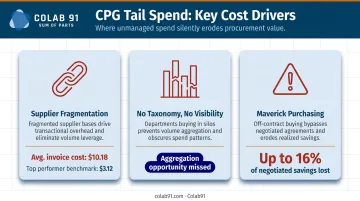
CIPS defines tail spend as the 10–20% of spend accounted for by 80% of an organization's suppliers. In CPG, that supplier count can be enormous — hundreds of MRO vendors, dozens of regional packaging suppliers, scores of marketing services firms.
Each relationship carries overhead: onboarding, invoicing, compliance verification, and payment processing. The numbers compound fast. Industry AP benchmarks cite an average invoice cost of $10.18, dropping to $3.12 for top performers — meaning a $300 transaction can carry $30 in processing overhead before any other inefficiency enters the picture.
No Taxonomy, No Visibility
Supplier fragmentation compounds quickly when there's no standardized spend categorization to make sense of it. Without frameworks like UNSPSC or a client-specific taxonomy, the same category gets recorded differently across systems — and no one can see that five departments are each buying from separate vendors for the same type of service.
The downstream effects are predictable:
- Each department decides in isolation, without visibility into what others are spending
- Volume aggregation opportunities go unrecognized across categories
- Consolidation savings never materialize because the data picture is too fragmented to act on
Maverick Purchasing as Both Symptom and Driver
Fragmented suppliers and poor taxonomy create fertile conditions for maverick buying. When procurement processes are slow, opaque, or simply inconvenient, employees bypass them. The result: purchases made outside contracts, at non-negotiated rates, from unapproved suppliers.
Research cited by Sievo from the Hackett Group estimates that organizations can lose up to 16% of negotiated savings when stakeholders buy from non-preferred suppliers. That direct cost premium is only part of the problem — maverick buying also breaks the organization's ability to enforce volume pricing, track ESG exposure, and monitor supplier compliance across the tail.
Strategies to Optimize CPG Tail Spend With AI
AI isn't a single tool — it's a capability layer that can be applied at different points in the procurement process. Effective tail spend optimization requires applying it in three places: the decisions being made, how purchases are managed day-to-day, and the organizational context those purchases happen within.
Strategies That Change Procurement Decisions
These approaches improve decision quality and compliance before or at the moment of purchase.
Automated Spend Classification
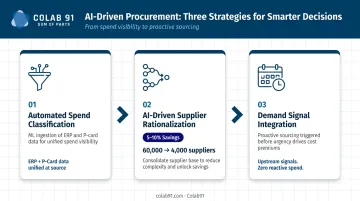
AI-powered spend analytics tools ingest raw transaction data from ERPs, P-cards, and expense systems and automatically classify it into spend categories using ML-based taxonomy matching. Work that once took analysts weeks now happens continuously.
For CPG procurement teams, this means a clean, current picture of where tail spend is concentrated — without waiting for a quarterly data pull. Academic research published in the Journal of Purchasing and Supply Management confirms AI's meaningful impact on spend classification accuracy and speed. Vendors like Coupa, Ivalua, and Sievo have all built this capability into their spend analytics platforms.
AI-Driven Supplier Rationalization
Once spend is classified, AI can surface duplicate suppliers, category overlaps, and low-value vendors that could be consolidated. JAGGAER documents cases where supplier bases have been reduced from 60,000 to 4,000 through managed rationalization — with procurement teams reporting 5–10% savings from actively managed tail spend programs.
This is a strategic decision, not an automated one. AI surfaces the consolidation candidates; procurement leaders decide which relationships to keep, merge, or exit.
Demand Signal Integration for Proactive Sourcing
AI can connect historical tail spend patterns with CPG production and promotional calendars to anticipate recurring purchases. Instead of reacting to urgent requests, procurement teams pre-source short-run packaging, seasonal MRO, and campaign materials before urgency forces off-contract buying. This addresses the root cause of a significant share of CPG tail spend accumulation.
Strategies That Change How Tail Spend Is Managed
These approaches improve control, compliance, and efficiency during the purchasing process.
AI-Guided Buying and Catalog Recommendations
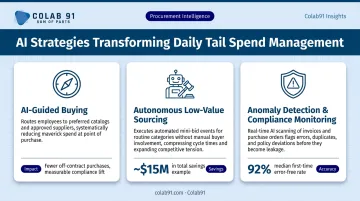
Guided buying portals use semantic search and recommendation engines to match employee requests to preferred supplier catalogs and pre-negotiated contracts. SAP describes the mechanism clearly: a simple interface that routes employees toward compliant purchases without requiring them to navigate procurement systems manually.
For CPG companies where marketing, operations, and logistics teams make independent purchases daily, this frictionless path to compliant buying reduces maverick spend without slowing down the business. The key design principle: make the right option easier than the wrong one.
Autonomous Low-Value Sourcing
AI can now run structured mini-competitive events for routine tail spend categories — office supplies, small MRO items, one-off services — autonomously. The system sets supplier parameters, issues requests, evaluates responses, and awards based on defined criteria.
A manufacturing case study from Fairmarkit illustrates the scale of impact: a Fortune 200 manufacturing leader implemented autonomous sourcing for MRO tail spend and generated nearly $1M in awarded savings in the first eight months. The program eventually grew to approximately $15M in total savings from automated sourcing events — covering categories that had previously been deemed not worth managing.
AI-Powered Anomaly Detection and Compliance Monitoring
AI embedded in procure-to-pay workflows monitors transactions continuously for policy violations, duplicate invoices, price deviations from contracted rates, and irregular supplier patterns. APQC data shows that the median first-time error-free invoice rate sits at 92% — meaning roughly 1 in 12 invoices has an error at the median organization.
For CPG companies with high transaction volumes across regions, continuous monitoring replaces manual audits with real-time alerts, reducing both fraud exposure and compliance risk across the full tail.
Strategies That Change the Organizational Context
Even the best AI tools produce nothing if the surrounding organization can't act on what they surface. Context is often the real cost driver.
Unified Data Architecture Across Procurement Systems
AI classification is only as good as the data it processes. CPG companies running multiple ERPs across regions, business units, or acquired brands need a unified data layer that normalizes vendor names, currencies, and spend categories before analysis can begin. In practice, this means master data management, continuous data cleansing, and ERP integration — foundational work that most AI vendors gloss over in their sales pitches.
The evidence is consistent. A GEP case study describing a Fortune 500 CPG enterprise found that meaningful indirect spend visibility only became possible after consolidating data from multiple ERP systems into a single analytical environment. Gartner's guidance on AI-ready data reinforces this: AI initiatives require data that is representative, clean, and consistent before they can deliver reliable outputs.
Embedding Procurement Analytics Capability at Scale
Mid-market and PE-backed CPG companies frequently lack the internal headcount to build and sustain AI-powered tail spend programs. Identifying consolidation opportunities in classified spend data is one thing; translating those insights into sourcing actions, supplier negotiations, and savings tracking requires domain-skilled analysts working continuously — not just quarterly.
This is where purpose-built offshore procurement and analytics capability centers become practically relevant. Colab91 builds dedicated India-based teams of procurement analytics professionals for US mid-market and PE-backed companies, combining AI-powered spend analytics with human analyst execution. The team delivers continuous spend intelligence across the full cycle:
- Spend classification to UNSPSC or client-specific taxonomies
- Vendor consolidation analysis and off-contract spend identification
- Savings tracking dashboards updated on a rolling basis
- Sourcing event support for categories previously considered unmanageable
Engagement models range from dedicated team arrangements to build-operate-transfer structures, depending on how much strategic control the client wants to maintain over time.
Regular Tail Spend Review Cadences
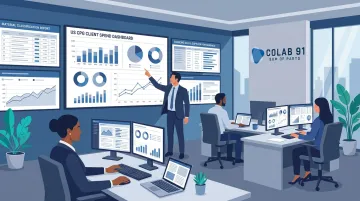
Without a governance cadence, even excellent AI tools produce insights that go unacted upon. Establishing a structured quarterly or semi-annual tail spend review — powered by AI-generated spend reports, supplier performance data, and savings tracking dashboards — shifts procurement from reactive to proactive.
The review doesn't need to be elaborate — just consistent. Clear ownership, reliable data inputs, and defined criteria for when a tail category warrants a sourcing event versus continued monitoring are what make the cadence work.
Conclusion
Reducing CPG tail spend with AI isn't about choosing the right platform. It requires a clear understanding of where costs actually originate — in the procurement decisions being made, in how purchases are managed and monitored, and in whether the organization has the data infrastructure and human capability to act on what AI reveals.
For mid-market and PE-backed CPG companies in particular, the sustainable path combines AI-powered tools with the right domain expertise and operational capacity. Building that capability deliberately — rather than treating it as an afterthought to software deployment — is what separates one-time savings from a continuous improvement program.
Frequently Asked Questions
How can CPG companies reduce tail spend?
Start by gaining spend visibility through AI-powered classification across all transaction sources. Then consolidate suppliers where volume can be aggregated, redirect purchases through guided buying portals tied to preferred contracts, and automate approval workflows for low-value transactions to reduce processing overhead and maverick buying.
What is the 80/20 rule in procurement and how does it apply to CPG tail spend?
In procurement, the Pareto principle describes a pattern where 20% of spend value is spread across 80% of supplier relationships and transactions. In CPG, that tail is especially fragmented — driven by multi-SKU complexity, seasonal purchasing, and buying spread across marketing, operations, and logistics.
What is a typical tail spend benchmark for CPG companies?
CIPS defines tail spend as the 10–20% of total spend accounted for by 80% of suppliers. JAGGAER benchmarks suggest procurement teams that actively manage tail spend typically uncover 5–10% savings and process efficiencies in those categories, though results vary by starting point and program rigor.
What AI tools are used for tail spend management in CPG?
Four tool categories cover most use cases: spend analytics platforms for classification and visibility (Coupa, Ivalua, Sievo); guided buying tools with recommendation engines (SAP Ariba); autonomous sourcing platforms for low-value competitive events (Fairmarkit, Keelvar); and AP automation with anomaly detection for compliance monitoring.
What are the biggest challenges CPG companies face in managing tail spend?
The most common obstacles are:
- Fragmented spend data spread across multiple ERPs and expense systems with no unified view
- Maverick purchasing driven by slow or opaque formal procurement processes
- Limited procurement bandwidth to convert tail spend insights into sourcing actions
How does AI-powered spend analysis differ from traditional spend analysis?
Traditional spend analysis is periodic, manually intensive, and dependent on pre-cleaned data — typically delivered as a quarterly or annual snapshot. AI-powered analysis runs continuously, auto-classifies transactions in real time, and surfaces anomalies or consolidation opportunities without waiting for a scheduled review cycle.