Introduction
Growth targets don't wait for hiring pipelines to catch up. For mid-market and PE-backed companies heading into 2026, that gap between ambition and execution is the central problem - internal teams are stretched, local talent is expensive and slow to find, and the business can't pause while you recruit.
This guide offers a practical framework for building offshore dedicated teams as a genuine operating model - not a cost-cutting workaround, but a structural response for companies that need to close capability gaps fast.
This guide focuses on a specific set of functions: procurement, spend analytics, financial modeling, and process transformation. These are the areas where India's talent density creates a genuine structural advantage - and where Colab91 has built offshore capability centers for PE sponsors including Carlyle Group and TPG.
Key Takeaways
- An offshore dedicated team is a permanent, embedded extension of your organization - built for long-term integration, not short-term vendor engagements
- Talent shortages in finance, procurement, and analytics are structural, not cyclical - 85% of North American CFOs report finance talent shortages
- PE-backed companies use offshore dedicated teams to compress value creation timelines post-acquisition
- India's talent pool of 5.8M technology professionals and 43.3M higher education enrollments directly addresses the execution gaps facing US mid-market companies
- The dedicated model outperforms staff augmentation and project outsourcing for ongoing operational functions
What Is an Offshore Dedicated Team?
An offshore dedicated team is a group of professionals based in another country - typically India for US companies - who work exclusively on your business priorities. They're embedded in your workflows, aligned to your goals, and function as a long-term extension of your organization.
The distinction from a typical vendor relationship is continuity. This team builds institutional knowledge over time, develops context about your business, and operates without a project end date - just like an internal function.
How It Differs from Traditional Outsourcing
The dedicated model differs from conventional outsourcing in ways that compound over time:
- You set the priorities - the team executes within your strategic framework, not a third party's delivery schedule
- A stable, long-tenure team builds context: your categories, your data, your key stakeholders
- Delivery is ongoing with no project end date, so the team deepens rather than resets
What Functions Belong Here
Offshore dedicated teams are no longer limited to software engineering. According to Deloitte's 2024 global outsourcing survey, outsourcing scope has shifted toward core capabilities including R&D, analytics, and marketing - functions that require genuine expertise, not just task execution.
In practice, companies are building offshore dedicated teams for:
- Strategic sourcing and category management
- Spend analytics and savings identification
- Financial modeling and operational reporting
- Data engineering and business intelligence
- Process transformation and operational support
Colab91 builds these teams specifically for procurement and analytics functions, recruiting domain specialists - not generalists - from India's large pool of mid-career professionals with backgrounds in strategic sourcing, finance, and data.
Why Offshore Dedicated Teams Are the Growth Strategy for 2026
Three structural forces have made this the right moment for the dedicated offshore model.
The Talent Shortage Is Real and Sector-Specific
This isn't a general labor market comment. The shortages hit hardest in exactly the functions mid-market companies need most.
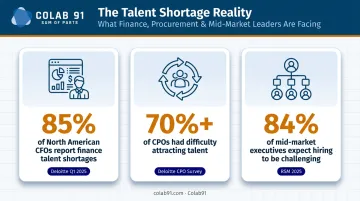
- Deloitte's Q1 2025 CFO survey found 85% of North American CFOs report accountant or finance talent shortages, with 45% calling it a major workforce challenge
- Deloitte's 2023 Global CPO Survey found more than 70% of CPOs had difficulty attracting talent over the prior year
- A 2025 RSM survey found 84% of mid-market executives with hiring needs expected filling roles to be at least somewhat challenging
The consequence isn't just a slower hire - it's operational risk. CFOs in that Deloitte survey cite increased workload for existing staff (44%), loss of investor credibility (42%), and erosion of board confidence (41%) as direct outcomes of being understaffed.
PE Sponsors Need Speed, Not Promises
Bain's 2025 midyear PE report identifies $1.2 trillion in buyout dry powder, with nearly 25% uninvested for four years or more. Sponsors are under real pressure to deploy capital and demonstrate returns - and that means portfolio companies need to build operating infrastructure fast.
McKinsey research shows accelerated transformations can improve EBITDA by more than 500 basis points in year one and capture 70–80% of total impact in under two years. That timeline only works if execution capacity is already in place. Offshore dedicated teams are one of the fastest ways to build that capacity.
Colab91's founding team built this model directly in PE contexts - scaling Impendi's India operations to 100+ practitioners serving Carlyle Group, TPG, Elliott, and BC Partners. The institutional knowledge from those engagements now shapes how Colab91 structures capability centers for new PE portfolio clients.
India's Talent Supply Has No Real Competitor
India's AISHE 2021-22 data reports 43.3 million higher-education enrollments and 9.85 million STEM enrollments. Nasscom estimates India's technology workforce at 5.8 million as of FY25, growing at over 2% annually.
Kearney's 2023 Global Services Location Index ranks India among the top three global services locations, citing cost advantage, talent density, and English-language capability. For procurement, analytics, and finance functions, that translates to senior domain expertise at compensation structures that are a fraction of comparable US roles - with output quality that matches or exceeds onshore delivery.
Offshore Dedicated Team vs. Other Hiring Models
Choosing the right model matters. The wrong one costs more than money - it wastes onboarding cycles, misaligns team structures, and delays the operational traction you actually need.
Dedicated Team vs. Staff Augmentation
Staff augmentation solves a different problem. It fills a temporary skill gap with a single contractor who comes in, does defined work, and leaves. That model doesn't build institutional knowledge. It doesn't compound over time.
A dedicated team is structured for continuity. The same people learn your category strategies, your spend data, your supplier relationships. That compounding context is what drives value for ongoing operational functions. Staff augmentation, by design, resets every engagement.
Dedicated Team vs. Project Outsourcing
Project outsourcing works when scope is fixed and deliverables are clear. A spend analysis with a defined end date, for example. But most business operations - procurement transformation programs, analytics roadmaps, cost reduction initiatives - are iterative. The requirements evolve as the business learns.
Fixed-scope outsourcing struggles with that evolution. A dedicated team adapts because the same people who understood your requirements in month one are still refining them in month twelve - building on context rather than starting over.
Quick Reference: Which Model Fits
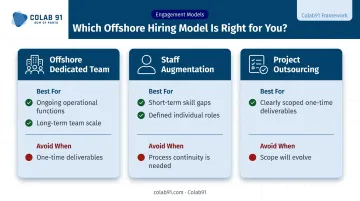
| Model | Best For | Avoid When |
|---|---|---|
| Offshore Dedicated Team | Ongoing operational functions, long-term scale | You need a one-time deliverable |
| Staff Augmentation | Short-term skill gaps, defined individual roles | You need process continuity or knowledge retention |
| Project Outsourcing | Clearly scoped, one-time deliverables | Scope will evolve or requirements are iterative |
Key Benefits Beyond Cost Savings
Cost arbitrage is real - senior domain experts in India cost a fraction of equivalent US hires. But framing the dedicated model purely as a cost play undersells it and often leads to poor decisions about how the team is structured.
What the dedicated model actually delivers is **capability access at the right cost structure** - a meaningfully different proposition.
Access to Talent That Doesn't Exist Locally
For mid-market companies in procurement or analytics, the honest challenge isn't just that US talent is expensive. It's that the supply of experienced, senior professionals in strategic sourcing, spend analytics, and financial modeling is genuinely thin in mid-market geographies.
India's professional talent base in these functions is deep and well-tested. That workforce developed real domain expertise through complex global programs - the same programs that previously ran through firms like Accenture, McKinsey, and Deloitte.
Scalability Without Structural Drag
PE portfolio companies don't have linear growth trajectories. They accelerate, they pivot, they prepare for exit. An offshore dedicated team can be scaled up or down throughout that lifecycle without the overhead of local hiring cycles, severance obligations, or the friction of a domestic restructuring.
That flexibility shows up at key inflection points:
- Expanding headcount rapidly after a bolt-on acquisition
- Tightening scope and reducing cost structure ahead of exit
- Pivoting team focus when a portfolio company enters a new vertical
- Maintaining continuity during leadership transitions onshore
The Strategic Hub Model in Practice
When structured well, an offshore team stops being a cost center and becomes something more useful: a nerve center for data, analysis, and process execution that informs decision-making across the organization.
Colab91's "Sum of Parts" approach is built on this logic - combining onshore leadership and client-facing expertise with offshore domain execution, so the total output exceeds what either team could deliver independently. That model was developed through direct experience with PE-backed engagements at Carlyle Group, TPG, and Pediatric Associates, where procurement and analytics teams were expected to drive strategic decisions, not just process transactions.
How to Build a High-Performing Offshore Dedicated Team
Step 1: Start with Outcomes, Not Headcount
Before defining roles, define what success looks like in 12-18 months. For a PE-backed portfolio company, that might mean:
- Standing up a procurement analytics function from scratch
- Achieving a specific category cost reduction target
- Building a data layer that feeds operational reporting to the board
Headcount follows from outcomes. Define success first, and you'll recruit the right people into the right roles. Skip that step, and you'll fill seats without giving anyone a clear mandate to deliver.
Step 2: Design the Operating Model Before Hiring
The most common mistake: hiring first and figuring out the structure later.
Before the first hire, define:
- How the offshore team interacts with onshore leadership (decision rights, escalation paths)
- What tools and workflows the team will use from day one
- How performance will be measured and reviewed
- What the first 90-day milestones look like
Gartner's 2025 CDAO survey found that more than one-third of analytics leaders don't identify establishing the operating model as a primary responsibility - and that gap correlates directly with teams that fail to deliver measurable impact. The operating model isn't an afterthought; it's the foundation everything else builds on.
Step 3: Choose a Partner with Genuine Domain Expertise
A staffing provider fills roles. A domain-experienced offshore partner understands the work well enough to help you design it. The distinction matters more than most buyers realize. Questions worth asking any prospective partner:
- Can you describe the functional work your team will actually perform - at the task level, not just the job titles?
- What's your team's depth in our specific category or function?
- How have you structured delivery for PE portfolio clients with compressed timelines?
- Has your leadership team actually performed this work, or only managed people who did?
These questions reveal the gap quickly. Colab91's managing partners, Madhur Kabra and Vijender Kapoor, each bring 16+ years of hands-on experience in strategic sourcing, analytics, and process transformation - they built and ran offshore centers before founding Colab91. When your engagement needs to produce results in 90 days, that operational depth is what closes the gap between a plan and a functioning team.
Step 4: Invest in the First 90 Days
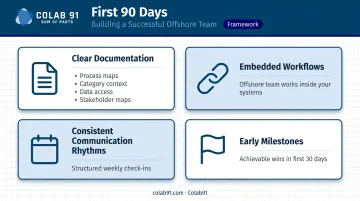
The first 90 days determine whether the engagement accelerates or stalls. High-performing offshore team engagements share a few common elements:
- Clear documentation from day one - process maps, category context, data access, stakeholder maps
- Embedded workflows - the offshore team works inside your systems, not parallel to them
- Consistent communication rhythms - structured weekly check-ins, not ad hoc calls
- Early milestones - achievable wins in the first 30 days that build trust and momentum
Step 5: Govern with KPIs, Not Micromanagement
Define the metrics that matter before the team starts. For procurement and analytics functions, that typically includes:
- Output quality (accuracy rates, stakeholder satisfaction scores)
- Turnaround time against defined SLAs
- Cost outcomes tracked against program targets
- Delivery velocity for recurring work products
Review these on a structured cadence - weekly or biweekly - and let the team own the how while you stay accountable for the outcomes. This is where tooling matters: Colab91 integrates AI-powered spend analytics and savings assessment tools directly into the delivery model, so performance is visible in the data rather than reported upward through status calls.
Managing Common Risks
Communication and Alignment
Distributed teams fail because of ambiguity, not distance. The fix is process design:
- Define who owns what decisions before work starts
- Document everything that would otherwise live in someone's head
- Build structured checkpoints into the weekly calendar from day one
This isn't about controlling the team - it's about removing the guesswork that slows them down.
Security, Compliance, and IP
As offshore teams gain access to procurement data, financial models, or operational reporting, governance matters. Before access is granted, organizations should have in place:
- Signed NDAs and defined IP ownership clauses
- Role-based data access controls
- Clear data residency and handling requirements
- Compliance alignment with relevant regulatory frameworks (SOC 2, GDPR where applicable)
Colab91 builds entity ownership, IP rights, and strategic control into engagement design from the start, not as add-ons once work is underway.
Cultural Integration
How you classify an offshore team shapes how they perform. Treat them as vendors and they'll stay transactional. Treat them as part of the organization and you get accountability, initiative, and institutional ownership. The practical difference:
- Include offshore team members in relevant planning cycles and company communications
- Prioritize retention and career development as shared responsibilities with your offshore partner
- Invest in direct relationships between offshore specialists and their onshore counterparts
Colab91 builds its team culture around meritocracy, work-life balance, and operational excellence. High retention means the same specialists stay on your account longer, building the institutional knowledge that makes delivery faster over time.
Frequently Asked Questions
What does an offshore team mean?
An offshore team is a group of professionals in another country who work exclusively for your organization - functioning as an extension of your internal team rather than an external contractor on a one-time project. They build organizational context over time, not just output.
What is the difference between an offshore dedicated team and staff augmentation?
Staff augmentation adds individual contributors temporarily to fill specific skill gaps. A dedicated team is a stable, long-term group that builds deep organizational knowledge and delivers consistently against your business goals. The two models are designed for different problems.
What functions can be offshored beyond software development?
Procurement, spend analytics, financial modeling, data engineering, process transformation, and operational reporting are all being offshored to India at scale - particularly by mid-market and PE-backed companies that need domain expertise they can't source locally.
How long does it take to set up an offshore dedicated team?
With the right partner and upfront operating model design, a functional team can be operational in 4-8 weeks. Defining roles, workflows, and success metrics before recruiting begins is the single biggest factor in reducing ramp time.
Is India a good location for offshore dedicated teams in 2026?
Yes. India has a technology workforce of 5.8 million professionals, strong English fluency across business and technical functions, and competitive cost structures. For US mid-market and PE-backed companies building analytical or operational capabilities, it remains the most practical offshore destination.
How do you manage an offshore dedicated team effectively?
Define clear KPIs before the team starts, establish consistent communication rhythms, and invest in a structured onboarding process. Treat the offshore team as a true extension of your organization with shared accountability for outcomes - not a vendor to monitor.