Introduction
Procurement teams are managing more complexity with the same headcount - supplier risk, cost pressure, compliance demands, and a growing flood of spend data that most organizations still can't act on fast enough.
The numbers confirm it: Deloitte's 2023 Global CPO Survey found 43% of CPOs reported a significant increase in overall procurement risk, with 89% citing inflation and cost pressure as a high or moderate impact on their function.
Procurement intelligence platforms address this gap directly. They convert raw spend data, supplier signals, and market trends into concrete decisions - not just dashboards. For mid-market and PE-backed companies, where procurement teams tend to be leaner and the margin for error tighter, picking the right platform carries real operational weight.
This guide breaks down what these platforms actually do, evaluates the five leading options, and identifies the factors that separate implementations that deliver ROI from those that stall in the data-cleaning phase.
Key Takeaways
- Procurement intelligence platforms unify internal spend, contract, and supplier data with external market signals to drive decisions - not just dashboards.
- Top platforms serve distinct needs: GEP SMART and Coupa lead on end-to-end S2P, Beroe on category intelligence, Zycus on AI automation, and SAP Ariba on enterprise P2P scale.
- Mid-market and PE-backed companies should prioritize ERP integration depth, AI-powered spend classification, and supplier risk capabilities.
- Experienced analysts are still required to translate platform output into concrete decisions and savings.
What Is a Procurement Intelligence Platform?
A procurement intelligence platform is a technology solution that unifies internal spend and contract data with external supplier and market intelligence to deliver strategic recommendations, not just historical reports.
That distinction matters. Traditional spend analytics tools tell you what happened: where money was spent, with which suppliers, in which categories. BI tools like Power BI or Tableau can visualize that data beautifully, but they require users to build their own views and ask their own questions.
Procurement intelligence platforms go further - they classify spend automatically, monitor supplier risk continuously, benchmark your costs against market rates, and push proactive alerts without waiting to be queried.
The result is a procurement function that can act on risk and opportunity before they show up in a quarterly review.
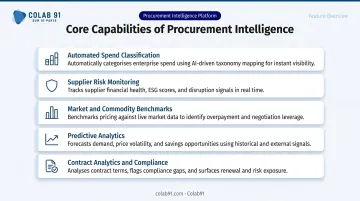
Core capabilities that define the category:
- Automated spend classification across ERP systems and business units
- Continuous supplier risk and financial health monitoring
- Market and commodity pricing benchmarks by category
- Predictive analytics for savings identification and demand forecasting
- Contract analytics and compliance tracking
Gartner predicts that 50% of organizations will support supplier contract negotiations with AI-enabled risk analysis tools by 2027 - meaning the shift from passive reporting to active intelligence is already underway. The five platforms below represent the leading options across this spectrum.
Top Procurement Intelligence Platforms
Each platform below is evaluated on AI maturity, intelligence breadth, integration flexibility, and fit across different organizational sizes and procurement maturity levels - so you can match the right tool to where your organization actually is, not just where it wants to be.
GEP SMART
GEP SMART is an AI-powered, cloud-native source-to-pay platform covering the full procurement lifecycle - from sourcing and spend analysis through contract management and supplier intelligence - within a single unified interface. It's particularly relevant for organizations looking to consolidate fragmented procurement tools rather than add another point solution.
GEP's patented AI-driven spend classification engine underpins measurable results across deployments: a global engineering firm achieved up to 98% spend visibility, while a Fortune 500 oil and gas company reported a 15% jump in procurement ROI. IDC MarketScape named GEP a Leader in Worldwide SaaS and Cloud-Enabled Procurement Applications for the third consecutive year in 2023.
| Criteria | Details |
|---|---|
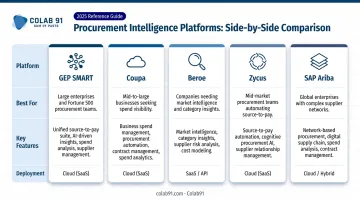
| Best For | Organizations seeking a comprehensive, AI-driven source-to-pay platform with strong spend analytics |
| Key Features | Patented AI spend classification, real-time supplier intelligence, automated sourcing, contract and supplier management |
| Deployment Model | Cloud-based SaaS; integrates with major ERP systems |
Coupa
Coupa is an AI-Native Total Spend Management platform that unifies procurement, sourcing, invoicing, supplier risk, and payments into a single system. Mid-to-large enterprises rely on it for broad spend visibility and compliance coverage across both direct and indirect categories.
The scale is notable: Coupa claims $10T in spend intelligence, a 10M+ buyer/supplier community, and 3,200 customers - including 55% of the Fortune 500. A Forrester Consulting Total Economic Impact study on Coupa Source-to-Pay reported a 276% ROI with a 10-month payback period, alongside a 100% increase in sourcing and spend reporting efficiencies. Coupa was also named a Leader in the 2026 Gartner Magic Quadrant for Source-to-Pay Suites, highest in Ability to Execute.
| Criteria | Details |
|---|---|
| Best For | Enterprises and PE-backed companies needing unified spend management with strong compliance and payment controls |
| Key Features | AI-powered sourcing and contract management, supplier risk monitoring, invoicing automation, spend analytics dashboards |
| Deployment Model | Cloud-based; integrates with SAP, Oracle, and other enterprise ERPs |
Beroe
Beroe takes a different approach: rather than competing as a full S2P suite, it specializes in market and category intelligence. Coverage spans 2,500+ sourcing categories with a combination of analyst-validated data and AI, making it particularly valuable for organizations that need granular, category-specific insights to support strategic sourcing decisions.
Its "Abi" AI assistant integrates directly with Microsoft Teams and Slack to push proactive category alerts - inflation signals, supply disruptions, pricing shifts - to category managers without requiring them to log into a separate platform. For organizations already running GEP, Coupa, or SAP Ariba as their S2P backbone, Beroe functions as a complementary intelligence layer rather than a replacement.
| Criteria | Details |
|---|---|
| Best For | Category managers and sourcing teams needing specialized market and pricing intelligence by category |
| Key Features | 2,500+ category intelligence modules, supplier risk monitoring, cost and pricing benchmarking, AI-powered alerts via Abi |
| Deployment Model | Subscription-based SaaS; integrates alongside existing S2P platforms |
Zycus
Zycus is an AI-driven source-to-pay platform focused on automating and accelerating procurement decision-making - from intake management through strategic sourcing. Its Merlin AI module handles contract data extraction at 90%+ accuracy and reduces contract cycle times by up to 50%, according to official Zycus documentation. The platform also claims the ability to automate up to 80% of routine procurement tasks.
Strong ERP compatibility (Zycus states 95% ERP compatibility) makes it practical for organizations managing multiple ERP environments - common in PE-backed portfolios where recent acquisitions bring varied technology stacks. Zycus was named a Leader in IDC MarketScape: AI-Enabled Source-to-Pay 2025.
| Criteria | Details |
|---|---|
| Best For | Mid-market organizations looking to automate routine procurement tasks and accelerate strategic sourcing with AI |
| Key Features | Generative AI and predictive analytics, intake management automation, sourcing optimization, broad ERP integration |
| Deployment Model | Cloud-based SaaS; integrates with SAP, Oracle, Workday, and 95% of ERP systems |
SAP Ariba
SAP Ariba is one of the most widely deployed enterprise procurement platforms globally, offering cloud-based sourcing, contract management, supplier collaboration, and procure-to-pay automation. What sets Ariba apart is raw network scale: SAP Business Network connects more than 8.5 million companies, and SAP reported $5.3 trillion in annual commerce and 746 million B2B transactions processed through the network in 2024.
For organizations already running SAP ERP, Ariba's native integration reduces implementation friction significantly. It's best suited for large enterprises or SAP-centric organizations where the depth of the P2P workflow - multi-currency, multi-regulatory, global supplier collaboration - outweighs the need for category-specific market intelligence.
| Criteria | Details |
|---|---|
| Best For | Large enterprises and SAP-centric organizations needing end-to-end P2P and supplier collaboration at scale |
| Key Features | Sourcing, RFPs, contracts, PO management, invoicing automation, supplier self-reporting, compliance tracking |
| Deployment Model | Cloud-based; native SAP integration; enterprise implementation timeline |
Key Features to Look for in a Procurement Intelligence Platform
Spend Analytics and Classification
The foundation of any procurement intelligence platform is its ability to automatically classify, clean, and analyze spend across ERP systems and business units - without requiring months of manual data preparation. Look for AI-powered classification that surfaces maverick spend, duplicate suppliers, and consolidation opportunities in near-real time.
The quality gap between platforms here is significant. A system that requires heavy manual taxonomy mapping before it surfaces insights adds time and analyst burden rather than removing it.
Supplier Intelligence and Risk Monitoring
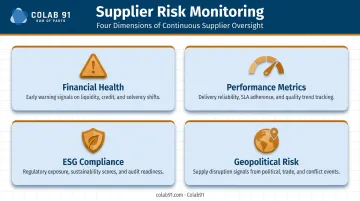
A strong platform provides continuous monitoring across four dimensions - not just static supplier records:
- Financial health - early warning signals on supplier stability
- Performance metrics - delivery, quality, and SLA adherence
- ESG compliance - regulatory and reputational exposure
- Geopolitical risk - supply disruption signals by region
This matters most for PE-backed companies managing supplier concentration risk across a portfolio, where a single supplier failure can cascade across multiple operating companies.
Market and Pricing Intelligence
Connecting internal spend data to external market signals - commodity pricing, inflation trends, supply-demand shifts - gives procurement teams the context to act strategically, not just react. McKinsey's 2024 guidance for CPOs specifically called out understanding macroeconomic exposures as a priority action. Look for platforms that benchmark actual spend against market rates by category and geography, enabling better-informed negotiations rather than instinct-driven ones.
Integration Depth and Time-to-Value
Procurement intelligence platforms should integrate with existing ERPs - SAP, Oracle, Workday - without requiring replacement of current infrastructure. Platforms that surface insights within 90 days of deployment have a structural advantage over those requiring multi-quarter implementations before any value is visible.
How We Chose the Best Procurement Intelligence Platforms
Platforms in this guide were selected based on AI maturity, breadth of procurement intelligence capabilities (spend, supplier, market, and risk), ERP integration flexibility, and suitability across mid-market and enterprise procurement functions.
A common mistake buyers make is selecting a platform based on brand recognition or feature checklists alone, rather than mapping capabilities to their actual procurement maturity and data readiness. A platform with sophisticated AI capabilities delivers limited value to an organization that hasn't yet cleaned its ERP data or established a consistent spend taxonomy.
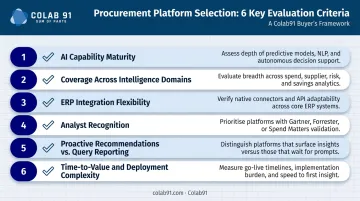
Evaluation criteria applied:
- AI capability maturity (classification, prediction, automation)
- Coverage across spend, supplier, market, and risk intelligence
- Integration flexibility with existing ERP and S2P infrastructure
- Analyst recognition from IDC, Gartner, and Forrester
- Proactive recommendations vs. query-dependent reporting
- Time-to-value and deployment complexity
Gartner's 2023 survey of 111 procurement leaders found only 14% were confident their current talent could meet future functional needs, with 96% reporting gaps in technology and data skills. That gap matters for platform selection.
Selecting a platform addresses the tooling side of the problem. Operationalizing the intelligence it generates still requires analysts who can interpret outputs, build category strategies, and act on recommendations.
For mid-market and PE-backed organizations that lack sufficient in-house depth, building a dedicated offshore procurement analytics capability can materially improve the ROI from any platform investment.
Colab91 works with companies in exactly this position, building India-based procurement and analytics teams with hands-on expertise in strategic sourcing, spend analytics, and supplier risk management. The leadership team previously scaled a 100+ practitioner procurement analytics operation serving PE clients including Carlyle Group, TPG, and Elliott.
Conclusion
No single platform wins across every dimension. The right procurement intelligence platform depends on organizational size, procurement maturity, ERP infrastructure, and the specific intelligence gaps - whether that's spend visibility, supplier risk, category benchmarking, or P2P automation.
Most effective procurement organizations end up combining an internal spend intelligence layer with specialized external market tools. GEP SMART and Coupa are strong anchors for end-to-end S2P; Beroe adds category depth alongside them; Zycus fits mid-market organizations prioritizing AI-driven automation; SAP Ariba is the natural choice for large, SAP-native enterprises.
What none of these platforms can substitute for is analytical capability. They surface intelligence: spend leakage identification, supplier risk flags, cost benchmarks. Translating those signals into negotiation strategies, category plans, and realized savings requires experienced procurement analysts.
For organizations that lack the internal capacity to act on platform outputs, Colab91 offers a direct solution. Its dedicated India-based teams - built and operated by ex-Impendi leadership with experience scaling offshore centers for PE sponsors like Carlyle Group and TPG - work alongside these platforms to convert procurement intelligence into negotiated savings and category outcomes. The model is designed specifically for mid-market and PE-backed businesses.
Frequently Asked Questions
What is a procurement intelligence platform?
A procurement intelligence platform is a technology solution that combines internal spend, supplier, and contract data with external market signals to surface strategic recommendations. Unlike traditional reporting tools, it actively guides sourcing decisions and risk management rather than simply displaying historical data.
What is the best AI platform for procurement?
The best platform depends on your organization's needs. GEP SMART and Coupa are strong for end-to-end spend management, Zycus specializes in automation-heavy procurement workflows, and Beroe focuses on category intelligence. Match AI capabilities to your procurement maturity and data infrastructure before selecting.
What is the difference between S2P and P2P?
Source-to-Pay (S2P) covers the full procurement lifecycle - from supplier selection and sourcing through contracting, purchasing, and payment. Procure-to-Pay (P2P) focuses on the transactional stage: purchase requisition through invoice processing and payment.
What are the four types of procurement?
The four types are direct procurement (raw materials and components), indirect procurement (operational goods and services), services procurement (outsourced or professional labor), and capital procurement (long-term assets like equipment or infrastructure). Most procurement intelligence platforms cover all four, with depth varying by category.
How is procurement intelligence different from spend analytics?
Spend analytics reports on historical patterns - what was spent, with whom, on what. Procurement intelligence builds on that foundation to add predictive signals, supplier risk monitoring, market benchmarking, and forward-looking sourcing recommendations that support decisions before they're made.