This guide is written for procurement leaders, CPOs, and mid-market or PE-backed company executives who need to understand how operating model design actually drives procurement performance - not just in theory, but in practice.
Here's what we cover: what a procurement operating model is, the three structural types and their real trade-offs, the four dimensions that determine whether any model works, and how to choose or evolve the right model for where your organization is today.
Key Takeaways
- A procurement operating model defines how people, processes, and technology work together to deliver procurement value.
- The three core models - decentralized, centralized, and center-led - each carry distinct advantages depending on company maturity and context.
- Savings potential is broadly comparable across models - redesigning your model is itself a lever for unlocking value.
- Evaluate every model across four dimensions: organization, processes, technology, and performance management.
- The right model evolves with the business - mid-market and PE-backed companies need the talent infrastructure to keep pace.
What Is a Procurement Operating Model?
A procurement operating model is the integrated framework that determines how an organization structures its people, governs its processes, deploys technology, and measures outcomes to deliver procurement value.
The distinction matters. A procurement strategy defines what you're trying to achieve - cost reduction, supply chain resilience, supplier innovation. The operating model defines how that strategy gets executed across the organization.
It is not an org chart, and it is not a technology platform. It is the mechanism that connects decisions about people, process, and systems to actual business outcomes.
Without a deliberately designed operating model, procurement functions drift. Teams operate inconsistently across business units, policy compliance varies, spend data sits in silos, and the function struggles to demonstrate value to the C-suite.
The model answers questions like:
- Who has authority to make purchasing decisions, and at what threshold?
- How are sourcing processes standardized across business units?
- Which systems support end-to-end procurement visibility?
- How is procurement performance defined and reported?
Organizations that answer these questions clearly turn procurement into a measurable value driver. Those that don't find the function stuck in reactive mode - managing requests rather than shaping strategy.
The Three Core Procurement Operating Models
Procurement operating models historically fall into three structural types. Each suits a different stage of organizational maturity and strategic priority. The data below draws from the KPMG / Procurement Leaders survey of over 400 global CPOs, which remains the most comprehensive cross-model savings comparison in the public domain.
Decentralized Procurement
In a decentralized model, procurement decisions are distributed across individual business units or departments. Each manages its own buying independently, often with its own supplier relationships and approval processes.
This is common in early-stage or fast-growing organizations that prioritize operational autonomy - and for good reason. Local teams move faster, respond to regional supplier dynamics, and don't wait for central approval.
The trade-offs:
| Advantage | Disadvantage |
|---|---|
| Local flexibility and responsiveness | No enterprise spend visibility |
| Faster operational decision-making | Inconsistent standards and governance |
| Suits high-autonomy business unit structures | Off-contract "maverick" spend accumulates |
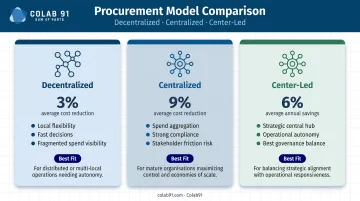
The KPMG data shows decentralized models deliver around 3% average cost reduction on direct spend - lower than the other models - partly because aggregated leverage and consistent sourcing disciplines are difficult to achieve when procurement is fragmented.
Centralized Procurement
Centralized procurement consolidates all purchasing decisions and activities under a single team or center of excellence. One group controls policy, supplier selection, contract negotiations, and spend approval.
The results are measurable: tighter compliance, aggregated spend leverage, and stronger supplier negotiation positions. KPMG's 2016 data shows centralized models achieve 9% average cost reduction on direct spend - the highest of any structural type.
The structural cost is also significant. Centralization creates distance between procurement and the business units it serves. Stakeholders experience delays, local needs get deprioritized, and over time, business units work around central procurement rather than through it.
25% of organizations in the KPMG survey reported that implementing a new centralized structure resulted in reduced savings - a direct consequence of stakeholder friction and model misfit.
Center-Led Procurement
The center-led model is a hybrid. Strategic functions - category management, supplier strategy, policy, and spend analytics - sit centrally. Operational execution is delegated to business units, which retain autonomy within defined guardrails.
This shifts procurement's role from control to influence. The KPMG survey found that 43% of mature procurement organizations target a center-led structure as their end state - more than centralized (30%) or hybrid (23%) approaches combined.
The performance data supports that preference:
- Delivers approximately 6% average annual savings - comparable to decentralized models, with better governance
- KPMG's analysis notes center-led models "correlate most closely with procurement benefits realized" - not just cost, but supplier relationship quality
- Maintains strategic coherence that fully decentralized structures can't sustain at scale
The catch: center-led procurement doesn't work without clear role definitions, active change management, and the specialized talent to sustain strategic functions centrally. That last point is where many mid-market companies stall.
The Four Dimensions That Make Any Procurement Model Work
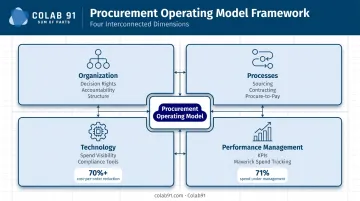
Choosing the right structural type is necessary but not sufficient. According to the Strategy& framework, any procurement operating model (whether centralized, decentralized, or center-led) must be designed and aligned across four dimensions. A model is only as strong as its weakest one.
Dimension 1: Organization
This covers how procurement is structured, where decision-making authority sits, and how accountability is defined across levels and functions.
Unclear decision rights are one of the most common sources of procurement dysfunction. When business units aren't sure whether they need central approval for a vendor contract, they either escalate everything (creating bottlenecks) or bypass procurement entirely (creating compliance gaps). The org structure is only as effective as the decision rights it enforces.
Dimension 2: Processes
End-to-end process design spans sourcing, contract negotiation, demand management, procure-to-pay, and supplier relationship management. Each stage must be standardized, documented, and genuinely connected to business workflows.
A process outlined in a policy document is not the same as one that is actually followed. Process gaps are where maverick spend originates and where cycle time accumulates. Strategy& notes that many procurement systems are built primarily for financial reporting rather than managing procurement transactions or performance, which means the process layer is often invisible to the tools meant to support it.
Dimension 3: Technology
Technology enables visibility, compliance, and efficiency, but only when it's integrated with the operating model's governance logic. Fragmented or underutilized tools create blind spots in spend data and slow execution instead of accelerating it.
The Hackett Group benchmarks show that technology adoption can reduce cost per order by more than 70% in well-implemented environments. That outcome requires technology to be selected and deployed in alignment with process and organizational design, not retrofitted once the model is already in place.
Dimension 4: Performance Management
Without clear metrics, reporting cadences, and KPI ownership, even a well-structured procurement function cannot demonstrate value or course-correct when performance slips.
Metrics should go beyond cost savings to include:
- Supplier performance and on-time delivery
- Contract compliance and maverick spend rates
- Procurement cycle times
- Spend under management as a percentage of total enterprise spend
The CPO Rising 2025 research found procurement teams now manage an average of 71% of total enterprise spend - the first time this threshold has been crossed in two decades of research. The remaining 29% is the gap that weak performance management leaves open.
Most organizations perform well on one or two dimensions and underinvest in the rest. Closing those gaps, without necessarily restructuring the team, typically delivers more measurable impact than any model redesign on paper.
How to Choose and Evolve Your Procurement Operating Model
Starting with an Honest Assessment
Choosing a procurement operating model starts with four organizational factors:
- Business objectives and growth stage - a fast-growing acquisition-driven company needs different governance than a stable single-entity business
- Regulatory and compliance requirements - heavily regulated industries typically require more formalized central oversight
- Technology readiness - center-led and centralized models depend on integrated systems that many mid-market companies haven't yet implemented
- Current talent capabilities - the model you design must be one your team can actually run
The Typical Evolution Path
Most organizations follow a predictable trajectory:
- Decentralized by default - procurement decisions live with whoever is buying; no formal model exists
- Centralized for control - as scale increases, finance or leadership centralizes procurement to gain spend visibility and compliance
- Center-led for balance - as stakeholder friction grows and the business becomes more complex, strategic functions move to a center of excellence while execution stays local
The transition to each stage is typically triggered by something specific: an audit finding, new PE ownership, M&A integration, or a CPO hire with a mandate to build capability. The KPMG survey found that 83% of organizations had changed their procurement operating model within the previous five years - frequent model change is expected, not unusual.
Building the Talent Infrastructure
This is where many mid-market and PE-backed companies get stuck. Center-led procurement requires specialized expertise - category management, spend analytics, supplier strategy - that most mid-market organizations don't have in-house at scale.
Building those capabilities onshore from scratch is slow and expensive. Offshore capability centers offer a practical path forward, delivering strategic procurement functions at lower cost and faster ramp times.
Colab91 structures these capability centers for PE-backed and mid-market clients, building dedicated India-based teams with domain expertise in sourcing, spend analytics, and procurement operations. The model pairs onshore strategic leadership with offshore execution depth, closing the talent gap without proportional onshore headcount growth.
Colab91's leadership team previously scaled a similar model at Impendi (acquired by Accenture), growing the India operation to 100+ practitioners serving PE sponsors including Carlyle Group, TPG, Elliott, and BC Partners.
Phase the Implementation
Attempting a full operating model transformation across all four dimensions simultaneously is a reliable way to fail. Prioritize the dimension with the most pressing gap:
- If spend visibility is the core problem - start with technology and performance management
- If compliance is the issue - start with process standardization and governance
- If the team lacks capability - start with talent and organization before redesigning anything else
A real-world example: a major paint and coatings company, after rapid acquisition-driven growth, centralized its global indirect procurement function and redesigned all four dimensions in sequence. The measured outcomes included 96% of invoices backed by purchase orders, a 50% decrease in average requisition approval cycle times, 14,000 strategic suppliers enabled on a digital portal, and coverage across 22,000 users in 20 countries.
Common Misconceptions and Pitfalls
Misconception: Centralized Is Always More Mature Than Decentralized
It isn't. A highly autonomous multi-business-unit company may deliberately maintain regional procurement accountability for valid strategic reasons - regulatory variation, local supplier ecosystems, or acquisition integration complexity. The right model depends on organizational context, not on structural sophistication.
Pitfall: Restructuring the Org Chart and Calling It a New Operating Model
This is the most common transformation error. Organizations redraw reporting lines, announce a new structure, and expect different results. But if the processes, governance logic, and performance management haven't changed, the dysfunction just moves to a new org chart. The work is in the other three dimensions.
Pitfall: Changing the Model When the Model Isn't the Problem
If the gap is in technology adoption, process discipline, or talent capability rather than structural design, a model restructure creates disruption without addressing the root cause. Identify the actual failing dimension first. A procurement function with clear processes, strong data, and capable talent will consistently outperform a structurally elegant model that lacks all three.
Frequently Asked Questions
What is a procurement operating model?
It's the integrated framework that aligns people, processes, and technology to deliver procurement value in support of business goals. It's distinct from a sourcing strategy (which defines what to achieve) and broader than an org chart (which captures only structure).
What are the three models of procurement?
The three core models are: decentralized (distributed decision-making across business units), centralized (consolidated control under one team), and center-led (strategic centralization with operational autonomy delegated to business units). Decentralized works for early-stage or highly autonomous businesses; centralized and center-led suit organizations with greater scale and governance demands.
What is the difference between centralized and center-led procurement?
Centralized procurement controls all purchasing decisions from one team. Center-led centralizes only strategic activities - category management, policy, supplier strategy - while delegating day-to-day execution to business units. The result is similar governance with significantly less stakeholder friction.
How do you choose the right procurement operating model?
Assess your business maturity, regulatory requirements, technology readiness, and current talent capabilities. The right fit depends on where your organization actually is today - a center-led model may be the goal, but it requires governance infrastructure and talent maturity that many mid-market companies are still building.
What are the typical stages of the procurement process?
Most procurement processes follow a consistent sequence:
- Need identification and sourcing strategy
- Supplier selection and negotiation
- Contracting and purchase order management
- Supplier performance review
The operating model determines who owns each stage, how decisions are governed, and what standards apply organization-wide.