External spend typically accounts for 50–80% of a company's cost base, yet McKinsey found that less than 20% of available procurement data is actively used by most organizations. The gap between what's being spent and what's being managed is where value quietly disappears.
A procurement opportunity assessment (POA) closes that gap. This guide explains exactly what a POA involves, how it works stage by stage, what it delivers, and how organizations turn findings into measurable financial improvement.
Key Takeaways
- A POA is a structured diagnostic — not a cost-cutting exercise — that maps spend, sourcing practices, and procurement gaps systematically
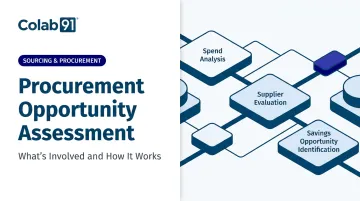
- It moves through four stages: data collection, spend analysis and category profiling, opportunity identification, and prioritized savings ranking
- Outputs include spend visibility, category insights, quantified savings potential, governance gaps, and a phased roadmap
- A rigorous assessment typically identifies 5–15% of addressable spend in savings potential
- Companies without dedicated procurement functions, mid-market firms in M&A transitions, and PE-backed businesses entering value creation phases benefit most
What Is a Procurement Opportunity Assessment?
A procurement opportunity assessment is a structured evaluation of an organization's current spending, sourcing practices, supplier base, and procurement processes — designed to surface gaps, inefficiencies, and actionable opportunities across cost reduction, risk mitigation, and value creation.
Procurement complexity accumulates silently. Contracts auto-renew without market review. Departments manage their own supplier relationships. Identical items get purchased at different prices across business units.
Without a structured diagnostic, these inefficiencies compound year over year — not because they're hidden, but because no one has looked for them systematically.
What a POA Is Not
Three terms get conflated regularly:
- A POA evaluates sourcing strategy, supplier governance, and process efficiency — not just price
- Spend analysis is one input into a POA; the full assessment goes much further
- Unlike a compliance audit, a POA is opportunity-forward, not violation-focused
One-time vs. ongoing: A one-time POA establishes a baseline — common at the start of a PE investment or transformation program. Continuous opportunity monitoring embeds that diagnostic logic into ongoing operations. For most mid-market companies, the one-time assessment is the right starting point.
How a Procurement Opportunity Assessment Works
A POA follows a defined sequence of stages. Each builds directly on the outputs of the previous one, moving from raw transaction data to structured insight to a prioritized action plan.
Stage 1: Spend Data Collection and Baseline Setting
This is where everything starts. Procurement teams or external advisors gather 12–24 months of transaction-level spend data from AP systems, purchase orders, corporate card records, and vendor master files.
Good data collection isn't just extraction — it requires:
- Normalizing supplier names (the same vendor may appear under dozens of variations)
- Mapping spend to categories consistently across business units
- Resolving conflicts between data sources and geographies
- Flagging gaps where spend is untracked or misclassified
Data quality is a genuine challenge here. McKinsey has noted that only 20–40% of information required for tendering is typically stored in central ERP systems. For companies without a dedicated procurement function, the data collection stage alone often reveals complexity that leadership didn't know existed.
Colab91's India-based analyst teams specialize in this data-intensive groundwork — spend cleansing, taxonomy classification (UNSPSC or client-specific), and enrichment — typically completing in weeks what internal teams take months to work through.
Stage 2: Spend Analysis and Category Profiling
Once data is structured, the team segments spend into categories — direct materials, indirect, IT, facilities, professional services, contingent labor — and identifies where the highest-opportunity areas sit.
The analytical work covers:
- Concentration analysis — which suppliers and categories represent the majority of addressable spend
- Off-contract spend detection — purchasing outside negotiated contracts
- Tail spend identification — fragmented low-value transactions that are costly to manage
- Addressable spend modeling — determining which portions of spend are genuinely negotiable
Stakeholder interviews run in parallel. Conversations with department heads, finance, and operations teams surface context that data alone can't provide: maverick purchasing habits, unspoken supplier dependencies, approval workarounds, and category-specific constraints that shape what's actually actionable.
KPMG's research found that only 41% of procurement professionals rate their organization's category management as highly mature — which means the category profiling stage frequently surfaces significant structural gaps, even in organizations that believe they're reasonably well-managed.
Stage 3: Opportunity Identification Across Three Dimensions
Opportunity identification is organized around three core dimensions:
| Dimension | Focus | Example Finding |
|---|---|---|
| Cost Reduction | Pricing, volume leverage, consolidation | Price variance on identical items purchased by different departments |
| Supply Base Management | Supplier rationalization, relationship structure, risk diversification | Duplicate suppliers for the same category across business units |
| Total Cost Management | Process efficiency, demand management, specification optimization | Specification complexity requiring premium-grade materials where standard grade would perform equally |
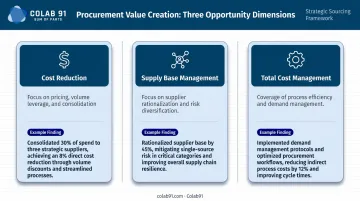
Every opportunity identified is assessed against implementation risk. Switching suppliers may reduce unit cost but introduce delivery or quality risk. Demand reduction initiatives can free up meaningful budget, though they often require significant stakeholder buy-in to execute. The goal is to identify opportunities that are both financially material and realistically implementable — not simply the largest savings on paper.
Stage 4: Quantification and Prioritization
Savings are modeled based on addressable spend, benchmarked market rates, and achievable improvement scenarios. Colab91's assessments typically identify 5–15% of addressable spend as recoverable savings. That range aligns with McKinsey's finding that companies in procurement transformation programs targeted 15–30% savings across two years — the difference being that a POA focuses on what's realistically capturable in the near term, not the full transformation ceiling.
Opportunities are then prioritized using a three-axis framework:
- Savings potential — how much value is available
- Implementation effort — complexity, stakeholder requirements, switching risk
- Timeline — what can realistically be captured and when
That scoring produces a tiered roadmap where each initiative is sequenced by when it can be resourced and executed:
- Quick wins (30–90 days): Contract enforcement, off-contract spend redirection, immediate consolidation opportunities
- Medium-term initiatives (3–6 months): Competitive sourcing events, supplier rationalization, payment terms renegotiation
- Longer-term transformations (6–12+ months): Category strategy overhaul, supplier development programs, demand management initiatives
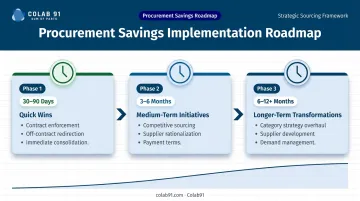
McKinsey's data suggests up to 50% of procurement savings can be delivered within six months, with full transformation impact typically requiring 12–18 months. Structuring a POA roadmap around those milestones keeps early momentum visible while longer-term initiatives build in parallel.
What a Procurement Opportunity Assessment Delivers
A well-executed POA produces five distinct outputs:
1. Consolidated Spend Visibility A single, accurate view of who the organization buys from, how much, and across which categories and business units. For most organizations conducting their first POA, this alone changes how leadership thinks about supplier relationships and budget allocation.
2. Category-Level Insights Surfaces the top cost-driver categories, under-managed spend areas, and categories where sourcing strategy is absent or misaligned with actual spend volume. Categories that appear low-risk often carry the largest undetected opportunity.
3. Quantified Savings Potential A data-backed estimate of achievable cost reductions, broken down by category and initiative, with confidence levels tied to data quality and market conditions. These figures give leadership a credible financial case for moving from diagnosis to execution.
4. Governance and Risk Review An assessment of where current procurement practices create exposure:
- Maverick spend outside approved channels (APQC benchmarks bottom-performing organizations at 2.5%+ of total purchases in maverick spend)
- Contracts renewing without competitive market review
- Single-source dependencies limiting negotiating leverage
- Missing approval controls across business units
WorldCC data shows poor contract management costs companies an average of 9% of their bottom line — governance gaps are not a minor issue.
5. A Phased Improvement Roadmap A prioritized action plan that sequences initiatives by value, feasibility, and organizational capacity. Each initiative is ranked so teams can act on the highest-return items first, without waiting for a full transformation to be in motion.
Common Signs Your Organization Needs a Procurement Opportunity Assessment
The organizations that benefit most from a POA tend to share recognizable characteristics:
- Purchasing decisions are distributed across departments, with no central function owning supplier relationships or spend oversight
- Supplier bases that expanded through rapid growth or M&A, outpacing the governance structures meant to manage them
- PE-backed businesses entering a value creation phase — McKinsey notes that procurement typically contributes one-third or more of total merger value, making it one of the first levers sponsors examine
- Spend decisions driven by immediate need rather than category strategy, with no forward-looking sourcing plan
Operational warning signs to watch for:
- Duplicate suppliers appearing across departments for the same category
- Contracts renewing automatically without any market comparison
- Significant price differences on identical purchases across business units
- No baseline metrics against which to measure improvement
- Limited visibility into spend outside the primary ERP system
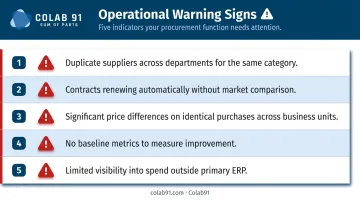
Organizations conducting their first POA routinely find meaningful savings in categories they considered well-managed — IT, professional services, and facilities are the most common surprises.
Turning Assessment Findings Into Action
The assessment is the beginning. Findings without execution produce no financial return.
Translating a POA into results requires three things:
1. Clear ownership and timelines. Every initiative in the roadmap needs an accountable owner, a defined savings target, and a deadline. Deloitte's 2025 CPO research found that procurement "Leaders" meet or exceed cost savings plans at a 96% rate versus 80% for "Followers" — the difference is execution discipline, not analytical sophistication.
2. Cross-functional alignment. Finance, operations, legal, and business unit leaders all need to be engaged before the roadmap is finalized. A savings initiative that procurement endorses but operations can't execute doesn't capture value; it creates conflict.
3. Execution capacity. Organizations without in-house procurement resources can still act on assessment findings through flexible engagement models. Colab91 provides:
- Fractional CPO support for strategic oversight without permanent headcount
- Strategic sourcing execution through dedicated offshore teams
- Continuous procurement analytics programs to convert roadmap initiatives into realized savings
- Cross-portfolio category leverage for PE portfolio companies — renegotiating IT, SaaS, professional services, and marketing contracts at the portfolio level rather than entity by entity
Frequently Asked Questions
What is a procurement assessment?
A procurement assessment is a structured review of an organization's spending, supplier base, and sourcing processes to identify inefficiencies, risks, and opportunities for cost savings. A procurement opportunity assessment specifically focuses on surfacing actionable improvement opportunities — not just documenting the current state.
What are the stages of opportunity analysis in procurement?
Most frameworks move through: data collection, spend categorization and profiling, opportunity identification (across cost, supply base, and process dimensions), quantification and prioritization, and roadmap development. Each stage builds directly on the outputs of the previous one.
How long does a procurement opportunity assessment take?
Most assessments take 4–6 weeks, per Efficio's published benchmark for opportunity assessments. Smaller or more data-ready organizations complete the process faster; larger multi-entity businesses (such as PE portfolio companies) require more time for data consolidation and stakeholder interviews.
What data is needed to conduct a procurement opportunity assessment?
Teams typically need 12–24 months of AP transaction data, purchase order records, corporate card spend, vendor master files, and available contract inventories. Data quality and completeness directly influence the confidence level of the resulting opportunity estimates.
What is the difference between a spend analysis and a procurement opportunity assessment?
Spend analysis categorizes and visualizes where money is going — it is a key input into a POA. The full assessment goes further by evaluating sourcing strategy, supplier governance, and process efficiency, then quantifying the specific value available through targeted improvements.
Who should be involved in a procurement opportunity assessment?
Beyond the procurement team, effective assessments draw in finance, operations and business unit leaders, and legal or compliance. Each group brings context that directly shapes the accuracy and practical value of the findings.