Introduction
Most procurement transformation initiatives don't fail because of bad technology. They fail because the people, processes, and organizational dynamics needed to support change weren't addressed before — or during — deployment.
McKinsey research puts the failure rate of large-scale enterprise transformations at 70%, and separately found that fewer than one-third of transformations successfully improve and sustain performance over time. For PE-backed and mid-market companies operating under compressed value-creation timelines, a stalled procurement transformation is measured in missed savings targets — not recovery time.
Procurement transformation change management is the structured approach to preparing people, redesigning processes, and deploying technology in a coordinated sequence — one where timing and order matter as much as the tools selected. This guide covers the practical steps, frameworks, and common pitfalls that CPOs, PE operating partners, and mid-market leaders need to navigate.
Key Takeaways
- Procurement change management is about people first, process second, and technology last.
- Executive sponsorship is the single strongest predictor of transformation success.
- Phased, milestone-driven rollouts reduce risk and build confidence faster than big-bang implementations.
- Resistance to change is predictable — map it by stakeholder group before it surfaces, not after.
- Sustaining transformation requires ongoing measurement, reinforcement, and embedded capability — not just a go-live event.
What Triggers the Need for Procurement Change Management
Common Business Triggers
Procurement transformation rarely starts from a blank slate. It typically begins when a business event makes the status quo untenable:
- Digital platform implementations — deploying e-procurement, P2P, or S2P systems without first addressing process and adoption readiness
- AI adoption — 73% of procurement leaders expected to adopt GenAI by end of 2024, creating organizational pressure to build supporting capabilities quickly
- M&A integration — acquired entities with different procurement processes, systems, and supplier bases that need to be harmonized
- Organizational restructuring — shifts from decentralized to center-led procurement models
- ESG and compliance requirements — evolving supplier transparency and risk reporting mandates that procurement operations aren't built to support
Operational Warning Signs
Sometimes the trigger isn't a single event. It's the accumulation of symptoms that signal change management is overdue:
- Maverick spend that keeps climbing despite policy updates
- Approval cycles measured in weeks, not days
- No reliable view into supplier performance or contract compliance
- Year-over-year savings that have plateaued
- Teams still running sourcing events through spreadsheets and email threads
When these symptoms stack up across multiple functions, the cost of delay compounds fast — and for PE-backed businesses, there's rarely room to absorb it.
The PE Urgency Factor
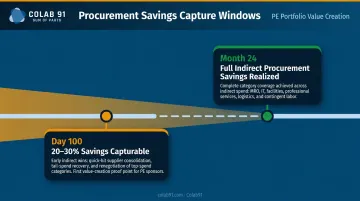
For PE-backed portfolio companies, the timeline pressure is acute. According to Alvarez & Marsal, all indirect procurement savings can be realized within 24 months post-close, with up to 20–30% capturable in the first 100 days. That compression makes change management a non-negotiable program element. There's no time to recover from a poorly planned rollout.
The People-Process-Technology Framework: The Right Order Matters
Most failed procurement transformations share a common sequencing error: they deploy technology first, then hope adoption follows. The correct order is the reverse.
People: Building the Right Capability First
Transformation cannot be driven by teams that are understaffed or skill-mismatched for the work ahead. Before any initiative launches, leadership needs an honest assessment of whether existing procurement talent has the strategic sourcing, spend analytics, and process design capability to execute the transformation — and close gaps before the start date, not during implementation.
Gartner found that only 14% of procurement leaders were confident their talent could meet the future needs of their function. That's a capability gap most organizations are actively carrying into their transformation programs.
Mid-market companies face a specific version of this problem: the same small team expected to lead the transformation is also responsible for keeping day-to-day procurement running. Running operations and redesigning them simultaneously is not a realistic ask of an already stretched function.
Augmenting in-house talent with dedicated domain specialists resolves this directly. Colab91 embeds procurement analysts, category managers, and spend analytics specialists into client teams as a dedicated offshore extension — closing capability gaps without the lead time of a full recruiting cycle or the fixed cost of permanent headcount.
Process: Redesign Before You Automate
Automating a broken process doesn't fix it — it just makes errors faster and harder to reverse. Process redesign must precede technology selection.
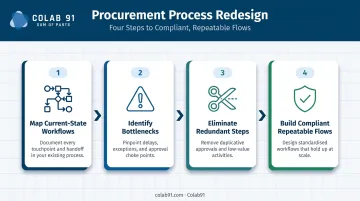
Effective process redesign involves:
- Mapping current-state workflows — document every step from requisition to payment, including informal workarounds
- Identifying bottlenecks — where do approvals stall? Where does rework occur?
- Eliminating redundant steps — question every handoff and approval layer
- Building compliant, repeatable flows — design the future state with auditability built in
Colab91's procurement transformation engagements include S2P process redesign as a core deliverable. The goal is a future-state design that is specific enough to implement, not a strategy document that stalls before execution.
Technology: Enable the Change, Not Drive It
Once processes are redesigned and people are ready, teams select and deploy technology to support that foundation, rather than expecting the platform to drive adoption on its own.
Practical implications:
- Platform selection should follow target operating model design, not precede it
- Phased rollouts reduce adoption risk compared to full-scale big-bang go-lives
- User acceptance testing needs real end-user involvement, not just IT sign-off
- Feedback loops during implementation catch adoption gaps before they become permanent habits
A Step-by-Step Procurement Change Management Roadmap
Step 1 — Define the "Why" and Set Realistic Goals
A transformation without a clear business case loses organizational buy-in at the first sign of friction. The case for change needs to connect to outcomes leadership cares about: cost reduction, cycle time improvement, compliance rates, supplier performance.
Goals should be specific, measurable, and calibrated to organizational change readiness. A company that has never run a formal sourcing event shouldn't set a year-one target designed for a mature procurement function.
For PE-backed portfolio companies, Colab91's Savings Opportunity Assessment and Procurement Diagnostic can quantify 5–15% of addressable spend as a savings opportunity within 4–6 weeks — giving the business case a concrete, defensible foundation before transformation planning begins.
Step 2 — Secure Executive Sponsorship Early
Prosci research shows that effective executive sponsorship raises the probability of achieving intended business benefits from 25% to 85%. The gap between those two numbers is where most transformations are won or lost.
Real sponsorship means more than a kickoff speech. It looks like:
- Active participation in steering committees (not just receiving status updates)
- Visible modeling of new procurement behaviors — using the new system, following the new process
- Accountability for outcomes tied to the sponsor's own performance metrics
Step 3 — Map and Engage Stakeholders Before Launch
Procurement transformation is often designed inside a procurement bubble and announced to the rest of the organization as a surprise. Resistance follows almost every time.
A stakeholder mapping exercise should answer three questions for every affected group:
- Who is impacted and how significantly?
- What are their specific concerns or objections?
- How should they be involved before launch — not just informed after?
Finance, IT, legal, business unit leaders, and key suppliers all need some form of engagement before go-live. The goal is straightforward: reduce the number of people who first encounter the change with no warning and no context.
Step 4 — Build a Phased Roadmap with Early Wins
A phased rollout reduces risk and builds the organizational confidence needed to sustain momentum through harder changes later. The first phase should be designed to produce a visible, measurable win within 30–90 days.
Examples of early wins worth engineering:
- A 30-day reduction in approval cycle time in a pilot category
- Spend categorization coverage improved from 60% to 85% in one business unit
- First competitive sourcing event run on the new platform with documented savings
Early wins aren't just motivational — they demonstrate to skeptical stakeholders that the transformation is real and delivering.
Step 5 — Invest in Training and Communication
A single all-hands announcement is not a communication plan. Ongoing, role-specific communication is what actually drives adoption.
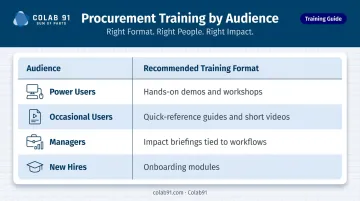
Effective training formats by scenario:
| Audience | Recommended Format |
|---|---|
| Power users and process owners | Hands-on system demos, workshops |
| Occasional users | Quick-reference guides, short videos |
| Managers | Impact briefings tied to their team's workflows |
| New hires | Onboarding modules that embed new behaviors from day one |
Every communication should answer "What does this mean for me?" as clearly as it answers "What are we changing?" Senior leaders are effective messengers for organization-level business context; direct managers carry more credibility when communicating personal process impact.
Overcoming the Biggest Challenges in Procurement Change Management
Resistance to Change
Resistance isn't a sign of failure — it's a predictable response to any meaningful change. The mistake is treating it as uniform. Different stakeholder groups resist for different reasons.
Prosci's research identifies mid-level managers as the most resistant group in enterprise transformations, followed by front-line employees. In procurement specifically, resistance tends to concentrate around:
- Legacy process owners who lose visibility or control under the new model
- Business unit leaders who see procurement policy as an encroachment on their autonomy
- Power users of old systems who have built their workflows around tools being replaced
The goal isn't converting every critic into an advocate. It's preventing active opposition from becoming organized enough to block progress. Tailored engagement plans for each resistance cluster — not a generic change communication blast — are what close that gap.
Lack of Leadership Alignment
Public endorsement from the CPO or CFO doesn't guarantee genuine alignment down the management chain. Middle managers who privately resist can slow adoption more effectively than any technical obstacle.
Tactics that create genuine alignment:
- Cascade transformation KPIs from executive sponsors to team leads — so managers have personal accountability for adoption metrics
- Create structured forums where managers can raise concerns before they become blockers
- Tie transformation participation to performance reviews, not just project dashboards
Supplier and Vendor Disruption
New sourcing strategies, contracting terms, and platform requirements ripple outward to suppliers. Suppliers weren't part of the internal planning process, which makes proactive outreach essential. Key steps to manage this:
- Assess supplier readiness before go-live, not after
- Communicate changes with enough lead time for suppliers to adapt
- Build planning buffer so go-live dates don't become hostage to supplier readiness
Compliance Gaps During Transition
Process transitions create windows where controls are at their weakest. Old processes have been abandoned; new ones aren't fully embedded yet. Temporary mitigation measures bridge that gap until new processes take hold:
- Spend monitoring dashboards to flag anomalies in real time
- Manual escalation triggers for high-risk transaction types
- Periodic audit checks until controls are consistently followed
How to Measure and Sustain Procurement Transformation
Metrics That Matter
Leading indicators (track adoption in real time):
- System utilization rates by user group
- Training completion rates
- Process compliance rates in pilot categories
Lagging indicators (track business impact over time):
- Purchase order compliance as a percentage of total orders
- Cycle time reductions against baseline
- Maverick spend trajectory quarter-over-quarter
- Year-over-year savings realization against target
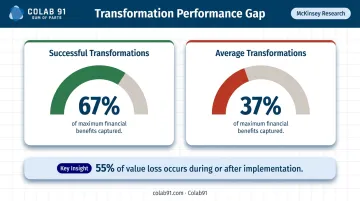
According to McKinsey, successful broad transformations capture 67% of maximum financial benefits versus 37% for others — and 55% of value loss occurs during or after implementation, not during planning. That timing puts the post-go-live measurement period at the center of any serious effort to sustain results.
Reinforcement Mechanisms
Transformation stalls when leadership attention moves on. Reinforcement has to be built into the operating model, not left to motivation:
- Recognize early adopters visibly — it signals to skeptics that the change is real
- Incorporate new processes into new-hire onboarding from day one
- Conduct periodic audits to surface regression before it becomes re-entrenched behavior
- Continue communicating results — savings captured, cycle times reduced, compliance improved
Sustaining Momentum at Scale
For organizations scaling transformation across categories or geographies, an embedded team with ongoing strategic sourcing and spend analytics capability is what sustains results beyond the initial rollout. Without that structural backbone, gains made during launch erode quickly as attention shifts to the next priority.
Colab91 works with mid-market and PE-backed companies to establish India-based procurement capability centers that provide this continuous operational support: dedicated category managers, ongoing spend intelligence, and supplier performance monitoring that keep transformation programs on track well after go-live.
Frequently Asked Questions
What is the difference between procurement transformation and procurement change management?
Procurement transformation is the strategic initiative — the "what" you're changing, whether that's a new operating model, new technology, or new sourcing strategy. Change management is the structured methodology for managing how people, processes, and technology adapt to those changes. One is the destination; the other is how you navigate people there.
How long does a typical procurement transformation take?
Tactical improvements — a pilot category, a single process redesign — can show measurable results in 90 days. Enterprise-wide transformations typically run 12–36 months depending on scope and organizational readiness. PE-backed companies often target accelerated 12–18 month value-creation cycles, which is achievable with phased roadmaps and pre-built offshore execution capacity.
What are the most common reasons procurement change management programs fail?
The most common failure modes include: weak executive sponsorship, communication that stops after the kickoff, insufficient role-specific training, unaddressed resistance that hardens into organized opposition, and deploying technology onto broken processes without redesigning them first.
How do mid-market companies manage procurement transformation with limited internal resources?
Focus on high-impact categories first rather than transforming everything at once. Phased rollouts preserve internal capacity, and bringing in external domain specialists — such as Colab91's offshore capability center teams — extends mid-market procurement functions without adding permanent headcount.
Which change management methodology — ADKAR, Kotter, or Prosci — works best for procurement?
No single methodology fits every situation. ADKAR works well for tool and process adoption at the individual level; Kotter suits broad cultural shifts; Prosci fits complex, multi-phase technology rollouts. Most mature programs blend elements from more than one.
How do you know when a procurement transformation has truly been sustained?
Transformation is sustained when new behaviors are embedded in culture and process — visible in consistent policy compliance, absence of regression after leadership attention shifts to other priorities, and new-hire onboarding that reflects the changed way of working as the default, not the exception.