According to Zylo's 2024 SaaS Management Index, the average company carries $18M in annual license waste, with only 49% of provisioned SaaS licenses actively used. For mid-market firms with 500–2,500 employees, that figure still reaches $9.5M per year — real EBITDA leakage that no one deliberately approved.
For PE-backed companies, this matters more than it might appear. Inherited tech stacks, redundant tools from prior ownership, and zero procurement ownership at the point of acquisition create cost structures that erode margins before any value-creation work even begins.
This guide doesn't recommend another software tool. Instead, it examines nine concrete strategies organized by where cost actually originates: the decisions you make before purchasing, how you manage what's already active, and the organizational conditions that allow sprawl to persist.
TL;DR
- SaaS costs accumulate through inaction, poor visibility, and decentralized purchasing — not sudden spikes
- The biggest cost drivers: redundant tools, underutilized licenses, unchecked auto-renewals, and shadow IT
- Sustainable optimization means rethinking what you buy, how you track it, and who owns the governance
- Treat SaaS governance as an ongoing program, not a one-time audit — savings compound when oversight is continuous
How SaaS Costs Silently Accumulate
SaaS spend rarely fails in a visible way. It compounds quietly.
A department head approves a trial that converts to a paid subscription. A new hire gets provisioned on six tools their predecessor used. Someone leaves, but their licenses stay active. A team adopts a workaround app because the approved tool is too slow for their specific workflow.
None of these decisions feel significant in isolation, and each is justifiable on its own terms.
The compounding problem looks like this in practice:
- New hires inherit access to legacy tools they never actually use
- Departing employees leave behind active, billable licenses
- Approved tools that feel inadequate get supplemented with shadow apps
- Departmental purchases bypass IT and finance, so no one has the full picture
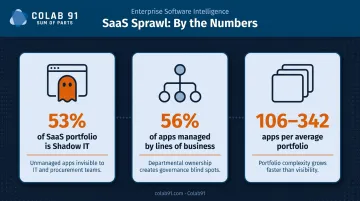
Productiv's research found that 53% of the average SaaS portfolio is shadow IT, with lines of business managing 56% of company app ownership. The average portfolio contains between 106 and 342 apps depending on how discovery is conducted — the variance itself reflects how much goes untracked.
These costs stay hidden until a budget constraint forces someone to look — at which point they typically represent spend that no one in leadership deliberately approved or even knew existed.
Key Cost Drivers Behind SaaS Overspending
Understanding where waste comes from matters more than the dollar amount. The drivers split into three categories:
| Category | Examples |
|---|---|
| Purchasing decisions | No cross-functional review before approval, no redundancy check |
| Management gaps | No renewal tracking, login data mistaken for adoption data |
| Organizational conditions | Decentralized buying, no dedicated ownership, shadow IT |
The relative weight of each category varies by company size. A 200-person mid-market firm tends to struggle most with decentralized purchasing and no formal policy.
A 2,000-person organization is more likely dealing with management gaps — contracts auto-renewing without review, orphaned licenses from employee turnover, and siloed data that prevents anyone from seeing the full stack.
Ownership context adds another dimension. PE-backed companies frequently face a distinct version of this problem: they inherit a tech stack from prior ownership that was never rationalized. The tools may have been appropriate for a different size or strategy, but no one has run a systematic review since the acquisition closed.
Addressing symptoms — canceling a few subscriptions after a budget review — without diagnosing root drivers produces short-term savings. Without structural fixes to purchasing controls and contract visibility, the same waste accumulates within 12–18 months, often at higher cost as the stack continues to grow unchecked.
9 Ways to Optimize Your SaaS Spend
The strategies below are grouped by where the cost leverage actually lives.
Strategies That Change Purchasing Decisions
Spend is most controllable before a purchase is made — and most consistently wasted when that moment passes without scrutiny.
Strategy 1: Conduct a Full SaaS Inventory Audit Before Any New Tool Is Approved
Most organizations approve new software requests without checking whether an existing tool already covers the use case. Zylo reports the average company has 15 duplicative online training apps, 11 project management tools, and 10 team collaboration apps. Those numbers represent purchases that cleared approval without a redundancy check.
A complete inventory audit pulls data from:
- Corporate credit card statements and expense reports
- SSO authentication logs
- Procurement and finance systems
- Browser extension discovery tools (for apps that bypass SSO entirely)
Zylo's research notes that only 21% of applications at the average organization sit behind SSO, which means identity data alone misses most of the portfolio. The audit baseline needs to combine all four sources before it's actionable.
This step alone typically surfaces redundant spend immediately — not because the tools are individually expensive, but because the aggregate of overlapping subscriptions adds up fast.
Strategy 2: Rightsize License Tiers Before Renewals, Not After
License tiers are almost always set at initial purchase based on projected usage. That projection rarely holds. Teams shrink, workflows change, and premium feature tiers go unused by the majority of provisioned users.
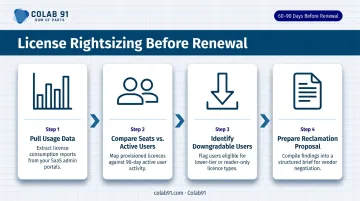
The window to act is 60–90 days before renewal:
- Pull actual usage data — logins, feature engagement, active user counts
- Compare contracted seat count against verified active users
- Identify premium-tier users who could be downgraded to standard
- Prepare a reclamation proposal before the vendor opens renewal discussions
This matters most for tools with tiered pricing structures, where the difference between a professional and enterprise tier can represent 40–60% of per-seat cost. Retroactive renegotiation after auto-renewal is not straightforward — proactive action before renewal is.
Strategy 3: Implement a Formal SaaS Purchasing Policy with Clear Approval Workflows
Decentralized purchasing — any employee with a corporate card can subscribe to a tool — is the root cause of shadow IT and duplicate spend. It's also the easiest driver to address with organizational policy rather than technology.
A basic SaaS purchasing policy should include:
- Approval thresholds specifying which categories require IT and finance sign-off (typically any subscription above a monthly floor, or tools that touch sensitive data)
- A standardized intake form with a built-in redundancy check before approval is considered
- Clear handling rules for unauthorized tools discovered after the fact
- An approved vendor catalog by category, reducing evaluation burden for common requests
Colab91's procurement transformation work for mid-market clients often starts here — establishing governance infrastructure before any sourcing or negotiation work begins, because without it, savings from other strategies get replaced by new unauthorized spend within months.
Strategies That Change How SaaS Is Managed
Once tools are in place, cost leakage comes from poor visibility, delayed action, and renewals treated as administrative tasks rather than procurement decisions.
Strategy 4: Centralize All SaaS Contracts and Renewal Dates in a Single Repository
Auto-renewals are one of the most preventable sources of wasted spend. BetterCloud's research found that 69% of software contracts carry an auto-renew clause with a 30–90 day cancellation notice window. Miss the window and you're locked in for another term, regardless of whether the tool is being used.
A centralized contract repository should track:
- Renewal dates and notice period deadlines
- Contract tier and seat count
- Named contract owner (internal)
- Current annual spend
- Last usage review date
Set alerts at 90–120 days before renewal, not 30. That window creates space for a real negotiation rather than a frantic cancellation attempt. Vendors know when the notice period closes — procurement teams often don't.
Strategy 5: Measure Tool Adoption by Workflow Usage, Not Login Frequency
Login data overstates adoption. A tool accessed once a week for a minor task looks identical in login metrics to one used daily for core work. This creates a false picture of what the organization actually depends on — and allows underperforming tools to sail through renewals unchallenged.
Adoption should be measured by:
- Which specific features are being used, not just whether a login occurred
- Session frequency and duration distinguishing habitual users from occasional ones
- Whether the tool is embedded in team workflows or peripheral to how work actually gets done
This data is what makes renewal conversations productive. A vendor facing evidence that 30% of contracted seats haven't logged in for 60 days has a weaker negotiating position than one whose tool is used daily by 90% of licensed users.
Strategy 6: Automate License Reclamation During Employee Offboarding
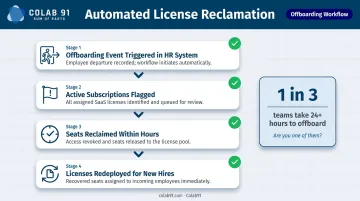
Active licenses assigned to former employees represent immediate, avoidable waste. BetterCloud reports that one-third of teams take more than 24 hours to complete offboarding steps, leaving licenses — and in some cases, active sessions — exposed after an employee's departure. In organizations with high turnover or frequent contractor use, this compounds quickly.
Automated offboarding workflows solve this by:
- Triggering license reviews the moment an offboarding event is initiated in HR systems
- Flagging active subscriptions tied to the departing employee
- Reclaiming seats within hours rather than days
- Making those seats available for redeployment before new purchases are requested
The reclamation step matters as much as the speed. If licenses aren't actively reallocated, procurement teams end up purchasing new seats for incoming hires while orphaned licenses sit idle — paying twice for the same capacity.
Strategies That Change the Organizational Context Around SaaS
Individual tool-level savings erode without the right organizational conditions underneath them. These three strategies address that foundation.
Strategy 7: Consolidate Overlapping Tools to Negotiate Volume Pricing
Multiple departments independently adopting tools with similar functions is one of the clearest patterns in SaaS overspending. When marketing, product, and operations each run their own project management tool because no one coordinated, the organization pays three sets of licensing fees, manages three vendor relationships, and gets no volume benefit from any of them.
Application rationalization — consolidating to a single best-fit tool per functional category — produces three types of savings:
- Eliminating redundant subscriptions cuts licensing costs immediately
- Consolidating seat counts with a single vendor unlocks volume pricing unavailable to fragmented buyers
- Fewer vendor relationships reduce contract management, renewal cycles, and support overhead
Vendors are materially more flexible when presented with a consolidation scenario. A procurement team that can offer to double contracted seats in exchange for a rate reduction is in a different negotiation than one renewing a mid-tier contract at status quo.
Strategy 8: Use Usage and Market Data as Leverage in Vendor Negotiations
Most companies renew SaaS contracts passively. The vendor sends a renewal notice, procurement or finance approves it at the proposed price, and the opportunity to negotiate closes without anyone realizing it was open.
Vendr's analysis of 20,000 deals and $2.3B in processed spend found an average savings of 16.49% for actively negotiated renewals. Vertice's internal data puts the average overpayment at 26% versus market-rate pricing. These figures reflect what happens when companies treat renewals as a procurement event rather than an administrative task.
Effective negotiation requires two inputs:
- Usage data — actual active seats vs. contracted seats, adoption rates, feature utilization. This establishes the real value being received and creates grounds to challenge the pricing baseline.
- Market benchmarks — what comparable organizations pay for the same tool at similar volume. Without this, procurement has no external reference to push against.
Colab91's Technology & SaaS Procurement practice supports this directly — providing spend data cleansing, classification, and competitive benchmarking that gives procurement teams concrete grounds to negotiate rather than accept vendor-proposed pricing at face value.
Strategy 9: Build Dedicated Procurement Capacity for Continuous SaaS Governance
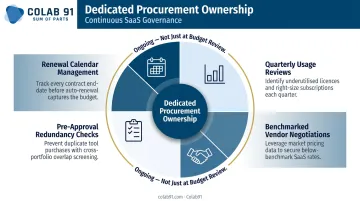
SaaS optimization is not a project with an end date. It requires ongoing ownership — renewal tracking, usage monitoring, vendor relationship management, and active sourcing when contracts come due. Most mid-market companies don't have that headcount internally.
Without dedicated ownership, the pattern repeats: a budget squeeze triggers a one-time audit, some subscriptions get canceled, costs creep back up over the next 12–18 months, and the cycle starts again.
Dedicated procurement capacity changes the model:
- Renewal calendars stay current — no missed notice windows, no passive auto-renewals
- Usage reviews happen quarterly, not annually during a budget crisis
- Vendor negotiations open with benchmarks and adoption data already in hand
- New purchase requests go through a redundancy check before approval, every time
Colab91 helps mid-market and PE-backed companies build this kind of dedicated offshore procurement capacity — India-based teams of category managers and analysts who own SaaS and technology spend governance as an ongoing function. Engagement models are flexible depending on where a company is in its offshoring journey: dedicated team builds, managed operations, or a build-operate-transfer (BOT) structure for companies that want to eventually own the function in-house.
For PE portfolio companies managing SaaS spend across multiple entities, cross-portfolio category leverage adds another layer — renegotiating technology contracts at the portfolio level rather than per-company produces savings that no single company could achieve on its own.
Conclusion
The nine strategies above cover different levers, but they point to the same conclusion: SaaS spend optimization holds only when organizations trace cost back to its source.
Canceling a few unused subscriptions after a budget review is not optimization. It's triage. The same conditions — decentralized purchasing, no renewal tracking, login data mistaken for adoption data — will regenerate the same costs within months.
What separates companies that sustain SaaS savings from those that don't is governance infrastructure: clear ownership, continuous usage tracking, and data-informed procurement decisions. That infrastructure doesn't require enterprise-scale headcount. It requires the right capacity, assigned to the right function, running continuously — not just at budget review time.
Frequently Asked Questions
What percentage of SaaS spend is typically wasted in organizations?
Authoritative benchmarks from Zylo and Productiv show that 44–55% of provisioned SaaS licenses are unused or underutilized. In dollar terms, Zylo's data puts average annual license waste at $9.5M for mid-market firms and $18–19.8M for the average organization — and both figures climb higher without centralized purchasing oversight.
What is the difference between SaaS spend management and SaaS spend optimization?
Management refers to tracking and controlling what already exists — contracts, renewals, access, spend visibility. Optimization is the active subset: reducing waste, improving ROI, and eliminating cost that doesn't deliver value. You can manage SaaS spend without optimizing it; optimization requires management as its foundation.
How do I identify shadow IT in my organization's SaaS stack?
Cross-reference SSO authentication logs against corporate credit card statements and expense reports. Unauthorized tools rarely appear in procurement or IT systems — they surface in finance data. That gap between IT records and finance data is where shadow IT consistently appears.
How often should companies audit their SaaS tech stack?
Run a full audit at least annually, with quarterly reviews of renewal calendars and usage data. Trigger additional reviews whenever headcount changes significantly, a new department is onboarded, or a merger or acquisition brings a new entity into the organization.
What is license rightsizing and why does it matter?
Rightsizing means aligning contracted seat counts and license tiers to verified active usage — downgrading or reclaiming seats that aren't being used before a renewal locks in the current baseline. It typically produces immediate cost savings without any disruption to users who are actively working in the tool.
How can procurement teams contribute to SaaS spend optimization?
Procurement teams bring negotiation expertise, vendor benchmarking, and contract governance discipline that most internal IT or finance functions lack. Without dedicated procurement capacity, companies routinely overpay at renewal and miss negotiation windows that usage data and market benchmarks would have opened.