Introduction
Many mid-market and PE-backed companies face the same inflection point: operational capacity needs to grow fast, but the build-vs-buy question for offshore talent never feels straightforward. Do you engage a vendor for a defined deliverable and move on? Or do you build an offshore team that compounds in value over time?
The wrong call has real consequences. Choose a project vendor when you need continuity, and institutional knowledge walks out the door at handover. Build a dedicated team before your operating model is clear, and you're absorbing fixed costs without the structure to use the capacity well.
That decision now carries more weight than it used to. Offshoring is no longer purely a cost play for this segment - according to Zinnov-NASSCOM's FY2025 report, there are now 480+ mid-market Global Capability Centers in India, 35% of which were established in just the last two years. That's a structural shift, not a trend.
What follows is a practical framework for making the right call - without guessing.
Key Takeaways
- A dedicated team assigns domain experts exclusively to your business for ongoing, evolving work - functions like procurement analytics or finance support that build institutional knowledge over time
- Project-based outsourcing contracts a vendor for a defined scope and timeline, with ownership transferring at handover
- Dedicated teams offer greater control, knowledge retention, and long-term cost efficiency
- Project-based models deliver speed and cost clarity for discrete, well-scoped tasks
- Choice of model turns on scope stability, knowledge intensity, and whether you need continuity across months or years
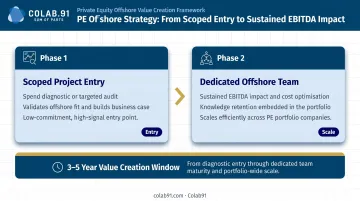
- Many PE-backed companies start with a scoped project to validate fit, then transition to a dedicated team once the operating model is clear
Dedicated Team vs Project-Based Outsourcing: Quick Comparison
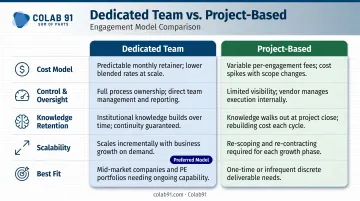
The table below breaks down how these two models differ across the dimensions that matter most for mid-market and PE-backed organizations.
| Dimension | Dedicated Team | Project-Based |
|---|---|---|
| Cost Model | Monthly run-rate; predictable recurring investment tied to team size and seniority | Fixed-price or milestone-based; lump-sum or payment-on-delivery |
| Control & Oversight | Client manages workflows, priorities, and output directly | Vendor manages execution; client reviews at defined checkpoints |
| Knowledge Retention | Context and domain expertise compound over time and stay with your business | Knowledge transfers at handover; continuity risk if vendor isn't re-engaged |
| Scalability | Team scales within the same engagement without renegotiating scope | Scaling requires a new contract or change order |
| Best Fit | Long-term, evolving functions - procurement analytics, finance support, spend category management | Discrete, well-defined work - spend diagnostics, process audits, one-time implementations |
What Is a Dedicated Team Model?
A dedicated team is a group of professionals who work exclusively for one client on an ongoing basis. They're not an independent vendor delivering against a statement of work - they function as an extension of the in-house team, operating within the client's tools, processes, and priorities.
For mid-market companies and PE portfolio businesses, this distinction matters. Building an offshore function through a captive entity requires in-country HR infrastructure, local compliance management, and entity setup - overhead that most mid-market operators can't absorb efficiently. A well-structured dedicated team model handles that complexity while preserving the client's strategic control.
How It Operates in Practice
The model differs from two commonly confused alternatives:
- Staff augmentation fills a skill gap with contracted individuals, but those individuals typically aren't aligned to a specific operational function or client culture over time
- Traditional outsourcing transfers execution ownership to a vendor; the client gets outputs, not operational visibility
A dedicated team operates as an integrated function, not a vendor. Priorities flow from client leadership. Output is reviewed directly. The team builds familiarity with client-specific data structures, supplier relationships, and internal processes - and that familiarity compounds sprint over sprint.
Use Cases: Where This Model Fits Best
Dedicated teams unlock the most value in functions that run continuously and grow more complex over time:
- Procurement analytics and spend category management
- Finance support and centralized accounting
- Data analytics and CFO intelligence functions
- Multi-function capability centers serving PE portfolio companies across multiple assets
Structuring these functions well requires more than hiring offshore talent - it requires a delivery model built around how these functions actually operate.
Colab91's "Sum of Parts" model blends onshore strategic oversight with offshore domain execution, positioning the India-based team as a strategic hub rather than a cost-reduction exercise. The leadership team previously scaled Impendi's India operations to 100+ practitioners serving marquee PE clients including Carlyle Group, TPG, Elliott, and BC Partners - and that operational experience directly shapes how engagements are designed today.
What Is Project-Based Outsourcing?
Project-based outsourcing engages an external vendor to deliver a defined scope of work by an agreed date. The vendor assembles the team, manages execution, and reports progress against milestones. When the project closes, ownership of the outputs transfers to the client - and the engagement ends.
The Four Primary Outsourcing Types
Most project-based arrangements fall into one of four categories:
- Business Process Outsourcing (BPO) - Business Process Outsourcing (BPO) - Delegation of business processes (finance, accounting, HR) to an external provider managing delivery against defined metrics. Gartner's definition covers the full scope
- IT Outsourcing (ITO) - Use of external providers for IT-enabled business processes, application services, and infrastructure
- Knowledge Process Outsourcing (KPO) - Outsourcing core information-related activities such as research, analytics, and data interpretation
- Professional Services Outsourcing - Engagement of specialized firms for advisory, consulting, or audit functions on a defined-scope basis
Use Cases: Where This Model Fits Best
Project-based outsourcing works well in specific scenarios:
- One-off initiatives with clear deliverables - a spend diagnostic, a process audit, a benchmarking study
- Time-sensitive compliance or regulatory work with a natural endpoint
- Pilot or proof-of-concept exercises before committing to a larger operating model
- Situations where the organization doesn't yet have internal readiness to manage an ongoing offshore relationship
The Primary Risk: Knowledge Walk-Out
The model's constraints become visible when the engagement ends. The critical vulnerability is what happens at handover.
When a vendor completes a procurement transformation or analytics build, the institutional knowledge - spend categories, supplier relationships, data structures, process nuances - typically leaves with the team. If the same work needs to be repeated or extended, the client starts over. That re-onboarding cost is real, even if it's rarely quantified upfront.
Dedicated Team vs Project-Based Outsourcing: Which Is Better?
Neither model is universally superior. The right choice is a function of four variables: scope stability, how knowledge-intensive the work is, budget structure preference, and strategic intent.
A quick decision framework:
- Work that is recurring, evolving, and knowledge-intensive → dedicated team
- Work that is discrete, well-specified, and has a natural endpoint → project-based
For PE-Backed Companies
PE sponsors typically operate on 3–5 year value creation timelines. PitchBook data shows the median US PE holding period reached 3.4 years in 2024, while McKinsey notes that lower entry multiples and higher financing costs are intensifying pressure on operational value creation.
Within that compressed window, a project-based engagement may be the right entry point - a spend analytics assessment or process audit to build the internal business case. But building toward a dedicated offshore team is often the faster path to EBITDA impact at scale. Institutional knowledge that survives personnel changes retains value through an exit - a vendor relationship does not.
Only 10–15% of the top 500 PE firms currently use Global Capability Centers, according to A&M/Everest analysis - meaning the operational advantage for those that do is still significant.
For Mid-Market Operators
For companies without large in-house teams, project-based outsourcing closes urgent skill gaps quickly. For functions like procurement, finance, or data analytics that run continuously, however, the economics shift over time. Repeated vendor onboarding, knowledge rebuilds, and contract renegotiations accumulate into a cost structure that a dedicated team avoids entirely.
The Hybrid Approach
Starting with a scoped project engagement before transitioning to a dedicated team is a proven path, not a fallback. The project phase validates the operating model, surfaces the knowledge gaps, and builds the internal business case. The dedicated team phase locks in continuity and begins compounding that knowledge.
Colab91's leadership team executed this exact progression at Impendi's India operations. Starting as a delivery function for PE clients, the team scaled to 100+ practitioners serving Carlyle Group, TPG, and others.
The trigger for scale wasn't a single project success. It was the recognition that recurring procurement and analytics work for PE portfolio companies required continuity - not repeated vendor engagement cycles.
Conclusion
Choosing between a dedicated team and project-based outsourcing comes down to the nature of the work itself - not a universal preference for one model over the other.
If your work is evolving, knowledge-intensive, and tied to long-term operational performance, a dedicated team builds compounding value. If your need is discrete and well-scoped, project-based outsourcing delivers efficiently. In practice, many mature offshore strategies use both models at different stages, shifting the balance as organizational needs evolve.
For mid-market and PE-backed companies, the real question is whether the offshore relationship is meant to close a one-time gap or build lasting capability. That distinction shapes not just which model fits, but what kind of partner you need: one that can execute a scoped deliverable, or one that can design and operate a capability center built to grow with you.
Frequently Asked Questions
Frequently Asked Questions
What is the difference between a dedicated development team and outsourcing?
A dedicated team works exclusively for one client on an ongoing basis, with the client managing direction, priorities, and output. Project-based outsourcing transfers execution ownership to a vendor for a defined scope and timeline.
What are the 4 types of outsourcing?
The four common types are Business Process Outsourcing (BPO), IT Outsourcing (ITO), Knowledge Process Outsourcing (KPO), and Professional Services Outsourcing. Project-based models appear across all four categories; dedicated team arrangements are more commonly associated with BPO and KPO contexts where continuity and domain depth matter.
When does a dedicated team model make more sense than project-based outsourcing?
A dedicated team is the stronger model when the work is ongoing, evolving, or knowledge-intensive - running a procurement analytics function, managing a finance support center, or handling spend category management where context and client familiarity compound in value over time.
Is project-based outsourcing cheaper than a dedicated team?
For a one-time, well-scoped task, project-based outsourcing typically has a lower upfront cost. For recurring functions over a 12–18 month horizon, a dedicated team tends to be more cost-efficient - it eliminates repeated vendor onboarding, knowledge rebuilds, and contract renegotiations that accumulate significantly over time.
Can a dedicated offshore team replace an in-house team?
A dedicated offshore team is an extension, not a replacement. The offshore team handles execution and builds domain depth; onshore leadership retains strategic oversight and client relationships. This "Sum of Parts" model pairs offshore efficiency with onshore expertise so each side performs better than it would operating alone.
How do PE-backed companies typically approach outsourcing decisions?
PE sponsors often begin with a scoped project engagement to validate fit and build the internal business case. Over time, dedicated offshore teams become the preferred model for sustained EBITDA impact - particularly for procurement, analytics, and finance functions that need to scale consistently across portfolio companies within a 3–5 year value creation window.