Introduction
Most procurement and finance leaders at mid-market and PE-backed companies are making budget decisions on data that's already weeks old. Forecasts get built from last year's actuals. Commodity swings show up in the variance report - after the quarter closes. Spend gets visible only once it's committed.
What matters with AI-powered spend analytics isn't the technology itself - it's whether you end up forecasting better, controlling spend in real time, and catching supply risks before they hit your P&L. Most implementations fall short not because the tools fail, but because the underlying data and processes aren't ready to support them.
This article breaks down three concrete advantages AI brings to spend analytics, and what it actually takes to extract lasting value from each.
Key Takeaways
- AI spend analytics moves procurement from backward-looking reports to forward-looking decisions
- Three core advantages: sharper spend forecasting, real-time budget visibility, and proactive risk detection
- McKinsey research shows AI can increase the pipeline of procurement value initiatives by up to 200%
- Fragmented data, missed savings, and budget surprises follow when these capabilities are absent
- Value requires clean data inputs, embedded workflows, and domain-expert analysts
What Is AI for Spend Analytics?
AI spend analytics is the application of machine learning, predictive modeling, and natural language processing to classify, analyze, and forecast organizational spending. The shift it enables is from hindsight to foresight - from explaining what happened last quarter to anticipating what happens next.
Where it applies:
- Procurement categories - tracking price trends, supplier behavior, and volume patterns
- Budget planning cycles - generating forward-looking spend projections rather than static reports
- Multi-entity environments - consolidating spend across business units, geographies, and ERPs into a single view
- Supplier risk monitoring - flagging financial health changes, compliance gaps, and concentration risks
The goal is earlier, more confident decision-making. For PE-backed and mid-market organizations, that means reduced budget variance, uncovered savings opportunities, and fewer end-of-quarter surprises.
Colab91 builds what they call "systems of intelligence" - unified data layers that AI can continuously learn from, not merely report on. A platform trained on your actual spend history across categories and geographies grows more accurate over time, compounding analytical value rather than resetting each cycle.
Key Advantages of AI for Spend Analytics
The three advantages below are framed around outcomes that procurement and finance leaders actually track - not theoretical model capabilities. Each one compounds with consistent application; early use delivers partial value, full integration drives the measurable cost and risk outcomes that justify the investment.
Advantage 1: Predictive Spend Forecasting
Spreadsheet-based spend forecasting has a fundamental flaw: it starts with last year's actuals and applies assumptions manually. AI replaces that process with models that ingest live data - ERP outputs, contract terms, commodity indices, supplier pricing history - and identify patterns that humans routinely miss.
In practice, AI procurement workflows:
- Build cleaned spend cubes automatically from raw ERP and AP data
- Integrate external market data to flag category-level price shifts
- Generate demand forecasts using machine learning, then produce sourcing scenarios based on those projections
- Identify seasonal patterns and variance drivers across categories
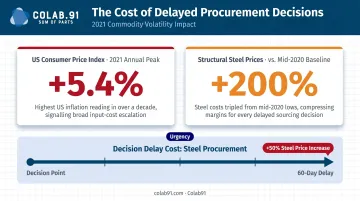
The commodity volatility of 2021 made the cost of static forecasting concrete. US CPI rose 5.4% in the 12 months ending June 2021. Steel prices climbed more than 200% versus mid-2020. McKinsey documented a case where a 60-day delay in acting on procurement data allowed steel prices to rise nearly 50% before a decision was made.
KPIs impacted: Budget variance (planned vs. actual), forecast accuracy rate, category-level spend per quarter, cash flow predictability
When it matters most: Organizations with commodity exposure, complex multi-category spend, or frequent M&A activity where spend baselines need rapid recalibration after acquisition.
Advantage 2: Real-Time Spend Visibility and Budget Control
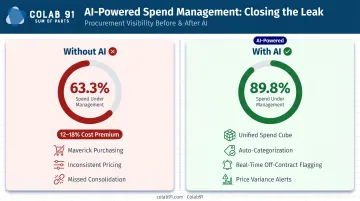
Most organizations don't actually see all their spend. According to Ardent Partners, the average organization manages just 63.3% of total spend - meaning more than a third sits outside procurement's line of sight. Best-in-class organizations manage 89.8%.
That gap is expensive. Dollars spent outside established contracts cost an additional 12%–18% more than contracted spend. Three specific leakage patterns drive most of that premium:
- Maverick purchasing - spend that bypasses approved vendors and contracts
- Inconsistent pricing - different business units paying different rates for identical items
- Missed consolidation - fragmented volume that loses leverage with key suppliers
Each one erodes savings year over year without visibility into where it's happening.
AI spend analytics addresses this by:
- Consolidating fragmented data from multiple ERPs, AP systems, and procurement platforms into a unified spend cube
- Auto-categorizing spend across suppliers and cost centers without manual tagging
- Flagging off-contract purchases in real time, not at month-end
- Highlighting price variances when different business units are paying different rates for the same item
The shift from 30-day-lagged reporting to near-real-time visibility changes what finance and procurement leaders can actually do. Budget reallocation decisions happen faster. Compliance enforcement has teeth. Year-end surprises shrink.
KPIs impacted: Percentage of spend under management, off-contract spend rate, PO compliance rate, time-to-insight from spend data
When it matters most: Multi-entity organizations, post-acquisition integrations, and businesses where spend data sits across business units with inconsistent categorization.
Advantage 3: Proactive Risk Detection and Cost Avoidance
Reactive procurement is expensive - not just in emergency sourcing premiums, but in the organizational drag that comes from constantly firefighting. The scale of that exposure is quantified in recent research. In a 2024 Gartner survey of 258 procurement professionals, as reported by the Institute for Supply Management:
- 42% cited disruption as a top procurement threat
- 33% cited macroeconomic factors
- 32% cited geopolitical trends
- 30% cited supplier capability and capacity issues
Yet the same research found that 79% of businesses lacked a comprehensive risk-management program for strategic suppliers. Most organizations can see these risks coming but lack the systems to act in time.
AI changes the posture. Rather than reacting after a supplier failure or price spike, AI monitoring:
- Tracks supplier financial health indicators and flags deterioration early
- Monitors external news and geopolitical signals for supply continuity risks
- Identifies category-level cost drivers before they hit the P&L
- Suggests preventive actions - dual-sourcing, pre-negotiation, inventory adjustment - while there's still time to execute
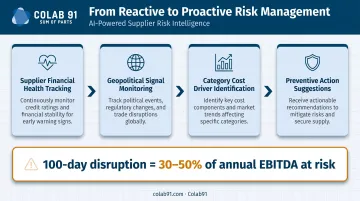
McKinsey's research on supply chain resilience found that a single disruption lasting 100 days or more can wipe out 30%–50% of one year's EBITDA for companies in most industries. For PE sponsors and portfolio company CFOs, a single supply disruption absorbing 30%–50% of annual EBITDA is the clearest argument for building proactive procurement capability.
KPIs impacted: Unplanned spend rate, supplier risk incidents, cost avoidance captured, supply continuity rate
When it matters most: Organizations with concentrated supplier bases, single-source dependencies, or high exposure to volatile raw material categories.
What Happens When AI Spend Analytics Is Missing
Operating without AI-driven spend analytics means working with data that's already stale by the time it reaches a decision-maker. Budget variances surface at period close, long after any corrective action was possible. Supplier risks become visible when they're already disruptions.
The compounding costs are predictable:
- Duplicate suppliers drawing from separate contracts at different rates
- Maverick spend accumulating across business units without visibility
- Missed consolidation where volume leverage exists but no one sees it
- Manual categorization lag that delays insights by weeks
The organizational cost is harder to quantify but real. Procurement teams operating in firefighting mode - reacting to price spikes, supplier failures, and demand surges - gradually lose credibility with finance and leadership. The function gets treated as a cost center, not a business partner.
The Hackett Group projected a 9% procurement efficiency gap in 2025, with workloads rising 10% while budgets grew only 1%. For teams still relying on manual processes and lagging reports, that gap doesn't hold steady - it compounds.
How to Get the Most Value from AI Spend Analytics
Technology alone doesn't deliver outcomes. Three factors determine whether AI spend analytics creates lasting value or becomes another underused tool:
Start with Data, Not Models
AI models are only as reliable as the data underneath them. The prerequisites:
- Standardized spend categorization across all business units
- Aligned ERP and AP data sources feeding into a single layer
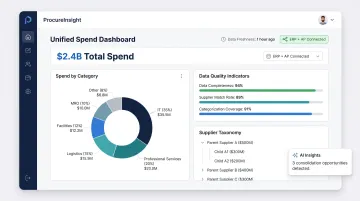
- Clean supplier taxonomy with consistent naming conventions
- Data governance policies that maintain quality as new data flows in
McKinsey found that 21% of CPOs had low data-infrastructure maturity, with less than 70% of spend data in one location - and another 30% admitted their spend data wasn't cleaned or categorized. Advanced models running on fragmented, uncleaned data produce unreliable outputs.
Embed Insights into Decisions
Analytics only creates value when it changes decisions. That means AI-generated outputs need to be present in:
- Quarterly budget reviews (not as supplementary reading - as the primary input)
- Sourcing events, where spend forecasts and supplier risk flags inform negotiation posture
- Supplier performance conversations, where compliance and pricing data drive the agenda
Reports that sit in dashboards without feeding into workflows are not generating value.
Pair AI Tools with Domain Experts
The most effective organisations staff dedicated analytics functions alongside their AI tools. McKinsey data shows that best-in-class procurement organisations place 22% of procurement employees in dedicated analytics roles.
For mid-market companies, that's rarely feasible with onshore headcount alone - Deloitte found 70% of CPOs reported difficulty attracting procurement talent.
Offshore capability centers that specialize in procurement analytics - like the ones Colab91 builds for mid-market and PE-backed companies - offer a consistent way to run spend analytics without depending on scarce onshore specialists. The key is pairing domain expertise with the AI tooling, so outputs get interpreted and acted on by people who understand what the numbers mean.
Conclusion
AI in spend analytics delivers value across forecasting accuracy, budget visibility, and risk-informed decision-making - but the real payoff is cumulative. Each capability reinforces the others, giving procurement teams the credibility and foresight to influence decisions that were once made around them.
That payoff doesn't come from software alone. It requires clean data, embedded workflows, and procurement professionals who can translate AI outputs into concrete action - adjusting budgets, renegotiating contracts, and flagging supplier risk before it compounds.
For mid-market and PE-backed organizations, that combination is a direct lever for EBITDA improvement and measurable enterprise value - the kind PE sponsors can point to at exit.
Frequently Asked Questions
Frequently Asked Questions
What is AI-powered spend analytics?
AI spend analytics uses machine learning and predictive modeling to classify, analyze, and forecast organizational spending in real time. This enables forward-looking procurement and budget decisions based on live data, not periodic historical reports.
How does AI improve budget forecasting accuracy?
AI identifies spend patterns, commodity price trends, and demand signals across historical and live data. Finance and procurement teams can then build budgets from predictive models rather than last year's actuals, reducing the gap between planned and actual spend at quarter-end.
What types of companies benefit most from AI spend analytics?
Mid-market and PE-backed companies with multi-category spend, fragmented ERP environments, or active M&A activity typically see the highest impact. AI resolves data consolidation and visibility gaps that manual processes can't handle at scale across multiple entities or geographies.
What data is needed to get started?
Three inputs form the foundation: clean spend data from ERP and AP systems, standardized supplier and category taxonomies, and historical purchase records. Data quality and governance must be established before advanced modeling can produce reliable outputs.
How is AI spend analytics different from traditional spend analysis?
Traditional spend analysis categorizes past spend in periodic, manual reports. AI spend analytics is continuous and predictive, surfacing risks and opportunities in near real time so teams can act before issues affect the budget.
How long does it take to see results?
Early wins like spend visibility, maverick spend identification, and category-level reporting typically surface within weeks of deployment. Predictive forecasting and risk modeling mature over 3–6 months as models train on organizational data.