Introduction
Supply shortages, rising costs, and margin pressure aren't edge cases for healthcare procurement leaders—they're the daily operating environment. According to the American Hospital Association, supply costs rose 9.9% in 2025, while total hospital expenses climbed 7.5%. Meanwhile, Kaufman Hall reports that 40% of hospitals had negative operating margins in 2023, with the median sitting at just 2.3%.
For PE-backed and mid-market health systems, those margins translate directly into sponsor pressure. PE firms aren't waiting years for procurement to catch up — they expect measurable cost reduction within months of close.
Strategic sourcing replaces reactive, price-accepting procurement with a systematic, data-driven approach focused on total value: cost efficiency, clinical quality, regulatory compliance, and supply continuity. Done right, it's one of the fastest levers available to procurement leaders operating under real constraints.
What follows covers how to structure sourcing across spend categories, where technology accelerates results, and what a durable sourcing capability actually requires.
Key Takeaways
- Supply costs in US hospitals rose 9.9% in 2025—making reactive procurement a financial liability, not just an inefficiency
- Strategic sourcing is not one-size-fits-all—direct negotiation, vendor consolidation, and competitive RFPs serve different category needs
- Indirect spend (~25–30% of non-labor expenses) is consistently under-managed and represents a significant, often untapped savings opportunity
- Without spend visibility, no sourcing strategy holds—you cannot prioritize what you cannot see
- Mid-market and PE-backed organizations frequently lack the talent and analytics infrastructure to run mature sourcing programs at scale
What Is Strategic Sourcing in Healthcare—and How Is It Different?
Strategic sourcing is a systematic, ongoing process: analyzing spend, segmenting suppliers, selecting the right approach per category, and measuring performance against both clinical and financial outcomes. It's built for continuity, not one-time cost cuts.
Strategic vs. Transactional Procurement
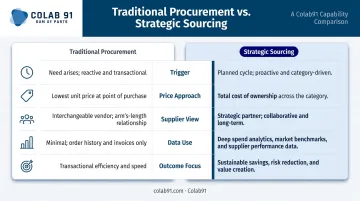
Traditional procurement is reactive by design — it responds to immediate needs, accepts listed prices, and seldom uses data to challenge vendor terms. The contrast with strategic sourcing becomes clear when you put both models side by side.
| Dimension | Traditional Procurement | Strategic Sourcing |
|---|---|---|
| Trigger | Immediate need | Proactive category planning |
| Price approach | Accept listed price | Benchmark against market |
| Supplier view | Transactional | Segmented by risk and value |
| Data use | Minimal | Spend analytics-driven |
| Outcome focus | Fulfillment | Cost, quality, and continuity |
The Healthcare Dimension
Strategic sourcing in healthcare carries dimensions absent from other industries. Every sourcing decision must account for:
- Clinical equivalency — Is a lower-cost substitute clinically acceptable?
- Patient safety — Does the product meet safety and quality standards?
- Regulatory compliance — Does the vendor meet FDA and accreditation requirements?
- Physician preference — Can the organization drive adoption of an alternative product?
These constraints don't eliminate the opportunity for savings — but they do require sourcing teams with genuine category depth, not generalists applying a one-size-fits-all playbook.
Why Healthcare Supply Chains Are Under Pressure Right Now
The numbers tell a clear story. According to the AHA's 2025 Cost of Caring report, supplies account for 18% of total hospital expenses—roughly $297 billion—while drug expenses add another 9%. Supply costs grew nearly 10% in a single year.
The Supply Disruption Risk
Shortages compound cost pressure. Premier's 2024 Supply Chain Resiliency Report found that nearly 40% of providers canceled or rescheduled cases quarterly in 2023 due to product shortages. For a medium-sized health system, supply shortages increase annual care costs by up to $3.5M, cause $350,000 in lost revenue, and tie up an additional $1M in excess inventory.
Reactive procurement amplifies these disruptions. Organizations without supplier diversification strategies or demand forecasting capabilities end up paying premium prices, accepting unfavorable contract terms, and delaying patient care when shortages strike.
The PE-Backed Pressure Point
These supply pressures land hardest on PE-backed and mid-market healthcare organizations, where the margin math leaves no room for error. With the median hospital operating margin at 2.3%, leaving almost no buffer for procurement inefficiency, every avoidable cost hit compounds quickly.
PE sponsors operate on defined timelines with measurable value-creation targets. Strategic sourcing, in this context, cannot be a multi-year ambition: it needs to deliver results within the first 100 days and continue building momentum through the hold period.
Direct vs. Indirect Spend: Mapping Where Healthcare Dollars Go
Before any sourcing strategy can work, procurement leaders need to know where money is actually going. Spend categorization is not a preliminary step—it is the foundation.
The Three Non-Labor Spend Categories
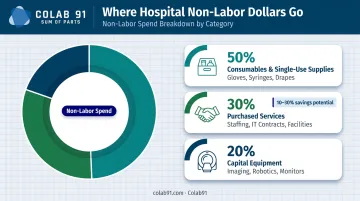
According to symplr's analysis of hospital non-labor expenditure, spend breaks down across three primary buckets:
- Capital equipment (~20%) — High-value, depreciable assets: CT scanners, surgical robots, ultrasound systems. Long purchase cycles, high physician involvement, and significant service contract obligations.
- Consumables and single-use supplies (~50%) — The largest category: medical/surgical supplies, IV therapy products, lab supplies, PPE. High transaction volume, GPO-addressable, and highly sensitive to usage variation.
- Purchased services (~30%) — Contracted third parties for revenue cycle management, imaging, clinical engineering, food service, facilities management, and more. HFMA estimates purchased services represent up to 30% of non-labor expenses, with potential savings averaging 10–30% per category.
Direct vs. Indirect: A Critical Distinction
| Direct (Clinical) Spend | Indirect (Non-Clinical) Spend | |
|---|---|---|
| What it covers | Implantable devices, dialysis services, surgical supplies, capital medical equipment | Pest control, facilities maintenance, landscaping, food service, utilities, environmental services |
| How it's managed | Purchase-order driven, subject to clinical scrutiny | Decentralized, multi-departmental, inconsistent contract governance |
| Scale | Core of clinical operations budget | ~25% of total hospital expenses (Vizient) |
| 2026 inflation outlook | Varies by category | 3.34% projected for indirect categories |
Indirect spend is where fragmentation quietly compounds. It spans dozens of non-standard categories, involves stakeholders across multiple departments, and rarely gets the systematic oversight that direct spend receives. The outcome: inconsistent vendor pricing, limited contract compliance, and savings left on the table.
That fragmentation becomes acute after acquisitions. Vendor proliferation across acquired entities can double or triple the supplier count in a single category, with no corresponding improvement in pricing or service quality — a common blind spot in post-merger integration planning.
Core Strategic Sourcing Approaches for Healthcare Organizations
No single sourcing method works across all categories. The right approach depends on market structure, spend volume, category sensitivity, and whether products are proprietary or commoditized.
Direct Negotiation
Works best when competitive alternatives are limited: physician preference items, branded capital equipment, sole-source clinical products.
Key tactics:
- Use GPO-agnostic benchmarking data to anchor the negotiation
- Communicate organizational cost management goals directly—transparency often moves suppliers
- Pursue non-price concessions: extended warranty terms, service agreements, loaner equipment, favorable payment terms
- Segment the conversation by contract line rather than negotiating globally
Vendor Consolidation
When a category has too many suppliers, pricing is volume-driven, or post-acquisition vendor counts have ballooned, consolidation is the right move.
In consumables and commodity categories, reducing supplier count drives volume discounts, cuts contract management overhead, and reduces administrative burden. A 300-supplier medical supply portfolio consolidated to 50 primary vendors creates real negotiating leverage.
One critical caution: over-consolidation creates single-point-of-failure risk. For critical supplies, maintain at least one qualified backup source.
Competitive RFP Process
This is the most powerful sourcing tool available (and the most resource-intensive). Reserve it for high-spend, high-risk categories: revenue cycle management, interpretation and translation services, clinical engineering, and contracted facility services.
Best practices for healthcare RFPs:
- Define fee structures prescriptively before issuing; avoid open-ended pricing responses
- Weight evaluation criteria beyond price — include clinical outcomes data, references, and implementation capability
- Assemble cross-functional evaluation teams that include clinical, operational, and finance stakeholders
- Use automated platforms to manage response collection and scoring, reducing bias and accelerating timelines
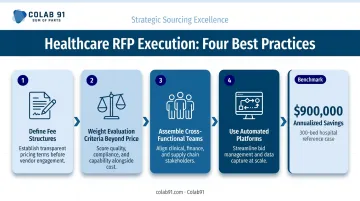
HFMA reports real results: a 300-bed hospital achieved $900,000 in annualized savings by reviewing clinical engineering service contracts through a competitive process.
Technology and Analytics: The Enablers of Smarter Sourcing
Spend Visibility First
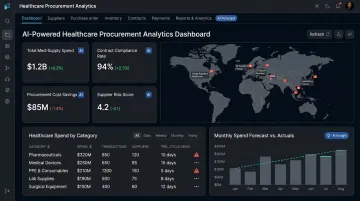
You cannot prioritize what you cannot see. A unified, cleansed view of spend—by category, supplier, facility, and contract compliance status—is the prerequisite for every sourcing initiative.
The gap here is significant. A symplr survey found that only 19% of healthcare supply chain leaders were very confident that physicians and clinicians supported supply chain activities. Separately, 63% cited cost savings as their top 2024 priority—yet most lacked the data infrastructure to pursue it systematically.
Digital Procurement Platforms
Modern procurement platforms solve the visibility problem by:
- Centralizing supplier contracts and pricing
- Automating purchase-order workflows
- Tracking contract compliance in real time
- Flagging off-contract spend before it becomes leakage
- Monitoring supplier performance against contracted terms
GHX projected that nearly 70% of US hospitals would adopt cloud-based supply chain management by 2026—with 71% citing financial pressure as the primary driver.
AI and Predictive Analytics
AI moves strategic sourcing from reactive to proactive. Applied to healthcare procurement, AI can:
- Analyze historical usage patterns to forecast supply needs by category and facility
- Identify supply chain bottleneck risks before they cause shortages
- Flag cost anomalies across thousands of SKUs simultaneously
- Surface off-contract spend in categories that would take months to audit manually
Deloitte's CPO survey found that 92% of CPOs were planning or assessing Generative AI capabilities in 2024, with enhanced analytics and decision-making ranked as the top value area—above productivity and cost optimization.
Total Cost of Ownership Analysis
Unit price is only part of the equation. TCO analysis evaluates the full cost of a procurement decision across its lifecycle:
- Acquisition price + shipping + storage
- Installation, training, and implementation
- Maintenance, service contracts, and downtime costs
- Regulatory compliance and waste disposal
A device priced 15% below a competitor can cost significantly more over five years once service contracts, downtime, and staff retraining are included. Running a TCO model before contract signature is what separates a negotiation win from a long-term cost trap.
Building Strategic Sourcing Capability in Mid-Market Healthcare Organizations
The Capability Gap
Most mid-market and PE-backed healthcare organizations run lean procurement functions. They handle purchasing—but strategic sourcing at scale requires capabilities most internal teams don't have:
- Dedicated category managers with deep expertise in specific spend areas
- Spend analysts who can cleanse, classify, and benchmark data
- Contract lifecycle management infrastructure
- Compliance monitoring processes that run continuously, not annually
Building all of this in-house takes years and significant investment. For organizations operating under PE timelines, that's not a viable path.
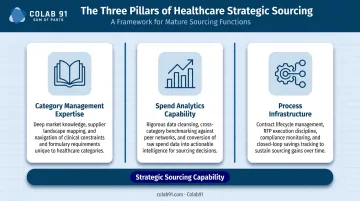
Three Components Every Sourcing Function Needs
- Category management expertise — Specialized knowledge of each spend area, including market dynamics, supplier alternatives, and clinical constraints
- Spend analytics capability — The ability to cleanse raw transaction data, classify it accurately, benchmark it against market, and generate actionable intelligence on a regular cadence
- Process infrastructure — Contract lifecycle management, RFP execution capability, compliance monitoring, and savings tracking that runs continuously
How Offshore Capability Centers Fill the Void
The practical solution for many mid-market and PE-backed healthcare organizations is augmenting their internal teams with offshore procurement and analytics specialists who bring domain expertise at cost-effective rates.
Colab91 builds dedicated India-based capability centers that place strategic sourcing analysts, spend analytics professionals, and category managers inside healthcare clients' procurement functions. These teams handle the full scope — spend analysis, opportunity identification, RFP execution, supplier negotiation, contract management, and savings tracking — as an integrated extension of the client's own team.
Healthcare clients including Pediatric Associates (a TPG portfolio company), Kindred Healthcare, and Amneal have used this model to build sourcing capability that would cost far more to replicate entirely onshore. Advisor Erika Jung, a former CPO with Fortune 100 and PE-backed healthcare experience, brings executive-level procurement expertise directly to client engagements.
The engagement models are flexible—dedicated teams, build-operate-transfer, and managed operations—structured to match the speed, scale, and strategic control requirements of each organization. For PE-backed healthcare platforms, this means a sourcing capability that can be stood up quickly, scaled as the portfolio grows, and delivers measurable results within the first 100 days.
Frequently Asked Questions
What is strategic sourcing in healthcare supply chain management?
Strategic sourcing is a long-term, data-driven procurement approach that prioritizes total value: cost efficiency, clinical quality, and supply continuity. It uses spend analysis, supplier segmentation, and category-specific strategies to continuously optimize both financial and clinical outcomes.
How does strategic sourcing differ from traditional procurement in healthcare?
Traditional procurement is reactive and transactional: it fills immediate needs at listed prices with minimal data use. Strategic sourcing uses spend visibility, market benchmarks, and supplier segmentation to proactively manage costs, reduce supply risk, and drive performance across every spend category.
What are the main spend categories in healthcare procurement?
The three primary non-labor spend categories are capital equipment (~20%), consumables and single-use supplies (~50%), and purchased services (~30%). Each requires a tailored sourcing approach; consolidation works well in consumables, while purchased services often benefit from competitive RFPs.
What is the difference between direct and indirect spend in healthcare?
Direct spend covers goods and services tied to patient care: implants, pharmaceuticals, medical equipment, and surgical supplies. Indirect spend covers operational costs not directly tied to care delivery, such as pest control, food service, and facility maintenance. It is frequently under-managed and represents a meaningful savings opportunity.
How can healthcare organizations balance cost savings with patient safety in sourcing?
Sourcing decisions must align with clinical evidence, quality standards, and regulatory requirements. Cross-functional evaluation teams that include clinical staff, not just procurement, help confirm that lower-cost alternatives meet the same performance and safety thresholds.
What role does analytics play in healthcare strategic sourcing?
Spend analytics provides the visibility needed to identify savings opportunities, track contract compliance, and benchmark supplier pricing. Without clean, categorized spend data, healthcare organizations cannot prioritize sourcing initiatives or measure whether interventions are delivering results.