Introduction
Scaling a mid-market or PE-backed company is expensive. Building every capability in-house means higher overhead, longer hiring cycles, and persistent talent gaps — especially in specialized functions like data engineering, procurement analytics, and AI/ML.
Offshore Development Centers (ODCs) directly address that equation.
According to IDC research covered by CIO, 67% of digital transformations are delayed due to skill shortages, and IT skills gaps could cost organizations as much as $5.5 trillion by 2026. These aren't abstract risks — they show up as missed deadlines, rising costs, and stalled growth.
The 10 benefits below cover the full picture: cost and speed advantages, yes — but also strategic outcomes like capability building, IP control, and scalability that executives and PE operating partners consistently track when evaluating offshore models.
Key Takeaways
- ODCs are dedicated offshore teams embedded in your organization — structured as long-term capability hubs, not vendor arrangements
- Core benefits include cost reduction, access to specialized talent, scalability, 24/7 productivity, and domain expertise
- Mid-market and PE-backed companies gain the most when ODCs replace reactive hiring with structured capability building
- Domain expertise — not just headcount — is what separates high-performing ODCs from commodity offshore arrangements
- ODC value grows over time as institutional knowledge, process fluency, and team depth build within your operations
What Is an Offshore Development Center?
An ODC is a dedicated team based in another country that operates as an integrated extension of your company — sharing your tools, processes, performance standards, and strategic objectives, rather than functioning as a vendor completing isolated tasks.
The term "offshore development center" is somewhat misleading in 2025. Modern capability centers go well beyond software and engineering. Today, they span:
- Procurement and strategic sourcing
- Spend analytics and FP&A
- AI/ML development and data engineering
- Finance operations and process transformation
This makes ODCs relevant across business functions — not just for tech teams.
At its most practical: an ODC exists to close capability gaps, increase execution speed, and reduce the cost of scaling. It's a delivery vehicle for a measurable outcome, not a structural end goal.
That scope matters for how you design one. Colab91, for example, builds ODCs for mid-market and PE-backed companies across both technical and non-technical domains — from 5-engineer software pods to full multifunctional capability centers with procurement analysts, data scientists, and engineering teams under one roof.
The 10 Benefits of Offshore Development Centers
The benefits below reflect outcomes businesses actually measure: cost, quality, speed, talent, risk, and growth.
Financial and Talent Advantages
Benefit 1 — Significant Cost Reduction
Labor cost differentials between the US and India are significant across every core function.
BLS May 2024 data shows US median wages at:
| Role | US Median Wage |
|---|---|
| Software Developer | $133,080 |
| Data Scientist | $112,590 |
| Financial Analyst | $101,350 |
| Operations Research Analyst | $91,290 |
India salary benchmarks (Michael Page 2024) for comparable roles in GCC/shared services environments run materially lower. Data Science/ML/AI professionals with 3–6 years of experience range from INR 30–50 lakhs (approximately $36,000–$60,000), and procurement analytics specialists in captive/shared services settings range from INR 20–40 lakhs (approximately $24,000–$48,000) at the senior manager level.
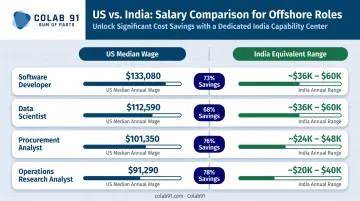
The savings extend beyond base salary. Benefits, real estate, and recruiting costs compound the gap — and the effect is most pronounced when scaling beyond 5–10 headcount or when PE sponsors are driving cost optimization across portfolio companies.
KPIs impacted: total cost of workforce, cost per output unit, EBITDA margin.
Benefit 2 — Access to a Global Talent Pool
Local hiring markets frequently lack the specialized skills companies need most — particularly in analytics, data engineering, and AI.
India's talent pipeline addresses this directly:
- 847,000 Bachelor of Engineering and Technology graduates annually (AISHE 2021–22)
- 2nd-largest AI/ML and big-data analytics talent pool globally, ranking 1st in AI skill penetration with a score of 3.09 (NASSCOM)
- AI and ML skill sets appeared in 14% of all US tech job postings in early 2024 — demand that domestic supply cannot match
For companies hiring procurement analysts, spend analytics specialists, or AI engineers, the constraint isn't budget — it's availability. An ODC in India removes the constraint.
KPIs impacted: time-to-hire, skill coverage ratio, attrition risk.
Benefit 3 — Scalability and Workforce Flexibility
ODCs allow companies to expand or contract teams based on project demand, market cycles, or M&A activity — without the fixed-cost liabilities of in-house hiring.
This matters particularly in PE contexts. Post-acquisition integration often requires rapid headcount build in specific functions. A managed ODC can stand up a new team far faster than a domestic hiring cycle — especially relevant given that SHRM reports the average cost per hire is nearly $4,700, and that figure doesn't capture the time lost during a 60–90 day search for a niche role.
Colab91 structures ODCs to scale from 5-engineer pods to 200+ person capability centers, with engagement models — dedicated team, BOT, managed operations — designed around the client's ownership timeline and growth stage.
KPIs impacted: headcount flexibility, time-to-scale, recruitment cycle time.
Benefit 4 — Faster Time-to-Market
When offshore teams operate in different time zones, the effective workday extends. Development tasks completed in India during US evening hours are ready for review when the onshore team returns in the morning — compressing delivery timelines without adding to the headcount or cost of the domestic team.
This "follow-the-sun" model works best when handoff processes are well-defined. PMI's guidance on distributed agile teams describes exactly this pattern: development performed in one geography, testing or review in another, keeping the sprint moving continuously.
KPIs impacted: sprint velocity, delivery cycle time, project lead time.
Benefit 5 — Access to Domain Expertise, Not Just Headcount
This is the most underestimated ODC benefit. The standard assumption is that offshore teams execute tasks that onshore teams direct. The better model is one where offshore teams own entire workflows and contribute analytical value.
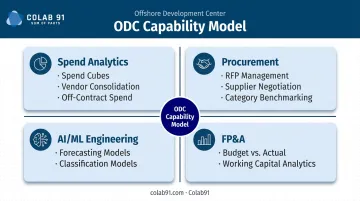
Colab91's ODC teams, for example, include:
- Spend analytics specialists building spend cubes, running vendor consolidation analysis, and flagging off-contract spend
- Procurement analysts managing RFP events, supplier negotiations, and category benchmarking
- AI/ML engineers developing forecasting and classification models
- FP&A analysts supporting budget vs. actual analysis and working capital analytics
This shifts the ODC from a staffing model to a capability model — one where senior-level analytical thinking scales alongside headcount, not in spite of it.
KPIs impacted: quality of output, speed to insight, analyst-to-outcome ratio.
Operational and Strategic Advantages
Benefit 6 — 24/7 Productivity Through Time Zone Leverage
Overlapping work shifts across time zones keep operations running continuously. For time-sensitive functions — issue resolution, reporting deadlines, deal-cycle support — this means problems get addressed faster and turnaround times shrink.
For PE portfolio companies running lean internal teams, an offshore team that closes out work overnight compresses turnaround times in ways that a purely domestic setup cannot replicate.
KPIs impacted: SLA adherence, issue resolution time, output per business day.
Benefit 7 — Stronger Focus on Core Business Priorities
When specialist execution is handled offshore, internal leadership redirects attention to strategy, customer relationships, and growth. This is especially valuable for mid-market companies where senior leaders routinely get pulled into execution work that shouldn't require their bandwidth.
An offshore team handling procurement analytics, spend reporting, or application development means the internal team focuses on decisions — not data gathering.
KPIs impacted: leadership bandwidth utilization, strategic initiative output.
Benefit 8 — Knowledge Retention and Institutional Memory
Unlike project-based outsourcing — where knowledge walks out the door at engagement end — a dedicated ODC builds deep institutional memory over time. The team learns your data structures, your decision-making logic, your vendor relationships, your technology stack.
This has real financial implications. Gallup estimates voluntary turnover costs US businesses $1 trillion annually, with replacement costs running 0.5x–2x of annual salary. A stable, embedded ODC team avoids the constant re-onboarding cycle that erodes productivity with rotating contractors or frequent in-house turnover.
KPIs impacted: onboarding time for new work, error rates, rework frequency.
Benefit 9 — Operational Risk Distribution
Concentrating all capability in a single geography creates single-point-of-failure risk. Local talent market disruptions, economic events, or hiring freezes in one location can stall operations.
KPMG's 2024 GCC resilience report recommends distributing critical functions across multiple geographies for exactly this reason. An ODC in India provides geographic diversification that reduces dependency on any single talent market — a structural hedge that most mid-market companies don't have today.
KPIs impacted: business continuity score, operational resilience.
Benefit 10 — Strategic Control Without Proportional Overhead
Traditional outsourcing puts a vendor between the client and the work. The client sees outputs but loses visibility into how decisions are made, how quality is maintained, and how priorities shift.
An ODC eliminates that gap. The client sets standards, owns output, directs priorities, and maintains full visibility — without building the full HR, real estate, and compliance infrastructure of an in-house team.
Colab91's engagement models explicitly address this: entity ownership, IP rights, governance frameworks, and security standards (SOC 2, ISO 27001) are built in from the start. Whether a client chooses a dedicated team, BOT structure, or managed operations model, strategic control remains with the client.
KPIs impacted: governance quality, output ownership, IP protection.
What Happens When Companies Skip the ODC Approach
The costs of not having an ODC don't appear on a single line item. They compound across time.
Common consequences for mid-market and PE-backed companies:
- Specialist roles in analytics, procurement, and engineering go unfilled for months, stalling projects with clear business value
- Domestic hiring for niche functions squeezes margins — a real problem when PE sponsors are tracking EBITDA closely
- Work that could run more efficiently offshore stays in expensive geographies by default, inflating cost structures
- Without a flexible offshore structure, post-acquisition staffing turns reactive, slowing integration timelines
The macro picture reinforces this. Korn Ferry projects a global shortage of 85.2 million workers by 2030, representing $8.45 trillion in unrealized annual revenue. IT skills gaps alone could cost organizations $5.5 trillion by 2026.
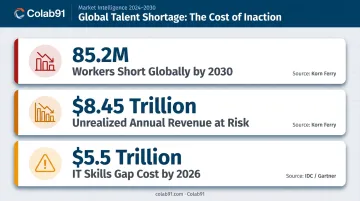
Every quarter without an ODC is a quarter a competitor spends building institutional knowledge, operational depth, and cost advantage that compounds over time.
How to Get the Most Value from Your ODC
The difference between an ODC that delivers and one that disappoints comes down to how it's set up and treated from day one.
Treat it as a capability center, not a cost fix. ODCs launched purely to reduce headcount costs tend to underperform. Define what capabilities the offshore team will own — not just tasks they'll support.
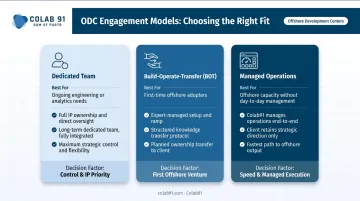
Choose the right operating model for your situation:
- Dedicated team — best for companies with ongoing, predictable engineering or analytics needs and a preference for direct control and IP ownership
- Build-Operate-Transfer (BOT) — best for companies without prior offshore experience who want expert-managed setup before assuming ownership
- Managed operations — best for companies that want offshore capacity without day-to-day operational responsibility
The model you choose shapes everything downstream. Colab91's "Sum of Parts" approach, for instance, blends onshore strategic oversight with offshore execution depth by integrating offshore teams into client workflows, KPI frameworks, and performance expectations from day one. The leadership team developed this model while scaling Impendi's India operations to 100+ practitioners serving Carlyle Group, TPG, Elliott, and BC Partners.
Invest in integration early. Shared tools, defined KPIs, regular performance reviews, and cultural alignment between onshore and offshore teams aren't overhead — they're what separates an ODC that delivers in year one from one that finally delivers in year three.
The longer an ODC team is embedded in your operations, the faster they work, the fewer errors they make, and the more value they generate. Early setup investment pays back — and keeps paying.
Conclusion
The 10 benefits of an ODC span financial, operational, and strategic dimensions. Cost reduction is where most companies start — but the real value lies elsewhere: specialized talent, institutional knowledge that compounds over time, and the ability to scale without proportional overhead.
For mid-market and PE-backed companies, an ODC is one of the highest-leverage decisions available. It closes talent gaps that slow execution, reduces costs that shrink margins, and builds the operational depth needed to scale sustainably across acquisitions and growth cycles.
For those operating in competitive markets, the compounding effect is real. Mid-market and PE-backed firms that establish offshore capability centers now gain faster growth, stronger margins, and more resilient operations — while those still dependent on reactive domestic hiring face rising costs with diminishing returns.
Frequently Asked Questions
What are the benefits of an ODC?
Core benefits include cost reduction, access to specialized global talent, workforce scalability, 24/7 productivity through time zone leverage, and the ability to redirect internal leadership toward strategic priorities. These advantages compound as the ODC matures and integrates with client operations.
What is the difference between a GCC and an Offshore Development Center?
A GCC is a fully owned, captive offshore entity built for long-term, multi-functional strategic operations — typically suited to larger organizations. An ODC is a more flexible, managed model that can be set up faster and scaled more easily across multiple engagement models. That makes it the more practical starting point for mid-market companies.
What does it mean to work from an ODC?
Working from an ODC means being part of a dedicated offshore team that operates as a true extension of the parent company — following its tools, processes, workflows, and performance standards — rather than functioning as an independent contractor or vendor resource completing isolated tasks.
Is an ODC the same as outsourcing?
No. Traditional outsourcing is project-based and vendor-managed, with limited client control over execution. An ODC is a long-term dedicated team operating under the client's standards, processes, and strategic direction — providing far deeper integration and direct ownership of output quality.
What functions can be handled by an Offshore Development Center?
Modern ODCs support functions well beyond software development. Colab91, for example, builds offshore teams across procurement and strategic sourcing, spend analytics, FP&A, data engineering, AI/ML engineering, DevOps, and process transformation — making the model relevant across industries and business functions.
How long does it take to set up an Offshore Development Center?
Setup timelines vary by model and complexity. A managed or partner-led ODC can typically become operational faster than a fully captive GCC build, which requires legal entity registration, infrastructure setup, and broader recruitment cycles. The right partner will provide a clear milestone sequence from initial engagement through operational delivery.