![The Role of AI in Strategic Sourcing and Procurement [2026]](https://file-host.link/website/colab91-oswk8p/assets/blog-images/bb87fd7e-ed6a-4e53-9287-a7d19dc9d43a/1781537065383428_630f4f3cc78f49619d5c5401d688e71b/360.webp)
Introduction
Procurement teams are under pressure from every direction. Tariff volatility is reshaping supplier landscapes overnight. Supply chain disruptions that once felt exceptional now arrive in waves. Meanwhile, stakeholders expect procurement to function as a strategic value driver — not just a cost center — while headcount budgets stay flat.
The old model of manual spend reviews, periodic supplier audits, and reactive sourcing events isn't keeping pace. According to McKinsey's 2025 supply chain risk survey, 82% of companies reported their supply chains were affected by new tariffs, with 20% to 40% of supply-chain activity impacted. That's not an episodic shock — it's the new operating environment.
What follows is a practical look at how AI is reshaping strategic sourcing in 2026 — where it's delivering real impact, what's holding teams back, and how mid-market and PE-backed organizations can build capability that sticks.
Key Takeaways
- 88% of procurement professionals now use GenAI at least weekly — up 22 percentage points year over year
- Highest-ROI use cases: spend analytics, supplier risk monitoring, RFP/RFQ automation, and contract analysis
- Mid-market companies can match enterprise procurement sophistication with clean data and domain-expert talent in place
- AI augments procurement professionals; human judgment and category expertise remain essential to generating real returns
- The gap between piloting AI (49% of teams) and scaling it (4%) comes down to talent and change management, not the technology itself
Why AI Is Reshaping Strategic Sourcing in 2026
The pressures driving AI adoption in procurement aren't theoretical. Tariff shifts are forcing supplier diversification decisions in weeks, not quarters. Inflationary cost environments are compressing margins while stakeholders demand sustained savings delivery — and procurement organizations face a structural capacity problem that isn't going away.
The Hackett Group's 2025 Key Issues Study found that procurement workload is projected to grow 10% while budgets grow just 1% — a 9% efficiency gap that manual processes simply cannot close. The same study found that 64% of procurement leaders believe AI will transform their roles within five years.
Weekly GenAI usage among procurement professionals tells a sharper story: AI at Wharton's 2025 research found 88% of purchasing and procurement respondents used GenAI at least weekly, with daily usage rising 31 percentage points year over year.
The Core Shift AI Enables
The fundamental change AI enables is moving procurement from reactive to proactive:
| Before AI | With AI |
|---|---|
| Risks discovered after disruption | Risks flagged before they escalate |
| Savings identified in annual reviews | Savings surfaced continuously |
| Sourcing decisions driven by incomplete data | Sourcing decisions backed by real-time market intelligence |
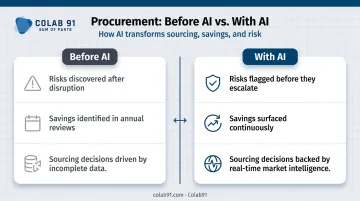
Procurement teams that treat AI as a point solution for one task will see modest efficiency gains. Those that embed it across the sourcing lifecycle — from spend analytics to supplier risk to contract negotiation — are the ones realizing step-change performance improvements.
AI Use Cases Across the Strategic Sourcing Lifecycle
Spend Analytics and Category Intelligence
Most procurement organizations are sitting on fragmented, inconsistent spend data spread across ERPs, procurement platforms, and accounts payable systems. The result: category managers are making sourcing decisions based on incomplete pictures.
Machine learning automates spend classification and data enrichment at scale. AI-powered platforms cleanse, classify, and continuously update spend data against standardized taxonomies — replacing manual taxonomy exercises that produce stale quarterly snapshots.
The result is continuous visibility into consolidation opportunities, off-contract spend, and tail-spend patterns that manual processes routinely miss.
Colab91's Spend Analytics platform transforms raw ERP and invoice data into an enriched, queryable spend cube — capturing supplier diversity attributes, ESG ratings, risk profiles, and contract terms alongside transactional data, updated continuously rather than as periodic reports.
The emerging layer on top of spend classification is AI-driven category intelligence: systems that combine internal spend data with external market signals to generate sourcing recommendations, benchmark pricing, and prioritize which categories to address first. For category managers running lean teams, this capability effectively extends analytical bandwidth without adding headcount.
Supplier Discovery and Risk Monitoring
Supplier risk management has historically meant annual financial reviews and periodic questionnaires — a cadence too slow to catch emerging risks. AI shifts this to continuous monitoring: tracking supplier financial health, ESG compliance, geopolitical signals, and news feeds in real time.
The investment in this area is growing. ISG's 2025 State of Enterprise AI Adoption report found that supplier risk assessment and monitoring averaged $2.0M in AI investment per deployment, with supplier management use cases averaging $2.6M and achieving 58% production deployment rates.
Beyond risk, AI improves supplier discovery by using large-scale external data to identify qualified new suppliers, reduce dependence on existing vendor pools, and support category diversification. For PE-backed portfolio companies managing consolidation across multiple acquired businesses, this is where AI earns its keep: identifying cross-portfolio supplier overlap and consolidation leverage points that manual analysis would miss.
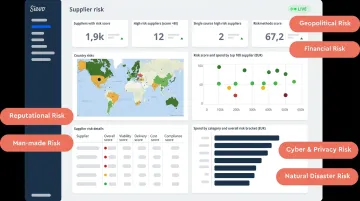
Colab91's Supplier Risk Management platform combines AI-powered continuous monitoring with offshore practitioner execution. When the system flags a supplier risk score change, Colab91's India-based team acts on that signal — engaging suppliers, assessing alternatives, and executing mitigation strategies on behalf of clients.
Sourcing Automation and Contract Intelligence
Generative AI is reducing the manual load on sourcing events. Procurement teams can now use AI to draft RFP and RFQ documents, analyze supplier responses, and score proposals against evaluation criteria — running more sourcing cycles across a wider range of spend categories without proportional headcount increases.
Contract intelligence is the other high-impact application. NLP-powered tools extract key terms, flag risk clauses, compare language against approved templates, and surface renewal and renegotiation windows — capabilities most mid-market companies have historically lacked.
Adoption is accelerating: Gartner predicts that 50% of organizations will use AI-enabled contract risk analysis and editing tools by 2027.
The contract data challenge is significant context here. A 2026 WorldCC/Sirion study found that only 27% of organizations store all executed contracts exclusively in CLM systems, with shared drives remaining a primary storage location for the majority. Contract AI cannot work without a reliable contract data foundation.
Key Benefits for Mid-Market and PE-Backed Companies
Mid-market procurement teams operate with fewer resources than large enterprises but face the same complexity. AI narrows that gap significantly.
Cost Savings and Spend Visibility
AI-powered spend analytics uncovers savings in areas that manual processes routinely miss:
- Tail spend — low-value, high-volume transactions consuming disproportionate resources
- Duplicate vendor relationships — particularly common in companies that have grown through acquisition
- Off-contract buying — purchases made outside negotiated agreements, often representing 15–30% of addressable spend
- Supplier consolidation opportunities — redundant vendor pools across decentralized business units
Colab91's Savings Opportunity Assessment typically identifies 5–15% of addressable spend as recoverable — delivered in a 4–6 week structured diagnostic that PE operating partners can use as a 100-day plan foundation.
Speed, Efficiency, and Proactive Risk Management
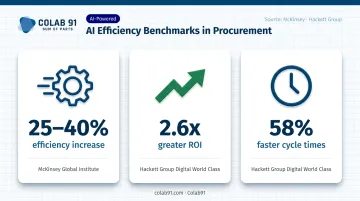
McKinsey research found that agentic AI could increase procurement efficiency by 25–40%. Hackett Group found that Digital World Class procurement teams using GenAI delivered 2.6x greater ROI and 58% faster cycle times than peers.
These gains come from automating repetitive tasks — spend classification, RFP drafting, invoice matching, contract summarization — freeing practitioners to focus on strategic and relationship-intensive work that actually drives savings. Risk management shifts from annual firefighting to continuous early-warning monitoring, with real-time alerts replacing periodic manual reviews.
Data-Driven Decisions and Competitive Parity
Efficiency gains translate directly into something mid-market companies have rarely had: competitive parity with large enterprises. AI tools give smaller procurement teams the analytical depth and sourcing sophistication that Fortune 500 functions have historically achieved through scale. Predictive analytics, market benchmarking, and scenario modeling now come embedded in procurement platforms — no data science team required.
For PE sponsors managing portfolio companies, this is a concrete value-creation lever: portfolio companies can execute category strategies and track savings with the same rigor as large enterprises, without the headcount overhead.
Challenges Holding Procurement Teams Back
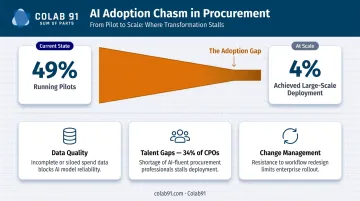
Understanding the benefits is straightforward. The harder question is why only 4% of procurement teams have achieved large-scale AI deployment despite 49% running pilots (Hackett Group, 2025).
Data Quality and Fragmentation
The most common barrier is data. Procurement organizations typically manage spend data scattered across:
The most common barrier is data. Procurement organizations typically manage spend scattered across:
- Multiple ERPs and procurement platforms
- Legacy contract repositories and shared drives
- Uncategorized spend with inconsistent supplier naming
- Contracts missing key metadata fields
These gaps undermine even the most capable AI tools before deployment begins.
Gartner's 2025 research found that 63% of organizations either lacked or were unsure they had the right data management practices for AI — and predicted that 60% of AI projects would be abandoned due to AI-unready data through 2026. Deloitte's 2024 global CPO survey confirmed the pattern: data quality was the most frequently cited internal barrier to AI adoption.
The solution is not to wait for perfect data before starting. AI can actually accelerate data quality improvement through cleansing, normalization, and deduplication — but teams need to start with a specific, bounded data domain rather than trying to clean everything at once.
The Talent Gap and Adoption Resistance
Data quality dominates the conversation, but talent is just as limiting. Most mid-market procurement teams lack the combination of data science fluency, change management capacity, and category expertise needed to extract value from AI tools at scale.
Gartner's 2026 survey found that only 36% of CPOs were very confident in their ability to redesign roles and processes around AI. Deloitte found that 34% of CPOs identified talent gaps as a primary barrier to delivering value. The pilot-to-production gap reflects this: piloting an AI tool is straightforward; embedding it into daily procurement workflows across a team requires structured enablement, governance, and sustained leadership sponsorship.
Teams that treat change management as an afterthought consistently find their AI investments stalled at the pilot stage — functional in demos, unused in practice.
How to Build an AI-Ready Strategic Sourcing Function
Start with High-Value, Scoped Use Cases
Anchor AI initiatives in specific business outcomes, not broad transformation aspirations. Proven high-ROI starting points include:
- Spend classification and analytics — immediate visibility gains with clear measurement
- Supplier risk monitoring — replaces manual processes with continuous coverage
- Contract metadata extraction — surfaces renewal windows and compliance gaps quickly
Invest in Data Readiness Without Waiting for Perfection
Don't delay AI deployment while waiting for clean data across every spend category. Instead:
- Identify the data domains that match your priority use cases
- Start there, with bounded scope
- Use AI itself to progressively improve data quality through cleansing and normalization
Colab91's Spend Analytics platform is built on this principle — designed to ingest fragmented ERP and invoice data and produce a clean, enriched spend cube, not require clean data as a prerequisite.
Choose Tools That Integrate With Your Existing Stack
AI procurement tools that create new data silos add complexity without value. Prioritize platforms that connect to existing ERPs, sourcing tools, and contract repositories — ensuring end-to-end spend visibility rather than another disconnected data island.
Build the Human Expertise Layer
This is where most mid-market AI initiatives stall. The organizations capturing the most value from procurement AI are those that pair intelligent tools with skilled practitioners who can interpret outputs, make judgment calls, and translate insights into sourcing strategy.
That talent gap is where most mid-market companies hit a ceiling. Building an internal team of category managers, analytics specialists, and sourcing practitioners takes time and budget that most organizations don't have.
Colab91's offshore capability center model addresses this directly. Dedicated India-based teams — strategic sourcing practitioners, category managers, and analytics specialists — operate as extensions of client teams, AI-augmented through Colab91's spend analytics, savings assessment, and supplier risk platforms. They handle spend cube construction, RFP event management, and continuous savings tracking.

Clients get experienced practitioners who can operationalize AI outputs, without the overhead of hiring and retaining that expertise domestically.
Measure and Iterate With Clear Benchmarks
Set measurable KPIs from the outset:
- Cost savings delivered against category targets
- Sourcing cycle time reductions
- Spend classification accuracy rates
- Number of supplier risk flags identified and acted on
- Off-contract spend as a percentage of addressable spend
Build in quarterly review cycles to assess AI performance against these benchmarks and course-correct. The discipline of measurement is what separates pilots that stall from programs that scale.
Frequently Asked Questions
What is the role of AI in strategic sourcing?
AI in strategic sourcing applies machine learning, NLP, and generative AI to automate data-intensive tasks — spend classification, supplier scoring, contract review — and surface intelligence that category managers can act on. This shifts procurement from reactive and manual to proactive, enabling teams to run more sourcing cycles across more categories without adding headcount.
How does AI improve supplier risk management?
AI monitors supplier financial health, news signals, ESG compliance, and geopolitical indicators in real time, replacing periodic manual reviews with continuous alerting. When a supplier's risk profile deteriorates, procurement teams receive early warning before disruption reaches the supply chain — enabling proactive mitigation rather than reactive crisis management.
What are the most common AI use cases in procurement today?
The most widely adopted use cases are spend analytics and classification, supplier risk monitoring, RFP/RFQ generation and scoring, contract analysis, and invoice processing automation. Spend analytics consistently ranks as CPOs' top GenAI investment priority for the immediate savings visibility it provides.
Can mid-market companies realistically adopt AI in procurement?
Yes — mid-market companies don't need Fortune 500 resources to benefit from procurement AI. The practical path is to start with targeted SaaS-based tools, focus on one or two high-ROI use cases, and supplement internal capacity with domain-expert partners rather than building every capability in-house.
What types of AI are most relevant to procurement?
Four types matter most:
- Machine learning — spend classification, anomaly detection, supplier scoring
- NLP — contract analysis and supplier communication
- Generative AI — drafting RFPs, summarizing contracts, producing category briefs
- Agentic AI — orchestrating multi-step procurement workflows with minimal human intervention
How long does it take to see ROI from AI in procurement?
Spend classification and contract visibility gains can deliver measurable value within weeks. Supplier risk monitoring and sourcing automation programs typically reach full production in 3–6 months. The fastest path to ROI is starting narrow: one use case, one data domain, and one measurable outcome before expanding.