What Is Procurement Risk Management — and Why It Matters Now
Procurement risk used to live in a spreadsheet someone updated once a year. That era is over.
Over 70% of CPOs reported that procurement-related risk increased in the prior 12 months, according to Deloitte's 2023 Global CPO Survey — and the share citing significantly increased risk nearly doubled from 20% in 2021 to 43% in 2023.
Several converging forces are driving this shift:
- Geopolitical volatility and tariff reshuffling disrupting established supply lanes
- ESG mandates raising the compliance bar for supplier relationships
- Post-pandemic supply fragility exposing single-source dependencies
- Tighter PE and board-level scrutiny on third-party spend risk
Procurement risk management is the systematic process of identifying, analyzing, and mitigating risks tied to vendors, contracts, spend governance, and compliance — across every stage of the procure-to-pay cycle.
The core problem: most organizations still treat it as a point-in-time activity. A vendor questionnaire at onboarding, an annual review, maybe a reactive scramble when a supplier fails. What they miss is everything that changes in between.
This guide is written for procurement leaders, CPOs, and operational teams at mid-market and PE-backed companies who need practical, scalable approaches they can implement immediately. It covers the risk categories that matter most, the frameworks teams actually use, and the tools that make continuous risk monitoring possible at scale.
Key Takeaways
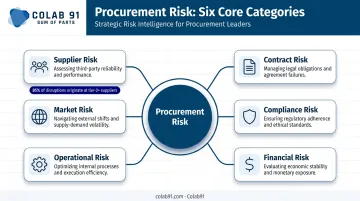
- Procurement risk spans six categories, each tied to a different stage of the procure-to-pay cycle
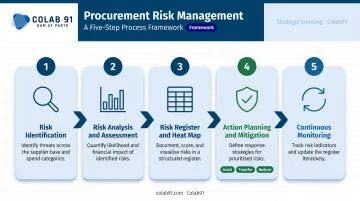
- A five-step process — identify, analyze, assess, act, monitor — is the operational backbone of any serious program
- ISO 31000 and COSO ERM set the standard, but execution depends on connecting frameworks to live workflows and data
- Mid-market and PE-backed companies often lack the capacity for continuous risk programs — closing that gap requires deliberate planning
The Six Core Categories of Procurement Risk
Procurement risk is not one thing. It manifests differently depending on the spend category, the supplier, and where you are in the procurement cycle. Mapping risk by category helps teams prioritize monitoring and assign clear ownership.
Supplier Risk
The most cited category — and often the least systematically tracked beyond tier-1.
Supplier risk includes performance failures (missed deliverables, quality defects), financial instability, and sub-tier failures that are invisible to the buying organization. McKinsey's 2025 supply chain risk survey found that 95% of companies have visibility into tier-1 supplier risk, but only 42% have visibility into tier-2 or beyond. Resilinc's multi-tier mapping data puts the consequence plainly: 85% of disruptions originate with indirect, tier-2-plus suppliers.
Contract Risk
Contract risk is the exposure created by ambiguous terms, missing renewal triggers, non-compliant clauses, or KPIs that no one actually monitors. Contracts that aren't actively managed become liabilities, especially in long-term services or direct materials agreements.
World Commerce & Contracting estimates that organizations lose an average of 11% of contract value through procurement contract leakage. The source is rarely legal drafting. It's financial mismanagement of obligations that were never tracked.
Compliance and Financial Risk
These two categories are increasingly inseparable.
- Compliance risk: ESG violations (modern slavery, environmental thresholds), local regulatory gaps, and audit failures that expose the organization to sanctions
- Financial risk: budget overruns, currency exposure, and payment delays that quietly erode margin
- The regulatory link: ESG non-compliance now carries direct financial penalties. The EU Corporate Sustainability Due Diligence Directive (2024/1760) requires member states to set penalties with a maximum of at least 5% of net worldwide turnover
Deloitte's 2023 CPO Survey found 40% of CPOs weren't measuring their own ESG factors. That's a material exposure given where regulation is heading.
Operational and Market Risk
Both categories are often underweighted because they feel like external forces. In practice, each has internal levers procurement teams can pull.
- Operational risk: fragmented systems, approval delays, and process gaps that reduce visibility and slow execution
- Market risk: pricing volatility, geopolitical shifts, and tariff changes that can upend sourcing strategy mid-cycle
- Concentration risk: over-reliance on single-source suppliers or single geographies that amplifies exposure when either category shifts
McKinsey found 82% of companies were affected by new tariffs in 2025, with 39% seeing direct increases in supplier and material costs. For category managers, that's not a macro headline. It's a line-item problem in the next budget cycle.
A Practical 5-Step Procurement Risk Management Process
Frameworks don't manage risk. Processes do. This five-step model is the operational backbone that turns risk policy into daily action — and it must be embedded in procurement workflows, not run as an annual exercise.
Step 1: Risk Identification
Risk identification requires cross-functional input, not just procurement assumptions. Finance, legal, operations, and category managers each see different exposure.
Scan both dimensions:
- Micro factors: organizational changes, new sourcing strategies, internal process gaps
- Macro factors: regulatory shifts, geopolitical events, supplier financial news, sanctions updates
Step 2: Risk Analysis and Assessment
With risks on record, each one needs to be analyzed for likelihood and potential impact. Qualitative techniques drive this step:
- Risk interviews: surface assumptions buried in individual teams
- Scoring matrices: apply consistent weight across risk types
- Structured workshops: align cross-functional stakeholders on severity
Segment by severity (high/medium/low) and document the logic behind each classification. That documentation is what makes a risk register audit-ready rather than just a list.
Step 3: Building the Risk Register and Heat Map
Two tools that only deliver value when they're connected to live data:
| Tool | Purpose | Key Requirement |
|------|---------|-----------------|
| Risk Register | Catalog of identified risks with owners, impact, and likelihood | Must be a living document, not a static spreadsheet |
| Risk Heat Map | Visual likelihood vs. impact matrix for leadership prioritization | Needs connection to live supplier and spend data |
When these tools pull from real-time supplier, spend, and contract data, they function as decision-support systems. Maintained manually in isolation, they collect dust.
Step 4: Action Planning and Mitigation
Three primary approaches — assign owners and timelines to each:
- Risk avoidance — exit the exposure entirely (exit a supplier, restructure a contract)
- Risk transfer or sharing — insurance clauses, contractual indemnities, supplier agreements
- Risk reduction — dual-sourcing, process controls, enhanced monitoring thresholds
Without clear ownership and deadlines, mitigation plans stall. Accountability has to be explicit.
Step 5: Continuous Monitoring
Risk doesn't stand still. Supplier financial health changes, regulations evolve, and new exposures emerge between reviews.
Continuous monitoring requires:
- Defined triggers: credit rating changes, sanctions matches, missed SLA thresholds, ESG score drops
- Clear escalation paths: who gets alerted, at what severity, and what the expected response timeline is
Research consistently shows the majority of supply disruptions trace back to tier-2-plus suppliers, not tier-1. Monitoring tier-1 alone leaves the most unpredictable risk exposure unchecked — the monitoring program has to reach deeper into the supply base for critical spend categories.
Key Frameworks: ISO 31000 and COSO ERM Applied to Procurement
Frameworks like ISO 31000 and COSO ERM provide globally recognized structure for risk management — but they don't come pre-configured for procurement. The value they offer is a governance scaffold. The challenge is operationalizing them.
ISO 31000: Principles-Based Risk Management
ISO 31000:2018 establishes principles for managing risk across any organization, regardless of sector or size. Its core principles include:
- Integration into organizational processes (not a parallel activity)
- Structured and comprehensive assessment
- Human and cultural factors
- Continual improvement
In procurement terms, this means embedding risk controls at sourcing, contracting, and supplier governance stages. ISO 31000 is principles-based, not prescriptive — which means procurement teams must define their own specific controls within its structure. Teams that treat this flexibility as license to avoid specificity end up with framework language in policy documents and nothing operational underneath.
COSO ERM: Governance and Internal Controls
COSO ERM (2017 update) focuses on enterprise-wide risk governance, with particular relevance to financial controls and audit readiness. Its five components — Governance and Culture, Strategy and Objective-Setting, Performance, Review and Revision, and Information/Communication/Reporting — map directly to procurement activities:
- Governance → Spend authorization and supplier segmentation
- Performance → Contract KPI monitoring and supplier scorecards
- Review and Revision → Contract renewal governance and category strategy updates
- Information/Reporting → Audit trails and procurement dashboards
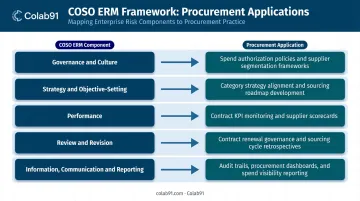
COSO is especially relevant for PE-backed companies and publicly traded firms where internal controls face external scrutiny.
Turning Frameworks into Practice
The most common failure: organizations adopt ISO or COSO language in policy documents but never connect those frameworks to actual procurement workflows, data, or tools. That gap shows up fast — Deloitte research found only 25% of organizations could identify and predict supply disruptions in a timely manner, a visibility problem that governance language alone cannot solve.
Practical bridges:
- Link risk scoring criteria to supplier segmentation tiers
- Automate compliance checks as part of contracting workflows
- Use spend analysis to flag high-risk categories for enhanced due diligence
Essential Tools for Procurement Risk Management
The shift from reactive to proactive risk management is largely a technology problem. Manual processes can't support continuous monitoring or cross-category risk visibility at scale.
Core Risk Management Artifacts
| Artifact | Function | Value When Connected to Live Data |
|---|---|---|
| Risk Register | Catalog of risks with owners and severity | Becomes dynamic; changes trigger actions |
| Risk Heat Map | Visual likelihood × impact matrix | Helps leadership prioritize attention |
| Risk Scoring Matrix | Quantitative prioritization tool | Enables consistent, auditable classification |
These artifacts work well in theory — but without live data feeding them, they're static snapshots that go stale fast. That's where technology comes in.
Procurement Technology Capabilities to Look For
Modern procurement platforms should deliver:
- Supplier financial health monitoring — continuous D&B scoring, credit signals, public financial data
- Sanctions and ESG screening — automated OFAC checks, ESG compliance flags
- Contract clause libraries — compliance alerts tied to renewal dates and key terms
- Spend anomaly detection — flags concentration risk and off-contract purchasing
- Risk-weighted spend exposure — connects supplier risk scores to actual spend, not just a risk list
Gartner reported in 2024 that 72% of procurement leaders were prioritizing GenAI integration. Deloitte's 2025 CPO research put a number on what that means: Digital Masters achieved 3.2x GenAI ROI versus 1.5x for laggards — a gap that widens as early adopters build on connected, intelligent infrastructure while others are still catching up.
Colab91's Supplier Risk Management platform pairs automated monitoring — covering financial health, OFAC/sanctions, ESG, geographic concentration, and cyber risk — with dedicated offshore analyst teams who execute mitigation, not just flag alerts. Risk scoring connects directly to spend at the supplier level, giving teams risk-weighted exposure visibility rather than raw scores divorced from dollar impact.
Proven Strategies to Mitigate Procurement Risk
Tools and processes create the infrastructure. Strategy determines how deliberately you reduce exposure before problems occur.
Supplier Diversification and Relationship Management
Over-reliance on a single source is one of the clearest and most preventable risk exposures in procurement. Deloitte's 2025 CPO Survey found 74% of CPOs identified finding alternative supply sources as an effective mitigation strategy, and McKinsey found 39% of organizations actively pursuing dual-sourcing in response to tariff and cost pressure.
Supplier diversification works best when paired with active supplier relationship management (SRM). Gartner reports that supplier collaboration rose in priority for 88% of procurement leaders over the past 24 months. Strong SRM practice surfaces risks earlier and preserves continuity for critical spend categories. That means:
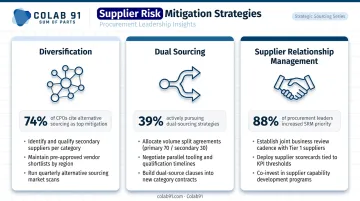
- Shared planning with key suppliers on demand and capacity
- Proactive communication before disruptions escalate
- Ongoing performance tracking tied to contract terms
Spend Analysis and Procurement Transparency
Spend analysis exposes what's hidden: rogue purchasing, off-contract vendor usage, concentration in high-risk suppliers. Procurement transparency, through traceable digital workflows and clear approval chains, closes the governance gaps that create compliance and financial exposure.
Deloitte found 64% of CPOs prioritized greater supply chain visibility and 61% focused on enhanced supplier information sharing as mitigation strategies. These aren't aspirational — they're responses to real exposure that spending data makes visible.
Translating that visibility into action requires connecting spend data to risk signals automatically. Colab91's Spend Analytics platform does this by linking financial exposure to supplier risk scores and surfacing concentration risk at the category level — without manual intervention.
Contingency Planning and Backup Sourcing
For mid-market and PE-backed companies with tighter timelines and fewer resources, contingency planning is structural protection against disruption:
- Pre-qualified alternative suppliers for critical categories
- Strategic inventory buffers where appropriate
- Documented crisis response protocols with clear ownership
This matters most during PE ownership timelines, when a supply disruption can directly compress EBITDA during a value-creation window.
Building Procurement Risk Management Capacity at Scale
Here's the gap most mid-market and PE-backed companies face honestly: they know continuous risk monitoring, spend analytics, and supplier intelligence need to happen — but they lack the headcount and specialized expertise to execute them at scale.
Only 14% of procurement leaders were confident their talent could meet future functional needs, according to Gartner's 2023 survey. Deloitte's 2025 CPO research named talent gaps as a top barrier for 34% of CPOs. Building a full in-house procurement analytics team is slow and expensive — particularly under PE ownership timelines where slow ramp-ups aren't an option.
One proven model: build a dedicated offshore procurement and analytics capability that augments the in-house team with domain-specialized practitioners handling continuous supplier monitoring, spend analysis, contract tracking, and risk reporting.
That's the model Colab91 builds for mid-market and PE-backed companies. It combines an AI-powered supplier risk platform with dedicated India-based procurement and analytics teams covering:
- Supplier financial health monitoring
- OFAC/sanctions screening and ESG compliance
- Spend anomaly detection
- Risk-weighted exposure analysis
- Contract tracking and ongoing category management
Teams deliver continuous intelligence on weekly or monthly cadence, with board-ready reports and on-demand category deep dives. PE sponsors including Carlyle Group, TPG, Elliott, and BC Partners have used this model across their portfolio companies to run high-quality procurement risk programs at a cost structure that in-house headcount can't match.
Frequently Asked Questions
What are the five major procurement risks?
The five core categories are supplier risk (performance failures, financial instability), contract risk (leakage from poor terms or governance), compliance risk (ESG violations, regulatory gaps), financial risk (budget overruns, currency exposure), and operational risk (process bottlenecks, system fragmentation). Market risk — pricing volatility and geopolitical disruption — is widely cited as a sixth.
What are the 4 types of risk management?
The four standard responses are: avoid (exit the exposure), transfer (shift risk via insurance or contract clauses), reduce/mitigate (dual-sourcing, controls, enhanced monitoring), and accept (retain the risk when the cost of mitigation exceeds its value).
What are the 5 P's of risk management?
One common version applicable to procurement: Predict (risk identification), Prevent (mitigation controls), Prepare (contingency planning), Respond (incident management), and Learn (post-event review and process improvement). The framework is a practical mnemonic rather than a formal ISO or COSO standard.
What is a procurement risk register, and why is it important?
A risk register is a documented catalog of identified risks, each with an assessed likelihood, potential impact, assigned owner, and mitigation plan. It's the foundational tool for making risk management systematic, visible, and audit-ready — and it only delivers value when connected to live supplier and spend data rather than maintained as a static document.
How does procurement risk management differ from supply chain risk management?
Procurement risk focuses on vendor selection, contracting, spend governance, and compliance within the buying organization's direct control. Supply chain risk management is broader — covering logistics, demand variability, multi-tier network disruptions, and physical distribution. Procurement risk is a subset of supply chain risk, but with distinct tools, ownership, and governance mechanisms.