
Introduction
India's offshore capability center market has become a core strategic lever for global companies - not a cost-cutting footnote. According to the Zinnov-NASSCOM India GCC Landscape Report, India's GCC market reached US$64.6 billion in FY2024, with over 1,700 GCCs employing 1.9 million professionals - a number that reflects not just scale, but momentum.
What's shifted is the scope. ODCs are no longer just software teams.
Today's offshore centers house procurement analysts, finance transformation specialists, spend intelligence experts, and AI-driven operations functions. That makes them directly relevant to PE-backed portfolio companies, mid-market businesses, and operations-heavy enterprises that wouldn't have historically considered offshoring.
This guide breaks down five of the top ODC firms in India so you can choose the right partner for your company's size, domain needs, and strategic goals:
- Which firms specialize in procurement, analytics, and domain-led functions
- What distinguishes each provider's model and strengths
- A practical framework for making the right choice
Key Takeaways
- An ODC is a dedicated offshore team that functions as an integrated part of your organization, not an outsourced vendor
- India holds roughly 50% of global GCCs, driven by deep talent pools, English fluency, and established delivery infrastructure
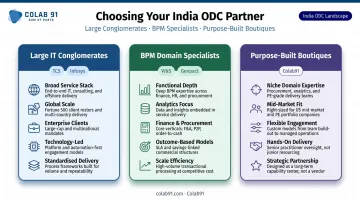
- The ODC landscape spans large IT conglomerates (TCS, Infosys) to BPM-focused specialists (WNS, Genpact) to purpose-built boutiques (Colab91)
- Firm size is not the right selection filter - domain depth, engagement flexibility, and fit for your company's scale matter more
- This guide profiles five firms and breaks down what makes an ODC partner the right fit - or the wrong one
Offshore Development Centers in India: A Quick Overview
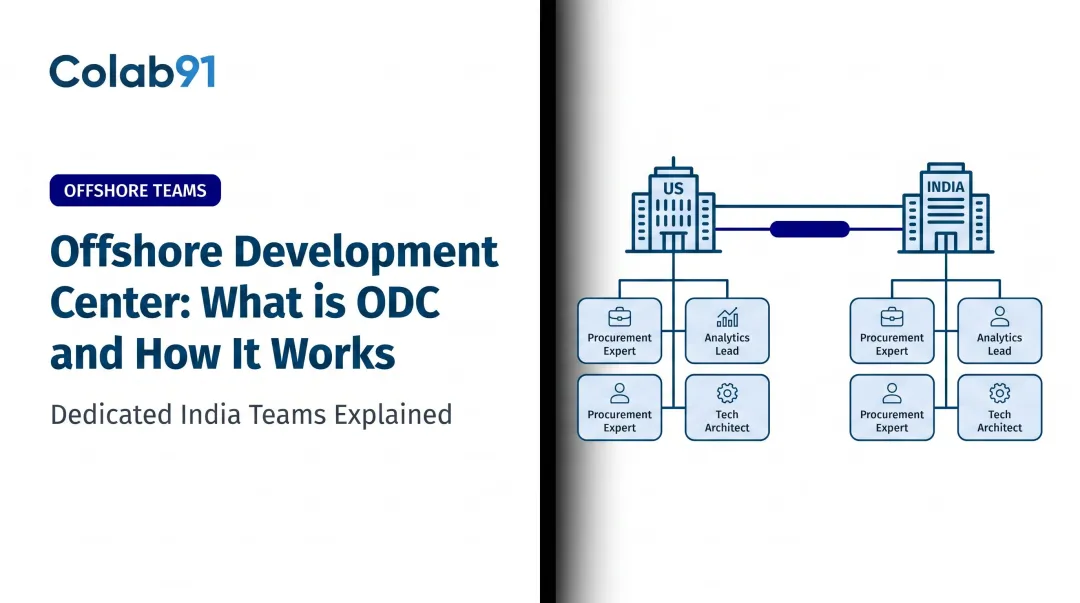
An offshore development center (ODC) is a dedicated team or facility established in another country that functions as an operational extension of the parent company. The key distinction from traditional outsourcing: it's not project-by-project. ODCs involve ongoing integration, shared processes, and continuity of people - the team knows your business, not just your requirements.
That makes location choice critical - and India's dominance here isn't accidental. Deloitte estimates India accounts for roughly 50% of global capability centers. A technology workforce exceeding 5 million professionals, strong English-language proficiency, and delivery infrastructure tested at enterprise scale for decades all reinforce that position.
Beyond Software Development
Many companies still associate Indian ODCs with software engineering. That's an outdated lens. The same Zinnov-NASSCOM report shows:
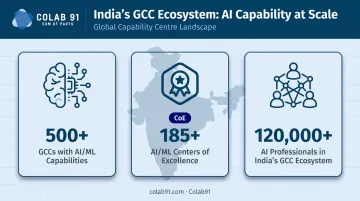
- 500+ GCCs in India now have active AI/ML capabilities
- 185+ dedicated AI/ML Centers of Excellence operate across the country
- 120,000+ AI professionals work within India's GCC ecosystem
Functions like spend analytics, procurement transformation, finance modeling, and supply chain intelligence are now core ODC deliverables - not edge cases. For mid-market companies and PE-backed businesses with complex indirect spend, that depth of available domain expertise changes the business case for offshoring entirely.
Top Offshore Development Center Firms in India
The firms below were selected based on domain depth, ability to scale teams, flexibility of engagement models, and fit across company sizes. The list intentionally spans large full-service providers to specialized capability center builders - the right choice depends on what you actually need.
Tata Consultancy Services (TCS)
TCS is India's largest software services exporter, with US$30 billion in consolidated revenue and 607,979 employees across 55 countries and 200+ delivery centers. For organizations that need to stand up large, complex, multi-function offshore teams quickly, TCS's bench depth and geographic reach are difficult to match.
Its ODC capabilities span the full technology and enterprise services stack, including AI CoEs, automation platforms (ignio, MasterCraft), and cloud-native delivery.
| Dimension | Detail |
|---|---|
| Core ODC Services | Software engineering, enterprise IT, analytics, BPO, cloud, AI-enabled business services |
| Ideal Client Profile | Large enterprises and multinationals with complex, multi-function offshore requirements |
| Engagement Model | Dedicated team, managed services, and hybrid models; highly customizable at scale |
Infosys
Infosys pioneered what it calls the Global Delivery Model and has since expanded into what it describes as "borderless ODCs" - delivery structures built around Centers of Excellence in AI, generative AI, quantum computing, cybersecurity, and mixed reality. With 323,578 employees across 59 countries and platforms like Infosys Topaz and Infosys Cobalt, it's a strong fit for clients pursuing technology-led transformation alongside offshore delivery.
Infosys BPM also offers Build-Operate-Transfer (BOT) structures, allowing clients to eventually take ownership of their India capability center after an initial partner-led setup phase.
| Dimension | Detail |
|---|---|
| Core ODC Services | Digital transformation, cloud, AI/ML, data analytics, ERP, and BPM |
| Ideal Client Profile | Mid-to-large enterprises undergoing digital modernization or analytics-led transformation |
| Engagement Model | Long-term ODC contracts with dedicated pods, Centers of Excellence, and BOT options |
WNS Global Services
WNS is a business process management firm with US$1.3 billion in FY2025 revenue and 65 delivery centers worldwide. Unlike TCS and Infosys, which lead with technology delivery, WNS focuses on domain-specific analytics and business process outsourcing - particularly for finance and accounting, procurement support, and industry-specific BPM across insurance, healthcare, and financial services.
Its decision science and analytics capabilities make it relevant to organizations that need offshore teams with genuine functional depth, not just execution bandwidth.
| Dimension | Detail |
|---|---|
| Core ODC Services | Analytics, finance & accounting, procurement support, industry-specific BPM, decision science |
| Ideal Client Profile | PE-backed firms, insurers, financial services companies, and mid-to-large enterprises with data-heavy operations |
| Engagement Model | FTE-based, transaction-based, and outcome-based pricing; flexible scaling with embedded analytics teams |
Genpact
Genpact reported US$5.08 billion in net revenues for 2025 and employs over 146,500 professionals across 35+ countries. Its India delivery footprint is substantial, with a sharp focus on finance transformation, procurement analytics, and AI-enabled operations.
Genpact's Lean Digital methodology combines process intelligence with technology - particularly relevant for CFO-suite functions like spend analytics, working capital management, and accounts payable automation.
It has a documented track record serving Fortune 500 firms and PE portfolio companies in these domains.
| Dimension | Detail |
|---|---|
| Core ODC Services | Finance transformation, procurement analytics, supply chain intelligence, AI-enabled BPM |
| Ideal Client Profile | Fortune 500 companies, PE-backed portfolio businesses, enterprises with complex finance and procurement functions |
| Engagement Model | Managed services, dedicated capability centers, and transformation program partnerships |
Colab91
Colab91 is a Gurugram-based capability center firm founded by former leaders of Impendi - a US-based procurement analytics firm later acquired by Accenture. Managing Partners Madhur Kabra (ex-Country Head, Impendi India) and Vijender Kapoor (ex-Principal, Impendi) spent two decades building and scaling offshore organizations.
They founded Colab91 to address a gap they saw firsthand: mid-market and PE-backed companies were being underserved by large generalist ODC providers.
Their most relevant proof point: they scaled Impendi's India operations to 100+ practitioners serving Carlyle Group, TPG, Elliott, and BC Partners. That experience - building a specialized offshore function from scratch for PE clients - is what informs Colab91's model.
What distinguishes Colab91 from the others on this list:
- Domain concentration: Procurement analytics, spend intelligence, and strategic sourcing - not broad IT delivery
- Client focus: Mid-market companies and PE-backed portfolios, not Fortune 500 enterprises
- Engagement design: Flexible models that keep strategic control with the client, with full lifecycle support from design through scaling
- "Sum of Parts" model: Onshore expertise (from leaders like Jeff Skiles, Director of USA Operations, and advisor Erika Jung, former CPO at Pediatric Associates) paired with offshore execution
| Dimension | Detail |
|---|---|
| Core ODC Services | Procurement analytics, strategic sourcing, spend intelligence, process transformation, AI-powered capability center design |
| Ideal Client Profile | Mid-market companies and PE-backed portfolio businesses seeking domain-expert offshore teams in procurement and analytics |
| Engagement Model | Flexible models with strategic control retained by the client; full lifecycle support from design through scaling |

How We Chose These ODC Firms
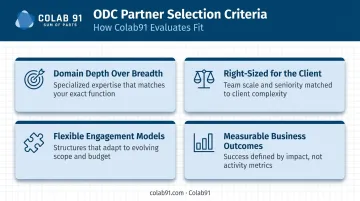
The firms on this list were selected on four criteria - and none of them is brand recognition.
1. Domain depth over breadth The most useful ODC partners have concentrated expertise in the specific function you need to offshore. Domain specialists reduce ramp-up time because they're not learning your industry from scratch - they've already solved similar problems for clients like you.
2. Right-sized for the client Mid-market companies - those with $50M–$500M in revenue, or PE-backed portfolios in growth mode - need more hands-on engagement design, faster time-to-productivity, and a provider who isn't routing them through junior account teams. Match matters.
3. Flexible engagement models The best ODC relationships protect client control - over strategy, over IP, over how the team evolves. Firms that only offer managed services with limited transparency aren't ODC partners; they're sophisticated vendors.
4. Measurable business outcomes Providers worth hiring track ROI, cost savings, and cycle time reduction alongside headcount and utilization - not just delivery metrics.
A common mistake: companies over-index on firm size and reputation while underweighting whether the provider has delivered for companies at a similar stage of maturity.
A PE-backed portfolio company in year two of a value creation program has different urgency, different governance tolerance, and different talent needs than a Global 2000 enterprise running a five-year transformation. The right ODC partner understands that difference before the first statement of work.
Conclusion
Choosing an ODC firm in India is a strategic decision. The right partner aligns with your domain requirements, your operating model preferences, and your growth trajectory - not just your cost targets.
Large providers like TCS and Infosys offer unmatched scale and breadth for enterprise clients with complex, multi-function requirements. WNS and Genpact bring genuine domain depth in BPM, analytics, and finance transformation.
For mid-market and PE-backed businesses that need specialized expertise in procurement or analytics, Colab91 offers a purpose-built model at the right scale - with direct experience building India teams for clients like Carlyle Group and TPG.
Look past the marquee names. Assess each provider on: depth of expertise in your target function, track record with companies at your stage, and whether their engagement model keeps you in strategic control - not just as a delivery vendor.
If you're a mid-market or PE-backed business looking to build a high-performing India team in procurement or analytics, Colab91 is worth a conversation. Their engagement model is built around your specific function, your team size, and your operating priorities - with the flexibility enterprise providers rarely offer at this scale. Request a consultation to see how a dedicated capability center could improve procurement performance and analytics output for your business.
Frequently Asked Questions
What is an offshore development center (ODC)?
An ODC is a dedicated team or facility established in a foreign country that operates as an extension of the parent company. Unlike traditional outsourcing, the relationship is ongoing: the team integrates with your processes, culture, and strategic goals rather than delivering isolated project work.
Is an offshore development center (ODC) the same as outsourcing?
They're related but distinct. Outsourcing delegates work to a third-party vendor with limited client oversight. An ODC is a dedicated team aligned to your processes and long-term direction, offering greater transparency, continuity of people, and strategic integration. The key difference is control.
What is the difference between a GCC and an ODC?
A GCC (Global Capability Center) is typically a fully owned subsidiary with P&L responsibility and broader functional scope - including strategy, finance, and R&D. An ODC is usually operated through a partner organization, focused on specific delivery functions, and involves lower setup complexity. GCCs suit large enterprises; ODCs are more accessible for mid-market companies.
How do you set up an offshore development center in India?
Core steps include:
- Define your business objectives and target functions
- Select a location and engagement model
- Establish legal and compliance frameworks
- Recruit talent, often through a local partner
- Build governance structures to align onshore and offshore teams
Which types of companies benefit most from ODCs in India?
Large enterprises and tech companies led early ODC adoption, but mid-market firms and PE-backed companies are now significant - and fast-growing - beneficiaries. Zinnov-NASSCOM data shows 480+ mid-market GCCs now operating in India, employing 210,000+ professionals - with 35% established in just the last two years.
How much does it cost to set up an offshore development center in India?
Setup costs vary by function, team size, location, and engagement model. Key cost drivers include legal entity setup, office infrastructure, HR and recruiting, compliance, and BOT transition fees (if applicable). One verified benchmark: Tier II/III Indian cities offer a 25–30% cost advantage over Tier I metros like Mumbai or Bangalore.