Introduction
Procurement leaders at mid-market and PE-backed companies face a familiar bind: deliver strategic cost savings, improve supplier performance, and establish spend visibility, all while running lean teams already stretched across day-to-day operations.
Category management is the primary engine of procurement value creation. Yet executing it well requires domain expertise, continuous market intelligence, and dedicated bandwidth that most internal teams simply cannot sustain across every spend area simultaneously.
According to the Hackett Group's 2024 CPO Agenda research, procurement workload is expected to rise 8% while headcount and budgets remain largely flat - creating a 6.6% productivity gap that only widens as category complexity grows.
This article makes a direct case: outsourcing category management is not a concession of control. It is a deliberate strategic choice - one that gives organizations specialized expertise, proven processes, and scalable infrastructure without building an expensive in-house function from scratch.
Key Takeaways
- Category management groups related spend holistically to create sustained value, not one-time cost cuts
- Mid-market and PE-backed teams typically lack the bandwidth and category depth to sustain this across all spend areas
- Outsourcing provides immediate access to specialist talent, market benchmarks, and analytics infrastructure
- The right partner functions as a strategic extension of your team, owning outcomes rather than just executing tasks
What Is Category Management in Sourcing?
The Core Definition
CIPS defines category management as organizing procurement resources to focus externally on supply markets - grouping related products and services into categories and managing each as its own business unit. The goal is not simply to buy cheaper, but to manage the full spend lifecycle with the same strategic discipline applied to a business unit with its own P&L.
Category management is not a sourcing event. It is an ongoing discipline that shapes sourcing decisions - what gets bought, under what terms, and through which supplier relationships - across the category's entire lifecycle.
Category Management vs. Strategic Sourcing
These two terms are frequently conflated, but they operate at different levels:
| Strategic Sourcing | Category Management | |
|---|---|---|
| Focus | Supplier selection and contract negotiation | Full spend lifecycle governance |
| Time horizon | Event-based, time-bound | Continuous, cyclical |
| Primary output | Signed contract | Category strategy, supplier relationships, compliance |
| Value creation | One-time savings | Sustained cost optimization and risk management |
Strategic sourcing is a tool used to execute category plans - not a substitute for having a plan in the first place.
The Five Principles That Make It Work
Effective category management rests on five interconnected principles:
- Spend analysis - accurate, structured visibility into what is being spent, with whom, and under what terms
- Price management - continuous benchmarking against market rates to prevent cost creep
- Demand management - understanding consumption patterns and eliminating unnecessary or duplicative purchasing
- Supplier performance management - ongoing monitoring of SLA compliance, quality, and relationship health
- Growth management - identifying where supplier innovation or strategic partnerships can create new value
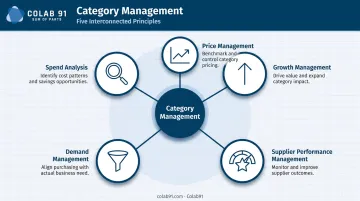
Sustaining all five simultaneously - across multiple categories and shifting market conditions - is where most in-house teams hit a ceiling. That capacity gap is precisely what makes outsourcing a strategic option worth examining.
Why Internal Category Management Falls Short
The Bandwidth Problem
Most procurement teams at mid-market organizations are generalists. A single category manager might be responsible for IT, facilities, HR services, and professional services simultaneously - none of which they can monitor with the depth the category deserves.
Deloitte's 2023 Global CPO Survey, covering nearly 350 procurement leaders across 40+ countries, found over 70% had difficulty attracting specialist talent. The skills gap is structural, not just a matter of finding the right hire.
The PE-Specific Pressure
PE sponsors typically expect procurement value creation to begin within the first 100 days. McKinsey's analysis of PE value creation found that procurement delivers over 20% of total financial impact across transformation initiatives - making it one of the highest-leverage levers available to sponsors.
Internal teams at newly acquired portfolio companies are rarely configured for that pace. Hiring specialist category managers takes three to six months and competes directly with other value-creation priorities for budget and attention.
The Data and Visibility Gap
Without a consistent spend taxonomy and centralized data infrastructure, category management becomes guesswork. Ardent Partners' CPO Rising research found that average spend under management reached 71% in 2025 - the first time above 70% in 20 years of tracking. That means roughly 29% of enterprise spend still operates outside procurement's structured oversight.
The consequences compound over time:
- Price creep across unmonitored supplier relationships
- Off-contract purchasing that erodes negotiated savings
- Fragmented supplier bases that reduce leverage
- SLA non-compliance that surfaces too late to recover
Indirect Categories Are the Hardest
Indirect spend categories are among the most demanding to manage well. Each requires continuous tracking across distinct dimensions:
- IT and telecoms: rapid pricing shifts and new entrant disruption
- HR/contingent labor: regulatory exposure and rate volatility
- Facilities management: SLA complexity and vendor fragmentation
- Professional services: scope creep and utilization blind spots
These categories move fast. Without dedicated expertise, most lean teams lack the structural capacity to keep pace - regardless of effort.
The Strategic Case for Category Management Outsourcing
Capability Access, Not Cost Cutting
The primary value of outsourcing category management is not headcount reduction. It is immediate access to domain expertise, market benchmarks, and proven methodologies that would take years and significant investment to build in-house.
Deloitte's 2025 CPO Survey makes the performance gap concrete. Digital leaders - organizations with mature data and analytics infrastructure - consistently outperformed followers across every key metric:
| Performance Metric | Leaders | Followers |
|---|---|---|
| Cost savings met or exceeded plan | 96% | 80% |
| Cost avoidance met or exceeded plan | 94% | 75% |
| Supplier performance met or exceeded plan | 84% | 59% |
| Innovation enablement met or exceeded plan | 56% | 24% |
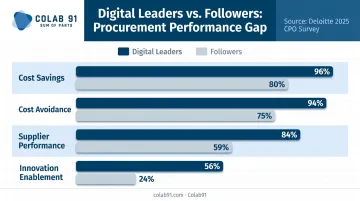
The gap is not marginal. Organizations with access to analytics infrastructure and specialist talent outperform those without by 15–30 percentage points on the metrics that matter most to procurement leadership.
The Sum of Parts Model
The most effective outsourcing relationships augment in-house procurement talent rather than replace it. Colab91's "Sum of Parts" model is built on this principle: offshore category management teams embed alongside internal functions, filling capability gaps while preserving institutional knowledge and cultural context.
Unlike traditional BPO, Colab91's India-based teams are built with domain experts who are front-end, AI-trained, and designed to integrate with clients' existing procurement culture - acting as an extension of the internal team, not a separate service bureau.
The Offshore Capability Center Advantage
Building a dedicated India-based team of procurement and analytics specialists - rather than engaging a transactional BPO - creates a durable, scalable hub that serves global operations with genuine domain depth.
Colab91's leadership has spent 16+ years doing exactly this. Managing Partner Madhur Kabra, formerly Country Head of Impendi's India operations (later acquired by Accenture), helped scale a multifunctional offshore organization to 100+ practitioners serving clients including Carlyle Group, TPG, Elliott, and BC Partners. That track record of building capability centers that deliver strategic value, not just process execution, sets the standard for what offshore category management can deliver.
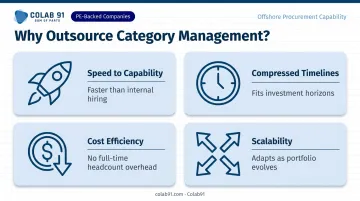
For PE-backed companies, this model is particularly compelling. Key advantages include:
- Stands up category management capability far faster than internal hiring
- Compresses sourcing timelines to fit investment horizons
- Delivers measurable cost and performance results without the overhead of full-time headcount
- Scales up or down as portfolio needs evolve
What Effective Category Management Outsourcing Actually Delivers
Spend Visibility and Cost Optimization
Outsourcing partners bring structured spend analysis methodologies that consolidate fragmented purchasing data, map spend to a consistent taxonomy, and identify where off-contract purchasing is eroding savings. The result is a single source of truth across categories - and better-negotiated contracts built on accurate baseline data rather than estimates.
Supplier Performance and Risk Management
Dedicated category managers continuously monitor:
- SLA compliance and performance trend data
- Benchmark pricing against current market rates
- Supply chain risk signals and concentration exposure
- Contract renewal timelines and renegotiation opportunities
Internal teams typically address these issues reactively - after problems have already materialized. Outsourced category management shifts this to proactive, continuous oversight.
Operational Scalability
Outsourcing eliminates the need to hire, train, and retain specialist category managers across every spend area. Organizations can scale category coverage based on priority without taking on permanent fixed costs.
For PE portfolio companies undergoing M&A, integration, or carve-out, this flexibility is particularly valuable. Colab91's engagement models are scale-agnostic - designed to adapt to each situation's size, scope, and complexity, including rapid expansion across newly acquired spend categories.
Strategic Organizational Value
Effective outsourcing partners move procurement beyond transactional execution. The real value lies in building organizational capability that compounds over time. They help organizations:
- Build governance structures and category roadmaps
- Develop internal procurement maturity over time
- Implement AI-powered spend analytics that remain as durable assets post-engagement
- Create reporting infrastructure that gives leadership real-time visibility
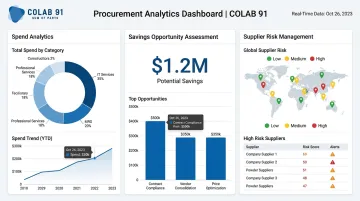
Colab91's AI-powered suite - covering spend analytics, savings opportunity assessment, and supplier risk management - is built as a unified data layer that persists beyond the engagement. Clients walk away with a functioning procurement intelligence system, not a project deliverable that goes stale.
Choosing the Right Category Management Outsourcing Partner
Not all outsourcing partners deliver the same value. Three criteria separate genuine strategic partners from vendors who execute tasks.
Domain Depth Over Generalist Breadth
The right partner must demonstrate verifiable expertise in your specific spend categories - not just broad procurement knowledge. Look for:
- Benchmarking access and category-specific track records
- Market intelligence from comparable organizations and industries
- Leadership with hands-on experience in PE operating environments
Colab91's team includes practitioners who have operated at every level of the procurement function. Advisor Erika Jung is a former CPO who led procurement transformation at Pediatric Associates (a TPG portfolio company) and Fortune 100 organizations. The firm's managing partners bring 16+ years each scaling offshore delivery centers for clients including Carlyle Group, TPG, and Elliott. That combination of CPO-level strategic experience and operational delivery track record is what domain depth actually looks like in practice.
Technology and Analytics Capabilities
A strong outsourcing partner should bring data infrastructure your internal team can inherit and use long after the engagement begins. Before committing, ask:
- How do you consolidate fragmented spend data across multiple ERP and procurement systems?
- Can you automate reporting and anomaly detection, or is analysis done manually?
- What does the client retain when the engagement evolves?
Partners who can answer these questions specifically with real tools, not theoretical frameworks, are the ones who build something that lasts beyond the engagement.
Engagement Model Flexibility
Evaluate whether the partner offers modular entry points - starting with spend analytics or one high-priority category, then scaling as results build - rather than requiring full-scope commitment upfront.
The best partners think in terms of long-term capability building alongside your team. That expectation is well-founded: according to Everest Group, the procurement outsourcing market reached $5.2 billion in 2024 and grew 8–10% - a scale that reflects how seriously organizations are treating these partnerships. The right partner won't just execute categories; they'll build the capability your team still uses five years from now.
Frequently Asked Questions
What is category management in sourcing?
Category management in sourcing is the practice of grouping related organizational spend into defined categories and managing each holistically: from spend analysis and market research through supplier negotiation and ongoing performance management. The goal is sustained value creation across the full spend lifecycle - not a single round of savings.
What are the five key principles of category management?
The five principles are supplier performance management, demand management, price management, spend analysis, and growth management. Each requires dedicated focus, and sustaining all five simultaneously across multiple categories is what makes category management difficult to execute with a lean internal team.
What are the five phases of category management?
The typical phases are: spend and demand analysis, supplier and market assessment, category strategy development, strategy execution (sourcing, contracting, supplier management), and ongoing review and optimization. The process is cyclical - completion of the review phase feeds back into analysis, not a conclusion.
When should a company consider outsourcing category management?
Outsourcing makes the most sense when internal teams lack category-specific expertise, when speed-to-value is critical (especially in PE-backed situations), or when complex indirect categories require continuous market monitoring. If the cost of dedicated category managers across all spend areas exceeds the outsourcing investment, the numbers favor outsourcing.
How is category management outsourcing different from strategic sourcing?
Strategic sourcing is a supplier selection and contract negotiation event. Category management outsourcing covers the full ongoing lifecycle - strategy, governance, compliance, and supplier relationships. It is a broader and more continuous engagement that treats each spend category as an actively managed business unit.
What makes a category management outsourcing partner effective for PE-backed companies?
Speed matters first - measurable results must arrive within tight investment timelines. Beyond that, effective partners bring deep familiarity with PE operating models and the ability to build scalable offshore capability that remains a durable asset to the portfolio company long after the initial engagement concludes.