Introduction
Procurement leaders are operating in a more unforgiving environment than at any point in recent memory. Tariff volatility - from US-China Section 301 escalations to EU reciprocal duty adjustments - is rewriting landed cost assumptions mid-contract. Geopolitical fragility is making single-source dependencies look like a liability.
CFOs are scrutinizing third-party spend harder than ever. For PE-backed companies navigating compressed investment timelines, sourcing functions are now being held to EBITDA contribution standards, not just compliance benchmarks.
Strategic sourcing has moved from a back-office function to a direct lever for enterprise value creation.
What separates high-performing sourcing functions is a systematic, data-driven approach to spend allocation - one that builds supplier resilience and long-term cost efficiency, not just lower unit prices on individual purchase orders.
This guide covers five practice areas that high-performing procurement teams are executing differently in 2026.
Key Takeaways
- Spend visibility comes before any sourcing decision - without it, you're negotiating blind
- Supplier segmentation determines where to invest relationship depth and where to optimize for efficiency
- Risk management belongs throughout the sourcing lifecycle, not just at contract signing
- AI accelerates sourcing tasks but only produces results when backed by clean data and human judgment
- Mid-market companies can now access enterprise-grade sourcing capability through offshore domain teams
Why 2026 Demands a Sharper Sourcing Strategy
The old sourcing playbook - annual RFPs, price benchmarking, reactive supplier swaps - was designed for stable markets. That's not what sourcing teams are navigating now.
According to Deloitte's 2023 Global CPO Survey, 70% of respondents said procurement-related risk or supply chain disruption increased in the prior 12 months, with 43% reporting a significant increase - more than double the 20% who said the same in 2021. That's not a blip; it's a structural shift.
Tariffs have become a direct sourcing cost variable, requiring active management across categories:
- US Section 301 modifications raised EV tariffs to 100% and semiconductor tariffs to 50% on Chinese-origin goods
- EU reciprocal tariff adjustments have altered landed cost calculations for a wide range of European-origin categories
- PwC's May 2025 Pulse Survey found 65% of executives were renegotiating supplier pricing or planned to, and 76% were reconsidering their company's presence in China
For PE-backed companies, the pressure compounds. McKinsey research found that GPs focused on asset operations generated IRR up to 2-3 percentage points higher on average. Sourcing functions are increasingly a lever for that operations-led value creation, and portfolio company CPOs are being measured on their ability to move that needle.
What separates high-performing sourcing teams in this environment isn't speed of reaction - it's the depth of capability built to handle sustained pressure. The practices below reflect what that looks like in practice.
Best Practice 1: Build Real Spend Visibility Before You Source
Mapping Spend Before You Negotiate
The most common and expensive mistake in sourcing is launching supplier negotiations without a clean, categorized view of what the organization is actually spending. Without that foundation, teams waste leverage, miss consolidation opportunities, and negotiate from a position of incomplete information.
According to Ardent Partners' 2025 procurement metrics research, average Spend Under Management sits around 63% - meaning roughly a third of organizational spend is operating outside structured sourcing oversight. That's a significant pool of unmanaged opportunity.
Effective spend analysis involves several interconnected steps:
- Consolidate data from all ERP and AP systems into a single working dataset
- Normalize supplier names to eliminate duplicates (the same vendor appearing under 12 different spellings is a common occurrence)
- Classify spend by category using a consistent taxonomy - UNSPSC is the most widely used standard for this
- Apply a Pareto lens - the top 20% of spend categories typically drive 80% of the savings opportunity
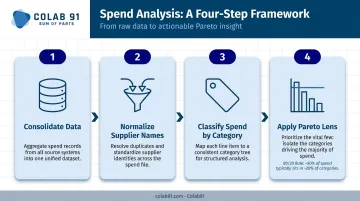
The output is a maintained data layer - not a one-time report - that sourcing decisions continuously draw from.
Before launching any RFP or negotiation, sourcing teams should have three things in hand: a category spend map, an inventory of fragmented spend (same item, multiple suppliers, different prices), and a prioritized list of sourcing opportunities ranked by potential savings impact.
Category Strategy Before Supplier Outreach
Once you know where to focus, category strategy determines how to compete in each target market.
Before going to market, sourcing teams need to understand three dimensions of each target category:
- Supply market structure - How many qualified suppliers exist? What are the switching costs? Where is the market pricing trending?
- Internal demand profile - What are the volumes, variability patterns, and specification requirements?
- Total Cost of Ownership - Not just unit price, but quality failure costs, lead time risk, onboarding burden, and supplier reliability
TCO thinking consistently produces better sourcing decisions than price-only comparisons. The classic failure mode: a lowest-bid supplier wins the RFP, then generates recurring quality failures, expedited freight charges, and defect management hours - ending up 15-20% more expensive than the next-best option.
As ISM notes, price-focused methods ignore acquisition costs - delivery, installation, maintenance, infrastructure changes. Those costs are real whether or not they appear in the initial negotiation.
Best Practice 2: Segment Suppliers and Invest in Strategic Relationships
Not every supplier deserves the same level of governance, attention, or relationship investment. Treating them all the same is a resource allocation failure.
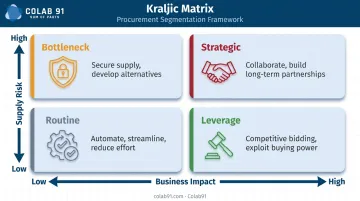
The Kraljic Matrix - introduced in Peter Kraljic's foundational 1983 HBR article "Purchasing Must Become Supply Management" - provides the most widely used framework for supplier segmentation. It classifies suppliers across two axes: supply risk and business impact. The result is four categories:
| Segment | Risk | Impact | Management Approach |
|---|---|---|---|
| Strategic | High | High | Executive QBRs, joint planning |
| Leverage | Low | High | Competitive sourcing, volume consolidation |
| Bottleneck | High | Low | Risk mitigation, dual sourcing |
| Routine | Low | Low | Automation, efficiency focus |
Strategic vs. Transactional Supplier Relationships
Strategic suppliers - those with high impact and high risk - warrant a fundamentally different engagement model than transactional vendors.
Strategic supplier management looks like:
- Executive-level quarterly business reviews
- Joint performance improvement plans
- Shared demand forecasts and capacity planning
- Co-investment in process or product innovation
- Proactive communication on supply risk and market changes
Transactional supplier management looks like:
- Competitive re-bidding on a defined cycle
- Compliance monitoring against contract terms
- Efficiency-focused transaction processing
Investing in strategic supplier relationships has a direct operational payoff. Suppliers who trust their customers prioritize your capacity needs during shortages first. They surface cost reduction ideas proactively - rather than waiting for those ideas to be extracted through negotiation - and they flag supply risk early, before a disruption becomes your problem.
Supplier Performance Management
Relationship investment only pays off when it's connected to accountability. A rigorous supplier performance management process requires:
- KPIs set at contract signing: on-time delivery, quality defect rate, responsiveness, cost compliance
- Scorecards updated continuously - not assembled from memory when a review is due
- Performance reviews where the data leads, not the relationship
That performance data should feed directly back into sourcing decisions. Underperforming suppliers get re-sourced. Top performers earn volume consolidation or preferred partnership status. Over time, this builds a supplier base that competes to stay in - which is a more durable lever than renegotiating the same contracts year after year.
Best Practice 3: Embed Risk Management Across the Sourcing Lifecycle
Supply chain risk isn't an edge case anymore. It's a permanent operating condition. Strategic sourcing teams need to embed risk identification and mitigation at every stage of the sourcing lifecycle - starting well before contract signing.
Pre-qualification: Assess financial health, geographic concentration, ESG compliance, and production capacity before a supplier enters the approved vendor list.
Contracting: Build in SLAs with teeth, force majeure language calibrated to current risk scenarios, and clear exit provisions that don't create leverage inversions.
Ongoing monitoring: Track geopolitical triggers, financial distress signals, and delivery performance data - continuously, not only when something breaks.
Supplier Diversification and Dual Sourcing
For any category where a single supplier represents a concentrated share of total supply, the organization is carrying undisclosed risk. The discipline is straightforward: identify sole-source or heavily concentrated categories, then build secondary supplier qualification plans before disruption forces the issue.
BCG's 2025 supply chain research calls this the "cost of resilience" model - accepting that some diversification increases near-term cost in exchange for agility and continuity when disruption hits.
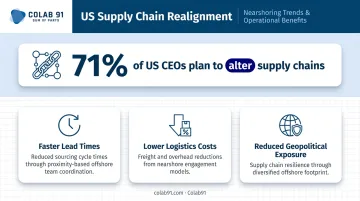
Nearshoring is gaining traction as part of this diversification push. Companies that built supply bases concentrated in offshore low-cost regions are now adding regional suppliers as a deliberate portfolio decision. The operational case is concrete:
- Faster lead times with reduced transit variability
- Lower logistics costs as fuel and freight rates shift
- Reduced geopolitical exposure in high-concentration corridors
Deloitte reports 71% of US CEOs plan to alter supply chains over the next three to five years, with supply footprint diversification as a primary driver.
Scenario Planning as a Sourcing Tool
Leading sourcing teams run scenario planning exercises that model what happens to cost and supply continuity under specific disruption cases - tariff escalation, supplier insolvency, port disruption, currency shifts. The goal isn't prediction. It's identifying where the current strategy is brittle, and what contingency actions need to be pre-built.
Teams that run these exercises regularly arrive at sourcing decisions already stress-tested against the scenarios most likely to derail them.
Best Practice 4: Use AI as a Force Multiplier, Not a Replacement for Judgment
AI's role in strategic sourcing in 2026 is real, but it's also more specific than the hype suggests. The Hackett Group reports that 64% of procurement leaders expect AI and GenAI to transform their roles within five years. Meanwhile, Gartner noted that GenAI for procurement hit the peak of inflated expectations in 2024 - which means organizations are now sorting out where AI actually delivers versus where it promised more than it delivered.
The highest-impact AI use cases for mid-market sourcing teams are:
- Automated spend categorization: eliminates weeks of manual data classification with taxonomy mapping that improves over time
- Market price benchmarking: surfaces real-time pricing signals across categories without analyst-hours of research
- Supplier risk signal monitoring: scans continuously for financial distress, geopolitical exposure, and news triggers
- Contract clause analysis: flags non-standard terms, compliance gaps, and missing protections at scale
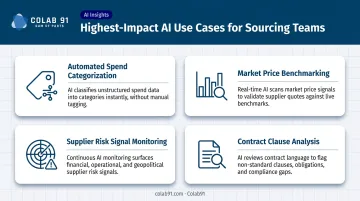
For resource-constrained sourcing teams, these are genuine force multipliers. Tasks that took weeks compress to days. Patterns that would go unnoticed in manual review surface automatically.
The critical caveat: AI tools produce poor outputs when fed unclean, uncategorized data. Spend classification AI trained on messy ERP exports generates confident-sounding but inaccurate categories. Supplier risk tools that can't reconcile normalized supplier names across systems flag the wrong entities.
The clean data foundation described in Best Practice 1 is a prerequisite for effective AI deployment, not a parallel workstream. Organizations that skip data hygiene and jump directly to AI tooling end up with analysis that looks polished but misleads decision-making.
Colab91's spend analytics platform is built on this principle, treating the underlying data layer as a "unified, durable data layer that AI can learn from, not just store." When sourcing decisions depend on the output, that architecture difference is what separates useful insight from expensive noise.
Best Practice 5: Scale Sourcing Capability Without Scaling Headcount Proportionally
The Talent Gap Facing Mid-Market Companies
Enterprise-grade strategic sourcing requires a combination of skills that is genuinely expensive to assemble internally: category specialists, spend analysts, supplier research expertise, and contract management capability. Deloitte's 2023 CPO Survey found that more than 70% of CPOs had difficulty attracting procurement talent over the prior 12 months - and the market hasn't loosened since.
Most mid-market companies are running underpowered sourcing functions relative to their spend complexity. A team of three handling $300M in third-party spend can't realistically run structured category strategies, supplier performance programs, spend analysis, and market benchmarking simultaneously.
The Hybrid Model in Practice
Leading mid-market and PE-backed companies are solving this with a hybrid structure: a lean onshore team focused on strategy, stakeholder management, and supplier relationships, paired with an offshore capability center handling the analytical and operational workload at scale.
The offshore team's typical scope includes:
- Spend data consolidation, classification, and analysis
- Supply market research and benchmarking
- RFP support and bid analysis
- Supplier performance data maintenance and scorecard tracking
- Supplier risk monitoring
The offshore team needs to be embedded in the sourcing process - with access to the same data infrastructure, category-level playbooks, and regular onshore-offshore communication cadences that keep both teams aligned on priorities.
Colab91 builds these India-based sourcing teams as strategic extensions of the onshore function. The model draws directly from the team's experience scaling Impendi's India operations from the ground up to 100+ practitioners, serving clients including Carlyle Group, TPG, Elliott, and BC Partners.

That experience shaped a clear view of what separates high-performing hybrid models from arrangements that deliver disconnected task completion. Offshore teams that integrate deeply with client culture and processes - acting as a true extension of the in-house function - deliver compounding value over time, not just one-time cost savings.
Frequently Asked Questions
What is the future of strategic sourcing?
Strategic sourcing is moving toward AI-augmented, data-driven decision-making with a stronger emphasis on risk resilience, ESG compliance, and total value over unit cost. Sourcing teams will increasingly function as strategic advisors embedded in business planning cycles - shaping decisions before contracts are written, not after they expire.
What are the key steps in strategic sourcing?
The core sequence runs: spend analysis and category prioritization → supply market research → strategy development (segmentation, TCO analysis) → supplier selection and negotiation → contract execution with defined KPIs → continuous performance monitoring. Each step informs the next - skipping spend analysis to start with supplier outreach consistently produces weaker outcomes.
How is strategic sourcing different from traditional procurement?
Traditional procurement focuses on executing purchase transactions efficiently - buying what's requested at an acceptable price. Strategic sourcing takes a planning-first approach, analyzing spend, structuring supplier relationships proactively, and making sourcing decisions that serve long-term business objectives rather than just responding to immediate purchase requests.
What role does AI play in strategic sourcing in 2026?
AI accelerates specific tasks - spend classification, market benchmarking, supplier risk monitoring, and contract analysis - but requires clean data and human judgment to generate reliable strategic insights. Organizations that implement AI on top of poor data end up with inaccurate analysis that looks credible, which is often worse than no analysis at all.
How can mid-market companies build strategic sourcing capability without large procurement teams?
The most effective model pairs a lean onshore team focused on strategy and relationship management with a specialized offshore capability center handling analytics, research, and operational sourcing support. This gives mid-market companies access to enterprise-grade sourcing capability at a cost structure appropriate for their scale - without the overhead of building a large internal function.