Offshore sourcing, done right, is one of the most direct answers to that gap. But the distinction between transactional outsourcing and strategic offshore capability-building is the difference between a one-time cost play and a durable competitive advantage.
This article covers what offshore sourcing actually means in the context of business services, the strategies that drive both productivity and cost efficiency, the risks worth taking seriously, and how to choose the right model for your business stage.
Key Takeaways
- Offshore sourcing generates the most value when treated as a strategic capability, not a vendor contract
- India remains the top destination for mid-market companies seeking procurement, analytics, and operational talent
- Domain expertise paired with offshore efficiency drives results — cost arbitrage alone falls short
- Clear KPIs and governance structures separate high-performing offshore teams from underperforming ones
- A capability center delivers faster time-to-value than a generic BPO or a full captive build
What Is Offshore Sourcing?
Offshore sourcing, in the context of business services, means building or engaging teams in a foreign country to deliver specific business functions — procurement, analytics, finance, IT, and operations being the most common. This is distinct from importing goods; the focus here is on sourcing talent and capabilities.
The more important distinction is structural:
- Transactional outsourcing — companies hand tasks to a third-party vendor at arm's length, with limited strategic integration and little shared ownership of outcomes
- Strategic offshore sourcing — dedicated offshore teams operate as extensions of the parent organization, embedded in governance structures and accountable for measurable results
That structural choice determines how you hire, onboard, and manage the team — and how much value it ultimately delivers.
Why India Leads for Mid-Market Companies
India has become the default offshore destination for US mid-market and PE-backed companies — and the numbers explain why. According to NASSCOM's 2025 Annual Strategic Review, India's technology industry workforce reached 5.8 million professionals in FY2025, with 1,750+ Global Capability Centers operating across the country.
The specific advantages for procurement and analytics work:
- Large English-speaking professional workforce with deep category and domain expertise
- Mature ecosystem of professionals experienced in serving US clients
- Practical time-zone overlap — morning India aligns with evening US for real-time collaboration
- Established regulatory and compliance infrastructure for data-sensitive work
The Strategic Case for Offshore Sourcing
Why PE-Backed and Mid-Market Companies Are Moving Faster
PE sponsors are compressing value creation timelines. McKinsey's research on PE value creation found that GPs focused on asset operations achieved IRRs 2–3 percentage points higher than peers — and with entry multiples under pressure, operational improvements are doing more of the work than financial engineering.
Offshore teams offer a direct mechanism to close the capability-cost gap:
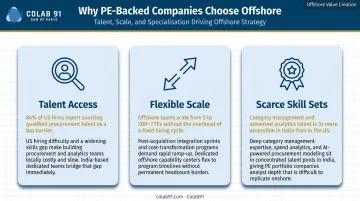
- Talent access — US hiring for procurement analysts, spend analysts, and category managers is genuinely difficult. BLS data shows only ~29,900 annual openings for financial analysts and ~58,700 for purchasing managers and buyers, in a market where 62% of hiring managers report worsening skills gaps
- Flexible scale — offshore teams can ramp for post-acquisition integration or cost transformation programs, then stabilize without the friction of permanent headcount additions
- Scarce skill sets — India's talent pool includes professionals with deep category management, strategic sourcing, and analytics expertise that's genuinely hard to find onshore
The Focus Dividend
When analytically intensive functions move offshore, onshore leadership recovers time for client relationships, strategy, and deal origination. That productivity gain compounds at the senior level — it doesn't show up in unit cost comparisons alone.
Colab91 builds India-based teams in procurement and spend analytics that own the continuous intelligence workload: weekly cadence reporting, category-level deep dives, and supplier performance tracking. Onshore leaders set direction and engage clients; the India team executes the analysis.
Offshore Sourcing Strategies That Maximize Productivity
Align Offshore Roles to Business Outcomes, Not Just Tasks
The most common productivity failure in offshore arrangements isn't a talent problem — it's a role design problem. When offshore teams are given isolated, disconnected tasks, they underperform because they lack the context to exercise judgment.
Outcome-oriented role design looks different in practice:
- A procurement analyst team owns spend data accuracy and monthly category reporting, not "runs reports on request"
- A financial modeling team delivers board-ready portfolio analyses on a defined cadence, not "builds models when asked"
- A sourcing operations team manages RFP events end-to-end with defined turnaround SLAs, not "supports sourcing projects"
This shift in framing changes hiring criteria, onboarding investment, and how performance is measured. Done right, it's the difference between an offshore team that generates strategic value and one that merely reduces a line on the labor cost report.
Build Governance and Communication Structures That Work Across Time Zones
High-productivity offshore teams don't happen by accident. The structure you put in place before day one determines how well the team operates at scale:
- Clear escalation paths with named decision-makers on both sides
- Weekly structured syncs at overlap hours (typically early morning India / evening US — around 7:30–8:30am EST / 6:00–7:00pm IST)
- Shared project management tooling with documented workflows
- Written standard operating procedures for recurring deliverables
- An onshore point of contact with genuine authority to unblock issues
Each of these elements addresses the same underlying challenge: the US–India time zone gap runs 9.5–12.5 hours depending on daylight saving. Teams that manage it well build around defined overlap windows and asynchronous handoff protocols — so delays don't compound overnight into missed deadlines.
Invest in Domain-Led Onboarding
Generic training programs fail offshore teams because they don't transfer the institutional knowledge required to make judgment calls. The fastest path to productivity is pairing strong domain knowledge with company-specific context from the start.
SHRM notes that effective onboarding can shave months off time-to-productivity — and for offshore teams, that difference is magnified by the distance between the team and the business context they're serving.
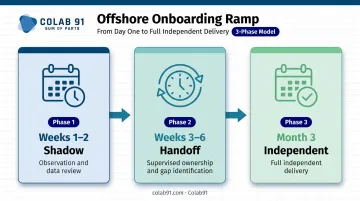
A structured ramp typically follows three phases:
- Weeks 1–2: Shadow onshore counterparts, review live spend or category data, build working knowledge of client-specific terminology and priorities
- Weeks 3–6: Take ownership of defined deliverables with senior review, identify knowledge gaps through live work rather than training simulations
- Month 3: Full ownership of core deliverables, escalation paths established, cadence operating independently
Driving Cost Efficiency: Where Offshore Sourcing Delivers the Most Value
Understanding the True Cost Equation
The cost efficiency case extends well beyond the wage differential. The full picture includes:
- US labor costs run deep — median pay for procurement and analytics roles ranges from ~$75,650 (purchasing agents) to $139,510 (purchasing managers) per BLS data, and BLS employer compensation data puts the fully-loaded cost at a further ~43% above base wages
- Overhead drops significantly — office space, benefits, compliance burden, and local infrastructure costs are all materially lower when teams are based in India
- Specialized talent at non-consulting rates — category management and spend analytics expertise that would require expensive consulting firm engagement onshore can be delivered through dedicated offshore teams at a fraction of the cost
Wipro's industry research suggests GCCs can deliver 50–60% labor cost savings, though treat that as a directional estimate, not a guaranteed benchmark for your situation.
Caution: Optimizing for unit cost without accounting for total cost of ownership leads to bad decisions. Factor in setup costs, governance overhead, knowledge transfer investment, and attrition risk alongside salary savings.
High-Value Functions That Generate the Strongest ROI Offshore
Not every function is equally suited to offshore delivery. For mid-market and PE-backed companies, the highest productivity-to-cost ratio consistently comes from:
| Function | Why It Works Offshore |
|---|---|
| Strategic sourcing & procurement operations | Analytical rigor, limited client-facing dependency |
| Spend analytics & category intelligence | Data-intensive, continuous output, scalable |
| Financial modeling & reporting | Structured deliverables, defined cadence |
| Data management & cleansing | High-effort, low-strategic-exposure |
| Back-office process execution | Volume-driven, process-documented |

The ROI compounds over time. As offshore teams build institutional knowledge, output quality rises while costs grow more slowly than onshore equivalents. India salary increases are projected at ~9.1–9.2% annually (per Aon); US compensation grew 3.4% in the 12 months ending March 2026 (per BLS). The absolute cost base stays lower even as offshore salaries increase — which means the financial advantage doesn't erode, it narrows gradually while capability deepens.
Common Risks in Offshore Sourcing and How to Mitigate Them
Three Risks That Matter Most
1. Output quality and consistency Use outcome-based KPIs with regular scorecard reviews — not activity metrics. Build quality checkpoints directly into the delivery cadence.
2. Talent attrition India's GCC market is competitive. Aon data shows overall India attrition declined from 18.7% in 2023 to 16.2% in 2025 — a positive trend, but retention still requires deliberate investment. Mitigation means clear career paths, competitive compensation benchmarking, and cultural signals that offshore roles are long-term strategic positions, not interchangeable contractor slots.
3. Knowledge dependency Critical institutional knowledge concentrated in one or two offshore individuals creates real succession risk. Address it from Day 1: documented SOPs, cross-training within offshore teams, and knowledge management embedded in standard operating procedures.
Data Security and IP Protection
For PE-backed companies managing sensitive portfolio data, a security breach can expose sponsors to regulatory liability and LP scrutiny. India's Digital Personal Data Protection Act (2023) establishes a data protection framework, with core security obligations phasing in through 2027, but regulatory compliance alone isn't enough.
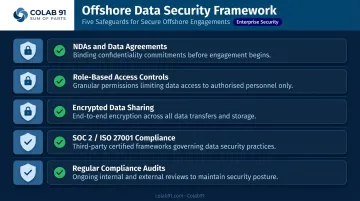
Practical safeguards that should be in place:
- NDAs and data handling agreements executed before access is granted
- Role-based access controls limiting data exposure to relevant team members
- Encrypted data sharing protocols for sensitive files
- Security framework compliance (SOC 2, ISO 27001) verified at setup
- Regular compliance audits, not just at onboarding
Everest Group notes that GCCs handling sensitive customer data face significant compliance risk when security isn't prioritized from the start, and that cybersecurity costs are frequently underestimated in offshore buildouts. Build the budget for it upfront.
Cultural and Communication Misalignment
This is the most underestimated risk, and language training alone doesn't solve it. Genuine cultural integration does:
- Joint team rituals (standups, retrospectives, shared Slack channels)
- Regular face-to-face or virtual face-to-face sessions, not just deliverable reviews
- Career development investment in offshore team members that signals long-term commitment
- Integration of offshore team members into client culture, not just client workflow
Colab91's ODC model includes integration with client engineering culture and rituals as a core engagement component — teams that share context, not just tasks, consistently outperform those that don't.
Choosing the Right Offshore Sourcing Model
Three Models Compared
| Model | Setup Effort | Strategic Control | Best Fit |
|---|---|---|---|
| Third-party BPO | Low | Limited | Transactional functions, short-term needs |
| Captive offshore entity | High | Full | Large enterprises with 500+ FTE targets and internal build capacity |
| Next-gen capability center | Moderate | High | Mid-market, PE-backed companies needing speed and domain alignment |
Everest Group data shows approximately 50% of new GCCs launched in 2024 used provider-assisted models such as Build-Operate-Transfer — reflecting the growing recognition that most mid-market organizations don't have the infrastructure to run a captive build independently.
What to Look for in an Offshore Partner
Once you've identified the right model, partner selection comes down to execution fit. Key criteria:
- Procurement, analytics, and finance expertise — not generic back-office experience
- A leadership track record in building and scaling offshore teams, not just managing them
- Operating model flexibility across dedicated team, BOT, managed operations, and hybrid structures
- Comparable client experience — mid-market and PE-backed engagements carry different demands than Fortune 100 captive builds
- Onshore-offshore integration capability that blends client-facing expertise with offshore delivery
Colab91's "Sum of Parts" model is built around this last point. Offshore domain experts handle continuous analytical and intelligence workloads; onshore leadership holds client and strategic relationships. The leadership team (Madhur Kabra and Vijender Kapoor) previously scaled Impendi's India operations to 100+ practitioners serving Carlyle Group, TPG, Elliott, and BC Partners — a direct proof point for the execution model.
A Practical Getting-Started Framework
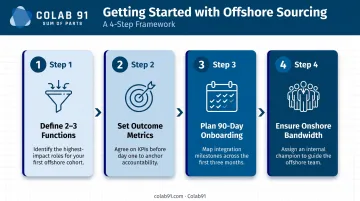
- Define 2–3 functions to offshore first — prioritize high-effort, lower-client-contact roles (spend analytics, category reporting, financial modeling)
- Set outcome metrics before launch — not activity metrics, but deliverable-based KPIs tied to business outcomes
- Plan for a 90-day onboarding period — don't evaluate full productivity before the team has had time to build institutional context
- Ensure onshore leadership has bandwidth — the first quarter requires genuine investment from onshore counterparts, not just oversight
Frequently Asked Questions
What is offshore sourcing?
Offshore sourcing is the practice of obtaining services or talent from a foreign country to reduce costs, access specialized skills, or scale operations. In the context of business services, it typically means building teams or engaging providers in markets like India to deliver procurement, analytics, finance, or technology functions.
How does offshore sourcing improve cost efficiency?
The core drivers are lower fully-loaded labor costs, reduced overhead, and access to specialized talent at non-consulting rates. Cost efficiency compounds over time as offshore teams build institutional knowledge — output quality increases without proportional increases in cost.
What business functions are best suited for offshore sourcing?
Procurement and strategic sourcing, spend analytics, financial modeling, data management, and back-office process execution deliver the most consistent offshore returns for mid-market and PE-backed companies. These functions require analytical rigor but don't depend on constant client-facing presence.
How is a capability center different from traditional offshore outsourcing?
Traditional outsourcing delegates tasks to a third-party vendor with limited strategic integration. A capability center builds a dedicated, domain-aligned offshore team that operates as a strategic extension of the parent organization. The difference is accountability and continuity: these teams are measured on business outcomes, not task completion.
How do you measure productivity in an offshore sourcing team?
Effective measurement focuses on output, not hours logged. Track:
- Output-based KPIs tied to business outcomes (not activity metrics)
- Quality and accuracy rates alongside turnaround time benchmarks
- A regular review cadence combining quantitative scorecards with stakeholder feedback
How should a mid-market company get started with offshore sourcing?
Start with 2–3 high-effort, lower-client-facing functions and define success metrics before launch. Partner with a firm that has domain expertise in your industry — not a generic outsourcing vendor. Budget for a structured 90-day ramp period before drawing conclusions about full productivity.