For US mid-market and PE-backed companies, this gap is especially acute. Senior AI and data roles are expensive, slow to fill, and increasingly out of reach without enterprise-level compensation packages. Building an offshore AI team - particularly in India - has become less of a cost play and more of a strategic necessity: access to deep talent pools, faster deployment, and the ability to build genuine domain capability rather than just headcount.
This guide walks decision-makers through the full build process - from defining goals and structuring roles to managing performance and avoiding the most common mistakes that cause offshore AI teams to underperform.
Key Takeaways
- Define use cases and success outcomes before you recruit - strategy first, hiring second
- India leads as the offshore destination for US mid-market companies: deep AI talent, analytics expertise, and real cost efficiency
- The most common failure point is governance: unclear ownership, poor onshore integration, and no performance baselines
- Success follows a structured path: scoping, role mapping, model selection, legal setup, onboarding, and performance management
- Capability centers outlast transactional hires because they operate with strategic intent, not just task execution
What an Offshore AI Team Actually Involves
An offshore AI team is a group of AI, data, and analytics professionals located in a different country, working as an integrated extension of a company's operations. Unlike a vendor relationship, these teams operate with accountability, ownership, and genuine business context built in.
What these teams actually do varies considerably:
- Data engineering - building and maintaining pipelines, data models, and infrastructure
- ML model development - designing, training, and iterating on machine learning models
- MLOps - deploying, monitoring, and maintaining models in production
- Analytics and reporting - procurement analytics, operational dashboards, financial modeling
- AI-enabled automation - process automation using AI, supplier data analysis, demand forecasting
Three Structures, One Worth Building
Offshore AI builds typically follow one of three models:
| Model | What It Is | When It Fits |
|---|---|---|
| Staff Augmentation | Individual role fills | Short-term skill gaps |
| Dedicated Project Team | Scoped, time-bound delivery | Defined project outcomes |
| Capability Center | Embedded, long-term strategic hub | Ongoing AI capability with institutional depth |
The capability center model is where durable value lives. The other two models have their uses, but they don't build compounding institutional knowledge - and they rarely integrate deeply enough to drive strategic decisions rather than just deliver outputs.
Colab91's "Sum of Parts" approach is built specifically around this model - augmenting a client's in-house team with domain expertise so the offshore function contributes to strategic decisions, not just task delivery.
Why US Mid-Market and PE-Backed Companies Are Building Offshore AI Teams Now
The US Hiring Problem Is Real
The Bureau of Labor Statistics reports a US median annual wage of $112,590 for data scientists and $140,910 for computer and information research scientists - and demand for these roles is projected to grow 34% and 20% respectively over the next decade. Lightcast data shows AI-skill job postings already command a 28% salary premium over comparable roles.
For mid-market companies competing against enterprises for the same talent, this market is practically closed. The roles take longer to fill, cost more to retain, and often require compensation structures that don't fit a mid-market operating model.
Why India Specifically
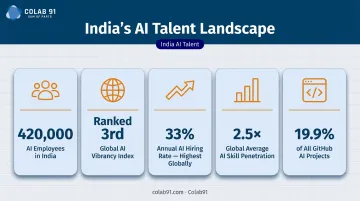
India is the strongest AI talent market outside the US right now. The numbers back it up:
- 420,000 employees working in AI job functions (NASSCOM-BCG, 2024)
- Ranked 3rd globally in Stanford's 2025 AI Vibrancy Index
- AI hiring rate of approximately 33% annually - the highest in the world
- AI skill penetration 2.5x the global average across comparable occupations
- Second-largest contributor to GitHub AI projects in 2024, at 19.9% of all AI projects
The talent depth is matched by a workable time zone. India Standard Time (IST) runs 10.5 hours ahead of Eastern Standard Time, so US morning hours (7:30–8:30am EST) align with end-of-day in India (6:00–7:00pm IST). That creates a real-time collaboration window without requiring either side to work unusual hours.
Why PE-Backed Companies Can't Wait
Deloitte's 2025 GenAI in M&A survey of 1,000 US corporate and PE leaders found that 86% now use GenAI, and 81% of PE firms expect measurable returns within 1–3 years. The PE model runs on fast, measurable value creation - and that window is short.
An offshore AI capability center, built with focused use cases and clear governance, fits that timeline. It delivers ROI within the 1–3 year window PE sponsors are tracking and gives portfolio companies a durable AI capability that survives the hold period.
What to Decide Before You Start Building
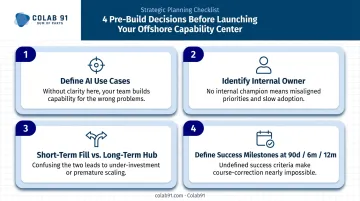
Most offshore AI teams underperform not because the talent is weak, but because scope, ownership, and integration expectations were never defined upfront. The four decisions below are quick to work through - but skipping any one of them significantly increases the probability of a slow start or a failed engagement.
Work through these before recruiting begins:
What AI use cases will this team own? If the answer is vague ("AI for analytics"), the hiring profile will be vague too - and you'll end up with overlap, gaps, or both.
Who internally will manage this team day-to-day? This is the single most common failure point in offshore engagements. That person needs real bandwidth and decision-making authority - not just a title on an org chart.
Is this a short-term capability fill or a long-term strategic hub? The answer changes your hiring profile, engagement model, tooling, and governance structure - these are not interchangeable paths.
What does success look like at 90 days, 6 months, and 12 months? Without defined baselines, performance reviews become subjective and retention suffers. Define the milestones before the first hire starts.
How to Build a High-Performing Offshore AI Team - Step by Step
Offshore AI teams most often underperform because the build process was rushed: hiring before scoping, choosing location on cost alone, delaying governance, treating onboarding as a one-day event. Each stage below exists to prevent a specific failure mode.
Step 1 – Define the AI Use Cases and Business Outcomes
Start with the business problem, not the technology. Generic goals like "use AI for analytics" produce generic teams with no clear mandate. Concrete use cases look more like:
- Automate supplier data analysis to reduce procurement cycle time
- Build a demand forecasting model for supply chain planning
- Create a spend analytics dashboard that surfaces savings opportunities by category
For each use case, map it to:
- A measurable business outcome (what changes if this works?)
- A data source (does the data exist and is it accessible?)
If the data doesn't exist or isn't accessible, the use case isn't ready to offshore yet. This is the check that most companies skip - and then wonder why the team's outputs don't drive decisions.
Step 2 – Map the Roles and Skills the Team Needs
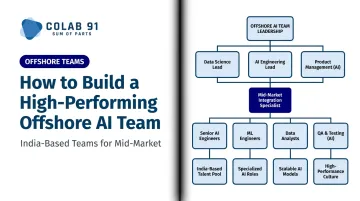
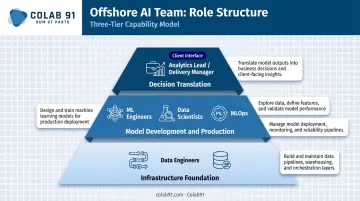
The core functional layers of an offshore AI team:
- Data engineers - build and maintain the data infrastructure everything else depends on
- ML/AI engineers - develop and deploy models
- Data scientists - experimentation, feature engineering, model evaluation
- MLOps specialists - production deployment, monitoring, model lifecycle management
- Analytics lead or delivery manager - translates outputs into business decisions, interfaces with onshore stakeholders
Role mix follows the use case stage. Early-stage builds need more data engineering and experimentation capacity. Production-scale work needs MLOps and deployment expertise. Don't hire for where you want to be in 18 months - hire for where the work actually is today.
Avoid stacking the team with senior hires from day one. A well-structured mid-weight team with a strong lead consistently outperforms an all-senior group with unclear ownership and no delivery cadence.
Step 3 – Choose the Right Engagement Model and Location
The three models match different scales and timeframes:
- Staff augmentation - individual role fills for short-term gaps; low integration, limited strategic value
- Dedicated offshore team - project or function ownership; works for defined scopes with clear endpoints
- Capability center - embedded, long-term strategic hub; builds institutional knowledge and compounds value over time
For mid-market and PE-backed companies with recurring AI and analytics needs, the capability center model is the right destination. The question is whether to start there or build toward it.
India remains the strongest location choice for US companies building AI capability centers. Kearney's Global Services Location Index consistently ranks India among the top three global services destinations on cost, talent pool, and skills depth. Deloitte identifies India as the global epicenter for Global Capability Centers, with data science, AI/ML, and digital product work increasingly concentrated there.
Colab91 is built specifically for mid-market and PE-backed companies that want to move beyond transactional outsourcing. The model combines domain expertise in procurement and analytics with offshore delivery, so teams operate as a strategic hub rather than a vendor relationship.
Step 4 – Set Up the Operating and Legal Foundation
Legal and compliance setup isn't a formality. Gaps here create risk exposure and slow down every future decision.
Legal foundations to establish:
- EOR (Employer of Record) or entity setup in India
- IP protection clauses for all work product
- Data privacy compliance for US customer or financial data
- NDAs for all team members
Operating infrastructure to establish before Day 1:
- Communication tools (Slack, Teams)
- Project management workflows (Jira, Asana)
- Data access protocols and security standards
- Reporting cadence and documentation standards
Colab91's engagement models address entity ownership, IP rights, and strategic control directly. These decisions shape every operational choice that follows.
Step 5 – Onboard and Integrate the Team Into Your Workflow
Onboarding is a 30–60 day structured process, not a single orientation session.
What effective onboarding includes:
- Business context: what the company does, who the stakeholders are, what decisions the AI outputs will inform
- Technical setup: tools, data access, workflow integrations
- Relationship building: introductions to onshore counterparts and regular sync cadence
Assign an onshore integration lead who holds regular syncs, provides real-time feedback, and actively removes blockers in the first 90 days. This single role has more impact on early team performance than any other structural decision.
Teams left to "ramp themselves up" take significantly longer to reach productivity and show higher attrition in the first six months. The offshore team cannot integrate into a business it doesn't understand - that context transfer is an onshore responsibility.
Step 6 – Establish Performance Baselines from Day One
Define KPIs before the team starts work - not after something goes wrong.
Typical performance metrics for offshore AI teams:
- Delivery cadence (sprint velocity, milestone adherence)
- Model accuracy targets (defined per use case)
- Data quality benchmarks
- Response time SLAs for stakeholder requests
- Business impact metrics tied to the use cases from Step 1
Structure three distinct review rhythms:
- Weekly operational check-ins - delivery status, blockers, immediate issues
- Monthly business reviews - output quality, use case progress, stakeholder feedback
- Quarterly strategic assessments - team health, capability growth, roadmap alignment
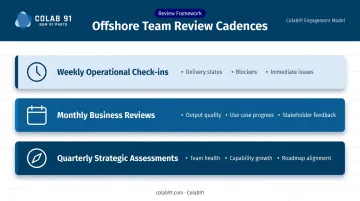
Don't collapse these into one meeting format. Each serves a different purpose, and conflating them produces reviews that are too operational for strategy and too high-level for execution.
How to Keep an Offshore AI Team High-Performing Over Time
Building the team is the beginning, not the goal. Four levers drive long-term output: communication, retention, continuous improvement, and disciplined scaling.
Communication and Alignment
- Establish clear channels by function: technical delivery, business reporting, escalations
- Run structured async updates for time-zone gaps
- Protect real-time collaboration windows for decisions that require synchronous input - the EST/IST overlap (US morning / India evening) works well for most teams
Talent Development and Retention
- India's tech attrition rates decreased in 2024 (NASSCOM), but salary growth is projected at 9% in 2026 (Aon) - pay alone won't retain top performers
- Offshore AI professionals stay for growth: complex problems, upskilling pathways, and visible career progression within the team
- Invest in higher-value work early; teams given strategic responsibility stay longer and perform better
Performance Improvement Loops
- Run retrospectives after each sprint or delivery cycle
- Make peer code reviews and model performance monitoring routine
- Build a feedback culture where onshore and offshore team members both contribute to process improvements
Scaling Strategically
- Add roles in response to validated capacity needs, not projected ones
- Each new hire should deepen the team's domain expertise in a specific area
- A focused team of 10 with deep functional knowledge consistently outperforms a generalist team of 15
The levers above are interdependent. Communication failures erode retention. Retention gaps stall improvement loops. And scaling too fast without domain depth undoes all three. Treat sustained performance as a system, not a checklist.
Frequently Asked Questions
What is the 10-20-70 rule for AI?
BCG defines the 10-20-70 rule as the allocation of effort in AI initiatives: 10% on algorithms and models, 20% on data and technology infrastructure, and 70% on people, processes, and organizational change. Most AI initiatives fail not because of technical gaps but because the people and process side is under-resourced relative to the model-building work.
How do you structure an AI team?
An effective AI team has three functional layers: a delivery and engineering layer (ML engineers, data engineers, MLOps), a science layer (data scientists, model developers), and a business interface layer (an analytics lead or delivery manager who translates model outputs into decisions). Team size and composition should follow the use case, not a fixed template.
What is the difference between offshore outsourcing and a capability center?
Offshore outsourcing means delegating specific tasks or projects to an external vendor with limited integration into the business. A capability center is an embedded, long-term function that operates with institutional knowledge, strategic ownership, and direct alignment to business goals - its outputs actively inform decisions rather than just execute instructions.
How long does it take to build an offshore AI team in India?
Most teams are operational within 8–16 weeks. The biggest variables are how clearly roles are defined before recruiting starts and whether legal and operating infrastructure is set up in parallel rather than sequentially. Companies that run these tracks simultaneously move significantly faster.
What roles are essential in an offshore AI team?
For most mid-market AI builds, the core roles are: a team lead or delivery manager, at least one data engineer, one ML/AI engineer, and a data analyst or scientist depending on the use case. MLOps becomes essential once models move into production and need ongoing monitoring and maintenance.
How do you manage performance across time zones?
Three practices matter most: define KPIs and deliverables that can be assessed asynchronously, protect a shared overlap window for real-time syncs (7:30–8:30am EST / 6:00–7:00pm IST works well for US East Coast teams), and use structured async updates so decisions are never held up waiting for the other side to come online.