That's where a remote dedicated software development team changes the equation. Not as a cost-cutting measure, but as a structural solution: a cross-functional engineering unit that owns delivery, scales with your roadmap, and operates as an extension of your product organization rather than a black-box vendor.
This guide covers how to structure, hire, onboard, tool-up, and manage a remote software development team — written specifically for mid-market and PE-backed companies that want a strategic offshore team, not just a contractor arrangement.
Key Takeaways
- US tech hiring takes an average of 47 days per role — a dedicated offshore team in India eliminates that bottleneck
- Team structure matters more than headcount: get the seniority mix and role composition right before scaling
- Legal foundations (IP assignment, NDAs, data security) must be in place before work begins — especially for PE-backed companies with exit timelines
- Tools matter less than discipline; async communication norms and a single source-of-truth PM tool are non-negotiable
- The biggest reason remote teams underperform is cultural, not technical — treat the team as an embedded unit, not a vendor
Why Mid-Market and PE-Backed Companies Are Building Remote Software Teams
The US tech labor market isn't loosening. According to McKinsey, tech unemployment sits at 2.2% against a national rate of 3.5%, with nearly 316,000 open tech positions recorded in March 2023. The Bureau of Labor Statistics projects 25% growth for software developers, QA analysts, and testers through 2032 — roughly 141,100 openings per year.
For mid-market companies, that's a structural hiring problem. You're competing for the same engineers as companies with far stronger employer brands and significantly larger recruiting budgets.
The Speed and Cost Reality
iCIMS reports a tech time-to-fill of 47 days as of mid-2024. That's nearly seven weeks before a single engineer writes a line of code, and longer still if interviews run multiple rounds or candidates drop out.
On compensation, the gap is substantial. Levels.fyi data shows US Senior Software Engineers at a median total compensation of approximately $249,000. India-based equivalents sit significantly lower — though total employer cost (benefits, infrastructure, management overhead, vendor margin) is what matters for true comparison, not base salary alone.
The case for an offshore team goes beyond cost. A well-structured team in India can be sourced, vetted, and onboarded in a fraction of the time a comparable US hiring cycle requires.
Why India Specifically
India's engineering ecosystem has matured well beyond commodity outsourcing. The scale of the talent pool makes it a structural choice, not just a cost one:
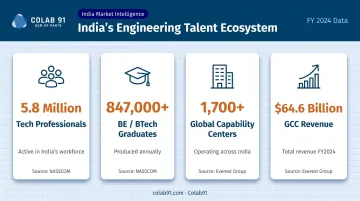
- 5.8 million tech professionals in the workforce as of FY2025 (NASSCOM)
- 847,000+ BE/BTech graduates produced annually
- 1,700+ Global Capability Centers generating $64.6 billion in FY2024 revenue — a model Microsoft, Salesforce, and Goldman Sachs have scaled for core product and engineering work
Everest Group reports that 45% of India's GCCs are mid-market firms with revenues between $100M and $5B — which means the infrastructure, talent pipelines, and operating playbooks already exist for companies at your scale.
How to Structure a Remote Software Development Team
Getting team structure right before headcount decisions matters. A poorly structured team of 20 underperforms a well-structured team of 10.
Core Roles (Non-Negotiable)
Every production-grade remote team needs these functions covered:
- Frontend / Backend / Full-Stack Engineers — the primary delivery capacity
- QA Engineers (manual and automation) — quality gates built into the sprint, not after it
- Project or Delivery Manager — owns process, blockers, and stakeholder communication
Specialist Roles (Added as the Team Scales)
These aren't optional indefinitely — they become necessary as scope grows:
- Solution Architect — owns technical design, long-term maintainability, and prevents costly rework
- DevOps Engineer — CI/CD pipelines, deployment reliability, infrastructure-as-code
- Business Analyst — translates shifting business requirements into engineering work (especially relevant in PE contexts where priorities evolve quickly)
Seniority Mix Strategy
A team of all senior engineers is expensive and creates bottlenecks. A team of all juniors creates quality risk. A balanced distribution typically works as follows:
| Seniority | Approximate Share | Primary Role |
|---|---|---|
| Senior | ~30% | Architecture decisions, critical code paths, technical mentorship |
| Mid-level | ~40% | Core delivery, feature ownership |
| Junior | ~30% | Well-scoped tasks, testing, documentation |
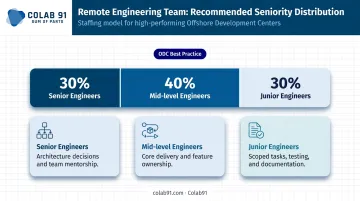
Seniors own the decisions that are expensive to reverse. Mid-levels carry the delivery velocity. Juniors handle volume work and grow into the codebase.
Team Structure Models
Two organizational models dominate in practice:
- Feature teams (stream-aligned pods) — cross-functional groups that own a product area end-to-end. Best for product-focused mid-market companies building distinct customer-facing features
- Platform/component teams — specialists maintaining shared infrastructure or core services. Best for mature products with significant technical debt or shared services dependencies
Most mid-market ODC builds start with feature teams and introduce platform structures as technical complexity grows.
Engagement Model: Which Fits Your Stage
How you structure the team internally is one decision. The commercial engagement model is a separate but equally consequential one.
| Model | What It Is | Best Fit |
|---|---|---|
| Staff Augmentation | Individual contractors added to an existing team | Filling specific short-term skill gaps |
| Dedicated Remote Team | Cross-functional unit that owns delivery end-to-end | Mid-market companies scaling a product roadmap |
| Capability Center (GCC/ODC) | Strategic offshore hub with embedded domain expertise | Long-term, multi-functional delivery at scale |
Colab91 operates in the third category — building India-based capability centers where ownership, governance, and cultural integration are established at the outset, not retrofitted later. For mid-market companies and PE-backed businesses building toward a 50–200+ FTE offshore footprint, this structural foundation is what separates a high-performing offshore team from an expensive coordination problem.
Building Your Remote Software Development Team: A Step-by-Step Process
Step 1: Define Requirements Before Reaching Out to Anyone
Document before you recruit. Vague requirements lead to mismatched hires and wasted sourcing cycles.
Your brief should include:
- Tech stack, platforms, and specific roles required
- What the team will own (product area, services, codebase)
- Key milestones and expected ramp-up timeline
- Budget envelope and engagement model preference
The more specific this brief, the faster partner selection and onboarding move.
Step 2: Choose the Right Partner
Not all offshore partners are equivalent. Evaluate on:
- Industry-specific domain experience (fintech, healthcare, SaaS — context shapes delivery quality)
- Proven track record building and scaling teams, not just placing contractors
- Defined governance and transparent delivery processes
- Cultural fit with how your internal team makes decisions and communicates
Avoid selecting purely on hourly rate. Total cost of ownership includes ramp-up time, turnover risk, and the management overhead your team absorbs when a partner underdelivers.
Step 3: Vet Rigorously
Go beyond resumes. A practical vetting process includes:
- Technical assessments or code reviews for engineers — architecture discussions, not just syntax
- Scenario-based interviews for delivery managers — how they handle blocked tickets, escalation paths, stakeholder conflicts
- A short paid pilot task — real-world problem-solving reveals communication quality and ownership mindset
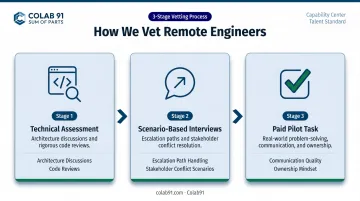
Communication quality and ownership mindset matter as much as raw technical skill.
Step 4: Lock Down Legal and IP Foundations
Before a single line of code is written, your engagement contract must cover:
- IP assignment clauses — all code and artifacts transfer fully to the client (under India's Copyright Act, this must be explicit, written, and signed)
- NDAs for all team members, not just the vendor entity
- Data security and access controls aligned with applicable regulations (DPDP Act 2023 in India; HIPAA or GDPR if relevant to your business)
- Termination and transition clauses — what happens if the relationship ends
For PE-backed companies, clean IP chain-of-title is a transaction prerequisite. Gaps here create diligence friction at exactly the wrong moment.
Step 5: Onboard for Productivity, Not Just Access
Once contracts are signed, onboarding begins — and it runs on two parallel tracks that are equally non-negotiable:
Technical onboarding:
- Repository access and dev environment setup
- Architecture walkthrough and codebase orientation
- Tooling alignment and CI/CD familiarization
Cultural onboarding:
- How decisions are made and escalated
- Meeting etiquette and async communication norms
- Stakeholder map and product priorities
A structured first-30-days plan shortens time-to-impact measurably. Teams that skip cultural onboarding can write clean code but still miss the product context that turns delivery into ownership.
Essential Tools for Running a Remote Software Development Team
The specific tool matters less than the discipline around using it. Pick a stack, enforce consistency, and make sure every team member knows what goes where.
Communication and Collaboration
- Slack or Microsoft Teams — async and real-time messaging; establish clear norms for what belongs in Slack vs. email vs. documentation
- Zoom or Google Meet — video standups and sprint ceremonies
- Notion or Confluence — team documentation and knowledge base (Jira and Confluence ranked as the most-used async tools for developers in the 2024 Stack Overflow Developer Survey)
Project Management and Tracking
- Jira, Asana, Linear, or ClickUp — sprint planning, backlog management, progress visibility
- GitHub Projects or GitLab boards — lightweight alternatives for engineering-only teams
For distributed teams, the PM tool is the single source of truth — it replaces hallway conversations and eliminates the "I didn't know that was blocked" problem.
Engineering and DevOps Toolchain
- GitHub or GitLab — version control and code review workflows
- GitHub Actions, CircleCI, or Jenkins — CI/CD pipelines
- Toggl or Clockify — time tracking for time-and-materials engagements or effort transparency
Invest in automation early. Automated testing, deployment pipelines, and environment provisioning pay off in delivery speed and quality consistency — and the returns compound as the team scales.
How to Manage a Remote Software Development Team Effectively
Clear Goals and a Structured Communication Cadence
Remote teams function on clarity. Ambiguity about priorities causes far more damage than time zone differences. Translate business goals into engineering OKRs and establish a predictable rhythm:
- Daily standups — async-first for distributed teams; reserve synchronous time for blockers that need real discussion
- Weekly syncs — alignment on priorities and dependencies
- Bi-weekly sprint demos — stakeholder visibility into what shipped
- Monthly retrospectives — process improvement, not just status
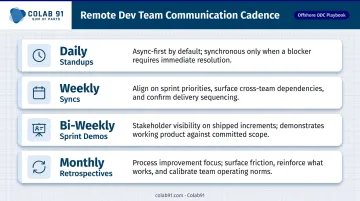
Establish async norms explicitly: response window expectations, how to signal blockers, where decisions get documented.
Build Accountability Through Shared Ownership
High-performing remote teams are characterized by ownership, not surveillance. Engineers who understand the "why" behind the product outperform engineers working from a task list.
Practical steps:
- Share customer feedback and product metrics with the team
- Involve developers in sprint planning — don't hand down tickets, build the sprint together
- Use unambiguous definitions of done
- Create space for the offshore team to raise red flags before they become incidents
This mindset shift — from vendor to embedded team — is what separates high-output remote teams from ones that technically deliver but never improve.
Track the Right KPIs
Engineering KPIs (use DORA metrics as your framework):
- Cycle time / lead time for changes
- Deployment frequency
- Change fail rate and recovery time
Delivery KPIs:
- Sprint velocity and on-time delivery
- Roadmap completion rate
- Bug density by sprint
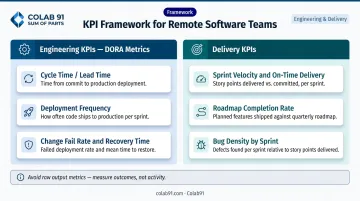
Avoid using raw output metrics — lines of code or tickets closed — as quality proxies. They measure activity, not outcomes. Monthly performance reviews plus quarterly roadmap planning sessions create a feedback loop that keeps the team aligned as business priorities shift.
Scale Deliberately and Plan for Continuity
Scaling up means adding roles in response to new product phases: bringing in a DevOps or ML engineer for targeted initiatives, not growing headcount for headcount's sake.
Scaling down requires structured knowledge transfer. One of the biggest hidden costs of remote teams is unmanaged turnover: institutional knowledge walks out when an engineer leaves without documented context.
Treat documentation as a standard deliverable, not an afterthought. Maintain these as baseline practice:
- Architecture decision records (ADRs) for design rationale
- Runbooks for operational procedures
- Workflow documentation for onboarding and handoffs
Colab91's model blends onshore strategic guidance with offshore execution to protect this continuity, keeping knowledge in the system even as team composition evolves.
Common Pitfalls When Building a Remote Software Development Team
Time Zone and Async Communication Gaps
Time zone differences are a management variable, not a blocker — but only if addressed deliberately. Companies that fail with remote teams treat time zone management as an afterthought.
Practical fixes:
- Establish 2–3 hours of mandatory daily overlap
- Agree on async norms before the team starts (response windows, escalation paths, documentation standards)
- Rotate meeting times periodically to avoid consistently burdening one geography
India offers a workable overlap window for US companies — same-day response is achievable with morning overlap.
Knowledge Silos and Documentation Debt
Teams move fast, skip documentation, members rotate, and institutional knowledge disappears. By the time leadership notices, the codebase is held together by the two or three engineers who've been there the longest.
Prevention:
- Documentation is part of the definition of done, not a separate task
- Use ADRs to capture technical reasoning, not just decisions
- Run knowledge-transfer sessions whenever team composition changes
For PE-backed companies approaching a transaction, clean and accessible documentation directly reduces diligence friction. Messy documentation is a red flag that slows deals.
Treating the Team as a Vendor
The most common reason remote development teams underperform is cultural, not technical. When the offshore team is treated as a black-box delivery engine — given task lists without product context — engagement drops, proactivity disappears, and turnover accelerates.
Gallup estimates 42% of employee turnover is preventable, with replacement costs running approximately 80% of salary for technical roles. That math changes quickly when you're losing senior engineers.
Fix the culture, and the output follows:
- Include the remote team in company all-hands and product updates
- Celebrate milestones and acknowledge contributions publicly
- Give engineers product context alongside technical tasks
- Create a feedback culture where remote team members feel safe raising concerns
Teams that get this right see measurably higher retention, stronger proactivity, and better code quality — not because they paid more, but because they invested in belonging.
Frequently Asked Questions
What tools are essential for running a dedicated remote software development team?
The core stack covers four categories: communication (Slack or Teams, Zoom), project management (Jira, Asana, or ClickUp), version control and code collaboration (GitHub or GitLab), and documentation (Notion or Confluence). Consistency in how the team uses these tools matters more than which specific tools you choose.
How do you manage time zone differences with a remote development team?
Establish a 2–3 hour mandatory daily overlap window, adopt async-first communication norms, and document decisions rather than relying on synchronous discussion. For US companies, India is a practical choice: same-day response windows are achievable with modest schedule coordination on both sides.
What is the typical cost of building a remote software development team in India?
India-based engineers are significantly less expensive than US equivalents at every seniority level, but total employer cost — including benefits, infrastructure, management overhead, and partner margin — is what drives the true savings figure. Most US companies see total cost savings of 40–60% depending on role seniority and engagement model.
How long does it take to build and onboard a remote software development team?
Sourcing and vetting takes 2–6 weeks; a structured onboarding program adds another 2–4 weeks before the team reaches full productivity. By comparison, a US hiring cycle averages 47 days per role before an engineer even starts.
What is the difference between staff augmentation and a dedicated remote development team?
Staff augmentation places individual contractors within a client-managed team. A dedicated team is a cross-functional unit that owns delivery, with its own PM and defined process. A capability center extends this further into a strategic offshore hub with embedded domain expertise and long-term organizational integration.
How do you protect intellectual property when working with an offshore development team?
The contract must include explicit IP assignment clauses ensuring all code transfers fully to the client; under India's Copyright Act, this must be in writing and signed. Layer in NDAs for all team members, role-based access controls, and compliance with applicable regulations (DPDP Act, HIPAA, GDPR).