Introduction
Procurement leaders today face a compound pressure few other functions deal with simultaneously: rising cost expectations from the CFO, fragmented supplier data spread across ERP systems and spreadsheets, and a C-suite that wants strategic value — not just purchase orders processed on time.
The stakes are real. According to Deloitte's 2025 Global CPO Survey, 57% of procurement leaders cite siloed operations as a barrier to delivering value, while 40% point to technology capability gaps. These aren't internal inconveniences — they're competitive liabilities.
Procurement transformation is how organizations close that gap — shifting the function from a reactive cost center into one that generates measurable value through better supplier relationships, faster cycle times, and data-driven decisions. This guide covers what that shift actually requires: a practical 7-step roadmap, the digital tools driving modern change, how to build the right team, and how to track real results.
Key Takeaways
- Procurement transformation is a structural shift — not a software upgrade
- Digitalization through AI, spend analytics, and e-procurement tools powers modern transformation
- A phased roadmap with executive alignment is essential for lasting results
- Offshore capability models help mid-market and PE-backed companies close talent gaps at scale
- Measurable KPIs — covering cost, cycle time, compliance, and supplier performance — define real success
What Is Procurement Transformation?
Procurement transformation is the deliberate process of redesigning how an organization sources, buys, and manages supplier relationships — shifting procurement from reactive and transactional to strategic and value-generating.
That definition matters because transformation is frequently confused with improvement. Fixing a broken approval workflow is improvement. Rethinking whether procurement should be centralized, center-led, or federated — and rebuilding the operating model accordingly — is transformation.
The Four Pillars
True transformation requires work across all four dimensions simultaneously:
- People — building strategic sourcing, analytics, and category management capabilities
- Process — standardizing source-to-pay workflows and eliminating maverick spend
- Technology — implementing e-procurement platforms, spend analytics, and supplier management tools
- Supply chain — redesigning supplier relationships and risk management practices
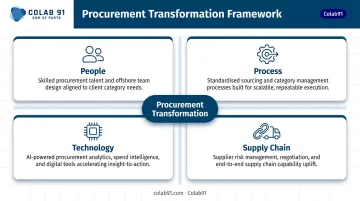
Addressing only one or two pillars is a common failure mode.
Organizations that implement Coupa or SAP Ariba without changing governance structures or upskilling their teams often see technology adoption rates stall within 12 months.
What Transformation Is Not
Procurement transformation is not:
- Cutting headcount to reduce procurement costs
- Implementing new software without process or governance changes
- A one-time project with a defined end date
- Something procurement can drive successfully without CFO and COO alignment
When digitalization efforts are layered onto an unreformed operating model, they accelerate existing dysfunction rather than eliminate it. That's why the next question matters: what does a successful transformation actually look like in practice?
Why Procurement Transformation Matters Now
The external environment has made transformation urgent — and the data shows why.
A 2024 Gartner survey of 258 procurement leaders found that 42% cited supply disruptions as the top risk to procurement's future success — ahead of macroeconomic factors and geopolitical risk. Meanwhile, producer prices rose 3.3% in 2024, compressing margins and intensifying pressure to find savings through smarter sourcing rather than volume cuts.
The competitive gap between leading and lagging procurement organizations is widening. According to Hackett Group benchmarks, top-performing procurement organizations (Hackett Group's "world-class" benchmark) operate at 21% lower labor costs and process purchase requisitions with 100% electronic automation — while peers still rely on manual workflows that introduce delay and compliance risk.
What's Driving the Urgency
- Post-COVID supply chain volatility exposed dangerous single-source dependencies
- Geopolitical disruptions (tariffs, trade restrictions, regional conflicts) require faster supplier switching
- Internal stakeholders — finance, operations, legal — now expect procurement to move at digital speed
- PE-backed companies face 100-day transformation timelines with no room for slow starts
Each of these pressures compounds the cost of inaction. Organizations that delay modernization don't just fall behind on cost — they accumulate structural fragility: fragmented supplier data, compliance gaps, and manual processes that competitors have long since automated.
The 7-Step Procurement Transformation Roadmap
Step 1: Assess Your Current State
Start with a full audit of existing workflows, tools, team capabilities, and spend data quality. Most organizations discover more fragmentation than they expected — duplicate suppliers, uncategorized tail spend, manual approval chains that slow purchasing to a crawl.
The assessment should cover both direct and indirect spend categories, with stakeholder interviews across finance, operations, and legal. A structured diagnostic — like the AI-augmented procurement assessments Colab91 delivers for mid-market clients — can compress this phase to 4–6 weeks, producing a quantified savings opportunity model targeting 5–15% of addressable spend.
That baseline is what makes everything in Steps 2–7 executable rather than speculative.
Step 2: Define Strategic Goals and Business Alignment
Set objectives tied to measurable business outcomes — not procurement-internal metrics.
Examples of well-defined targets:
- Reduce procurement cycle time by 30% within 12 months
- Achieve 95% contract compliance across indirect spend
- Capture $X in savings on top-five spend categories
Alignment with the CFO and COO at this stage determines whether the transformation gets sustained investment or gets deprioritized when competing priorities emerge.
Step 3: Build a Phased Roadmap with Stakeholder Buy-In
A procurement-only transformation roadmap stalls. Bring finance, legal, operations, and key suppliers into the planning process early — their adoption is what makes the roadmap real.
The roadmap should be phased, with early wins (spend visibility, quick-win sourcing events) deliberately sequenced to build momentum. McKinsey data shows that companies in the fastest transformation quartile capture at least 16% of their financial target within the first three months — which is only possible with a well-scoped early phase.
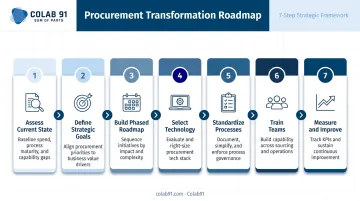
Step 4: Select and Implement the Right Technology
Choose tools based on your maturity level and integration requirements — not vendor demos. Key categories include:
| Tool Category | Purpose |
|---|---|
| E-procurement platforms (Coupa, Ariba, Jaggaer) | Source-to-pay process automation |
| Spend analytics | Visibility, savings identification, compliance tracking |
| Supplier management systems | Risk monitoring, performance tracking, contract compliance |
| ERP integration | End-to-end data flow from purchase to payment |
Avoid the temptation to overhaul the entire tech stack at once. Targeted investments with clear ROI — spend analytics, automated approvals — often deliver faster results early in the journey.
Step 5: Standardize Processes and Governance
Without standardization, maverick spend returns within months of any technology deployment. This step requires organizational discipline, not just software configuration. At minimum, establish:
- Procurement policies and approval workflows by spend category
- Preferred supplier lists with defined onboarding criteria
- Spend thresholds that apply consistently across departments and geographies
- Exception-handling processes that don't create workarounds
This is where most transformations struggle. Getting governance right takes longer than the technology implementation — plan for it.
Step 6: Train Teams and Manage Change
Teams that don't understand why the transformation is happening will work around it. Communicate the business case plainly — cost targets, cycle time goals, compliance expectations — and revisit it throughout the rollout.
Training should cover strategic sourcing, category management, and digital tools, particularly AI and analytics. Early visible wins do more for adoption than any internal communication campaign: a successful sourcing event or a newly automated approval process makes the change feel real.
Step 7: Measure, Refine, and Continuously Improve
Define KPIs before the transformation starts. Track them consistently. Share results with leadership at least quarterly using dashboards that connect procurement performance to business outcomes — cash flow, EBITDA, supply chain resilience.
The KPI data from Phase 1 should directly shape the scope, sequencing, and resource allocation of Phase 2 — not serve as a backward-looking report card.
Key Pillars of Digital Procurement Innovation
Spend Analytics and Visibility
Real-time spend visibility is the foundation everything else depends on. Without it, procurement teams make strategic sourcing decisions based on incomplete or stale data.
Spend analytics tools enable leaders to identify savings opportunities, supplier consolidation targets, tail spend leakage, and off-contract spend, turning procurement into a data-driven function rather than a reactive one.
Colab91's AI-powered spend analytics platform takes this further: it cleanses, classifies, and enriches spend data with supplier risk, ESG, and contract terms, giving clients continuous intelligence rather than waiting on annual reports.
AI and Automation in Procurement
AI adoption in procurement is accelerating fast. Deloitte's 2024 GenAI procurement survey found that 92% of CPOs are planning or assessing GenAI capabilities, while Gartner predicts that 50% of organizations will use AI-enabled tools for supplier contract negotiation by 2027.
Current AI applications in procurement include:
- Automated invoice processing and approval routing
- Predictive supplier risk monitoring
- Demand forecasting and inventory optimization
- AI-assisted contract review and risk flagging
- GenAI-driven sourcing recommendations
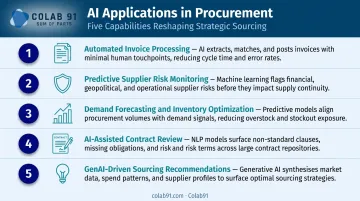
The capability gap is significant: 71% of CPOs report limited to moderate knowledge of GenAI. Organizations that move quickly on adoption now will hold a structural advantage as that gap widens.
E-Procurement Platforms and ERP Integration
Spend visibility alone isn't enough if procurement data stays fragmented across systems. Modern e-procurement platforms centralize the source-to-pay process and connect with existing ERP and finance systems, reducing the manual reconciliation and delayed reporting that disconnected tools create. When data flows end-to-end from requisition through payment, compliance improves and cycle times drop.
The procurement software market reflects this shift: the global market was valued at $10.06 billion in 2025 and is projected to reach $21.29 billion by 2033.
Supplier Relationship Management Technology
Digital SRM tools enable continuous monitoring of supplier performance, risk profiles, and contract obligations, moving procurement from transactional vendor management toward genuine strategic partnership.
Gartner data shows that 89% of procurement leaders are under pressure to deepen supplier relationships due to supply shortages. SRM technology makes that possible at scale, providing real-time alerts when supplier risk scores change rather than waiting for annual reviews.
Building the Right Team and Operating Model
The people pillar is consistently the most underinvested in procurement transformation. Deloitte's 2025 CPO Survey found that 34% of CPOs cite talent gaps as a barrier to execution — and the gap is specific. Most procurement teams are staffed for transactional processing, not strategic sourcing, category management, or spend analytics.
Capabilities a Transformed Team Needs
- Covers direct and indirect categories through strategic sourcing expertise
- Interprets and acts on data using spend analytics skills
- Treats each spend category as a managed business unit (category management)
- Manages suppliers for both performance and risk
- Drives adoption across the organization through change management
Building these capabilities in-house takes time and budget that mid-market and PE-backed companies typically don't have.
The Offshore Capability Model as an Accelerator
For mid-market and PE-backed organizations under pressure to transform quickly, partnering with a specialized offshore procurement capability center provides immediate access to domain experts in strategic sourcing and spend analytics. This sidesteps the cost and timeline of full in-house recruitment.
Colab91's model works precisely this way: dedicated India-based teams of category managers and sourcing specialists act as extensions of a client's procurement organization, owning the full value chain from spend analysis and opportunity identification through RFP execution, negotiation, and contract management. The "Sum of Parts" approach augments existing in-house talent with offshore domain expertise, building a combined capability that neither side could replicate alone.
This is particularly valuable for PE portfolio companies with 100-day transformation timelines. The offshore team can begin delivering spend intelligence within weeks while longer-term operating model changes are designed in parallel.
Operating Model Governance
Speed of deployment only matters if the operating model can sustain it. Whether you build in-house, offshore, or a hybrid, the governance structure must define:
- Clear roles and decision rights (what does procurement own vs. business units?)
- Escalation paths for supplier disputes, compliance breaches, and budget overruns
- Performance accountability tied to KPIs, not just activity metrics
Without this governance structure, well-resourced transformations lose momentum within 18 months.
Measuring Procurement Transformation Success
Core KPIs to Track
| KPI | What It Measures |
|---|---|
| Cost savings (realized vs. targeted) | Actual procurement-driven savings against plan |
| Procurement cycle time | Days from requisition to purchase order release |
| Contract compliance rate | % of spend under active, managed contracts |
| Supplier on-time delivery | ISM benchmark: high performance ≥ 95% |
| Tail spend as % of total spend | Fragmentation and leakage indicator |
| Stakeholder satisfaction scores | Internal perception of procurement's strategic value |
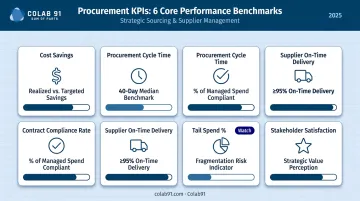
Per APQC benchmarks, the median procure-to-pay cycle time for goods is 40 days across 4,112 companies. World-class procurement organizations beat that figure by a wide margin through electronic processing and automated approvals.
Executive Reporting Cadence
Share transformation results with the C-suite at least quarterly. Dashboards should connect procurement KPIs directly to business outcomes that finance leaders care about. Gartner recommends going beyond cost savings to communicate:
- EBITDA impact and working capital improvement
- Revenue enabled by procurement decisions
- Year-over-year contribution to earnings per share and cash flow
- Supply chain resilience indicators
Procurement leaders who frame results in CFO language hold their budget through shifting business priorities. Those who report in procurement-only metrics are the first cut when leadership recalibrates.
Transformation Is Iterative
The data from KPI tracking is not just a scorecard — it's the input for the next wave of improvement. Organizations that treat transformation as a continuous loop rather than a one-time project consistently outperform those that declare victory after Phase 1.
Frequently Asked Questions
What is procurement transformation?
Procurement transformation is the process of redesigning procurement from a transactional, reactive function into a strategic driver of business value, achieved through better processes, technology, data, and talent. It addresses all four pillars (people, process, technology, supply chain) rather than just implementing new software.
What are the 7 stages of procurement?
The 7 stages are: need identification, purchase request, supplier evaluation and selection, purchase order creation, order receipt and inspection, invoice approval, and payment/record-keeping. Transformation targets each stage to automate approvals, cut cycle times, and close compliance gaps.
What are the 4 types of procurement methods?
The four main methods are: open tendering (open to all suppliers), restricted tendering (invited suppliers only), request for quotation or RFQ (standard, low-complexity goods), and sole sourcing (single supplier for specialized or proprietary needs).
What are the key challenges of procurement transformation?
The most common barriers are lack of executive buy-in, data and system fragmentation, talent gaps in strategic sourcing and analytics, change resistance from stakeholders, and difficulty proving ROI early enough to sustain momentum.
How does technology support procurement transformation?
E-procurement platforms, spend analytics tools, AI-driven automation, and ERP integrations together enable real-time visibility, faster approvals, better supplier management, and sharper, evidence-based decisions at every stage of procurement.
How long does a procurement transformation typically take?
McKinsey research indicates procurement transformations typically take 6–18 months for a meaningful step change, with early wins achievable in the first 3–6 months. Full strategic transformation, covering people, process, and technology, generally runs longer depending on organizational complexity.