: Why It's Transforming GCC](https://file-host.link/website/colab91-oswk8p/assets/blog-images/5aa12744-b04a-4148-bd25-17f480546ada/1780067044983634_43ef83b2981b41bbb4bf5cfcee3ebfc2/360.webp)
Introduction
Most mid-market companies underestimate what it actually takes to set up a Global Capability Center in India. Navigating Indian labor law, registering a foreign entity, recruiting domain talent in an unfamiliar market, and building governance structures from scratch - that workload lands on teams that are already stretched thin.
For PE-backed companies without a dedicated GCC function, the operational lift alone can stall or sink the initiative before it gains momentum.
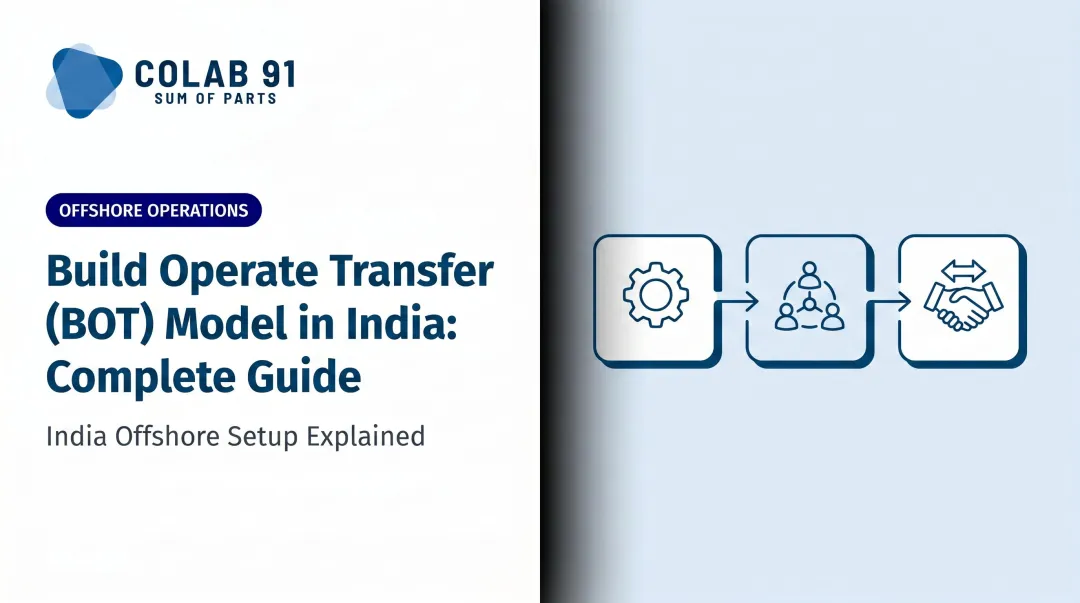
The Build Operate Transfer (BOT) model resolves this tension directly. Rather than forcing a binary choice between perpetual outsourcing and risky direct ownership, BOT lets a specialist partner build the center, run it until it's genuinely mature, and then hand over full ownership to you.
This article explains exactly how BOT works across its three phases, why it's reshaping GCC setup for mid-market companies specifically, and what separates a well-structured BOT engagement from one that falls apart at the handover stage.
Key Takeaways
- BOT = Build, Operate, Transfer: a partner builds your offshore GCC, runs it until it's mature, then hands over full ownership
- Combines outsourcing speed with eventual in-house control, without sacrificing one for the other
- The three phases typically span 18–36 months, with transfer triggered by agreed performance milestones
- BOT is particularly valuable for mid-market and PE-backed firms that lack dedicated GCC setup expertise
- Partner selection is the single biggest risk variable: domain expertise matters more than general outsourcing credentials
What Is the BOT Model and Why Is It Relevant to GCCs?
The Build Operate Transfer model is a contractual engagement where a service provider builds an offshore center from scratch, operates it for a defined period under agreed governance, and then transfers full ownership - personnel, legal entities, processes, and IP - to the client.
That last part is what separates it from traditional outsourcing. In a conventional outsourcing arrangement, the vendor owns the center indefinitely. You buy outputs. In BOT, ownership always moves to you.
The GCC Connection
Global Capability Centers are wholly owned offshore entities that the parent company controls directly - hiring their own talent, owning all IP, and running high-value functions such as analytics, procurement, finance, and R&D. As Zinnov describes it, in a GCC the parent company establishes the offshore entity, hires talent, and owns all IP from day one.
The challenge is getting there. Direct GCC setup requires entity registration, FDI approvals, real estate, IT infrastructure, and local talent networks - in a market most mid-market companies have never operated in.
BOT closes that gap by bridging the setup capability a mid-market company typically lacks. The partner provides infrastructure, regulatory knowledge, and local talent access during the Build and Operate phases - while you co-design the operating model, approve key hires, and set performance standards from day one. The result is a center built to your specification, not a generic offshore template.
Not the Infrastructure Version
The term "BOT" also appears in public-private infrastructure contexts - toll roads, power plants - but that's a separate construct. In IT and business services, BOT is purpose-built for establishing offshore teams and transferring operational control.
Its adoption in India's GCC ecosystem has accelerated meaningfully. Everest Group identifies BOT, Assisted Build Out, and Joint Venture as provider-supported GCC setup constructs that have expanded rapidly, driven by enterprises with limited GCC setup experience and insufficient knowledge of local talent markets.
The Three Phases of BOT Explained
BOT is a deliberate progression from risk-sharing to full autonomy. Each phase has distinct obligations, deliverables, and contractual triggers - and understanding what happens in each phase is essential for structuring an engagement that actually works.
Build Phase
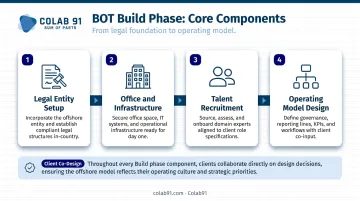
The Build phase is where the partner establishes the operational foundation. Depending on the agreed structure, this includes:
- Legal entity setup - incorporating a private limited company or using the partner's existing structure, including FDI and MCA registrations
- Office and infrastructure - securing dedicated space or slots in a multi-tenant facility, plus IT systems and security
- Talent recruitment - sourcing, assessing, and onboarding the initial team against role specifications you've defined together
- Operating model design - governance structures, reporting lines, SOPs, and escalation paths aligned to your strategic goals
The client's role here is not passive. You co-design the organizational blueprint, set performance standards, and approve key hires. The Build phase determines whether you get a GCC tailored to how your company actually works - or a generic offshore team that someone else designed.
Operate Phase
The Operate phase is where the partner runs the center day-to-day. Responsibilities typically include:
- Payroll, compliance, and HR management
- Performance management and workflow delivery
- Vendor relationships and facilities oversight
- KPI reporting through regular leadership reviews and shared dashboards
This phase matters more than most clients expect. Culture forms here. Processes sharpen. The team evolves from newly hired individuals into a functioning unit that reflects your operating standards.
A well-managed Operate phase delivers a center genuinely ready for transfer. One where the client has disengaged produces a center that looks functional on paper but collapses the moment the partner steps back.
Morgan Lewis notes that during the Operate phase, the GCC functions under service levels, risk-sharing provisions, and governance protocols - which must be defined contractually, not left to informal arrangement.
Transfer Phase
Transfer involves the structured handover of legal entities or assets, employment contract transitions, knowledge documentation, and a transitional services agreement that bridges any gaps after the partner exits.
Under India's Industrial Disputes Act, Section 25FF, employees with one year or more of continuous service are entitled to notice and compensation when ownership transfers - unless continuity of service is maintained, terms remain no less favorable, and the new employer assumes retrenchment liability. Mishandling this creates real financial and legal exposure.
The most common BOT failure point happens here: transfer terms that weren't defined clearly at the outset. Trigger conditions, IP ownership, asset versus share transfer structures, and transitional support obligations all need to be contractually specified from day one - not negotiated under pressure when the transfer date arrives.
Why BOT Is Transforming GCC Setup
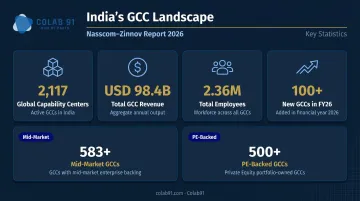
India's GCC ecosystem has scaled dramatically. The Nasscom-Zinnov GCC Landscape Report 2026 puts India at 2,117 GCCs generating USD 98.4 billion in revenue and employing 2.36 million people - with over 100 new GCCs established in FY26 alone. The report also identifies 583+ mid-market GCCs and 500+ PE-backed GCCs already operating in India.
That growth is real. What's also real is how many of those centers struggled through setup without a coherent model.
Why Mid-Market Companies Specifically Benefit
Traditional direct GCC setup requires navigating entity registration with India's Ministry of Corporate Affairs, FDI approvals, local real estate, and a talent market most mid-market firms have no prior exposure to. Deloitte describes the GCC establishment process as including legal structure selection, MCA registration, and FDI or SEZ approvals - each one a meaningful hurdle for a company doing this for the first time.
BOT compresses that timeline by letting the partner apply existing infrastructure, regulatory relationships, and talent networks. For mid-market and PE-backed companies without dedicated GCC teams, the partner's operational expertise is the primary mechanism for getting this right.
Colab91's leadership team built this understanding through direct experience. Managing Partner Madhur Kabra previously served as Country Head of Impendi's India operations before its acquisition by Accenture, scaling a multifunctional offshore organization to 100+ practitioners across procurement and analytics.
That track record - serving PE portfolios including Carlyle Group, TPG, Elliott, and BC Partners - represents the domain depth that generic outsourcing firms don't carry into these engagements.
IP and Optionality Advantages
Unlike traditional outsourcing where IP often sits with the vendor, BOT is designed so that IP, data, and proprietary processes belong to the client. Contractual IP rights should be established at engagement start, not negotiated at handover.
The model also carries structural advantages worth naming:
- IP ownership: Client retains all data, processes, and proprietary systems from day one
- Flexibility during Operate: Strategy shifts mid-engagement are manageable - you're not locked into a fully owned center
- Capital optionality: Committed capital stays lower until you've validated the operating model
For PE-backed companies operating under defined portfolio timelines, the ability to course-correct before full ownership transfers is a meaningful difference from building a center outright.
BOT vs. Direct GCC Setup vs. Traditional Outsourcing
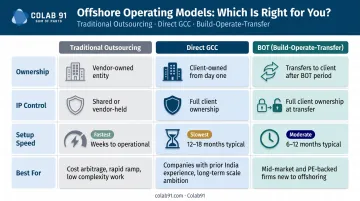
Three models, three different risk profiles:
| Model | Ownership | IP Control | Setup Speed | Best For |
|---|---|---|---|---|
| Traditional Outsourcing | Vendor-owned permanently | Vendor retains | Fastest | Cost arbitrage, commodity functions |
| Direct GCC | Client-owned from day one | Client retains | Slowest | Companies with prior India presence and internal GCC expertise |
| BOT | Transfers to client at maturity | Client retains throughout | Moderate | Mid-market/PE-backed companies new to offshore operations |
When Direct GCC Makes Sense vs. When BOT Wins
Companies with prior India presence, a dedicated GCC leadership team, and existing compliance infrastructure can reasonably pursue direct setup. The control is immediate and the overhead is justified.
For everyone else - particularly mid-market firms and PE-backed companies standing up their first offshore center - the expertise gap is the real problem. Most failed GCC launches trace back to the same set of avoidable missteps:
- Wrong location choice for the target talent pool
- Wrong entity structure for the operating model
- Wrong talent approach for domain-specific functions
- Wrong governance design for the transition phase
BOT removes that gap by putting someone with direct experience in the driver's seat during the phases where mistakes are most costly.
BOT vs. ODCs
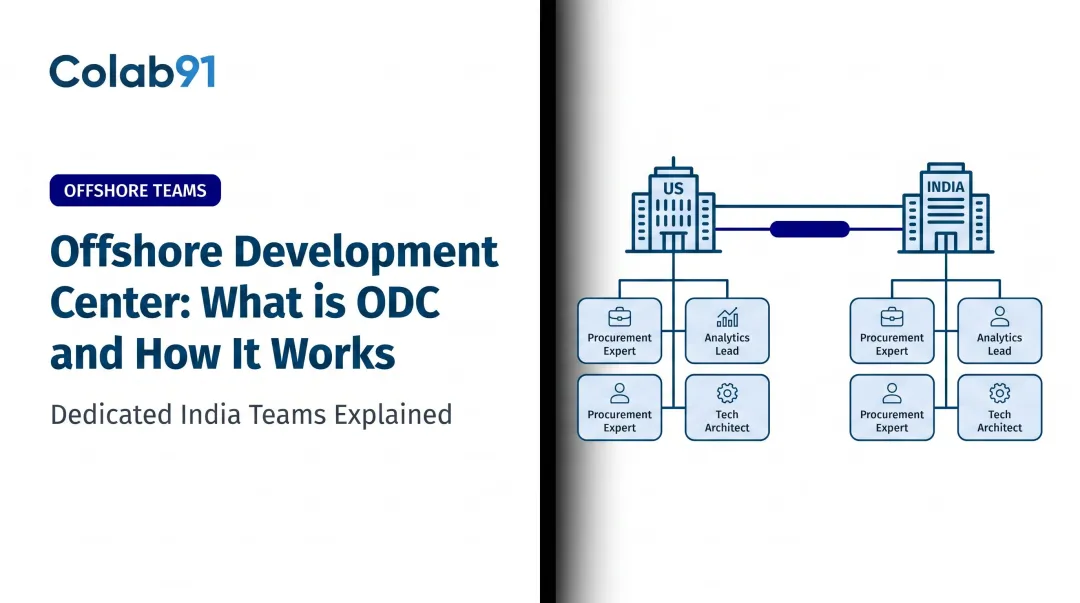
The same logic applies when comparing BOT against Offshore Development Centers (ODCs). ODCs are vendor-owned and vendor-managed indefinitely - you receive services, but you never receive ownership. For companies that want to build a lasting strategic asset with full control over talent, IP, and operating model, an ODC creates permanent dependency rather than resolving it.
BOT is structurally designed to produce the opposite outcome: a mature, fully owned entity that you run as a strategic hub, not a service you subscribe to.
Challenges of the BOT Model and How to Navigate Them
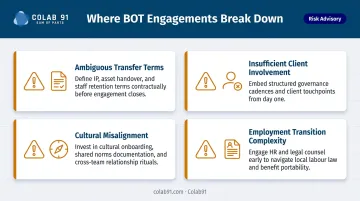
BOT works well when structured correctly. When it isn't, the failure modes are predictable:
- Ambiguous transfer terms - trigger conditions, asset vs. share transfer, IP ownership, and transitional support must be contractually specified at the engagement start, not retrofitted at the end
- Insufficient client involvement during Operate - companies that treat the Operate phase as a black box consistently struggle at transfer; the team won't reflect the parent company's values if you haven't been present to shape them
- Cultural misalignment - a center that operates to the partner's culture, not yours, requires significant remediation post-transfer
- Employment transition complexity - moving staff from partner payroll to client payroll across jurisdictions requires advance legal planning, given India's Section 25FF obligations
The Governance Imperative
BOT does not mean the client steps back. Effective BOT requires regular leadership reviews, shared KPIs, and active client involvement in team culture from month one. Companies that show up only at transfer milestones get centers that are operationally functional but strategically thin.
Everest Group identifies unclear mandates, disconnect between GCC leaders and enterprise leaders, and talent pitfalls as the primary GCC risk categories - all of which are compounded by passive client engagement during the Operate phase.
Partner Selection Is the Highest-Stakes Decision
Governance quality also depends on who your partner is. A BOT partner with strong generalist outsourcing credentials but no domain expertise in your function will build an operationally sound center that lacks strategic depth. For companies in procurement, analytics, or finance, that gap shows up in talent quality, process design, and the center's ability to deliver value beyond cost arbitrage.
Colab91 was built around this problem. The managing partners spent two decades building and scaling procurement and analytics functions for PE portfolios at Impendi - later acquired by Accenture - and that domain depth shapes how Colab91 designs centers. The result is a center built to carry strategic weight at transfer, not just operational continuity.
Frequently Asked Questions
What does build-operate-transfer (BOT) mean?
BOT is a structured engagement model where a service provider builds an offshore center from scratch, runs it under agreed governance for a defined period, then transfers full ownership - staff, IP, and operations - to the client. It combines outsourcing speed with the long-term control of an in-house GCC.
What is an example of a build-operate-transfer?
A US-based PE-backed company engages a BOT partner to establish a procurement and analytics GCC in India. The partner handles entity setup, talent recruitment, and operations for 24 months. At an agreed milestone, full ownership transfers to the client as a wholly owned entity: employment contracts, IP, and processes included.
What is the difference between BOT and BOOT (Build-Own-Operate-Transfer)?
In BOOT, the service provider owns the center during the operate phase and carries more financial risk. In BOT, the client typically retains stronger IP rights and governance input throughout. Transfer terms are agreed at engagement start, not determined by the provider's ownership position.
What is the difference between a GCC and an ODC?
A GCC is a wholly owned offshore entity of the parent company with full control over operations, talent, and IP. An ODC is vendor-owned and managed - the client receives services but not ownership.
Who is the BOT model best suited for?
BOT suits companies that want offshore capability without the complexity of building it independently. It's the right fit for:
- Mid-market and PE-backed firms new to offshore operations
- Organizations without internal GCC setup expertise
- Businesses that want to validate offshore performance before committing to full ownership
How long does the BOT process typically take from build to transfer?
The full BOT lifecycle typically spans 18 to 36 months, depending on team size, function complexity, and contractual milestones. Some engagements are structured for earlier transfer once the center reaches defined performance benchmarks.