Introduction
Most IT budgets don't blow up in a single quarter. They erode - slowly, category by category, renewal by renewal. Zylo's 2024 SaaS Management Index, which analyzed over 30 million SaaS licenses and $34 billion in software spend, found that businesses waste an average of $18 million annually on unused licenses alone. Meanwhile, 69% of IT leaders surveyed by Gartner reported cloud cost budget overruns in 2024.
For PE-backed and mid-market companies, these aren't just budget line items. They're margin points. Duplicate tools, auto-renewing contracts, and shadow IT purchases quietly compress the budget available for actual innovation - the technology refresh and capability investments that drive competitive advantage.
The real problem is that IT sourcing decisions get made reactively, without spend visibility, without market benchmarks, and often without procurement involved until contracts are already on the table. This article examines where IT costs originate across the sourcing lifecycle, and what it takes to fix them structurally, while also building the supplier relationships that actually advance innovation goals.
Key Takeaways
- IT costs accumulate incrementally - through subscription renewals, license expansions, and shadow IT - rarely surfacing all at once
- The top cost drivers are unused licenses, vendor lock-in, fragmented internal demand, and reactive sourcing decisions
- Cutting costs requires three levers: smarter upfront sourcing, tighter in-lifecycle management, and restructuring how IT procurement is organized
- When done well, IT strategic sourcing recovers margin and directly funds the innovation agenda
How IT Costs Typically Build Up
IT costs rarely announce themselves. They accumulate in the background: a tool purchased by one team, a license tier that was "close enough" at renewal, a cloud environment that scaled with usage but never scaled back down.
The data reflects this clearly. Productiv's analysis of more than 30,000 applications found that only 45% of company SaaS applications were used regularly over a 60-day period. The same research found that **56% of all applications were shadow IT** - purchased and managed entirely outside central IT. Shadow IT at that scale isn't an edge case. It's the default.
What makes this particularly costly is the compounding effect. A poorly structured enterprise license in year one (one that bundles unneeded seats or locks in a five-year term) creates a cost ceiling that follows you for years. By the time it surfaces in a budget review, the negotiating window has already closed.
Three dynamics drive this pattern:
- Subscription sprawl: Zylo found the average organization carries duplicative software across categories, including 15 online training apps, 11 project management tools, and 10 team collaboration apps
- Price inflation without intervention: SaaS prices rose an average of 10.5% in 2024, per Vendr's analysis of $4B+ in managed spend; absent active renegotiation, renewals simply absorb that increase
- Invisible spend: Without consolidated spend data, no one sees the full picture until an audit forces the conversation
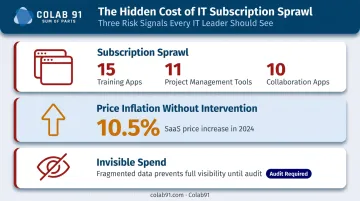
The implication is clear: early intervention is worth far more than late correction. Waiting for a budget crisis to trigger a sourcing review means the most expensive decisions are already set in stone.
Key Cost Drivers in IT Strategic Sourcing
Understanding where costs originate makes it much easier to address them. Most IT cost problems trace back to four structural drivers.
Software License Complexity
License management is the most pervasive issue. According to Zylo's 2024 data, 51% of SaaS licenses go unused monthly - yet most organizations continue paying for them at renewal because no one has mapped utilization against entitlement. The gap between what's purchased and what's actually used is where a significant portion of that $18M in average annual waste lives.
Vendor Dependency
When a single vendor controls a critical platform, pricing power shifts decisively in their direction. Organizations that have built deep integrations, trained staff on proprietary workflows, or stored years of data in one place find it nearly impossible to credibly threaten a switch - and renewal pricing reflects that leverage accordingly.
Fragmented Internal Demand
IT purchasing decisions made department-by-department - without central visibility - produce predictable outcomes: redundant tools solving the same problem, off-contract purchases that bypass negotiated rates, and category consolidation opportunities that never get captured. This isn't a technology problem. It's a governance problem.
Failure to Reassess the Market
Technology evolves faster than most IT contracts. Organizations that skip regular vendor benchmarking often end up renewing legacy solutions at premium prices - while competitors have already migrated to more capable, more cost-efficient platforms. Each renewal cycle without a market check is another year of overpaying for yesterday's solution.
Cost-Reduction Strategies for IT Strategic Sourcing
The right approach depends on where in the sourcing lifecycle the cost is being created. Some originate in the decision, some in the management, and some in the broader structure of how IT is acquired.
Strategies That Change IT Sourcing Decisions
Cost leaks here before any contract is signed. Fixing them requires deliberate decision criteria - not just vendor familiarity or procurement convenience.
Run a license and entitlement audit before any major renewal. Map current utilization against what you're paying for. The output typically reveals shelfware, over-provisioned tiers, and redundant tools - all of which become negotiating leverage. This audit is one of the highest-ROI actions available, and it should happen at least 90 days before any significant renewal.
Apply a structured build vs. buy vs. subscribe evaluation. Define the criteria upfront:
- Total cost of ownership over 3–5 years
- Integration requirements and switching costs
- Exit flexibility and contract terms
- Alignment with internal capability roadmap
Without this framework, decisions default to vendor pressure or whatever the team is already familiar with - neither of which is a reliable cost-optimization signal.
Consolidate the vendor base. Spend analysis typically reveals supplier overlap. Fewer, more strategic vendor relationships yield better pricing, stronger SLAs, and a more defensible negotiating position than a fragmented portfolio where each tool is managed in isolation.
Strategies That Change How IT Spending Is Managed
Once contracts are live, cost discipline shifts to visibility and accountability. These strategies address spending that escapes notice until renewal time - when options are already narrowed.
Implement category-level spend visibility. Shadow IT and off-contract purchases are only manageable when procurement has a consolidated view of what's being bought, by whom, and at what price. Without this, spend audits are reactive and incomplete.
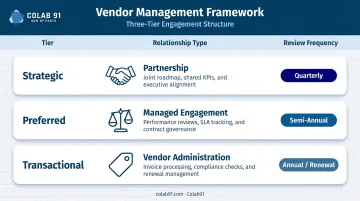
Establish a vendor tiering and performance review cadence. Not all vendors warrant the same attention:
| Tier | Relationship Type | Review Frequency |
|---|---|---|
| Strategic | Partnership investment | Quarterly |
| Preferred | Competitive pricing + SLA accountability | Semi-annual |
| Transactional | Lowest cost, standardized terms | Annual or at renewal |
This structure ensures resources go where they create the most value, and that all vendors are held to measurable commitments.
Build a contract renewal calendar with proactive alerts. Set triggers at 180 and 90 days before expiration. Most auto-renewals at inflated rates happen because no one owned the renegotiation process. A renewal calendar is among the simplest, highest-return governance changes a sourcing team can make - and it requires no new technology, just ownership.
Strategies That Change the Context Around IT Sourcing
Some cost problems aren't tactical - they're structural. How sourcing is organized, resourced, and informed determines whether tactical improvements hold or erode over time.
Invest in market intelligence before entering major negotiations. Knowing what comparable organizations pay for the same platforms fundamentally changes negotiating posture. Tools like Vendr (built on $15B+ in B2B software pricing data and 130,000+ real negotiations) and Vertice (covering 10,000+ SaaS vendors) give procurement teams the external reference points needed to challenge vendor pricing with confidence rather than intuition.
Involve procurement early in the planning cycle. Late procurement involvement is a structural cost driver - it reduces competitive tension, limits the evaluation window, and gives vendors the upper hand. When IT sourcing decisions are made before procurement enters the room, the best cost and contractual outcomes are often already off the table.
Augment in-house capacity with offshore procurement and analytics expertise. Mid-market companies rarely have the internal resources to run ongoing spend analysis, market benchmarking, and RFP development at the pace the IT category demands. A dedicated India-based capability center - staffed with domain experts in sourcing and analytics - provides that capacity without the overhead of a large onshore team.
Colab91 builds exactly these teams for mid-market and PE-backed companies. Their leadership previously built and scaled Impendi's India operations (later acquired by Accenture), running procurement and analytics programs for clients including Carlyle Group, TPG, and BC Partners.
Turning IT Sourcing Into an Innovation Engine
Cost recovery is only half the equation. What you do with recovered budget determines whether IT strategic sourcing creates lasting competitive advantage or just preserves the status quo.
McKinsey estimates that the average company has an opportunity to optimize and potentially reinvest 30% of IT spend through improved IT productivity. For a company spending $20M annually on IT, that's $6M that could be redirected toward technology refresh, capability building, or R&D (rather than absorbed by shelfware and inflated renewals).
Beyond savings reinvestment, the discipline of strategic sourcing itself changes how organizations engage with the technology market:
- Suppliers treated as strategic partners (not just contract targets) share early roadmap access, offer pilots of new capabilities, and co-develop solutions - but only when the relationship is actively managed, not just revisited at renewal time.
- Organizations that regularly assess alternatives discover better delivery models, newer pricing structures, and more capable platforms well before those locked into auto-renewal cycles.
- Teams that run disciplined build/buy/subscribe analyses develop compounding institutional knowledge about the technology market, which feeds stronger decisions across every future category.
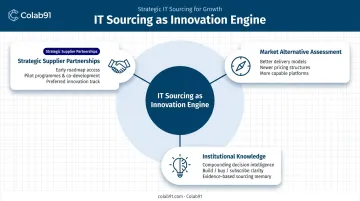
Treat sourcing as a cost exercise and you optimize last year's spend. Treat it as a market-informed function and you build the capability to spot - and act on - better technology options before competitors do.
Conclusion
IT costs spiral not because technology is inherently expensive, but because sourcing decisions get made without structure, contracts run without governance, and procurement capacity is consistently under-resourced relative to the spend it's meant to manage. The fix isn't arbitrary budget cutting - it's identifying where cost originates across the decision, management, and structural layers of IT sourcing, and addressing each layer deliberately.
For mid-market and PE-backed companies, the stakes are particularly high. IT spend is one of the fastest-growing cost categories, and the margin impact of unmanaged sprawl grows year over year without much visibility until it shows up in the numbers.
When IT strategic sourcing is executed continuously - with the right data, clear governance, and domain expertise behind it - it becomes a dual-purpose function: one that protects margin and creates the budget for the innovation agenda that actually drives growth. That kind of sustained execution is exactly what dedicated offshore procurement and analytics teams are built to deliver.
Frequently Asked Questions
What are the 7 steps of IT strategic sourcing?
The standard process covers: spend analysis, category profiling, supply market research, sourcing strategy development, RFx and supplier selection, negotiation and contract execution, and ongoing supplier performance management.
What are the 5 P's of IT sourcing strategy?
The 5 P's framework - People, Process, Platform, Performance, and Partnership - provides a lens for building and sustaining an IT sourcing function. Each element addresses a distinct dimension, from day-to-day operational mechanics to the vendor relationships that determine long-term value.
What are the 4 pillars of strategic sourcing for IT?
The four pillars are spend visibility, supplier management, contract governance, and continuous market intelligence. Effective IT sourcing programs require all four operating simultaneously - gaps in any one pillar tend to create the cost leakage that the others are trying to prevent.
What are the 4 sourcing approaches in IT?
The four primary approaches are single sourcing, dual sourcing, multi-sourcing, and global or offshore sourcing. The right approach depends on criticality, risk profile, and scale - high-criticality platforms typically need dual sourcing for resilience, while commodity tools fit competitive multi-vendor setups.
How is IT strategic sourcing different from general procurement?
IT sourcing requires specialized knowledge of licensing models, cloud economics, integration complexity, and security compliance - areas that general procurement frameworks aren't designed to handle. Getting IT sourcing wrong doesn't just create overspend; it creates technical debt and contractual lock-in that's difficult to unwind.
How can mid-market or PE-backed companies build an effective IT sourcing function without a large in-house team?
Start with spend visibility and contract renewal governance - these create the most immediate value with the least investment. From there, augment capacity through an offshore procurement and analytics capability center that brings domain-grade expertise at a fraction of the cost of building a full onshore team. Colab91 builds exactly this kind of dedicated offshore capability for mid-market and PE-backed organizations, combining procurement domain expertise with India-based delivery efficiency.