Introduction
U.S. manufacturing alone spent nearly $120 billion on purchased energy in 2022-$69.5 billion on electricity and $50 billion on natural gas, according to the EIA's Manufacturing Energy Consumption Survey. Commercial buildings add billions more across electricity, gas, water, and waste.
Yet a significant share of that spend is managed passively. Contracts auto-renew. Rate structures go unreviewed. Invoice anomalies pass undetected because no one is actively looking. The result is margin compression that compounds steadily across multi-year agreements.
Utility costs aren't inherently fixed. They become expensive through reactive decisions, poor contract structure, and the absence of systematic oversight-all problems that procurement teams can directly address.
This blog examines how strategic sourcing changes that equation across three dimensions:
- Pre-contract decisions - how organizations evaluate suppliers, rate structures, and terms before committing
- Active contract management - how they monitor spend, catch billing errors, and enforce contract terms
- Demand-side configuration - how operational context drives underlying consumption and cost
Key Takeaways
- Utility spend is one of the largest neglected cost categories in mid-market organizations-most excess cost comes from inaction, not market forces
- Auto-renewals, rate escalation clauses, and unmonitored consumption drift silently compound costs year over year
- Strategic sourcing replaces reactive purchasing with structured market analysis, competitive bidding, and vendor accountability
- Timing market entry correctly, maintaining spend visibility, and consolidating demand before bidding drive the biggest savings
- Mid-market and PE-backed companies can build this discipline without large in-house teams-the right systems and analytics capabilities make it scalable
How Utility Costs Typically Build Up
Cost accumulation in utilities is rarely a single event. It builds slowly across billing cycles, contract renewals, and operational changes - and by the time it's visible, the damage is already done.
The Mechanics of Silent Escalation
Most organizations treat utility invoices as fixed operational expenses - volume arrives, gets approved, gets paid. Rate escalation clauses built into long-term contracts increase costs annually, but because no one is tracking the rate trajectory against market benchmarks, the increase registers as normal.
The problem only surfaces during renewal conversations, financial audits, or unexplained budget variances. At that point, multiple contract cycles of avoidable cost have already passed.
Consumption-Side Costs Are Equally Hidden
Beyond rate escalation, consumption-side costs add another layer:
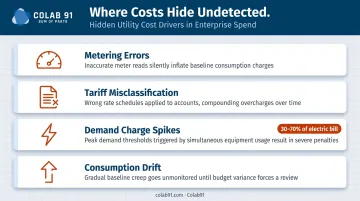
- Metering errors that persist undetected across billing periods
- Tariff misclassification where an organization is billed under the wrong rate structure for its actual load profile
- Demand charge spikes triggered by peak usage intervals-DOE data shows demand charges can represent 30% to 70% of a commercial electric bill
- Consumption drift from operational changes that were never reflected in contract parameters
None of these are self-correcting. Without structured spend analytics, each billing period adds another layer of unrecovered cost - exactly the kind of gap that proactive utility sourcing is designed to close.
Key Cost Drivers in Utility Strategic Sourcing
Understanding where cost originates is a prerequisite for addressing it. Four drivers consistently account for the bulk of avoidable utility spend.
Rate Structure Complexity
Utilities typically offer multiple tariff options:
- Flat rates and block rates
- Time-of-use pricing
- Demand-based structures
- Interruptible service contracts
Organizations on the wrong tariff for their actual consumption pattern consistently overpay - the problem isn't that rates are high, but that the structure doesn't match their load profile.
As LBNL research on demand charges confirms, savings outcomes depend heavily on both the tariff design and the customer's specific load characteristics. This isn't a universal calculation; it's a load-profile and rate-design alignment problem.
Contract Timing
Timing has an outsized effect on negotiating leverage. Organizations that reach out to suppliers within weeks of contract expiration have, in practice, already ceded their options. There's no time to run a competitive process, benchmark current rates, or explore alternative structures.
CIPS notes that missing critical renewal dates can significantly affect business revenue, especially where contracts renew automatically. Initiating sourcing reviews 12–18 months before expiration restores those options:
- Run a competitive bid process without deadline pressure
- Fix contract term, index pricing, or aggregate multi-site volumes
- Correct tariff misalignments before the renewal window closes
Deregulated vs. Regulated Market Structure
In regulated markets, the utility is the only game in town. Competitive pressure is limited. In deregulated electricity and gas markets, multiple suppliers compete on price and structure - but only for organizations that show up with organized load data, a structured RFP process, and genuine market intelligence.
FERC data shows roughly two-thirds of U.S. electricity load is served within RTO/ISO regions. Many states allow commercial and industrial customers to choose their electricity or gas supplier. That choice only matters if it's actively exercised.
Regulatory Pass-Through Costs
Even in competitive markets, regulated pass-through costs sit outside supplier negotiations - and they're often where the real overcharges hide. Transmission fees, distribution charges, environmental levies, and rider costs are frequently accepted as fixed when they shouldn't be.
The DOE's electricity bill guide recommends reconstructing bills from rate schedules line by line. That means verifying:
- Rate class application and demand calculations
- Power factor charges and their basis
- Tax exemptions that apply to your operation
Tariff audits can surface whether an organization is on the correct rate class, whether pass-through treatment matches contract terms, and whether applicable exemptions have been claimed. These aren't exotic interventions; they're basic due diligence that most mid-market organizations have never performed.
Cost-Reduction Strategies for Utility Sourcing
Utility cost reduction opportunities fall into three distinct categories: decisions made before entering a contract, how spend is managed while contracts are active, and the operational context that drives underlying demand.
Strategies That Change Decisions
These are actions taken before or during the sourcing process that determine whether an organization enters a contract at competitive or disadvantageous terms.
Proactive Contract Timing
Start sourcing reviews 12–18 months before contract expiration. That's the minimum runway needed to run a structured market evaluation, gather competitive bids, and negotiate from a position of genuine choice. Organizations that allow auto-renewals give suppliers full leverage and typically renew at above-market rates by default.
Competitive RFP Execution
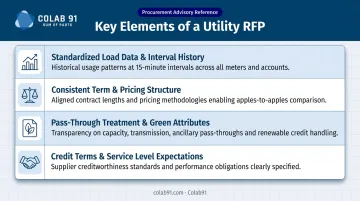
In deregulated markets, always invite multiple suppliers to bid using a structured RFP process. Even when the incumbent ultimately wins, the process yields better pricing because competitive displacement is a real possibility. Key elements of a utility RFP include:
- Standardized load data and interval history
- Consistent term and pricing structure across all bids
- Clear pass-through treatment and green attribute requirements
- Defined credit terms and service level expectations
Tariff Classification Review Before Signing
Before executing any new or renewed utility contract, audit the rate classification against the organization's actual consumption pattern. Switching from a standard commercial tariff to a time-of-use or demand-charge structure (or vice versa) can significantly change total cost without changing the vendor.
Strategies That Change How Spend Is Managed
This is where most mid-market organizations have the largest gap. Active management during the contract term is where cost discipline either holds or erodes.
Continuous Invoice Monitoring
Systematic invoice auditing catches billing errors, unauthorized rate changes, and demand charge spikes before they compound. DOE's Energy Data Management guidance notes that streamlining utility data access can reduce collection time by 10–33%, and recommends structured data checks before analysis.
Manual review is insufficient at scale. Organizations with multiple facilities, complex tariff structures, or high invoice volumes need analytics infrastructure (or a dedicated team) that can flag anomalies in real time rather than catching them in annual audits.
Mid-Contract Performance Reviews
Establish KPIs with utility vendors at contract inception: billing accuracy, reliability metrics, response times for disputes. Conduct formal mid-contract reviews rather than waiting for renewal. For PE-backed portfolio companies managing multiple sites, this creates the visibility needed to identify which locations are underperforming on cost efficiency and why.
Building Dedicated Sourcing Capability
Many mid-market companies lack in-house procurement resources to manage utility sourcing as a continuous discipline. The alternative to building a full internal team is establishing an offshore capability center that specializes in spend analytics and strategic sourcing.
Colab91 builds this kind of function for mid-market and PE-backed clients: dedicated India-based teams of domain experts in procurement and analytics that operate as an extension of the client's in-house team. The model treats utility spend as an actively managed cost category year-round, not a renewal exercise that gets attention every few years. Leadership previously scaled Impendi's India operations to 100+ practitioners serving firms like Carlyle Group and TPG, so the operational framework for continuous sourcing discipline is already proven.
That kind of ongoing management capability is what makes the strategies in the next category viable - because monitoring regulatory windows and managing demand exposure requires someone actively watching the market, not just reviewing contracts at renewal.
Strategies That Change the Context Around Spend
These approaches address the underlying operational and structural conditions that drive utility demand and market exposure.
Demand Consolidation Before Going to Market
Organizations with multiple facilities that source utility services independently forfeit volume leverage. Consolidating demand across sites before running a sourcing event creates a more attractive load package, improves data quality, and can unlock better pricing tiers in deregulated markets. Framework agreement structures - where prices and terms are agreed across multiple locations simultaneously - make this consolidation practical to execute.
Peak Demand Management
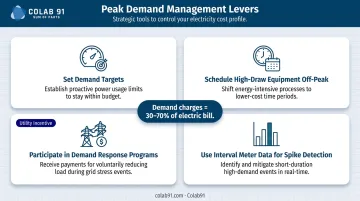
Where demand charges apply, load management is a direct cost lever. Demand charges can represent 30–70% of a commercial electric bill, and ratchet clauses can set billed demand at 70–80% of a prior peak even if current usage is lower.
Practical levers to reduce peak exposure include:
- Setting demand targets at a defined percentage of historical peak
- Scheduling high-draw equipment outside peak windows
- Participating in demand response programs for utility credit or revenue
- Using interval meter data to identify recurring demand spikes
Cleveland-Cliffs demonstrated the upside: by targeting demand at half of normal peak, they generated $500K–$1M annually through demand response participation.
Monitoring Regulatory and Market Shifts
Deregulation, green tariff programs, renewable energy credits, and government incentive programs all affect the utility cost landscape on fixed timelines. The DSIRE database tracks commercial and industrial utility rebate and efficiency programs by jurisdiction, but organizations need active market monitoring to act on these windows before they close.
Conclusion
Utility strategic sourcing delivers results when it targets cost at the root - whether that's poorly timed contract decisions, gaps in governance discipline, or unchallenged assumptions about actual demand.
Treated as a continuous cycle, it compounds over time:
- Market intelligence informs when and how to contract
- Contract governance preserves the value of those decisions
- Demand optimization reduces the cost base that sourcing operates against
Organizations that run this cycle year-round outperform those that manage utilities as a fixed cost line.
Mid-market and PE-backed companies don't need large in-house procurement teams to build this discipline. They need strong analytics capability, a structured sourcing process, and the operational rigor to act on market signals before contracts force their hand.
Frequently Asked Questions
What are the 5 core processes of strategic sourcing?
The five core processes are spend analysis, supply market research, supplier evaluation, competitive bidding (RFP/RFQ), and contract negotiation with performance management. In utility sourcing, these translate to load data analysis, market rate benchmarking, supplier qualification, structured RFP execution, and ongoing contract compliance tracking.
What is the difference between P2P and S2P in strategic sourcing?
Procure-to-Pay (P2P) covers the transactional side: requisition through invoice payment. Source-to-Pay (S2P) extends upstream to include supplier identification, evaluation, and contracting before a purchase order is created. Utility sourcing benefits most from those upstream S2P activities.
What are the main procurement methods used in strategic sourcing?
The primary methods are competitive bidding (RFP/RFQ), sole-source negotiation, reverse auctions, and framework agreements. In deregulated markets, competitive RFPs and framework agreements tend to deliver the best results; in regulated markets, negotiated approaches focused on rate classification and pass-through terms are more applicable.
How often should utility contracts be renegotiated?
Sourcing reviews should begin 12–18 months before contract expiration, with mid-contract benchmarking conducted annually. In volatile energy markets, particularly for natural gas, more frequent reviews help confirm the current pricing structure still reflects market conditions.
What is the difference between utility sourcing and utility expense management?
Utility sourcing is the upstream process of identifying, evaluating, and contracting utility services at competitive terms. Utility expense management is the broader lifecycle discipline-covering invoice management, billing audits, and ongoing vendor oversight after contracts are in place. Both are necessary; neither alone is sufficient.