Introduction
Procurement typically accounts for 20% to 50% of company revenue spent on goods and services, according to Deloitte - yet many organizations still treat cost reduction as something that happens when budgets get squeezed, not as a deliberate operating discipline.
The result is a familiar pattern: reactive cuts that feel like progress but leave the underlying cost structure unchanged. Suppliers get squeezed on price, purchasing freezes get imposed, and six months later the same problems resurface.
This article explains what strategic cost management in procurement actually means - how it differs from tactical cost cutting, the core components that make it work, and how to measure whether it's delivering real results.
For mid-market and PE-backed companies especially, these decisions aren't just procurement topics. They shape EBITDA directly - and McKinsey research found that inefficient sourcing has left some midsize industrial companies with margins 30% to 40% below peers. That's a boardroom problem.
Key Takeaways
- Strategic cost management is a proactive, long-term approach to controlling costs in ways that strengthen business performance - not just reduce spend temporarily
- It differs from tactical cost cutting by targeting structural improvements: sourcing, supplier relationships, category discipline, and process efficiency
- Key components: spend visibility, Total Cost of Ownership analysis, category management, supplier collaboration, and compliance
- For mid-market companies, building the internal capability to execute this is often the hardest part - offshore procurement teams are an increasingly practical solution
- Success is measured through financial KPIs (savings, cost avoidance, working capital) alongside operational metrics like cycle time, compliance, and supplier performance
What Is Strategic Cost Management in Procurement?
Ivalua defines strategic cost management as a systematic process that separates costs contributing to a company's competitive position from those that may weaken it. That framing matters, because it immediately shifts the question from "how do we spend less?" to "which costs create value, and which ones don't?"
In practice, strategic cost management transforms procurement from a transactional function into a meaningful contributor to business performance. When procurement teams have the data, the mandate, and the tools to act strategically, their decisions shape cost structures, supplier ecosystems, and sometimes even product design.
What "Strategic" Actually Means Day-to-Day
The term gets used loosely. In practice, strategic cost management means:
- Proactive decision-making before budget pressure forces your hand
- Designing specifications for cost-efficiency from the outset, not retrofitting savings after the fact
- Selecting suppliers based on total value, not lowest quoted price
- Continuously reviewing whether current spend patterns still serve the business
The scope covers the full procurement lifecycle - from how spend categories are structured, to how contracts are managed, to how supplier performance is tracked over time. This isn't a one-time initiative - it's how high-performing procurement functions operate day in and day out.
Why It Matters at the Organizational Level
When this discipline is mature, the outcome isn't just a lower cost base. The procurement function becomes more resilient - capable of absorbing market volatility without reverting to panic-driven cuts. For PE-backed companies working against defined value creation timelines, that resilience shows up as more predictable EBITDA and a stronger story at exit.
Strategic Cost Management vs. Tactical Cost Cutting
Tactical cost control isn't wrong - sometimes it's necessary. Delaying non-critical purchases, pushing back on supplier rate increases, or pausing discretionary spending can all be legitimate short-term responses to budget pressure.
The problem is that these measures treat symptoms rather than root causes. A narrow focus on unit price alone can actually increase total supply chain costs over time, as Gartner's 2024 analysis warns. Reactive cuts tend to trigger downstream consequences that cost more than the original savings:
- Quality issues that increase returns and rework
- Strained supplier relationships that reduce flexibility
- Process workarounds that consume operations team capacity
A Concrete Example
Consider a company switching from a reliable packaging supplier to a cheaper alternative to hit a quarterly cost target. The unit price drops. But if the new supplier's delivery reliability is worse, returns increase, production scheduling becomes harder, and the operations team spends more time managing exceptions. The total cost goes up.
Strategic cost management asks that question before the switch - not after the damage is done.
The Core Distinction
| Approach | Question It Asks | Horizon |
|---|---|---|
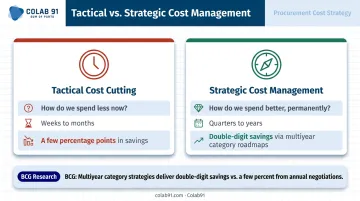
| Tactical cost cutting | How do we spend less now? | Weeks to months |
| Strategic cost management | How do we spend better, permanently? | Quarters to years |
BCG research illustrates this gap: traditional annual category negotiations typically deliver only a few percentage points in savings, while a multiyear category roadmap using multiple value levers can deliver double-digit savings. The distinction comes down to whether procurement is reacting to budget pressure or systematically redesigning how spend is managed.
Core Components of Strategic Cost Management
Spend Visibility and Analytics
Blind spots in spending data are where cost programs quietly fail. Strategic cost management starts with a consolidated view of what is being spent, with whom, in which categories, and under what contract terms.
Spend analysis functions as the diagnostic layer: it surfaces duplicate suppliers, off-contract purchasing, maverick spend, and pricing inconsistencies that would otherwise stay buried. McKinsey identifies lack of spending transparency as a primary obstacle for mid-market companies, recommending a structured "spend cube" to identify synergies across business units.
The financial stakes of poor visibility are real: Hackett Group benchmarking shows that Digital World Class procurement teams suffer 59% less savings loss from maverick spend and contract noncompliance than their peers.
Total Cost of Ownership (TCO)
Purchase price is one data point. TCO is the full picture, accounting for maintenance, quality failures, downtime, switching costs, and end-of-life disposal over the asset's lifecycle.
Procurement teams that evaluate decisions on unit price alone consistently find that apparent savings erode once operational costs are included. Gartner's guidance is direct: embed TCO principles into every sourcing decision, not just high-value capital purchases. This applies equally to indirect categories, services, and recurring spend.
Where TCO analysis matters most:
- Maintenance-heavy equipment with low purchase price but high uptime costs
- Services contracts with hidden scope-creep and renegotiation penalties
- Indirect spend categories where switching costs are routinely underestimated
Category Management
Organizing spend into defined categories, each with a dedicated strategy, preferred suppliers, pricing benchmarks, and sourcing cadence, gives procurement teams the structure to manage complexity at scale.
Without category management, spend fragments. Pricing becomes inconsistent across business units. Volume leverage disappears. BCG's manufacturer case study illustrates how introducing a second freight supplier and adjusting award allocations created competitive tension that unlocked more than 10% savings in a category that had been stuck for years.
Supplier Relationship Management
Strategic cost management looks beyond individual transactions to the ongoing supplier relationship. McKinsey's research found that companies regularly collaborating with suppliers achieve lower operating costs and higher profitability than industry peers - a result that one-off negotiations simply cannot replicate.
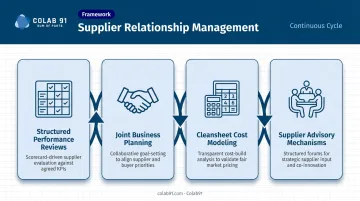
Effective SRM requires:
- Structured performance reviews and two-way scorecards
- Joint business planning and improvement programs
- Cleansheet cost modeling for strategic categories
- Supplier advisory mechanisms for longer-term alignment
Process and Compliance Discipline
The best sourcing strategy fails if people don't use it. Maverick spending, contract leakage, and slow approval cycles erode savings quickly. Hackett found that 75% of procurement professionals cite lack of self-service or guided buying tools as a primary cause of non-compliance.
Process simplification and guided buying tools close the gap between what procurement designs and what the business actually does - which is where most cost programs either hold or fall apart.
Key Strategies to Execute Strategic Cost Management
Competitive Sourcing and Market Testing
Keeping the market honest requires regular bidding events and price benchmarking - not just at initial sourcing but on a structured cadence for key categories. Competitive sourcing isn't only about unit price; it should also secure favorable payment terms, delivery windows, indexation rules, and service credits that protect total cost.
Hackett's benchmarking shows that Digital World Class procurement teams source 6.9x more spend through e-auctions than peers and engage with suppliers 23% earlier in the sourcing process.
Supplier Consolidation and Volume Leverage
Concentrating spend with a smaller preferred supplier base - rather than spreading it across fragmented vendors - creates conditions for better pricing, stronger relationships, and more reliable performance. Hackett data shows that high-performing procurement teams manage 3.6x fewer suppliers per $1B in spend than their peers.
The trade-off is supply chain resilience. Consolidation and concentration risk need to be balanced deliberately - single-source dependency in critical categories introduces vulnerabilities that can quickly dwarf any cost advantage.
Technology and Digital Procurement Tools
Digital platforms that centralize requisitions, contracts, catalogs, and spend data remove manual friction, reduce errors, and provide the real-time visibility needed to enforce category strategies and track savings consistently.
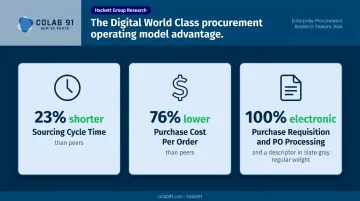
The performance gap is significant: Digital World Class teams achieve 23% shorter sourcing cycle times, 76% lower purchase cost per order, and 100% electronic processing of purchase requisitions and POs. These aren't minor efficiency gains - they represent a fundamentally different operating model.
Technology creates the conditions for strategic cost management to work - but realizing those gains still depends on having the right procurement talent in place to act on what the data reveals.
Building Procurement Capability at the Right Cost Structure
For mid-market and PE-backed companies, one of the most persistent barriers to executing strategic cost management is the cost of building a high-functioning procurement team onshore. A US-based strategic procurement analyst averages around $118,000 annually (Glassdoor).
Multiplied across the analysts, category managers, and spend analytics professionals needed to run a mature function, that headcount cost becomes a real constraint - particularly for companies operating below $1B in revenue.
Many organizations are addressing this by establishing India-based procurement capability centers: dedicated teams of sourcing analysts, spend analytics professionals, and category managers that work as an integrated extension of the onshore function. The model preserves strategic control and domain depth while operating at a fraction of onshore headcount costs.
Colab91 works specifically with mid-market and PE-backed companies to design and build these capability centers. Our leadership team previously scaled Impendi's India delivery operations - later acquired by Accenture - serving PE sponsors including Carlyle Group, TPG, and BC Partners.
The model pairs onshore strategic direction with India-based execution depth, allowing US procurement leadership to concentrate on decisions that genuinely require their judgment and proximity.
Measuring the Impact of Strategic Cost Management
Financial KPIs
Two distinct metrics matter here, and leadership teams should understand both:
- Cost savings: Verified reductions against a prior-year or baseline price - actual dollars no longer being spent
- Cost avoidance: Preventing future spend increases through proactive action - price increases that were negotiated away, specifications that were redesigned to reduce cost
Both are legitimate measures of procurement value. Neither should be treated as a one-time project result. They should be tracked quarterly, accumulated into an annual pipeline, and reported against targets.
Working capital is the third financial dimension that often gets overlooked. Better payment terms, improved supplier financing arrangements, and reduced inventory buffers all free up cash. McKinsey's analysis found that a company paying five days early on €1B in annual procurement spend could free up to €14M in cash by optimizing payment timing.
Operational KPIs
Financial outcomes are lagging indicators. Operational metrics tell you whether the approach is being executed consistently:
- Sourcing cycle time: Top-performing procurement teams achieve 23% shorter sourcing cycles (per The Hackett Group benchmarks) - faster sourcing means faster savings realization
- Contract compliance rate: The percentage of spend flowing through contracted channels; low compliance erodes negotiated savings
- Purchase cost per order: High-performing teams run at 76% lower cost per transaction than peers
- Supplier on-time delivery and invoice accuracy: Leading indicators of relationship health and supply chain stability
High compliance rates and short cycle times confirm that the strategy is being executed consistently, not just documented in a slide deck.
Continuous Review and Governance
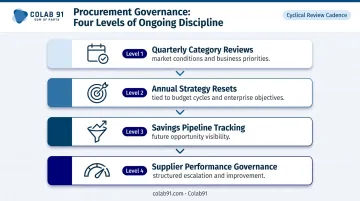
Sustained savings don't come from a single initiative. Strategic cost management is an ongoing discipline that requires structured review at every level:
- Quarterly category reviews against market conditions and business priorities
- Annual strategy resets tied to budget cycles and enterprise objectives
- Savings pipeline tracking that maintains visibility into future opportunity, not just past results
- Supplier performance governance with structured escalation and improvement programs
Organizations that sustain the highest savings levels have made these cadences part of how procurement operates day-to-day. Pipeline visibility and governance aren't project deliverables - they're how the function runs.
Frequently Asked Questions
What are the cost management strategies in procurement?
The main levers are spend analysis and category management, competitive sourcing, supplier consolidation, TCO-based decision making, contract compliance, and process automation. The most effective programs combine several of these in a coordinated approach rather than deploying them in isolation.
How is strategic cost management different from cost cutting?
Cost cutting is a reactive, short-term tactic: reducing spend quickly under pressure, often by delaying purchases or squeezing supplier rates. Strategic cost management is a proactive, structural approach that improves how and where the organization spends over the long term, without sacrificing quality or operational performance.
What is Total Cost of Ownership (TCO) and why does it matter in procurement?
TCO is the full cost of a purchase over its lifecycle, including acquisition, maintenance, downtime, quality failures, and switching costs. Decisions based solely on purchase price frequently lead to higher total costs, while TCO-informed decisions consistently reveal better long-term value.
What KPIs should organizations track for strategic cost management?
Track both financial KPIs (cost savings, cost avoidance, working capital improvement) and operational KPIs (sourcing cycle time, contract compliance rate, supplier delivery performance, invoice accuracy). Monitoring both gives leadership an accurate read on program health.
How can mid-market companies implement strategic cost management without a large internal team?
Building India-based procurement capability centers, combining sourcing analysts, spend analytics professionals, and category managers in cost-efficient locations, is an increasingly practical option. Colab91 designs and staffs this model for mid-market and PE-backed companies, delivering strategic procurement depth at a fraction of the cost of equivalent onshore teams.
How often should an organization review its cost strategy in procurement?
At minimum, an annual review tied to budget cycles, with quarterly check-ins on supplier performance and category strategies. The most effective organizations treat it as a continuous discipline, with structured review cadences and savings pipeline tracking running year-round.