The problem rarely comes down to effort. It comes down to strategy.
Without a documented sourcing strategy, procurement teams default to transactional buying: chasing the lowest quoted price, re-running the same RFPs, and managing supplier relationships reactively. The result is cost leakage, supply risk, and missed opportunities for supplier-driven innovation.
This article breaks down 7 proven procurement sourcing strategies - when to use each, how they interact, and how to build the right combination for your supply chain goals.
Key Takeaways
- Procurement sourcing strategy is a deliberate, data-driven framework for acquiring goods and services to maximize total value - not just minimize unit cost.
- 7 core strategies covered: outsourcing, insourcing, low-cost country sourcing, global sourcing, supplier portfolio management, tailored sourcing, and continuous improvement.
- No single strategy fits all spend categories - the Kraljic matrix helps match the right approach to each category.
- Strategy selection hinges on supply risk, total cost of ownership, organizational capability, and supplier market dynamics.
- Mid-market and PE-backed companies use offshore capability models to execute sourcing strategies without adding proportional headcount.
What Is a Procurement Sourcing Strategy?
A procurement sourcing strategy is a structured, analytics-backed plan that governs how an organization identifies, evaluates, selects, and manages suppliers to achieve the best total value - not just the lowest purchase price.
Traditional procurement optimizes individual transactions for short-term cost. Strategic sourcing looks further - at total cost of ownership (TCO), supplier performance, market dynamics, supply risk, and long-term business alignment.
As CIPS puts it: price is only one factor in strategic sourcing - not the defining one.
The Kraljic Matrix: Where Strategy Starts
Before choosing an approach for any category, procurement teams need to understand two variables:
- Supply risk - how difficult or disruptive it would be to switch suppliers
- Profit impact - how significantly the category affects business performance
The Kraljic Matrix, introduced by Peter Kraljic in 1983, uses these two dimensions to classify spend into four quadrants:
| Quadrant | Supply Risk | Profit Impact | Typical Strategy |
|---|---|---|---|
| Strategic | High | High | Partnership, tailored sourcing |
| Leverage | Low | High | Competitive bidding, LCCS |
| Bottleneck | High | Low | Dual sourcing, supply protection |
| Non-critical | Low | Low | Automation, spot pricing |
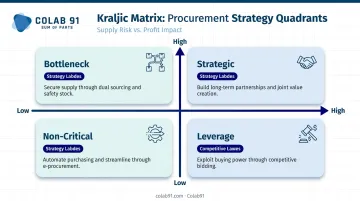
Category segmentation shapes every decision that follows: which suppliers to prioritize, how to structure negotiations, and which of the 7 strategies fits each spend area.
The 7 Procurement Sourcing Strategies
These strategies are not mutually exclusive. Most organizations deploy a mix depending on category risk, market conditions, and operational maturity.
Strategy 1: Outsourcing
Outsourcing in procurement means delegating specific activities - or entire category management functions - to an external provider. The goal is to access specialized expertise not available in-house while freeing internal capacity for higher-priority work.
The model has evolved well beyond basic vendor delegation. Companies are now building dedicated offshore capability centers - procurement analytics teams, strategic sourcing functions, and spend intelligence operations based in lower-cost markets - that function as genuine extensions of in-house teams rather than arm's-length service providers.
This is particularly effective for mid-market firms and PE-backed companies that need to scale sourcing capacity without proportional cost growth. The procurement-as-a-service market reflects this shift: Grand View Research projects it to reach $16.48B by 2033, growing at a 10.8% CAGR.
Colab91 operates in this space, building India-based offshore procurement teams for mid-market and PE-backed companies. Its leadership scaled Impendi's India operations to 100+ practitioners - serving Carlyle Group, TPG, Elliott, and BC Partners - before that firm was acquired by Accenture. The model prioritizes domain experts who embed with client teams rather than operating as a conventional BPO.
Strategy 2: Insourcing
Insourcing is the deliberate choice to bring procurement activities back in-house rather than relying on external suppliers or agencies. It makes strategic sense when:
- The category involves high IP sensitivity or regulated data
- Supplier dependency has created unacceptable continuity risk
- TCO analysis favors internal delivery over external cost
- The organization has built sufficient internal expertise to execute effectively
The last point matters more than most organizations acknowledge. Insourcing before internal capability is ready typically increases cost and reduces quality - the opposite of the intended outcome. Skipping a capability assessment first reliably drives up cost and erodes quality.
Strategy 3: Low-Cost Country Sourcing (LCCS)
Low-cost country sourcing involves procuring goods or services from markets with lower production or labor costs - Vietnam, India, Eastern Europe, and Mexico being common examples - to achieve significant unit cost reductions while maintaining acceptable quality.
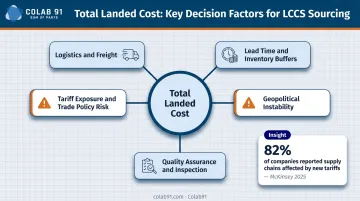
Total landed cost analysis - not purchase price comparison - is what separates effective LCCS from costly mistakes. Decision-making must account for:
- Logistics and freight costs
- Lead time and inventory buffer requirements
- Quality assurance and inspection costs
- Tariff exposure and trade policy risk
- Geopolitical instability in source markets
Recent tariff shifts have changed the math. McKinsey's 2025 supply chain risk survey found 82% of companies reported supply chains affected by new tariffs, with 39% pursuing dual sourcing and 33% developing nearshoring or onshoring plans as a direct response. LCCS remains viable, but the risk calculus requires reassessment more frequently than most sourcing calendars allow.
Strategy 4: Global Sourcing
Global sourcing is broader than LCCS. Where LCCS prioritizes cost reduction, global sourcing focuses on accessing specialized capabilities, diversifying supply, or entering new markets - regardless of whether the source country has lower costs.
The operational complexity is real. Companies pursuing global sourcing must actively manage:
- Currency fluctuation - exchange rate swings can erode margins faster than sourcing savings accumulate
- Logistics complexity across multiple geographies, customs regimes, and transit times
- Supplier relationship dynamics shaped by cultural and regulatory differences
- Geopolitical instability that can disrupt supply continuity with little warning
Supply chain visibility also degrades sharply beyond tier one. McKinsey's 2025 data shows only 42% of companies have visibility into tier-two suppliers or beyond - a real blind spot for organizations relying on global supply networks. Regional sourcing hubs, supplier diversification, and technology-enabled visibility tools are the primary mitigations.
Strategy 5: Supplier Portfolio Management (Multi-Sourcing)
Supplier portfolio management means deliberately managing a diversified portfolio of suppliers across each spend category rather than depending on a single vendor. The goals are risk reduction and competitive tension.
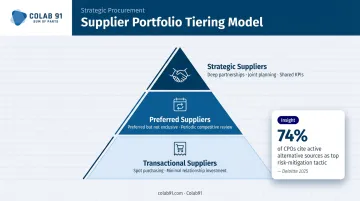
The practical mechanics involve segmenting suppliers into tiers:
- Strategic suppliers - deep partnerships, joint planning, shared KPIs
- Preferred suppliers - preferred but not exclusive, periodic competitive review
- Transactional suppliers - spot purchasing, minimal relationship investment
Deloitte's 2025 CPO Survey found 74% of CPOs identified maintaining active alternative sources as an effective risk-mitigation strategy - the single most-cited tactic. For critical components or high-disruption categories, dual sourcing functions as a hedge: one primary supplier holds the volume, one secondary supplier stays qualified and ready to scale.
Strategy 6: Tailored (Category-Specific) Sourcing
Tailored sourcing rejects the one-size-fits-all approach. The sourcing model for each spend category is customized based on its unique market dynamics, risk profile, strategic importance, and supplier landscape.
A practical contrast:
- IT services (strategic category): collaborative, long-term contracts, joint governance, performance-based incentives, limited competitive tension
- Office supplies (non-critical category): e-auctions, spot pricing, catalog buying, automated POs - minimal relationship investment
Tailored sourcing is only possible with robust category-level spend analysis and cross-functional stakeholder input. Without that foundation, procurement teams end up applying the same negotiation playbook to categories with fundamentally different market structures - and leaving value on the table.
The Hackett Group found that Digital World Class procurement organizations delivered 1.9x more overall cost savings and 17% shorter sourcing cycle times than peers - driven largely by category-specific execution discipline.
Strategy 7: Continuous Improvement and Monitoring
Market conditions shift, supplier performance drifts, and organizational needs evolve. A sourcing strategy that goes unmonitored becomes a value destroyer within 12–24 months - which is why continuous improvement deserves its own place in the sourcing toolkit.
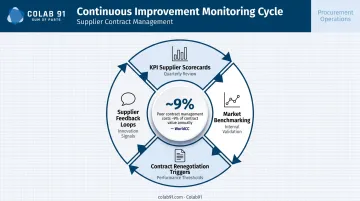
An effective monitoring cadence includes:
- KPI-based supplier scorecards reviewed quarterly - Gartner reports 62% of companies practicing supplier relationship management use scorecards, though only 22% track both operational and non-operational metrics
- Market benchmarking at regular intervals to validate whether contracted rates remain competitive
- Contract renegotiation triggers linked to specific performance thresholds or market events
- Open feedback loops with strategic suppliers to surface innovation opportunities and early warning signals
Poor contract management has a measurable cost. WorldCC estimates that the average business loses nearly 9% of contract value annually through weak contract management - best performers lose around 3%, worst performers around 15%.
How to Choose the Right Sourcing Strategy
Strategy selection starts with spend analysis and category segmentation. Before committing to any approach, procurement teams need visibility into spend volume, supply risk, supplier market concentration, and strategic importance per category. The Kraljic Matrix provides the most widely used framework for this segmentation.
Assess Organizational Capability Honestly
Even the right strategy on paper fails if the internal team lacks the skills, data infrastructure, or bandwidth to execute it. A lean mid-market procurement team cannot simultaneously run global sourcing initiatives, manage a multi-tier supplier portfolio, and execute category-specific strategies without burning out or cutting corners.
Gartner found that only 14% of procurement leaders expressed confidence their talent can meet future functional needs - and 96% reported gaps in technology and data skills. Organizational capability is often the binding constraint on strategy selection, not market conditions.
Apply a Portfolio Approach by Category Tier
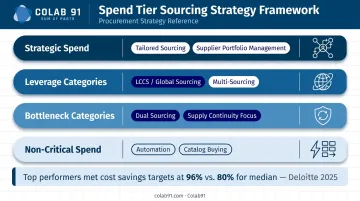
Effective procurement functions run multiple strategies simultaneously across different spend categories. A practical allocation by tier:
- Strategic spend → tailored sourcing + supplier portfolio management
- Leverage categories → LCCS or global sourcing + competitive tension through multi-sourcing
- Bottleneck categories → dual sourcing + supply continuity focus
- Non-critical spend → automation, catalog buying, minimal touch
Getting the allocation right is only half the work. The other half is ensuring strategy decisions are based on total cost of ownership - not just quoted price. TCO analysis must account for:
- Quality costs and defect rates
- Logistics and landed cost
- Risk premiums and supply continuity exposure
- Supplier switching costs
- Long-term relationship value
Procurement leaders who factor in TCO consistently outperform peers. Deloitte's 2025 CPO data shows top performers met or exceeded cost savings targets at 96%, compared to 80% for the median.
Common Challenges in Executing Sourcing Strategies
Data Gaps and Spend Visibility
Sophisticated sourcing strategies require clean, categorized spend data. Most organizations don't have it. Spend data sits fragmented across ERP systems, spreadsheets, and AP records - uncleaned and unclassified. Without reliable spend analytics, category prioritization and supplier selection are built on assumptions.
AI-powered spend analytics tools address this directly. Colab91's offshore capability center model incorporates spend analytics as a foundation service, building the data infrastructure that strategic sourcing decisions require.
Skill and Capacity Constraints
Strategic sourcing demands a blend of analytical, negotiation, and relationship management skills that most mid-market procurement teams haven't yet developed at scale. Deloitte's 2023 CPO Survey found that more than 70% of CPOs had difficulty attracting procurement talent over the prior 12 months.
The practical response is a "Sum of Parts" model: a lean in-house team focused on stakeholder management and strategic direction, supported by specialized offshore talent handling analytics, category research, RFx execution, and supplier performance monitoring. That combination delivers the functional depth of a larger team without the overhead cost.
Stakeholder Alignment and Change Management
Sourcing strategies often fail not because of poor supplier selection, but because internal stakeholders resist changes to existing supplier relationships or procurement processes. Deloitte's 2025 CPO Survey identified siloed ways of working as the top barrier to procurement value delivery, cited by 57% of respondents.
The fix requires cross-functional governance, clear decision rights, and shared KPIs established at the outset. Retrofitting these structures after resistance emerges rarely works.
Conclusion
Procurement sourcing strategy is not a one-time decision. The companies that get the most from their supply chain spend match the right strategy to each spend category, invest in analytical rigor, and build the organizational capacity to execute at scale - then continue adjusting as market conditions evolve.
If your procurement function is stretched thin or lacks the specialized talent to execute these strategies effectively, Colab91's offshore capability center model helps mid-market and PE-backed companies build high-performing India-based sourcing teams. The approach delivers strategic depth across spend analytics, category expertise, and sourcing execution - without the cost of equivalent onshore hires.
Frequently Asked Questions
What are the 7 steps in strategic sourcing?
The standard process runs: spend analysis, supplier market research, sourcing strategy development, RFx release, negotiation and supplier selection, contract execution, and ongoing supplier performance monitoring.
What are the 4 pillars of strategic sourcing?
The four commonly cited pillars are spend analysis, supplier selection and management, contract management, and continuous improvement. These pillars form the structural foundation across which all 7 sourcing strategies operate. Weakness in any one pillar limits what the others can achieve.
What are the 5 C's of supply chain management?
The 5 C's are Cost, Capacity, Capability, Continuity, and Control. Each directly informs sourcing strategy decisions - for example, Continuity drives multi-sourcing choices, while Capability determines whether a global or outsourced sourcing model makes sense for a given category.
What is the difference between a sourcing strategy and a procurement strategy?
A sourcing strategy focuses on how to identify and engage suppliers for specific categories or needs. A procurement strategy is the broader organizational framework governing all purchasing activities, governance structures, and value creation goals - sourcing strategy sits within it.
How do you know when to outsource versus insource a procurement function?
The decision comes down to whether internal expertise, data infrastructure, and capacity can match what an external provider delivers. Outsourcing makes sense when specialized skills or cost efficiency are achievable externally without giving up control over critical processes or sensitive data.