The gap between "people working remotely" and a team that actually performs like a unit is significant. It's wider still for companies managing cross-border or cross-timezone teams - US companies building India-based capability centers, for example, face not just distance but cultural and communication dynamics that compound every cohesion failure.
This guide covers what needs to be in place before you hire the first person, the step-by-step process for building cohesion, the variables that determine whether it holds, and the mistakes that quietly destroy it.
Key Takeaways
- Cohesion is built deliberately - through operating model design, onboarding structure, and communication rhythms, not by accident.
- Hiring for remote-readiness (self-direction, async communication, accountability) matters as much as technical skills.
- Cross-border teams need intentional cultural alignment and planned overlap hours to prevent drift.
- The most common failure: skipping the foundation of clear roles, communication norms, and accountability - then expecting tools to compensate.
- Remote cohesion isn't a one-time initiative; it requires ongoing reinforcement through recognition, check-ins, and leadership visibility.
What You Need Before Building Your Remote Team
Most remote team cohesion failures are preparation failures. Teams get assembled before the foundation is ready. Three prerequisites must exist before the first hire.
Leadership and Governance Readiness
You need onshore leadership (or a defined senior point of contact) who understands how remote teams actually work, models the communication behaviors they expect from the team, and is available during defined overlap hours.
For cross-border setups, a bridge leader who understands both cultures is critical. At Colab91, Jeff Skiles serves this function as Director of USA Operations, bridging US client relationships with India-based delivery teams to keep both sides aligned.
Technology Stack and Access
Locking in your tools before hiring prevents the confusion that erodes trust early. Before the team goes live, lock in:
- A reliable communication platform (Slack, Teams, etc.)
- A project management system (Asana, Jira, Linear)
- A shared document repository (Google Workspace, Confluence, SharePoint)
- Secure access and onboarding protocols
Clear Accountability Structure
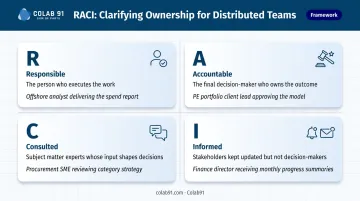
Every team member needs to know who owns what, who to escalate to, and how success is measured. A RACI framework (Responsible, Accountable, Consulted, Informed) works well for this. Without it, remote teams default to ambiguity - which kills cohesion faster than any tool gap.
How to Build a Cohesive Remote Team
Step 1: Define Your Operating Model and Remote Work Policy
Cohesion starts with clarity. Before hiring anyone, define exactly how the team will function.
Answer these questions explicitly:
- What's synchronous vs. asynchronous?
- What are the core overlap hours between locations?
- How are decisions made, and who has final authority?
- What does "good work" look like - and how is it measured?
Then document a remote work policy covering: communication protocols, expected response windows, working hours expectations, and tool standards. Without this, every future cohesion effort is built on unstable ground.
For cross-border teams setting up an India-based capability center, for instance, the operating model must also account for timezone alignment windows, onshore-offshore reporting lines, and how local teams integrate into global workflows. Colab91's approach is to design the operating model before scaling the team - a sequencing step that mid-market companies frequently skip, and pay for later.
Step 2: Identify Roles and Hire for Remote-Readiness
Cohesion problems that show up six months in are often hiring problems in disguise. SHRM identifies four essential remote work soft skills: adaptability and resiliency, self-motivation, communication, and collaboration. These need to be screened for directly, not assumed.
Structure job descriptions to specify:
- Expected async communication volume
- Autonomy level and supervision structure
- Cross-cultural collaboration requirements
- Documentation and written clarity expectations
During interviews, use scenario-based questions that surface:
- How candidates handle ambiguity with no immediate feedback
- How they've communicated across cultural or timezone differences
- How they manage accountability without close supervision
Domain skills get someone hired. Whether they actually thrive in a distributed environment depends almost entirely on remote-readiness.
Step 3: Onboard with Culture and Clarity as the Priority
Remote onboarding is where cohesion is seeded or lost. A new hire who doesn't understand the team's norms, communication style, and working rhythms will take months longer to integrate - or disengage before they get there.
Microsoft found that new hires who met their onboarding buddy more than eight times in the first 90 days reported the buddy helped them become productive at a rate of 97%. That's a measurable integration outcome, not a soft benefit.
A cohesion-focused remote onboarding includes:
- Structured introductions to every team member before week two
- A dedicated buddy or mentor for the first 60–90 days
- Tool access and workflow documentation ready on day one
- Early "low-stakes" collaborative tasks that build relationship capital without high-pressure stakes
For cross-border teams, onboarding must also include cultural orientation: helping team members understand working style differences, communication preferences, and how to navigate feedback or disagreement across cultures. Treat it as operational risk reduction, not a soft skills add-on.
Step 4: Establish Communication Rhythms and Collaboration Infrastructure
Cohesive remote teams don't just use good tools; they have agreed norms around how and when to use them. The specific tools matter far less than the documented rules governing them.
A workable channel framework:
| Channel | Purpose |
|---|---|
| Instant messaging (Slack/Teams) | Quick questions, informal updates |
| Video calls | Decisions, relationship-building, feedback |
| Project management tool | Task visibility, accountability, status tracking |
| Shared documents | Asynchronous collaboration, institutional knowledge |
Cadence matters as much as tooling. Build in psychological predictability with a consistent rhythm:
- Daily async standups - brief written updates, no meeting required
- Weekly team syncs - video, focused on blockers and alignment
- Monthly one-on-ones - relationship maintenance and feedback loops
- Quarterly goal reviews - outcome accountability and forward planning
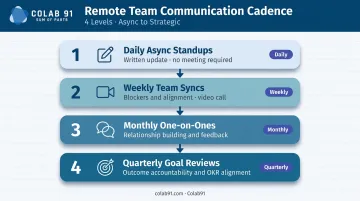
The specific cadence is less important than sticking to it. Microsoft found weekly Teams meeting time rose 252% since 2020, but only 28% of leaders had created team agreements governing those meetings. More meetings without better structure just creates noise.
Step 5: Build Relationships and Recognition into the Operating Rhythm
Informal relationship-building happens naturally in offices. In remote settings, it has to be engineered: not as a nice-to-have, but as a direct requirement for cohesion.
Microsoft found 43% of leaders identified relationship-building as the top remote and hybrid challenge, and 56% of remote employees reported fewer work friendships after going remote. Fewer friendships means weaker trust loops - and weaker trust loops show up in slower decisions and higher attrition.
Practical mechanisms that work:
- Scheduled virtual coffee chats (15 minutes, no agenda)
- Dedicated 5–10 minutes at the start of team meetings for non-work conversation
- Team check-in rituals (weekly wins, one personal update per person)
- Virtual team events tied to shared milestones, not just the calendar
Recognition deserves equal attention. According to Gallup and Workhuman research, well-recognized employees were 45% less likely to have turned over after two years. In distributed teams where visibility is already limited, proactive recognition does double duty: it reinforces contribution and signals that leadership is paying attention.
A simple kudos channel in your messaging platform, public acknowledgment in weekly syncs, and milestone celebrations (work anniversaries, project completions) cost almost nothing and compound over time.
Key Factors That Affect Remote Team Cohesion
Even well-structured remote teams can drift apart if these variables aren't actively managed.
Communication Quality, Not Just Frequency
Overcommunicating low-value information creates noise. Undercommunicating creates isolation. The goal is high-signal communication - timely, purposeful, and structured.
Buffer found that among remote workers who felt disconnected, the top reasons were lack of social opportunities (56%), minimal interaction (53%), and not knowing colleagues as people (51%). Communication volume alone doesn't solve this - the nature of the communication does.
Cultural Alignment Across Geographies
For cross-border teams, cultural differences are among the leading cohesion failure points - not because they're insurmountable, but because they're routinely ignored.
The Culture Factor's Hofstede data shows India scores 77 on power distance vs. 40 for the US, and 48 on individualism vs. 91 for the US. These gaps show up in practice across four common friction points:
- How feedback is given and received
- How disagreement gets surfaced (or suppressed)
- How decisions are escalated vs. made independently
- What "yes" actually signals in context
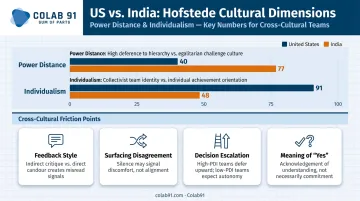
Teams that invest in explicit cultural orientation - not assumption - significantly reduce friction in these areas.
Trust and Psychological Safety
Amy Edmondson's research established that psychological safety - the shared belief that a team is safe for interpersonal risk-taking - is directly associated with team learning behavior and performance. Google's Project Aristotle identified it as the first of five dynamics in effective teams.
In remote settings, psychological safety doesn't emerge from proximity. It has to be built through leadership consistency, follow-through on commitments, and explicit space for dissent.
Managers who model vulnerability and invite challenge create it. Those who don't make it harder for the entire team.
Performance Clarity and Outcome Orientation
Remote teams measured by presence rather than output suffer on both ends - managers become paranoid, and employees become disengaged. Microsoft found 85% of leaders said hybrid work made confidence in productivity harder, while 87% of employees reported they were productive. That trust gap is a management design problem, not a remote work problem.
Outcome-based performance management - clear OKRs, measurable deliverables, regular feedback loops - gives team members autonomy to perform and the accountability that keeps the team aligned. Goal clarity also reduces the ambiguity-driven conflict that fractures cohesion over time.
Manager Adaptability
Managers who transplant in-office management styles into remote contexts are a leading driver of remote team dysfunction. Effective remote managers operate differently:
- Proactive check-ins rather than waiting for issues to surface
- Async-first communication as a default
- Outcome-based evaluation instead of activity monitoring
- Early detection of disengagement through conversation, not surveillance
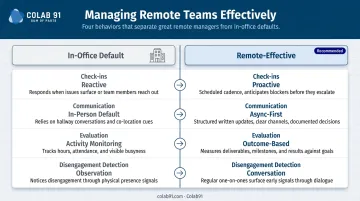
This isn't natural for managers trained in physical proximity. It requires deliberate coaching and organizational support - not just a policy change.
Common Mistakes That Undermine Remote Team Cohesion
Treating remote as a location change rather than an operating model change. The tools exist, but the infrastructure, norms, and rituals that cohesion requires don't build themselves. Assuming the team will figure it out is the most expensive mistake.
Prioritizing tools over relationships. Collaboration software enables cohesion; it doesn't create it. Microsoft's Work Trend Index found that 43% of leaders cite relationship-building as their top challenge - even on teams that are already well-tooled.
Ignoring cultural and timezone dynamics in cross-border teams. Scheduling all critical meetings during onshore hours, skipping cultural orientation, and treating offshore team members as vendors rather than integrated colleagues create a two-tier team dynamic.
Managing by surveillance rather than outcomes. Monitoring activity metrics instead of defining clear deliverables signals distrust. When people can't show effort through physical presence, watching keystrokes instead of setting clear goals accelerates disengagement.
When Is Building a Cohesive Remote Team the Right Move?
Distributed team-building isn't a fit for every organization or every function. It requires operational maturity, leadership alignment, and goal clarity to succeed.
It makes clear strategic sense when:
- Local talent supply is constrained or cost-prohibitive
- The work is digital, deliverable-based, and measurable
- Leadership has the bandwidth to manage cross-timezone relationships
- The organization can define outcomes clearly enough to manage remotely
For US companies considering India-based capability centers, the market has matured well beyond enterprise-only territory. NASSCOM-Zinnov data shows 480+ mid-market GCCs operating in India with 210,000+ employees - a clear signal that this model is now accessible at the mid-market level. Colab91 helps mid-market and PE-backed companies tap into this infrastructure without the complexity of building a center from scratch.
It's premature when:
- There's no defined operating model
- Leadership has no experience with distributed management
- The culture is heavily presence-based and hasn't been examined
- Roles require deep real-time collaboration that async workflows genuinely cannot support
For most companies, the path to a cohesive remote team is clear - provided the operating model, leadership alignment, and role definitions are locked in before the first hire goes out.
Frequently Asked Questions
What makes a remote team cohesive vs. just functional?
A functional remote team completes tasks. A cohesive one shares trust, communicates proactively, and operates with a sense of collective identity. That difference comes from deliberate relationship-building and cultural alignment - not better tooling.
How do you build trust in a remote team across different time zones?
Consistent communication rhythms, planned overlap hours, and follow-through on commitments build the foundation. Informal touchpoints - even brief ones - add the human layer that sustains trust across geographic distance.
How often should remote teams check in to stay cohesion?
How often should remote teams check in to stay cohesive?
A layered cadence works best: daily async updates, weekly team syncs, and monthly one-on-ones. The right frequency depends on team size and workflow complexity, but skipping the monthly individual check-in is where most cohesion breaks down.
What are the biggest mistakes companies make when building cross-border remote teams?
The most common failures: not designing the operating model upfront, underestimating how cultural differences shape communication and escalation, and treating the offshore team as a vendor rather than a co-invested partner. When all three happen at once - and they usually do - the team never fully integrates.
How do you maintain culture in a distributed remote team?
Culture is transmitted through consistent behaviors, rituals, and recognition - not physical proximity. It needs to be actively designed into onboarding, team meetings, and how leaders communicate, not hoped for as a side effect of good intentions.
When should a company consider building an offshore remote team rather than hiring locally?
When local talent is scarce or expensive, the work is deliverable-based, and there is genuine leadership capacity to manage cross-timezone relationships and cultural integration. Without that third condition, the first two rarely produce the results companies expect.