The capacity squeeze is real. Hackett Group's 2024 finance research projected 5% workload growth for finance functions while staffing budgets were expected to shrink — a 6% productivity gap that manual processes simply cannot close.
This guide covers what automated spend management software actually does, why mid-market and PE-backed CFOs can't afford to delay, and a direct comparison of the five platforms best suited to their needs in 2026.
Key Takeaways
- Automated spend management replaces fragmented, manual spend tracking with real-time control across expenses, AP, procurement, and corporate cards.
- Manual expense reports cost an average of $58 each to process — automation cuts that to under $10.
- Top platforms for CFOs in 2026: Coupa, Ramp, Airbase, SAP Concur, and Brex — matched to distinct company profiles and scale points.
- Key selection criteria: ERP integration depth, AI automation maturity, multi-entity support, and pre-submission policy enforcement.
- Software alone isn't enough — CFOs also need procurement analytics expertise to convert spend data into category-level savings.
What Is Automated Spend Management Software?
Automated spend management software is a unified digital platform that captures, enforces, approves, and reports on all company spending in real time. It replaces spreadsheets, manual reconciliations, and disconnected tools across expense reports, accounts payable, procurement, and corporate cards — giving CFOs a single source of financial truth.
How It Differs from Basic Expense Management
The distinction matters. Expense management handles employee reimbursements and T&E. Automated spend management covers the full enterprise scope:
- Vendor payments and purchase orders
- Procurement workflows and sourcing approvals
- Budget tracking against real-time spend
- Strategic spend analytics across categories and suppliers
That broader scope — and the AI now embedded across these workflows — explains why the market is growing at a pace most enterprise software categories can't match.
The 2026 Market Context
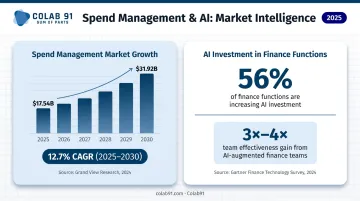
The spend management software market was valued at $17.54 billion in 2025 and is projected to reach $31.92 billion by 2030 — a 12.7% CAGR.
AI is the primary driver. According to Gartner, 56% of finance functions plan to increase AI investment by at least 10% over the next two years, and AI-enabled finance tools can make teams 3x to 4x more effective at delivering high-quality guidance.
In practical terms, 2026 platforms don't just track spend — they enforce policy before money leaves the business, flag anomalies automatically, and compress month-end close from weeks to days.
Why CFOs at Mid-Market and PE-Backed Companies Can't Afford Manual Spend Management
The Per-Report Cost Problem
Processing a single expense report manually costs an average of $58. Automation brings that figure below $10 per report, saving roughly $23 per report on average. For a 300-person company where employees submit even one report per month, the math is punishing. Add 18 minutes and $52 per erroneous report on top — and GBTA research shows 19% of expense reports contain errors.
That cumulative cost erodes CFO credibility with PE sponsors who hold finance teams to measurable efficiency standards.
The Visibility Gap
Manual and fragmented spend systems create a fundamental lag problem. CFOs typically see where money went 30 to 60 days after it's already been spent. For PE-backed companies where portfolio reviews and board reporting require current data, that lag isn't just inconvenient — it's a strategic liability.
Real-time spend management eliminates the lag. CFOs can see departmental spend against approved budgets today, not next quarter.
The Talent Shortage Reality
Hiring your way out of this problem isn't an option. The BLS projects accountant and auditor employment to grow just 5% from 2024 to 2034, while the AICPA reports that new CPA exam candidates fell from 2023 to 2024. The pipeline is contracting.
Automation must fill the capacity gap — particularly for mid-market companies that can't compete with large enterprises on recruiting budgets or brand pull.
Compliance and Fraud Risk
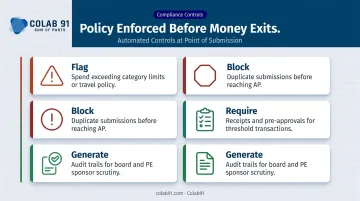
Without automated policy enforcement, out-of-policy spending gets caught — if at all — through manual review after the fact. Emburse's 2024 research found that 24% of employees admitted passing personal purchases off as business expenses. Modern platforms enforce policy before submission, closing this gap before money exits the business.
Key controls that automation enforces at the point of submission:
- Flags spend that exceeds category limits or violates travel policy
- Blocks duplicate submissions before they reach AP
- Requires receipts and pre-approvals for threshold-based transactions
- Generates audit trails that satisfy board and PE sponsor scrutiny
The Software + Expertise Gap
Spend management software handles the transactional layer. What it can't replace is category-level interpretation, supplier negotiation strategy, or a prioritized savings roadmap. For PE-backed companies under value-creation pressure, the software is a starting point — not the full answer. The CFOs who move the needle pair automation with domain expertise that turns spend data into sourcing action.
Top 5 Automated Spend Management Software Tools for CFOs in 2026
These five platforms were selected for CFO-relevant depth: ERP integration, AI automation maturity, multi-entity support, compliance controls, and proven traction at mid-market to enterprise scale.
Coupa
Coupa is an AI-native total spend management platform used widely by large manufacturers, global enterprises, and PE-backed portfolio companies for end-to-end source-to-pay operations.
Its differentiation for CFOs lies in scale of intelligence. Coupa's platform harnesses $10 trillion in spend intelligence, with its benchmark network built on over $8 trillion in global cumulative spend collected across 19 years. That data powers supplier discovery, risk monitoring, and intelligent sourcing decisions that smaller platforms simply can't match.
| Category | Details |
|---|---|
| Best For | Large enterprises and PE portfolio companies with complex, multi-category procurement needs |
| Key CFO Features | AI-driven spend analytics, 3-way matching, supplier risk management, real-time spend visibility |
| Pricing | Quote-based; contact Coupa sales directly |
| Implementation | Complex deployments can require significant lead time; G2 reviewers note backend configuration and admin training requirements |
Ramp
Ramp is an AI-first corporate finance platform that has become a leading choice for US mid-market companies looking to automate spend controls, cut vendor costs, and close the books faster.
Its AI policy agent enforces spend rules in real time. Its vendor intelligence tools surface duplicate SaaS subscriptions and overpriced contracts. The free core platform means mid-market CFOs access enterprise-grade automation without a large software budget. Vanta, using Ramp's spend management tools, achieved a 3-day faster month-end close and saved 20 hours per month through automated transaction coding.
| Category | Details |
|---|---|
| Best For | Mid-market US companies prioritizing cost reduction, automation, and fast accounting close |
| Key CFO Features | AI spend policy enforcement, vendor cost optimization, automated receipt capture via SMS/Slack, ERP sync |
| Pricing | Free core tier; Ramp Plus at $15/user/month (20% discount on annual billing); Enterprise is custom-priced |
| Implementation | Faster deployment than enterprise suites; credit limits based on revenue, bank balances, or capital raised |
Airbase
Airbase (now part of Paylocity following a $325M acquisition in October 2024) is a unified spend management platform built for mid-market finance teams that need AP automation, expense management, and corporate card controls under one CFO dashboard.
The core value is consolidation. Rather than managing separate tools for AP, expenses, and cards, Airbase routes all three through a single approval workflow engine. Recharge cut its month-end close from 25–30 days down to approximately 7 days after implementation. YourMechanic reported 5% monthly savings on subscription spend and reclaimed more than a week of finance time per month.
| Category | Details |
|---|---|
| Best For | Mid-market companies (100–5,000 employees) consolidating multiple disconnected finance tools |
| Key CFO Features | Unified AP + expenses + cards, automated invoice extraction, GL sync, multi-entity visibility |
| Pricing | Quote-based; exact public pricing not currently disclosed post-Paylocity acquisition |
| Implementation | Described by customers as faster to deploy than enterprise suites; no exact timeline publicly confirmed |
SAP Concur
SAP Concur is the longest-established enterprise T&E platform, the go-to choice for Fortune 500 and large PE-backed organizations requiring deep SAP ERP integration, global tax compliance, and end-to-end travel and expense lifecycle management.
For CFOs overseeing global operations across multiple countries and tax jurisdictions, Concur's regulatory compliance depth and SAP ecosystem integration remain difficult to match. CFOs should also weigh the implementation realities: G2 reviewers and Gartner Peer Insights (579 ratings, 4.2 rating) cite implementation complexity, training requirements, and setup friction as real considerations.
| Category | Details |
|---|---|
| Best For | Global enterprises and SAP-integrated organizations with complex T&E and multi-country compliance needs |
| Key CFO Features | End-to-end T&E management, automated policy enforcement, global tax/compliance support, SAP ERP integration |
| Pricing | Transaction-based; G2 shows a Base tier starting at $7 and a Plus tier at $11; Premium and Travel & Expense tiers are quote-based |
| Implementation | User reviews cite complexity and significant training needs; dedicated finance systems resources required |
Brex
Brex is an AI-powered corporate spend platform originally built for venture-backed startups that has evolved into a serious mid-market option — with high credit limits tied to cash balances, integrated travel booking, and live budget controls designed for fast-growing, PE-backed companies.
Brex is trusted by 1 in 3 venture-backed US startups and used by 35,000+ companies. Its "Live Budgets" give CFOs real-time visibility into departmental spend against approved limits. AI compliance audit tools flag out-of-policy transactions automatically. For PE-backed companies scaling headcount rapidly, Brex's high-limit credit program and cross-portfolio visibility tools are particularly well-suited. Note: international card transactions carry an FX markup of up to 3%.
| Category | Details |
|---|---|
| Best For | VC and PE-backed growth-stage companies needing high credit limits and real-time spend controls |
| Key CFO Features | Live Budgets, AI compliance audits, integrated travel booking, multi-entity spend controls |
| Pricing | Essentials at $0/user/month; Premium at $12/user/month; Enterprise is custom-priced |
| Implementation | Faster deployment than enterprise suites; PE partners receive white-glove onboarding and cross-portfolio visibility |
How We Chose the Best Spend Management Software for CFOs
This guide evaluated platforms from a CFO perspective — not a general buyer perspective. The selection criteria map directly to CFO business outcomes:
| Criterion | CFO Business Outcome |
|---|---|
| Real-time spend visibility | Enables proactive board reporting, not retrospective summaries |
| Pre-submission policy enforcement | Reduces audit risk and expense fraud before money exits |
| ERP integration depth | Accelerates month-end close; eliminates manual reconciliation |
| Multi-entity management | Critical for PE portfolio oversight and cross-entity reporting |
| AI/automation depth | Offsets finance talent shortages; closes the productivity gap |
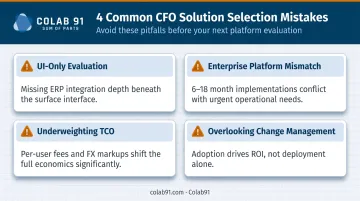
Common Selection Mistakes CFOs Make
- Choosing on UI alone, without evaluating ERP integration depth or data sync frequency
- Selecting enterprise platforms without accounting for 6–18 month implementation timelines — a mismatch against urgent business needs
- Total cost of ownership gets underweighted — per-user fees, FX markups on international transactions, and implementation services can significantly shift the economics
- Overlooking change management — adoption drives ROI, not deployment
Conclusion
For mid-market and PE-backed CFOs, automated spend management has moved from operational convenience to strategic necessity. Effective financial guidance depends on current data — and that means replacing manual processes with platforms that enforce policy, close books faster, and surface spend intelligence continuously.
The right platform gives CFOs the data layer they need. But data without interpretation is just noise. Maximizing ROI from spend management software — particularly in category-level savings, supplier negotiation, and procurement analytics — requires domain expertise alongside the technology.
This is the gap Colab91 addresses. By building dedicated India-based procurement analytics teams for mid-market and PE-backed organizations, Colab91 provides the human layer that software alone cannot replicate:
- Continuous spend intelligence and category monitoring
- Supplier negotiation preparation and support
- Savings realization tracking
- Board-ready category-level deep dives
Their model pairs AI-augmented spend analytics with offshore domain experts — built specifically for CFOs who have a platform in place but need the analytical depth to convert visibility into measurable savings.
CFOs evaluating their spend management stack should assess not just tool features but operational readiness. Does your team have the procurement expertise, data governance habits, and change management capacity to make the software investment pay off? If the answer is uncertain, the platform selection conversation and the talent conversation should happen at the same time.
Frequently Asked Questions
What is an automated spend management system?
An automated spend management system is a unified digital platform that captures, approves, enforces, and reports on all company spend in real time — covering expenses, AP, procurement, and corporate cards. It replaces manual reconciliation and disconnected tools with centralized financial control and continuous visibility.
Where do CFOs spend their time?
Most CFO time gets consumed by financial reporting, manual reconciliation, compliance oversight, and cross-functional firefighting — leaving little room for the strategic work they're actually hired to do. McKinsey's 2024 CFO survey found that 60% of CFOs named strategic planning a top priority, yet 98% of finance functions have automated 25% or less of their processes. Automated spend management directly closes that gap.
What is the difference between spend management and expense management?
Expense management covers employee-initiated reimbursements and T&E. Spend management encompasses the full enterprise spend lifecycle — vendor payments, procurement, AP automation, and strategic analytics. Spend management is the broader, CFO-level discipline; expense management is one component within it.
What features should CFOs prioritize when evaluating spend management software in 2026?
Focus on five capabilities:
- Real-time ERP integration (not CSV exports)
- Pre-submission AI policy enforcement
- Multi-entity management for PE portfolio oversight
- AI-powered OCR for receipt and invoice capture
- Customizable approval workflows that scale with organizational complexity
How does automated spend management software support PE-backed companies?
PE-backed companies benefit from centralized spend visibility across entities, faster month-end close that aligns with portfolio reporting cycles, and compliance controls that reduce audit risk. These capabilities directly enable PE value creation mandates — making spend management software a core part of the operating partner toolkit.
How long does it take to implement spend management software?
Timelines vary significantly. Modern mid-market platforms like Ramp or Airbase can go live in weeks. Enterprise suites like SAP Concur or Coupa typically require several months to over a year. Scope discipline and change management drive faster deployment more than platform choice alone.