Introduction
For most mid-market and PE-backed companies, external spend - everything paid to third-party vendors, suppliers, and service providers - absorbs between 50-80% of the total cost base, according to McKinsey's procurement research. Yet it routinely receives less scrutiny than headcount or capital expenditure.
That asymmetry is where value erodes: department heads approve vendor contracts without market benchmarks, SaaS tools get purchased twice by separate teams, and auto-renewals roll through unchallenged.
By the time finance notices, the opportunity cost has compounded across quarters.
Fixing it requires more than a one-time cost review. This guide walks through why external spend stays underoptimized, the strategic sourcing pillars that address it, and how building a dedicated procurement capability - including offshore models - creates durable savings.
Key Takeaways
- External spend represents 50-80% of total costs at most organizations, yet less than 20% of available procurement data is used to drive decisions
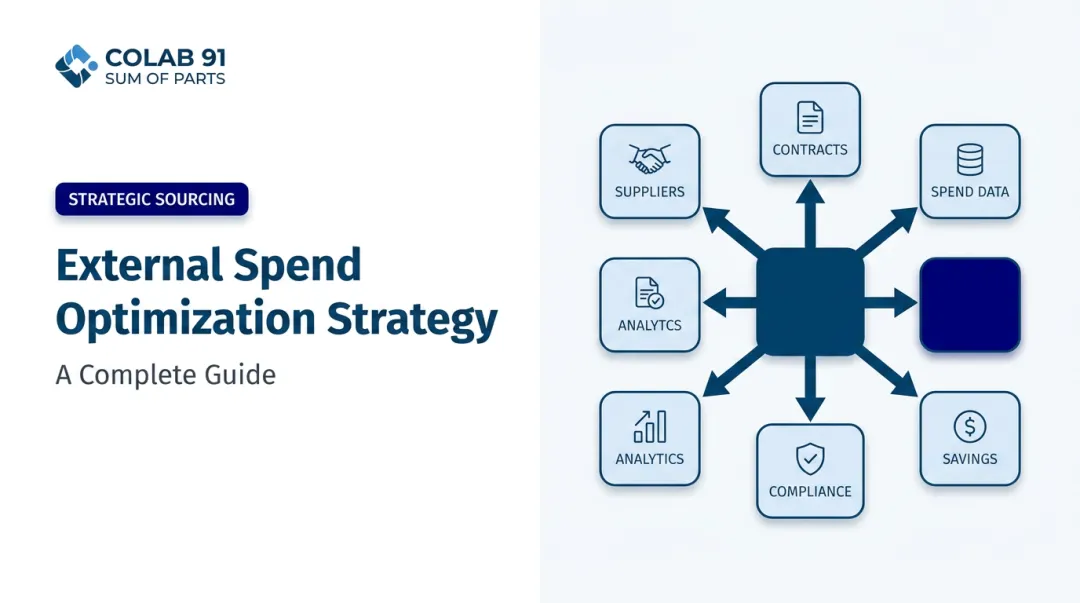
- Four pillars underpin any effective optimization program: spend visibility, strategic sourcing, supplier relationship management, and governance
- Proven cost strategies - spend consolidation, competitive benchmarking, contract rationalization, and category management - target the highest-impact levers first
- Mid-market and PE-backed companies face lean teams, EBITDA pressure, and compressed timelines - making offshore procurement capability centers a faster, lower-cost path than standing up onshore teams
Why External Spend Remains Underoptimized
Kearney's third-party economics research puts external spend at more than 50% of total costs - sometimes reaching 80% - and notes it often runs 3-4x total labor costs. Their analysis also shows a 5% reduction in external spend can increase EBIT by 25-50%. That's not a rounding error. It's a fundamental lever.
So why does it stay unmanaged?
Fragmentation Across Functions
In most mid-market organizations, purchasing decisions sit with department heads and budget owners - not trained procurement professionals. The result is fragmented vendor relationships, inconsistent pricing, and duplicate arrangements that no one has visibility into.
A common example: the same SaaS platform purchased by Marketing, Sales, and IT under three separate contracts at three different price points. None of the buyers knew the others existed. Finance sees the aggregate spend line, but can't identify which categories are overpaying, which contracts are auto-renewing, or where consolidation is possible.
The Governance Gap
FTI Consulting frames it clearly: "Controls manage behavior. Governance shapes intent." The distinction matters.
In most mid-market companies, the accountability is split three ways:
- Business units own budgets
- Procurement owns process
- Finance owns reporting
No single function owns the central question - whether external spend is actually advancing strategic priorities. The result: spend accumulates without strategic alignment, and savings opportunities remain invisible until a crisis forces the conversation.
The Behavioral Dimension
Spend decisions aren't purely rational. FTI identifies familiarity bias, the endowment effect, and loss aversion as tendencies that override enterprise-level procurement logic. A 2025 study in public procurement found that personality traits predict loss aversion and status quo bias among procurement professionals.
The practical consequence: buyers protect existing vendors to preserve their timelines and relationships - even when market alternatives offer better economics.
The 4 Pillars of Strategic Sourcing
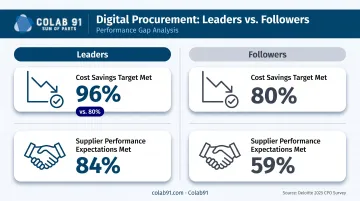
Organizations with all four pillars operating together consistently outperform reactive buyers on cost outcomes, supplier performance, and procurement resilience. Deloitte's 2025 CPO survey found that digital procurement leaders met cost savings targets at 96% vs. 80% for followers, and met supplier performance expectations at 84% vs. 59%.
Pillar 1: Spend Visibility and Analysis
Spend visibility is the prerequisite for everything else. Without a clean, consolidated view of who is buying what, from whom, at what price, and under what contract terms, any sourcing strategy is built on assumptions.
This means normalizing data across ERP systems, credit card transactions, and expense platforms - not just pulling a GL report.
Two analytical approaches matter here:
| Analysis Type | What It Reveals | When to Use It |
|---|---|---|
| Top-down | Spend by category or business unit; patterns and anomalies at scale | Early diagnostic; prioritization |
| Bottom-up | Invoice-by-invoice review; duplicates, pricing anomalies, misclassifications | Contract rationalization; targeted savings |
Combining both delivers the sharpest picture. McKinsey's survey of 35 CPOs identified establishing a single-source-of-truth platform for external cost as the highest-priority analytics use case - yet less than 20% of available procurement data is currently being used to drive insights.
Pillar 2: Strategic Sourcing
Strategic sourcing is a disciplined, repeatable process: evaluate supply markets, define category strategies, run competitive bidding, and select suppliers based on total value - not just unit price.
When urgency drives decisions, leverage disappears. When procurement is planned, suppliers compete - and that difference shows up directly in contract outcomes.
Indirect spend - IT, marketing, professional services, facilities - is where most organizations have the largest untapped opportunity, precisely because it has received the least procurement rigor. McKinsey's retail indirect sourcing research shows that a structured, TCO-based program can reduce indirect costs by 10-15%, with average opportunities reaching 18% across categories.
Pillar 3: Supplier Relationship Management
Supplier relationships sit on a spectrum from transactional (interchangeable vendors competing on price) to strategic (co-innovation partners with shared long-term goals). Most organizations treat too many suppliers as strategic - spreading attention thin and reducing leverage everywhere.
Active supplier relationship management means:
- Regular performance reviews against defined SLAs and KPIs
- Structured escalation paths with clear ownership - not informal firefighting
- Periodic market benchmarking - even with long-standing suppliers - to confirm pricing remains competitive
- Clear segmentation: which suppliers get strategic attention, which get standardized management
Pillar 4: Governance and Compliance
A governance framework defines spend thresholds requiring procurement involvement, preferred supplier lists, contract compliance requirements, and category ownership accountability.
Without it, organizations with strong sourcing processes still see value eroded by maverick spend. APQC's benchmarking data shows that organizations with 2% or more maverick purchasing carry a $2.58 higher procurement cost per $1,000 in purchases than organizations below that threshold.
Proven Strategies for Cost Optimization in Procurement
The best programs sequence these strategies by where the fastest savings and lowest disruption intersect - quick wins first, structural changes second.
Spend Consolidation and Demand Aggregation
Moving from fragmented supplier arrangements to a smaller, preferred panel unlocks volume leverage and simplifies contract management. Think IT software licenses purchased independently across six business units, or facilities maintenance contracted separately at each site.
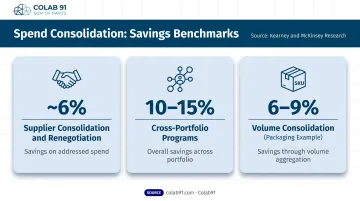
Kearney's cross-portfolio work finds that supplier consolidation and renegotiation can yield approximately 6% savings on addressed spend, with cross-portfolio programs delivering 10-15% savings overall. A McKinsey North American retailer example found that packaging standardization - where 80% of SKUs were unique to a single region - was expected to capture 6-9% savings through volume consolidation alone.
Competitive Benchmarking and Market Testing
Benchmark current pricing and contract terms against market rates. Then use that data to re-negotiate with incumbents, or run a competitive RFP/RFQ process.
The key insight: even when the incumbent supplier is retained, the act of competitive market-testing typically drives meaningful price improvements. Suppliers behave differently when they know alternatives have been evaluated.
Contract Rationalization
Many organizations carry a tail of expired, auto-renewed, or redundant contracts that no longer reflect competitive market rates or current business needs.
Contract rationalization is often the fastest quick-win lever:
- Audit the contract portfolio for overlapping or duplicate agreements
- Flag auto-renewals before they trigger
- Consolidate fragmented terms into master agreements where volume supports it
- Eliminate contracts for services no longer actively used
Minimal operational disruption. Measurable savings in the first 30-60 days.
Category Management
Contract rationalization and benchmarking are tactical levers. Category management is the structural layer that makes savings durable.
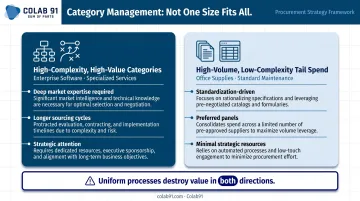
It treats each spend area - IT, logistics, professional services, real estate - as a distinct business with its own supply market analysis, sourcing strategy, and performance targets. Category complexity varies enormously:
- High-complexity, high-value categories (enterprise software, specialized professional services) require deep market expertise and longer sourcing cycles
- High-volume, low-complexity tail spend (office supplies, standard maintenance) benefits from standardization and preferred panels - not strategic attention
A single procurement process applied uniformly across both types destroys value in opposite directions: over-engineering simple purchases and under-investing in complex ones.
Spend Analytics and Technology Enablement
Modern spend analytics platforms have made category-level visibility accessible to mid-market companies, not just large enterprises. Core capabilities that matter:
- Real-time spend dashboards by category, supplier, and business unit
- Contract expiry alerts and auto-renewal flags
- Supplier performance tracking against defined KPIs
- Anomaly detection for pricing irregularities and duplicate payments
Mid-market-accessible platforms worth evaluating:
- SpendHQ - AI-powered spend intelligence, positioned for companies in the $100M–$1B range
- Coupa - AI-driven spend management with an explicit SMB offering
- Simfoni's Strategic Spend Terminal - combines spend analytics, eSourcing, and pipeline management in a single interface
KPMG's 2024 procurement survey found 60% of respondents were implementing technology or data analytics solutions in the next 12-18 months - a signal that this is no longer a large-enterprise-only conversation.
Common Pitfalls That Undermine Procurement Value
Even well-designed procurement improvement programs stall. The reasons are almost always organizational rather than technical. Three pitfalls account for most of the gap between procurement's potential and its actual contribution:
Treating procurement as a cost center. When procurement is funded and measured solely on savings, it optimizes for savings - sometimes at the expense of supplier quality, supply chain resilience, and innovation access. McKinsey's work on procurement's expanding role points toward resiliency, margin, growth, and value-chain impact as the real mandate. Organizations that define procurement narrowly leave significant value on the table.
Decentralized decisions without enterprise accountability. Business units make locally rational but enterprise-suboptimal purchasing decisions: protecting timelines, preserving vendor relationships, sidestepping procurement processes they perceive as slow. Without clear decision rights and incentive alignment, governance frameworks exist on paper but rarely in practice.
Mistaking negotiation for optimization. Renegotiating existing contracts is one tactic within a broader program. Organizations that stop there miss the deeper savings available through demand management, specification rationalization, supplier consolidation, and category strategy. Negotiation is one input to the process, not the process itself.
Building a Sustainable Procurement Capability: The Offshore Advantage
The structural challenge for mid-market and PE-backed companies is this: they need the procurement rigor of a large enterprise but lack the headcount, budget, and talent pipeline to build it internally. Hiring a full in-house strategic sourcing team is expensive. Engaging large consulting firms is episodic and doesn't leave lasting capability behind.
The Case for Offshore Procurement Capability Centers
Offshore procurement capability centers - staffed with experienced procurement analysts, sourcing specialists, and spend analytics professionals - give mid-market companies access to dedicated, domain-expert talent at a fraction of the cost of equivalent onshore resources.
This is not traditional outsourcing or BPO. The distinction matters: the offshore team functions as an embedded extension of the client's procurement function, integrated into the client's culture and workflows, not a detached shared-services provider processing transactions at arm's length.
For PE-backed portfolio companies in particular, where EBITDA improvement timelines are compressed and procurement sophistication is often underdeveloped at the point of acquisition, this model accelerates value creation programs. Kearney's cross-portfolio research shows these initiatives typically deliver 1-3% EBITDA improvement, 10-15% savings on addressed spend, and ROI exceeding 10x program cost - with results appearing within 6-12 months.

Colab91's leadership team has spent two decades building exactly this model. Managing Partners Madhur Kabra and Vijender Kapoor previously led Impendi's India operations (subsequently acquired by Accenture), scaling a multifunctional offshore organization to 100+ practitioners serving PE sponsors including Carlyle Group, TPG, Elliott, and BC Partners.
Jeff Skiles, Director of USA Operations, bridges onshore client relationships with offshore delivery - ensuring US-based clients receive strategic guidance alongside operational execution.
That experience now extends across a range of client engagements, including:
- Pediatric Associates (TPG portfolio company) - healthcare procurement transformation
- Sabre and Kindred Healthcare - technology and healthcare services
- Amneal and Veolia - pharmaceuticals and industrial services
Each engagement is structured around the client's specific size, scope, and complexity, with explicit consideration for entity ownership, IP rights, and strategic control.
For mid-market companies that need serious procurement capability without the cost and timeline of building it from scratch, this model offers a direct path to measurable results - without starting over.
Frequently Asked Questions
What are the 4 pillars of sourcing?
The four pillars are spend visibility and analysis, strategic sourcing, supplier relationship management, and governance and compliance. Each pillar depends on and reinforces the others, forming the operating framework for any effective external spend optimization program.
What strategies do you use for cost optimization in procurement?
The core strategies are spend consolidation, competitive benchmarking, contract rationalization, category management, and technology-enabled spend analytics. Effective programs sequence these by targeting the fastest savings with the least disruption - typically contract rationalization and consolidation first, then category strategy.
What is external spend optimization?
External spend optimization is the structured process of analyzing, governing, and strategically managing all third-party expenditure to reduce costs, improve supplier performance, and align spend with business priorities. The measure of success is the value received from every dollar spent externally, not just what you paid.
How do PE-backed companies approach external spend management?
PE-backed companies tackle external spend through value creation plans that prioritize quick-win cost reduction in indirect spend, then build sustainable procurement governance across the holding period. The compressed timeline between acquisition and exit makes offshore capability centers and experienced procurement advisors particularly effective at delivering results quickly.
How long does it take to see results from a procurement optimization program?
Contract rationalization and competitive re-sourcing of high-spend, low-complexity categories can deliver measurable savings within 30-90 days. Full programs typically run 6-12 months, structured to generate early ROI well ahead of longer-term governance improvements.
What is the difference between strategic sourcing and procurement?
Procurement is the broader function covering all activities related to acquiring goods and services. Strategic sourcing is a specific methodology within procurement that applies rigorous market analysis, competitive bidding, and category strategy to generate optimal supplier value, rather than processing purchase orders reactively when demand arises.