Introduction
Offshore captive centers were once the exclusive territory of Fortune 500 multinationals with deep pockets and dedicated global expansion teams. That's changing fast. According to Everest Group, over 300 new Global Capability Centers were set up in 2023 alone, with India and Eastern Europe emerging as the dominant destinations. The Zinnov-NASSCOM mid-market GCC report goes further, documenting 480+ mid-market GCCs already operating in India — representing 27% of the country's entire GCC landscape.
That growth reflects a real tension. Traditional outsourcing hands control of your processes, people, and institutional knowledge to a vendor whose incentives don't always align with yours. Yet building a fully owned offshore operation sounds expensive, slow, and operationally complex — particularly for companies without a dedicated global expansion function.
This guide addresses that tension directly. It's built for mid-market leaders and PE operating partners who want an honest assessment of whether the captive model fits their situation — and what a realistic, lower-risk path looks like when it does.
Key Takeaways
- Over 300 new GCCs launched in 2023; mid-market companies now account for 27% of India's GCC landscape
- Captive centers offer full operational control, direct IP governance, and long-term talent ownership
- Setup requires 6–12 months, significant upfront capital, and executive buy-in
- Best-fit functions include procurement analytics, financial modeling, and spend analytics — commodity or highly variable work is not a match
- The Build-Operate-Transfer (BOT) model gives mid-market companies a lower-risk entry point into captive offshoring
What Is an Offshore Captive Center?
An offshore captive center is a wholly owned, company-operated facility located in a lower-cost country. The employees are direct legal employees of the parent organization — not of a vendor. You'll hear several names for this model: Global Capability Center (GCC), Global In-House Center (GIC), or simply captive center. These terms are largely interchangeable.
From Back Office to Strategic Asset
The original captive playbook was simple: move transactional back-office work offshore, reduce costs. That model still exists, but it's no longer the defining one. NASSCOM-Zinnov data shows that nearly 90% of India GCCs are now multi-functional, supporting technology, operations, and product engineering simultaneously. More than half have matured into portfolio and transformation hubs.
The scale of capability now housed in these centers reflects that shift:
- 120,000+ AI/ML professionals employed across India GCCs
- 185+ AI/ML Centers of Excellence established within those centers
- Engineering R&D GCCs growing 1.3x faster than the broader GCC sector
- GCCs increasingly functioning as enterprise innovation hubs, not just execution arms
Why India Remains the Primary Destination
India's position at the top of captive center destinations isn't just about labor cost. The talent depth across non-IT domains — procurement analytics, financial modeling, category management, data science — is genuinely difficult to replicate elsewhere. Colab91's own delivery centers in Gurugram recruit specialists across strategic sourcing, spend analytics, FP&A, AI/ML engineering, and commercial analytics for mid-market US clients. That breadth of domain expertise, available at scale, is the real advantage.
Captive Center vs. Offshore Outsourcing: What's the Difference?
The core distinction is ownership. In offshore outsourcing, a third-party vendor owns the workforce, the processes, and the operational infrastructure. In a captive model, the parent company owns everything — the entity, the employees, the data, and the institutional knowledge those employees accumulate.
Key Trade-Offs at a Glance
| Dimension | Captive Center | Offshore Outsourcing |
|---|---|---|
| Ownership | Parent company owns entity and workforce | Vendor owns operations; client buys output |
| Time to Launch | 6–12 months typically | Weeks to 2–3 months |
| Cost Structure | Higher upfront; lower ongoing at scale | Lower upfront; vendor margins compound over time |
| IP / Data Security | Direct governance; no third-party access | Reliant on vendor contractual protections |
| Cultural Alignment | Employees identify with parent company | Employees loyal to vendor, not client |
| Scalability | Full control; can pivot without contractual constraints | Dependent on vendor capacity and contract terms |
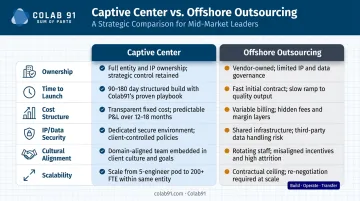
The pattern is consistent across industries: outsourcing gets you moving faster, while captive ownership compounds in value the longer you operate.
When Companies Use Both
Most organizations eventually find that neither model works in isolation. Everest Group's sourcing boundary analysis recommends that GCCs own CX architecture, platform strategy, AI operations, and governance, while standardized execution and migration work can be handled by external providers. The captive-for-core, outsource-for-commodity split is a practical entry point — build ownership where it matters strategically, and use vendors where speed or standardization outweighs control.
The Strategic Benefits of an Offshore Captive Center
Full Operational Control
When you run your own center, you set the processes, the KPIs, the tools, and the work culture. No vendor agenda. No SLA renegotiation every 18 months. No competing client priorities.
When your strategy changes — a new product line, a shift in sourcing model, a pivot in data infrastructure — your captive adapts without contractual friction. That speed rarely shows up in a cost comparison spreadsheet, but it compounds over time.
Long-Term Cost Efficiency
Setup costs are meaningfully higher than outsourcing. That's a fact worth acknowledging upfront. But the economics shift at scale. A captive eliminates vendor margins that compound year over year, reduces per-resource costs as the center matures, and delivers stronger ROI across a multi-year horizon.
EY's GCC Vision 2030 report provides useful context: the current average GCC cost per FTE in India sits at approximately $29,100, projected to rise to $37,760 by 2030 as talent demand outpaces supply. The appropriate comparison isn't captive vs. zero — it's captive vs. a vendor arrangement where those same FTE costs are marked up for margin, coordination overhead, and vendor management infrastructure.
Talent Ownership and Retention
Employees at a captive center identify with the parent company's mission and brand. They attend your town halls, wear your logo, and advance their careers within your organization. That alignment drives retention in ways vendor-managed models cannot replicate. In outsourcing arrangements, employees feel loyalty to the vendor, not the client.
Institutional knowledge builds and compounds over time rather than walking out the door when a vendor rotates staff to another account.
IP, Data, and Regulatory Control
For companies managing sensitive financial data, proprietary sourcing strategies, or regulated patient information, the captive model provides direct governance over security policies, access controls, and compliance protocols. You own the policies and enforce them — not a third party's contractual assurances.
This matters most for PE-backed companies managing proprietary deal data and healthcare organizations subject to HIPAA, where a vendor's compliance posture is never fully within your control.
Access to Specialized Talent Pools
This is where the "skills arbitrage" angle matters more than the cost arbitrage angle. Zinnov-NASSCOM data shows that mid-market GCCs are 1.3x more likely to engage in transformation-focused work and anchor 47% of their global product management talent in India.
Colab91's Gurugram-based teams cover procurement analytics, spend cube construction, category management, supplier risk management, AI/ML model development, and financial modeling — functions that mid-market companies often cannot staff affordably onshore, if they can find the talent at all.
Risks and Challenges You Can't Ignore
High Setup Investment and Extended Timeline
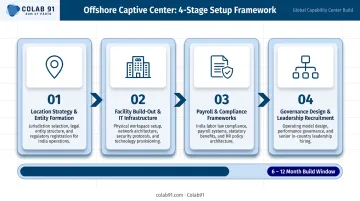
Setting up a legal entity, leasing office space, building HR infrastructure, and hiring locally takes significant capital. The typical timeline is 6–12 months before a center is meaningfully operational. Companies that underestimate this runway run into cost overruns and productivity gaps that erode the business case.
The setup components alone are substantial:
- Location strategy and entity formation
- Facility build-out and IT/security infrastructure
- Payroll and compliance frameworks
- Governance model design and leadership recruitment
Everest Group notes that emerging globalizers and PE-backed firms increasingly value packaged setup solutions that bundle these components — precisely because the coordination complexity is real.
Local Compliance Complexity
India has distinct labor laws, tax treatment, payroll regulations, and data protection requirements. Each state adds further nuance, and missteps create legal exposure, penalties, and operational disruption. Local legal and HR expertise is the foundation everything else sits on.
Management Bandwidth and Cultural Alignment
Running a remote team across time zones places genuine demands on leadership. Without a strong, empowered local leader who has real decision-making authority, performance and morale erode. Hierarchical work cultures — common in India — may require deliberate encouragement of autonomous decision-making and proactive communication, rather than assuming employees will surface problems without being asked.
Scale Challenges for Smaller Operations
Everest Group reports that many of the 1,000+ GCCs established between 2022 and 2025 are micro or nano centers with fewer than 100 FTEs. At that scale, fixed overhead — facilities, HR infrastructure, compliance, leadership — is difficult to justify against what an experienced outsourcing provider can deliver per resource. This is a specific risk for mid-market companies starting small without a credible path to scale.
Productivity Stagnation Without Structural Accountability
Outsourcing contracts often include contractually mandated productivity improvements. Captive centers have no equivalent external pressure — and without deliberate internal governance, they can grow complacent over time. HFS Research frames this directly: GCCs that don't define accountability for outcomes risk drifting into passive execution rather than active value creation. Performance governance built in from day one — KPIs, reporting cadences, defined escalation paths — is what separates centers that compound value from those that plateau.
Is an Offshore Captive Center Right for Your Business?
Assess Function Fit
Captive centers perform best for functions that are:
- Ongoing and stable, not project-based or highly variable
- Knowledge-intensive, with institutional knowledge that compounds over time
- Tied to proprietary data or processes, where IP and data control matter
- Analytically or technically deep, with domain expertise as the primary value driver
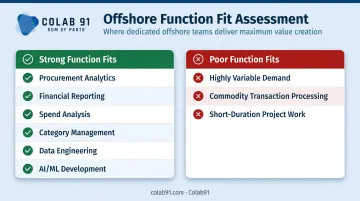
Strong fits include procurement analytics, financial reporting, spend analysis, category management, data engineering, and AI/ML development. Poor fits include highly variable demand, commodity transaction processing, or short-duration work.
Evaluate Financial Readiness
Build a detailed 3–5 year business case comparing the full cost of a captive build against a vendor arrangement. Factor in setup costs, leadership investment, and time-to-productivity — not just steady-state operating costs.
Year one savings targets are almost always too aggressive. The economics strengthen in years two through five as the center matures and fixed costs amortize.
Check Leadership Commitment
A captive center requires an executive sponsor with genuine long-term commitment, not just initial enthusiasm. Everest Group's research on GCC transformation failures points repeatedly to two root causes: lack of clear enterprise mandate and executive turnover after launch.
Ask honestly: does your leadership team have the appetite to manage this as a strategic priority through the inevitable friction of the first 12–18 months?
The PE-Backed Company Calculus
That leadership commitment question becomes even more pointed when a defined exit timeline is in play. For PE-backed companies on a 3–5 year hold period, timing matters. A captive center established in year one of a hold creates transferable operational capability — a functioning offshore team, embedded processes, and institutional knowledge — that can meaningfully enhance exit value. One established in year three often doesn't have enough time to reach steady-state performance before the exit process begins.
Red flags that suggest captive may not be right:
- Significant financial instability or budget uncertainty
- Demand that is highly variable across quarters
- No in-country knowledge or local partnerships to draw on
- No senior leader willing to personally own the offshore relationship
- Functions with short-duration or project-based work patterns
If several of these apply, the captive model isn't the right fit yet. Address the underlying conditions first.
A Smarter Middle Ground: The Managed Captive Model
For mid-market companies that want the strategic control of a captive without the full overhead of a DIY build, two models are worth understanding.
Build-Operate-Transfer (BOT)
Everest Group defines the BOT model as one where a specialist partner invests capital, leases facilities, sources talent, and operates the center on the client's behalf — with the intent to transfer full ownership after a defined period. The benefit: reduced upfront investment and operational risk, faster time to market. The trade-off: BOT arrangements typically carry higher costs than a fully owned model during the operate phase, and transfer mechanics need to be negotiated carefully from the start.
The Next-Gen Capability Center Partner
The more relevant model for most mid-market companies is working with a specialist that brings domain expertise, a pre-built India operating infrastructure, and a proven talent network — not a generic staffing provider or a large systems integrator with no functional depth.
Colab91 operates in this space. The firm builds India-based capability centers for US mid-market and PE-backed companies, with domain depth in procurement, analytics, and technology. The leadership team previously built and scaled Impendi's India operations to 100+ practitioners serving Carlyle Group, TPG, Elliott, and BC Partners before that firm was acquired by Accenture. The infrastructure, talent pipelines, and operating playbooks are already in place.
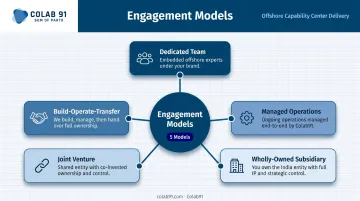
Engagement models are structured around each client's priorities and can include:
- Dedicated team — domain experts embedded as an extension of your in-house function
- Build-Operate-Transfer (BOT) — partner-managed build with a defined path to full ownership
- Managed operations — ongoing delivery responsibility stays with the partner
- Joint venture — shared ownership with aligned incentives
- Wholly-owned subsidiary — full entity control from day one
For a mid-market company that isn't ready to build from scratch but wants more than a vendor relationship, the right partner collapses years of setup time into months — without sacrificing strategic control.
Frequently Asked Questions
What does "offshore captive" mean?
An offshore captive is a company-owned delivery center in another country, where employees are direct legal employees of the parent organization — not a third-party vendor. That ownership means full control over operations, processes, and governance.
What is the difference between GCC and ODC?
A Global Capability Center (GCC) is a multi-function offshore unit covering business domains such as procurement, analytics, finance, and technology. An Offshore Development Center (ODC) focuses narrowly on software development and engineering work for a specific client or product team.
What is an example of offshore BPO?
Offshore BPO is when a company contracts a third-party provider in another country to handle business processes such as customer support, payroll, or data entry. Unlike a captive, the company does not own or manage the operation — that responsibility sits entirely with the vendor.
How long does it take to set up an offshore captive center?
A basic setup typically takes 6–12 months, covering legal entity registration, office establishment, initial hiring, and onboarding. Partnering with a specialist that brings pre-built infrastructure, local compliance expertise, and existing talent networks can cut that timeline to 3–4 months.
Is a captive center a viable option for mid-market companies?
Yes, though captives are no longer exclusively for large enterprises. With 480+ mid-market GCCs already operating in India, smaller and more focused setups are increasingly common — particularly when a specialist partner reduces upfront complexity, compliance risk, and time to productivity.