Introduction
India's GCC market hit $64.6 billion in revenue in FY2024, with over 1,700 centers employing nearly 1.9 million people. Projections from EY and NASSCOM-Zinnov put that figure at $99–$110 billion by 2030, with new setups expected to rise from 70 to 115 annually. What's changed is who's building them: mid-market and PE-backed companies now account for 35% of new GCC activity, with 480+ mid-market centers already operational.
Yet many small and mid-sized GCCs under 500 FTEs stall within 2–3 years. The India opportunity is real - the execution isn't always. Wrong operating model, murky scope, cultural neglect, and hiring for headcount instead of capability are the recurring failure points.
This guide covers the foundational best practices that determine whether your GCC becomes a strategic asset - covering operating model design, talent strategy, governance, and the cultural integration most guides skip entirely.
Key Takeaways
- Your strategic rationale (cost, talent access, or capability building) should determine GCC design before any operational decisions are made
- Operating model selection (captive, BOT, managed) must reflect your company's size, risk tolerance, and time-to-value requirements
- Entity setup and location choice directly shape tax exposure and long-term operational flexibility
- Talent strategy requires role design, career pathing, and domain expertise - not just a headcount target
- Governance and KPI frameworks must be built before launch, not bolted on after problems appear
Define Strategic Objectives Before You Build
Most GCC failures trace back to one root cause: launching without a clear answer to "why are we doing this." Companies that skip that question almost always end up with an expensive offshore staffing operation - not the capability center they intended to build.
The Three Valid Motivations - and Why They're Not Interchangeable
There are three legitimate reasons to build a GCC:
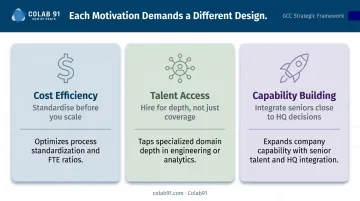
- Cost efficiency - reducing labor costs for defined, transferable processes
- Talent access - tapping India's depth in engineering, analytics, procurement, or other specialized domains
- Capability building - establishing a strategic hub that expands what the company can do, not just where it does it
Each motivation demands a different design approach. A cost play optimizes for process standardization and FTE ratios. A capability play requires investing in senior domain talent, career infrastructure, and integration with HQ strategy - and those two models don't share a budget.
According to Everest Group, GCCs launched mainly for tactical cost reduction frequently become low-cost staffing projects rather than enterprise capability engines - a pattern that shows up most often in centers under 500 FTEs.
Questions Leadership Must Answer Before Breaking Ground
Before any vendor conversations or location visits, leadership needs clear answers to:
- Which functions will the GCC own versus merely support?
- What is the expected time-to-value - 12 months, 3 years?
- Is this a single-function center (procurement analytics, financial modeling) or a multi-function hub?
- Will the GCC eventually take on global decision-making roles, or remain an execution layer?
Why Mid-Market Companies Must Be More Deliberate
Getting those answers right matters even more at the mid-market level. Enterprise players can absorb a misaligned GCC launch and course-correct over two to three years. Mid-market and PE-backed companies face tighter ROI timelines from sponsors, limited internal bandwidth to manage offshore complexity, and far less margin for error.
Zinnov data shows that mid-market GCCs average 448 employees, roughly one-third the size of enterprise setups. They are also 1.3x more likely to operate as digital innovation hubs. That's a real opportunity - but only if the scope is focused from day one. A domain-specific center of 15–25 practitioners built around a clear capability gap consistently outperforms a broad multi-function hub at this stage.
A strong business case document includes:
- Cost-benefit analysis versus current state
- Headcount projections by function with ramp timeline
- Break-even analysis (18–36 months for a well-scoped center)
- Risk scenarios covering regulatory, talent, and operational variables
- KPIs tied to business outcomes - not FTE counts alone
Choose the Right Operating Model for Your Stage of Growth
Three primary models exist, and the differences between them are not cosmetic.
Captive (Wholly-Owned Subsidiary)
The company sets up its own legal entity, hires directly, and owns all IP and operations. This model offers maximum control and long-term capability ownership, but it demands real upfront investment in HR, legal, compliance, and leadership infrastructure.
It's best suited for companies with established India relationships, strong internal compliance capacity, and a genuine long-term commitment.
For many mid-market companies, it's the highest-risk choice in the early stages - not because of any inherent flaw, but because the operational scaffolding to execute it simply isn't there yet.
Build-Operate-Transfer (BOT)
A vendor sets up and runs the center temporarily, then transfers it to the company. BOT compresses launch timelines and reduces initial risk. The catch: it requires careful contract design upfront, particularly around transfer rights, IP ownership, non-solicitation provisions, and compensation alignment at the point of transfer.
Everest Group reports that BOT models rose from under 10% of GCC setups to nearly 40%, reflecting how the market has shifted toward risk-reduction approaches.
Managed / GCC-as-a-Service
An experienced partner runs the center on the company's behalf, with domain expertise already embedded. This model is increasingly popular with mid-market companies that want strategic offshore capability without standing up an internal operations function.
This is where Colab91's approach fits directly. Rather than layering a generic offshore operation onto a client's existing team, Colab91's "Sum of Parts" model augments in-house talent with domain-specific practitioners in procurement and analytics, while managing operating infrastructure end-to-end.
Companies including Velocity Procurement, BlueRidge Partners, and Kindred Healthcare have used this model to build genuine capability quickly - without waiting years for an internal buildout to mature.
How to Choose
The right model depends on where you are operationally, not just where you want to go. Run your situation against these factors:
| Factor | Points Toward Captive | Points Toward BOT/Managed |
|---|---|---|
| Internal India HR/legal capacity | Strong | Limited |
| Time-to-value requirement | 2–3 years acceptable | Under 12 months |
| PE sponsor ROI timeline | Flexible | Tight |
| Function complexity | Well-defined, transferable | Domain-specific, specialized |
| Prior offshore experience | Significant | First or second GCC |
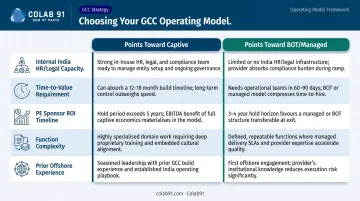
The captive model is not inherently wrong. It's often premature - and choosing it by default because it "feels more permanent" is one of the more expensive mistakes mid-market companies make.
Navigate Location, Entity Setup, and Legal Compliance
Entity Structure
Three main legal structures are available for establishing a presence in India. Each has distinct implications for liability, tax, and long-term flexibility:
- Wholly-Owned Subsidiary (WOS/Private Company): Limited liability, minimum 2 members and 2 directors (including at least one India-resident director). Cleanest structure for a long-term operating GCC with full IP ownership and transferability.
- LLP: More flexible governance, but requires tighter review of FDI eligibility and tax treatment for your specific activities.
- Branch Office: An extension of the foreign parent, subject to RBI/AD route approvals. Taxed at 40% plus surcharge and cess. Generally not the right choice for a GCC.
Entity choice affects permanent establishment risk, the ability to transfer the GCC in the future, and your transfer pricing obligations. Engaging local legal counsel and a tax advisor before incorporation - not after - is essential.
Location Selection
Bengaluru, Hyderabad, and NCR (including Gurugram) dominate for complex, domain-specific functions. The talent ecosystems, infrastructure, and GCC density in these cities create real advantages in hiring senior practitioners and building leadership pipelines.
Tier-2 cities - Pune, Coimbatore, Jaipur - offer up to 30% lower operational costs and potentially better retention for certain roles, according to NASSCOM Community research. Demand growth in tier-2 GCC locations is forecast at 30–40%. The trade-off: tier-2 cities often require longer hiring cycles for specialized or senior roles.
Colab91 operates from Gurugram, which gives clients direct access to NCR's deep talent pool across procurement, analytics, and technology functions - one reason the company's engagements tend to concentrate in that corridor.
Compliance Layers You Cannot Defer
- Transfer pricing: Document arm's-length pricing for all intercompany transactions from day one - Indian tax authorities scrutinize this closely
- DPDP Act (Digital Personal Data Protection Act, 2023): Covers any processing of Indian residents' personal data; penalties for security safeguard failures can reach INR 250 crore per PwC's analysis
- Employment law: Gratuity, Provident Fund contributions, and termination rules apply from the first hire - no grace period
- Sector-specific rules: Healthcare GCCs handling US patient data need HIPAA controls; BFSI centers must align with RBI guidelines
- SEZ classification: If pursuing Special Economic Zone tax benefits, factor compliance requirements and approval timelines into your setup schedule from the start
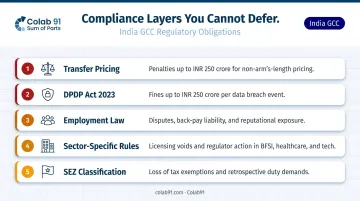
Compliance gaps discovered after launch are expensive to unwind - legal restructuring, back taxes, and regulatory penalties routinely dwarf the cost of proper upfront design.
Build a Talent Strategy That Goes Beyond Hiring
Hiring Plan vs. Talent Strategy
A hiring plan sets headcount targets. A talent strategy answers harder questions:
- What domain expertise is required at each level?
- How are roles structured to retain high performers?
- What does a career path look like at 18 months and 3 years?
- What does employer brand mean in this specific talent market?
Competing for generic talent in India's GCC market is expensive and inefficient. Specificity wins. Companies that define functional expertise requirements before posting roles - and build compensation and career infrastructure around those requirements - fill roles faster and retain people longer.
Domain Expertise as a Sourcing Filter
The strongest GCCs in procurement, analytics, and technology don't hire generalists and train them into the function. They hire practitioners with functional depth and build the offshore operation around that expertise.
This is the core distinction in Colab91's model: teams are staffed with pre-screened domain practitioners - people with hands-on procurement or analytics experience - rather than candidates who match a generic offshore profile.
When Colab91's leadership scaled Impendi's India operations to 100+ practitioners serving PE sponsors like Carlyle Group and TPG, the talent model was built around functional capability first, not location or cost band.
Compensation Structuring
Compensation packages must account for:
- Provident Fund (PF) - both employer and employee contributions are legally mandatory
- Gratuity - accrues after 5+ years of service; provision for this cost from day one
- Skill-family benchmarking - Zinnov data shows ER&D and AI/ML talent commanded premium compensation even as average salary increments dropped 1–2% across broader functions in 2023
- Long-term retention structure - critical for GCCs structured under a Build-Operate-Transfer (BOT) arrangement
Establish Governance and Cultural Integration from Day One
Governance Is Not a Phase-Two Problem
GCCs that launch without defined reporting lines, decision rights, and accountability structures drift - both culturally and strategically. By the time HQ notices the misalignment, the cost of correction is significant.
A governance framework from day one includes:
- Clear escalation paths between the GCC and HQ
- Defined local leadership authority (what decisions can the GCC head make independently?)
- HQ integration cadence - weekly operational reviews, monthly strategic alignment
- IP and data security protocols covering both Indian regulations and any parent-country obligations
- Performance accountability tied to KPIs, not just activity metrics
The Cultural Gap Is Underestimated
The distance between a US-based parent company and an India-based GCC team isn't just geographic. Expectations around communication directness, decision-making autonomy, and what "escalation" means differ in ways that compound over time if not addressed early.
Practical steps that work:
- Deploy senior HQ leaders to the GCC for the first 90–120 days - not just for knowledge transfer, but for relationship building
- Create shared workstreams with joint ownership rather than handoff-based task transfer
- Invest in cultural orientation for both sides - the India team needs to understand HQ's operating context, and HQ needs to understand how the India team works best
Deloitte's culture analysis across approximately 130,000 employee reviews at Indian GCCs identifies empowerment, inclusion, and innovation as consistent strengths. Yet HQ-GCC mindset misalignment - where enterprise leaders expect transformation while GCC leaders are told to stay in narrow lanes - remains one of the most common underperformance patterns.
The GCC Head Is a Governance Lever
Underinvesting in the GCC head role is one of the costliest early mistakes. This person must operate fluently in the parent company's culture, hold credibility with senior HQ stakeholders, and build a talent brand strong enough to attract top local hires. That profile commands a premium - budget for it accordingly, and start the search before you need the seat filled.
Track the Right KPIs to Measure GCC Success
The Problem with Cost-Only Metrics
Most GCCs launch with cost savings as the primary scorecard. That focus matters - but organizations that track only cost metrics tend to underinvest in the capabilities that justify the center's existence. They also lose their best people, who eventually recognize they're being managed as a cost line rather than a strategic asset.
Everest Group's research on GBS/GCC value quantification identifies the core problem: weak links to enterprise KPIs, siloed data systems, and negligible connections to CXO-level metrics make it nearly impossible for GCCs to prove their value - even when they're delivering it.
A KPI Framework That Matures Over Time
| Stage | Focus Areas | Example Metrics |
|---|---|---|
| Year 1 (Ramp) | Operational setup | Headcount ramp rate, process transfer completion, error rates, compliance status |
| Year 2 (Delivery) | Quality and integration | Output quality scores, SLA adherence, cross-functional collaboration, stakeholder NPS |
| Year 3+ (Strategic) | Value and innovation | New capabilities built, process improvements driven, revenue impact, risk mitigation quantified |
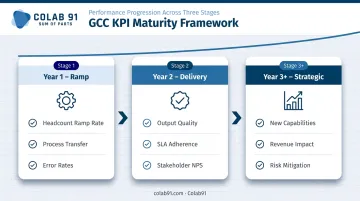
Building this framework before launch ensures the right data is captured from day one. Retrofitting a measurement system after 18 months means operating blind during the period when governance habits are being formed - and those habits are very hard to undo.
The KPIs that matter most at maturity - innovation contribution, revenue impact, risk reduction - require longitudinal data. Start tracking baseline performance in month one, or those metrics simply won't exist when leadership asks for them.
Frequently Asked Questions
How long does it typically take to set up a Global Capability Center?
Timelines depend heavily on the operating model. Captive setups typically require 9–18 months when accounting for entity incorporation, hiring, and process transfer. BOT or managed models can compress this to 3–6 months. The single largest variable is how clearly objectives and scope are defined before execution begins.
What is the minimum team size needed to justify a GCC?
There's no universal threshold, but a minimum viable GCC typically starts at 15–25 FTEs to justify infrastructure and dedicated management. For mid-market companies, a focused center of 10–15 domain specialists can deliver meaningful ROI when scope is tight and the team is built around genuine expertise rather than headcount.
What is the difference between a GCC and traditional outsourcing?
In a GCC, the company owns and operates the center - the talent, IP, culture, and institutional knowledge stay with the parent. In traditional outsourcing, a third-party vendor manages delivery against contractual SLAs with limited integration into the parent company's strategy or team.
How do you choose the right location for a GCC in India?
Key criteria: depth of domain-specific talent, infrastructure quality, cost of operations, and access to established GCC ecosystems. Tier-1 cities (Bengaluru, Hyderabad, NCR) dominate for complex and specialized functions. Tier-2 cities suit well-defined roles where cost efficiency and retention matter most.
What are the most common mistakes companies make when setting up a GCC?
The most consistent failure patterns:
- Launching without clear strategic objectives
- Underinvesting in the GCC head role
- Treating the center as a pure cost play
- Neglecting cultural integration between HQ and the India team
- Skipping governance design before the first hire is made
Can mid-market companies realistically benefit from setting up a GCC?
Yes - and increasingly so. Mid-market companies are establishing successful GCCs, particularly through managed or BOT models that reduce setup complexity and compress time-to-value. The key is starting focused: one or two high-value functions, a well-defined scope, and a talent strategy built around domain expertise rather than headcount.