Introduction
Procurement teams are navigating their toughest operating environment in decades. Tariff volatility, inflationary supplier costs, and supply chain fragility are compounding simultaneously—while traditional tools offer dashboards and static reports when what teams need is real-time intelligence and speed.
Generative AI addresses this directly. Unlike earlier automation that required structured data and predefined rules, Gen AI reads contracts, interprets supplier signals, drafts RFPs, and answers spend questions in plain language—across the full source-to-pay lifecycle.
The adoption signal is clear: 72% of procurement leaders had prioritized Gen AI integration into procurement strategies as of mid-2024, according to Gartner. Yet only 36% have deployed it in a meaningful way, per EY's 2025 Global CPO Survey. That gap is exactly what this guide addresses—covering what Gen AI actually means for procurement, the use cases delivering results, why most pilots stall, and a practical roadmap for mid-market and PE-backed teams ready to move from curiosity to execution.
Key Takeaways
- Gen AI generates actionable insights from unstructured data across the full source-to-pay process
- Proven use cases include spend analytics, contract summarization, RFP drafting, and supplier risk monitoring
- The pilot-to-scale gap is wide—most barriers are talent, data quality, and governance, not technology
- Mid-market and PE-backed companies can leapfrog legacy approaches but need a specific business problem to anchor around
- AI initiatives succeed when anchored to measurable outcomes, not tool adoption targets
What Is Generative AI in Procurement—and Why 2026 Marks a Tipping Point?
Gen AI vs. Other Procurement Technologies
Procurement has layered multiple generations of technology over the past two decades. It helps to know where each fits:
| Technology | What It Does | What It Can't Do |
|---|---|---|
| RPA / Traditional Automation | Executes predefined workflows using structured data | Handle ambiguity or unstructured inputs |
| Machine Learning | Identifies patterns, predicts outcomes from historical data | Read a contract or draft a summary |
| NLP | Extracts structured meaning from text | Generate new content or reason through novel scenarios |
| Generative AI (LLMs) | Reads, interprets, and generates content across unstructured data | (Requires strong governance and human validation) |
| Agentic AI | Autonomous agents acting across workflows with minimal prompting | Still emerging; requires robust controls |
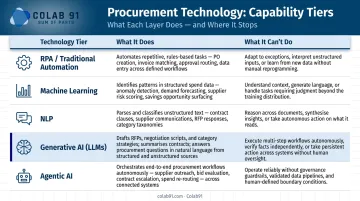
Generative AI—specifically large language models—sits in a different category from its predecessors. Unlike earlier tools, it doesn't need predefined rules or clean structured inputs. Put it in front of a 200-page supplier contract and it returns a flagged summary of non-standard clauses in minutes. Give it a three-sentence brief and it drafts a full RFP. Ask a natural-language question about regional spend and it answers directly, no data analyst required.
That breadth of capability is what makes the inflection point real.
Why 2026 Is the Inflection Year
The numbers reflect a genuine shift in organizational posture:
- 92% of CPOs were planning or assessing Gen AI capabilities in 2024, per Deloitte's CPO Survey
- 80% of global procurement leaders plan to deploy Gen AI within three years, per EY's 2025 Global CPO Survey
- Yet only 4% of procurement teams report large-scale deployment, per The Hackett Group
That 4% figure is the critical one. The technology has matured. The organizational barriers—data quality, talent gaps, governance frameworks—have not.
2026 is the year organizations that address those barriers structurally will pull ahead of those still running isolated pilots.
McKinsey's research on agentic AI in procurement points to 20–30% procurement staff efficiency gains in autonomous sourcing scenarios. These are case-based observations from early deployments, not projections. The gap between 4% scaled deployment and those efficiency gains is the business case for moving now.
Key Generative AI Use Cases Across the Source-to-Pay Lifecycle
Gen AI's value isn't confined to one function. Deloitte's CPO Survey identified spend analytics, RFP/RFQ generation, and contract review as the top three areas where early adopters are investing. Here's what each looks like in practice.
Spend Analytics and Category Intelligence
Most procurement teams still rely on manual reporting cycles and dashboard-dependent analytics. A category manager pulls a spend report, cleans the data, classifies it, and two weeks later has a view that's already stale.
Gen AI changes this dynamic in three concrete ways:
- Maps messy, uncategorized transaction data to UNSPSC or client-specific taxonomy without manual intervention
- Lets buyers query spend in plain language — "Which direct materials suppliers haven't been reviewed in 18 months?" — and get answers in seconds
- Surfaces consolidation opportunities, off-contract spend, and price anomalies across business units without custom analyst queries
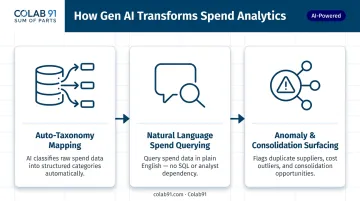
Deloitte found 38% of early adopters piloting or deploying Gen AI specifically for spend dashboards and analytics—the highest adoption rate of any source-to-pay use case.
Contract Lifecycle Management
Contracts are one of procurement's most persistent bottlenecks. Review cycles stretch for weeks. Obligations get missed. Non-standard clauses slip through manual review.
The technology cuts through that backlog by:
- Summarizing complex agreements across dozens of pages in minutes
- Extracting key obligations, termination clauses, and liability terms automatically
- Flagging deviations from standard contract language
- Accelerating approval workflows by reducing review time per contract
Gartner predicts that by 2027, 50% of organizations will support supplier contract negotiations through AI-enabled contract risk analysis and redlining tools. EY's 2025 survey shows CLM already ranks second among active Gen AI deployments in procurement at 19%.
Sourcing and RFP Automation
Gen AI compresses sourcing cycle times by handling the language-intensive work that slows most teams down:
- Drafting RFPs from informal internal requirements
- Scoring and comparing supplier responses against weighted evaluation criteria
- Auto-generating evaluation summaries with supplier-by-supplier commentary
- Simulating negotiation scenarios based on historical pricing and market data
The result: procurement teams run more sourcing events with the same headcount — or the same number of events with less.
Supplier Risk and Performance Management
Supplier risk monitoring is one of the areas where Gen AI delivers the clearest near-term value. Traditional approaches rely on periodic manual reviews—annual assessments, quarterly check-ins. By the time a risk surfaces, the exposure has often already materialized.
Continuous monitoring changes that equation. Gen AI tracks:
- Supplier financial health signals (credit, D&B data, public financial disclosures)
- Geopolitical and geographic concentration risk
- ESG compliance and regulatory risk
- News feeds and adverse event signals
Gen AI synthesizes these inputs into proactive risk alerts rather than periodic reports, giving procurement teams the ability to act before disruptions hit.
Taken together, these four use cases span the full source-to-pay cycle — and they share a common thread: replacing slow, manual, analyst-dependent work with decisions that happen in hours, not weeks.
The Business Case: Quantifying Gen AI's Value in Procurement
Three Value Pillars
The ROI case for Gen AI in procurement sits across three distinct value layers:
- Automation: Eliminates repetitive, manual workloads — data entry, report generation, contract drafting
- Augmentation: Gives buyers real-time intelligence that improves decision quality and speed
- Advisory: Moves procurement from cost-processing to a driver of business-wide cost decisions
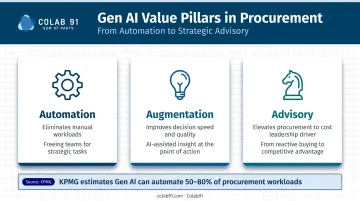
KPMG estimates Gen AI can automate, eliminate, or shift to self-service 50–80% of current procurement work. That's not a projection for 2035—it's KPMG's assessment of what current technology is capable of against today's procurement workloads.
What Early Adopters Are Seeing
The Hackett Group's research on early Gen AI adopters in procurement shows:
- 9.9% productivity improvement (weighted average across adopters)
- 9.5% effectiveness and quality improvement
- 20–30% staff efficiency gains in autonomous sourcing scenarios, with 1–3% incremental value capture (McKinsey)
These are conservative near-term figures from actual deployments, not long-range projections.
The Strategic Elevation Argument
As Gen AI absorbs transactional workload, procurement teams gain bandwidth for work that AI cannot replace: category strategy ownership, supplier innovation partnerships, and organization-wide cost leadership.
KPMG research involving 400 procurement and outsourcing executives found 96% had already made progress toward implementing Gen AI. For teams that haven't started, that number signals a widening gap — in cost efficiency, talent leverage, and sourcing speed — that compounds the longer adoption is delayed.
Why This Matters Especially for PE-Backed and Mid-Market Teams
For companies where procurement runs lean — 2 to 5 FTEs managing significant spend — Gen AI's ability to multiply output without multiplying headcount is the central argument. Higher spend coverage, faster sourcing cycles, and stronger contract compliance all follow. Each maps directly to the cost efficiency targets PE sponsors build into their value-creation plans.
The Adoption Gap: Why Most Gen AI Pilots Never Scale
The Numbers Behind the Gap
The Hackett Group data is stark: 49% of procurement teams have piloted Gen AI use cases. Only 4% report large-scale deployment.
MIT research reinforces the broader pattern—95% of enterprise Gen AI pilots generate zero measurable ROI. The organizations closing the pilot-to-scale gap aren't just more enthusiastic about AI. They've built different structural conditions for it to operate in.
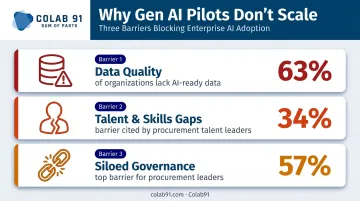
The Three Barriers That Actually Block Scale
1. Data quality
Gartner reports that 63% of organizations either lack, or are unsure they have, the right data management practices for AI—and predicts that through 2026, 60% of AI projects unsupported by AI-ready data will be abandoned.
Fragmented ERP systems, inconsistent spend taxonomy, and unclean supplier master data don't just slow Gen AI down. They make its outputs unreliable. A model that classifies spend incorrectly, or flags the wrong supplier as high-risk, erodes trust faster than it builds it.
2. Talent and skills gaps
Deloitte's 2025 CPO Survey identified talent gaps as a barrier for 34% of procurement leaders. The gap isn't just technical—it's interpretive. Teams need to know not just how to use AI outputs, but when to question them and where human judgment remains essential. Without deliberate training, those interpretive gaps persist even after the tools are deployed.
3. Siloed governance
Deloitte identifies siloed operations as the top barrier to procurement value delivery at 57%. Gen AI initiatives that sit inside a single team or business unit rarely generate the cross-functional data access and organizational alignment required to scale.
The Shadow AI Risk
Microsoft's Work Trend Index found that 78% of AI users bring their own AI tools to work. In procurement, this means supplier data, contract terms, and pricing information are entering personal AI accounts without organizational visibility or control.
The exposure goes beyond IP leakage. Inconsistent output quality and untracked compliance gaps accumulate into real liability. Governing AI tooling centrally isn't a technology preference; it's a prerequisite for operating safely at scale.
The Change Management Dimension
Gen AI implementation is not a technology project. It's a people and process transformation that requires three things to stick:
- AI literacy — teams understand what the technology can and cannot do
- AI adoption — workflows are redesigned around AI outputs, not bolted on top of existing processes
- AI-enabled transformation — procurement's role in the business evolves as AI handles more transactional work
Organizations that treat these layers as optional tend to find out they weren't. Tool deployment without process and capability change is what keeps most pilots from becoming anything more.
A Practical Adoption Roadmap for Mid-Market and PE-Backed Companies
Start With Problems, Not Tools
Before selecting any Gen AI platform or building custom capabilities, define two or three specific business outcomes you want to move. Examples:
- Improve spend classification accuracy from 60% to 90% in the top five indirect categories
- Reduce contract review cycle time from four weeks to one week
- Increase sourcing event throughput by 30% without adding headcount
These become the evaluation criteria for any Gen AI solution. McKinsey's guidance is direct: Gen AI in operations should be deployed as a digital transformation focused on the business challenge, not as a technology initiative in search of a problem.
Start with low-risk canonical use cases—spend analytics, contract summarization, RFP drafting—prove value in a bounded scope, then scale.
Build the Data Foundation Without Waiting for Perfection
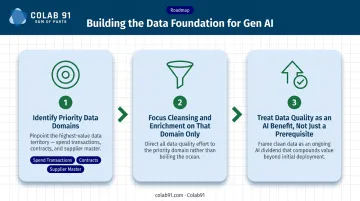
Data quality is the most cited blocker, but the wrong response is to delay Gen AI adoption until everything is clean. Instead:
- Identify the specific data domains required for your priority use case (spend transaction data for analytics; contract repository for CLM; supplier master data for risk monitoring)
- Focus cleansing and enrichment efforts there first—not across the entire data estate
- Treat data quality improvement as a benefit of AI implementation, not just a prerequisite
For mid-market companies without in-house procurement analytics talent, augmenting with offshore domain experts is a practical alternative to onshore hiring. Dedicated India-based practitioners (as Colab91 builds for PE-backed clients) can own data governance, spend classification, and AI-output validation at a fraction of the onshore cost.
The hybrid approach pairs AI-augmented spend analytics with human analyst judgment on category strategy and supplier dynamics, delivering weekly spend signals rather than quarterly PDF decks.
Define Governance Before Scaling
The organizations that scale Gen AI successfully establish governance early. For mid-market companies, this doesn't need to be complex:
- Designate an owner for Gen AI in procurement, typically the CPO or a senior category leader with IT alignment
- Establish an approved tools list with clear data-handling policies (what data can enter which tools, under what conditions)
- Define an output validation protocol : who reviews AI-generated contract summaries, RFP drafts, and supplier risk alerts before action is taken
- Secure dual sponsorship from the CPO and CIO to ensure procurement AI initiatives have both business and technology backing
Gartner advises CPOs to double down on data governance and incorporate privacy standards into supplier contracts as Gen AI affects procurement operations. That guidance applies whether you're running a three-person procurement team or a fifty-person function.
The goal isn't enterprise-grade complexity. A one-page policy, a named owner, and a defined review process are enough to start scaling without creating compliance exposure.
Frequently Asked Questions
How can generative AI be used in procurement?
Gen AI can draft and evaluate RFPs, summarize contracts and extract key risks, classify and analyze spend data, monitor supplier risk signals, and automate supplier communications. It handles language-intensive, data-heavy tasks across the full source-to-pay process—available on demand, without the bottlenecks of manual review cycles.
What is the difference between generative AI and traditional procurement automation?
Traditional automation follows fixed rules and requires structured data inputs. Gen AI reads and interprets unstructured content—contracts, emails, PDFs—generates new content like negotiation scripts or market summaries, and reasons through ambiguous scenarios without being explicitly programmed for each case.
Will generative AI replace procurement professionals?
Gen AI removes repetitive administrative work so professionals can focus on higher-value work: supplier strategy, risk management, and commercial negotiations. Organizations that upskill their teams to work alongside AI gain a real competitive edge over those that treat it as a headcount replacement.
What are the biggest challenges in adopting generative AI for procurement?
The three most cited barriers are poor data quality and fragmented systems that make AI outputs unreliable, skills gaps in validating and acting on AI recommendations, and weak governance structures that allow shadow AI usage while leaving organizations exposed to IP and compliance risks.
How should mid-market companies start with generative AI in procurement?
Anchor the effort in a specific, measurable business problem—spend classification accuracy or contract turnaround time are good starting points. Begin with a low-risk use case using existing data, and build governance before scaling. Access to specialist procurement analytics talent, whether in-house or through an offshore capability partner, is often what separates teams that scale from those that stall.
What procurement data do you need to implement generative AI successfully?
It depends on the use case: spend analytics needs clean, categorized transaction data; contract AI needs a structured repository of executed agreements; supplier risk tools need reliable supplier master data and third-party data feeds. Focus data preparation on the specific domain of your chosen use case rather than attempting a full data overhaul upfront.