According to Everest Group's research based on 496 enterprise interviews, attrition has become the single biggest pain point in technology service delivery. The failure mode is almost never bad talent - it's a bad build.
This guide covers the exact steps, prerequisites, and critical success variables for building a remote tech team that functions as a strategic asset, not just a cheaper headcount line.
Key Takeaways
- Choose your operating model before hiring anyone - structure drives outcomes
- Build in four stages: define the model, source strategically, onboard with structure, establish operational rhythms
- Prioritize role clarity, communication design, cultural integration, and outcome-based performance management
- Unstructured onboarding is the leading driver of first-year attrition - don't skip it
- India's 5.8 million-strong tech workforce specializes in data, cloud, and product engineering - but only structured builds capture that value
How to Build a Remote Tech Team: Step by Step
Step 1: Define Your Operating Model
Before sourcing a single candidate, decide what you're actually building.
Scope the functions first. Not every tech function belongs offshore. Strong candidates include:
- Software engineering (feature development, platform work)
- QA and test automation
- Data engineering and analytics
- DevOps and cloud infrastructure
Functions that typically require onshore proximity: product strategy, customer-facing technical roles, and anything requiring real-time regulatory judgment.
Then choose your delivery model. Three options exist, each with different trade-offs:
| Model | Control | Ramp Speed | Scalability |
|---|---|---|---|
| Dedicated Capability Center | High | Slower | High |
| Staff Augmentation | Low | Fast | Limited |
| Hybrid | Medium | Medium | Medium |
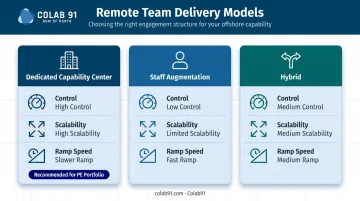
A dedicated capability center takes longer to stand up but builds institutional knowledge, team identity, and long-term retention. Staff augmentation fills seats quickly but produces no continuity. For PE-backed companies building durable tech capacity, the dedicated model wins - it's the only one that compounds over time.
Step 2: Source and Hire the Right Talent
Build a geography-specific sourcing strategy. India's tech workforce reached 5.8 million employees in 2025, with net hiring of 126,000 and 2.2% year-on-year growth, per NASSCOM's 2025 Strategic Review. For data and AI roles specifically, India ranked first globally in AI skill penetration and holds the second-largest AI/ML/Big Data talent pool, with over 416,000 professionals in the field.
English proficiency varies by function and city - important for cross-timezone collaboration. EF EPI 2025 scores for India's tech hubs: Bengaluru (569), Mumbai (570), Hyderabad (554), all well above the global average of 488. Screen at the candidate level, not the country level.
Screen for remote-readiness, not just technical skill. A deep talent pool means your screening criteria matter more, not less. Technical ability gets candidates to the interview - remote-readiness determines whether they'll actually perform. Build your scorecard around four dimensions:
- Ownership mindset - can self-direct without supervision
- Written communication quality - writes clearly, communicates with context
- Async discipline - documents proactively, doesn't create blockers by waiting
- Cross-timezone judgment - knows when to escalate vs. resolve independently
Use scenario-based interview questions tied to distributed dynamics: "Walk me through how you'd handle a blocker at 2pm your time when your US counterpart is offline until tomorrow morning."
Step 3: Onboard and Integrate
Standardize Day 1 before the hire logs in. On their first day, every offshore hire should already have:
- Full tool access provisioned
- Calendar invites to relevant standing meetings
- An assigned onboarding buddy
- A living handbook covering workflows, escalation paths, and communication norms
- A clear first-week schedule
The goal: zero ambiguity on Day 1. Every hour a new hire spends figuring out logistics is an hour they're not building context.
Run a structured 30-60-90 day plan. The integration arc should move deliberately:
- Days 1–30 (Orientation): Understand the codebase, architecture, team norms, and stakeholders. No major solo deliverables yet.
- Days 31–60 (Contribution): Paired delivery on real work. Regular check-ins. Explicit feedback loops.
- Days 61–90 (Ownership): Independent delivery. KPIs active. Integrated into sprint planning and team rituals.
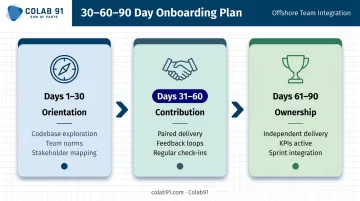
Skipping this structure doesn't save time - it costs it. Research cited by SHRM shows employees are 58% more likely to remain three years when onboarding is structured.
For remote tech hires, the stakes are higher. The informal feedback loops that help co-located hires self-correct simply don't exist offshore - structured onboarding is the substitute.
Step 4: Establish Operational Rhythms
Define sync vs. async explicitly. Without deliberate communication design, distributed teams default to one of two failure modes: over-meeting (Zoom fatigue, low throughput) or radio silence (misalignment, blockers unresolved for days). Atlassian's 2024 survey of 5,000 knowledge workers found that 78% feel meeting expectations prevent actual work and 72% consider most meetings ineffective.
A healthy weekly rhythm for an India-US team might look like:
- Monday: Async sprint kickoff notes shared before US morning standup (India evening)
- Tuesday/Thursday: 30-minute live sync in the overlap window (8–9am US Eastern / 6:30–7:30pm IST)
- Daily: Async status updates via shared project tool - blockers flagged, not saved for the next call
- Friday: Async retrospective notes; no live calls unless critical
Getting the rhythm right solves the communication side. The other half is knowing whether work is actually moving.
Build performance visibility from Day 1. Define output-based metrics before the team starts, not after the first sprint slips. Track delivery outcomes, not hours online:
- Sprint velocity - work completed per sprint (use within one team; don't compare across teams)
- Deployment frequency - how often code ships to production successfully
- Defect escape rate - bugs that reach production without being caught earlier in QA
- Change fail rate - deployments that cause production failures
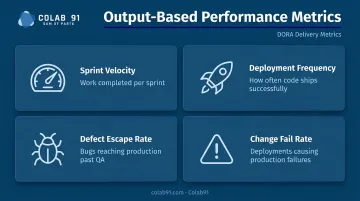
DORA's software delivery framework underpins these metrics, giving onshore leadership concrete delivery data without requiring daily status calls.
When Does Building a Remote Tech Team Make Strategic Sense?
This model isn't universally the right fit. The decision depends on scope, internal bandwidth, and timeline.
It makes sense when:
- You need to scale tech capacity without competing in a constrained local market (US software developer median wages hit $133,080 in May 2024, per BLS, with demand projected to grow much faster than average through 2034)
- You need specialized skills - particularly in data engineering, AI/ML, or cloud - that are scarce domestically
- You have enough scope to form a self-sufficient unit, typically five or more people, with defined work streams and a long enough runway to absorb the ramp
It underperforms when:
- The work demands constant in-person collaboration or real-time customer interaction
- Internal leadership lacks the bandwidth to manage a distributed team actively
- The project timeline is too compressed for a 3–6 month structured build
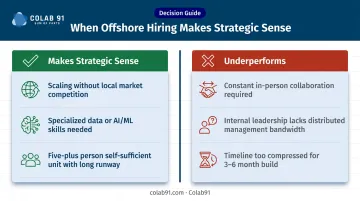
The conditions matter more than the headcount. A five-person team with clear scope and an engaged internal sponsor will outperform a larger team built reactively - every time. Before sizing or sourcing, get the fundamentals right first.
What You Need Before Building Your Remote Tech Team
Preparation quality determines how fast the team reaches full productivity. Most build failures trace back to readiness gaps, not talent gaps.
Organizational Readiness
Before hiring anyone, confirm:
- Executive ownership - a senior internal sponsor who will make decisions, remove blockers, and advocate for the team
- Defined scope - specific functions, deliverables, and a skills matrix tied to real work
- Daily point of contact - at least one internal person who interfaces with the offshore team every day
Without these three, even a well-hired team will drift. The offshore team can't self-correct if the onshore side is absent or ambiguous.
Infrastructure and Legal Readiness
Employment law, IP ownership clauses, and data security requirements vary significantly by country. Before the first hire starts:
- Collaboration tools provisioned and access-controlled
- IP protection clauses in employment contracts specific to India
- Secure remote access systems configured
- Employment compliance framework confirmed for the target geography
Entity ownership structure, IP rights, and strategic control need to be resolved before the engagement model is finalized - not retrofitted after hiring begins. Colab91 builds these decisions into the design phase for exactly this reason.
Talent Strategy Readiness
Have in place before you source:
- Compensation benchmarks for the India market (use Mercer, Aon/Radford, or WTW)
- A shortlist of hiring channels: local job platforms, referral networks, offshore partners
- A skills matrix tied directly to the defined operating model scope
Key Variables That Determine Remote Tech Team Success
Once the team is built, outcomes are shaped by a handful of controllable variables. Most underperforming remote teams fail at one of these - not at the hiring stage.
Role Clarity and Accountability
Remote team members cannot self-correct without explicit ownership. Ambiguity that's manageable in a co-located environment compounds in a distributed one. Undefined roles create duplication, blind spots, and interpersonal friction that erode cohesion faster than any technical gap.
Every team member needs a clear answer to: What do I own? What does success look like? Who do I go to when I'm blocked?
Communication Architecture
Design your sync vs. async framework before the team launches. Teams that define when to meet, when to message, and when to document consistently outperform those relying on informal norms.
Excess meetings are a measurable drag on distributed teams. For distributed engineering teams, async-first communication isn't a preference - it's a direct throughput decision (fewer interruptions, more focused delivery time).
Cultural Integration
Remote tech professionals who feel disconnected from the parent company's mission stop contributing strategically. They execute tasks, disengage gradually, and become easy targets for competing offers. Gallup's Q12 meta-analysis covering 100,000+ teams links high engagement to 23% higher profitability.
Intentional culture practices that move the needle:
- Shared team rituals (not just work meetings)
- Transparent decision-making with offshore team included
- Visible recognition in shared channels
- Career pathing that extends to the offshore team, not just onshore staff
Performance Management Framework
Without output-based metrics, managers either micromanage or assume everything is fine until a deadline slips. The solution is a dashboard of delivery outcomes:
- Deployment frequency - how often the team ships; a reliable throughput indicator
- Change lead time - time from code commit to production; measures delivery speed
- Defect escape rate - quality issues that reach production; catches process gaps early
- Sprint velocity - team-level capacity signal; never compare this across different teams
These metrics are useful - but only if treated carefully. ThoughtWorks (the global technology consultancy) has observed that once a metric like story points becomes a target, teams find ways to optimise for the number rather than the outcome. Pair your quantitative dashboard with qualitative signals: code review quality, stakeholder feedback, and how frequently the team surfaces blockers without being prompted.
Common Mistakes That Derail Remote Tech Teams
Treating hiring as a staffing transaction. Picking the cheapest available resource without designing team structure, operating model, or career path produces transactional results and high turnover. Retention requires intentional design from day one.
Skipping structured onboarding. Assuming distributed hires will "figure it out" without a formal integration plan is one of the most expensive mistakes in remote team management. Unstructured onboarding typically doubles ramp time and is a leading driver of first-year attrition. The first 44 days after a hire are the highest-leverage window for retention, per BambooHR's 2024 State of HR research.
Building without communication discipline. Launching a team with no async norms, no documentation culture, and no defined meeting cadence leaves the team running on reactive threads and misaligned assumptions rather than coherent delivery cycles.
Going it alone without prior experience. For companies building their first offshore tech team, the learning curve is steep and early structural mistakes are expensive. The Colab91 leadership team built and scaled multifunctional offshore organizations to 100+ practitioners during their time at Impendi, later acquired by Accenture, with clients including Carlyle Group and TPG portfolio companies.
That experience across operating model design, talent sourcing, and performance architecture compresses the build timeline and reduces the risk of costly early missteps.
Frequently Asked Questions
Frequently Asked Questions
How do you build a successful remote tech team?
Four systems need to work together: a deliberate operating model chosen before hiring, strategic talent sourcing with remote-readiness screening, structured onboarding with a 30-60-90 day plan, and performance management tied to delivery outcomes. Each one reinforces the others - gaps in any single system will show up in team performance.
What qualities should I look for when hiring remote tech talent?
Beyond technical skill, three qualities matter most: ownership mindset (self-directs without supervision), async communication discipline (writes clearly, documents proactively), and adaptability to cross-timezone collaboration. Screen these through scenario-based interview questions, not self-report.
How do you manage time zone differences in a distributed tech team?
Design a 2–4 hour overlap window for real-time collaboration and default to async for everything else. India-US teams can achieve workable overlap around 8–9am US Eastern / 6:30–7:30pm IST. The key is making async the default protocol, not the fallback.
How long does it take to build and onboard a remote tech team?
A typical build-to-productivity timeline runs 3–6 months: 4–8 weeks for sourcing and hiring, and 60–90 days for structured onboarding to full contribution. Timelines compress significantly with experienced partners and pre-built infrastructure already in place.
What's the difference between staff augmentation and a dedicated remote tech team?
Staff augmentation fills individual seats on a short-term basis - no team identity, no institutional knowledge, no strategic continuity. A dedicated capability center is built to grow, retain knowledge, and function as a long-term extension of the business. Past the six-month mark, the gap between the two models becomes difficult to ignore.
How do you maintain accountability without micromanaging?
Replace activity tracking with outcome-based metrics. Define deliverables clearly, set sprint-level or quarterly KPIs tied to business outcomes, and use regular structured check-ins to surface blockers early - not to monitor behavior. Visibility into outputs builds accountability. Monitoring inputs breeds resentment.