Introduction
Most companies scaling a remote team make the same mistake: they treat headcount growth as a proxy for capability growth. Hire more people, the thinking goes, and you'll get more done. What actually happens is the opposite.
Research from Bain and HBR found that a single weekly executive committee meeting can consume up to 300,000 hours annually when cascaded prep and related meetings are included. Add offshore headcount without a structured operating model, and that coordination cost doesn't just grow — it compounds.
For mid-market and PE-backed companies under pressure to deliver value quickly, this isn't an abstract risk. Limited management bandwidth means every hour spent managing misalignment is an hour not spent on growth. Scaling a remote team successfully requires deliberate architecture: a clear operating model, defined ownership, and systems that hold together at 50 people the same way they held together at 10.
This article covers:
- How to assess readiness before hiring
- Which operating model fits your situation
- How to acquire and onboard talent at scale
- How to measure performance in distributed teams
Key Takeaways
- Scaling headcount without an operating model produces compounding misalignment, not growth.
- Documented workflows and clear ownership must exist before your first new hire.
- Choosing between distributed, hub-and-spoke, or capability center models is your most consequential structural decision.
- Autonomy and domain expertise are stronger predictors of remote performance than tenure.
- Output-based KPIs and structured weekly check-ins sustain performance as headcount scales.
Why Scaling Remote Teams Without a Strategy Breaks Down
Early-stage remote teams run on informal systems: Slack pings to the right person, tribal knowledge passed through quick calls, and easy access to senior leaders who fill gaps on the fly. These systems work surprisingly well — until they don't.
The failure point is predictable. Once headcount crosses a critical threshold, the informal scaffolding collapses. The person who "just knew" how things worked is now three layers removed from new hires. The senior leader who answered every question is now overloaded. And no one has written anything down.
The Compounding Misalignment Problem
Unclear role ownership doesn't just create confusion — it multiplies. Consider a procurement function scaling from five to twenty analysts. At five people, everyone knows who owns supplier negotiations, who handles spend classification, and who escalates contract issues.
At twenty, those informal handoffs become missed deliverables. Two analysts duplicate the same spend categorization work. A sourcing deadline slips because no one was clearly responsible for the final approval step.
Each misalignment creates downstream delays that erode output quality. Declining quality then pulls senior leaders back into execution work — precisely the management bandwidth mid-market companies can least afford to lose.
Adding headcount is a cost; scaling capability is an investment. Companies with value creation mandates need the second, but frequently get only the first.
Downstream Signals of a Broken Scaling Approach
Watch for these symptoms before they become structural problems:
- Onboarding time is rising with each new hire cohort
- Output quality varies significantly across team members doing the same work
- Senior staff are routinely doing work that belongs one level below them
- Early attrition is climbing — HBR research found up to 20% of staff turnover occurs within the first 45 days
- New hires keep asking the same questions that no one has documented
These aren't individual performance issues. They're operating model failures.
Assessing Your Readiness to Scale Your Remote Team
Before making a single new hire, three operational signals should confirm you're genuinely ready to scale — not just under pressure to grow.
You're ready when:
- The core team is consistently turning down work or missing SLAs due to capacity, not quality issues
- New hires keep asking the same questions, signaling that undocumented tribal knowledge exists and needs capturing
- Senior staff are regularly doing work that belongs one level below them
If those conditions aren't present, adding headcount will accelerate dysfunction, not output.
Minimum Viable Infrastructure Before Hiring
Three things must exist before you add remote headcount:
- Every recurring process written down in a shared, searchable system (documented SOPs, not mental models)
- An org chart with explicit ownership of decisions and deliverables — titles alone don't count
- At least one defined success metric per function, so new hires know what "done well" looks like from day one
NASSCOM and Zinnov's research on mid-market capability centers identifies the absence of standardized operating procedures as the most common gap that derails offshore scaling for smaller companies. It's also the most avoidable failure.
Onshore, Offshore, or Hybrid?
The model you choose before hiring determines cost structure, control, and scalability for years. Four factors should drive that decision:
- What's the total cost of the function today — and what does the target cost structure look like?
- Can the work be structured and documented, or does it require deep institutional knowledge to execute?
- Does the role need real-time collaboration, or can it run async with defined overlap windows?
- How much strategic oversight does the onshore team need to retain day-to-day?
A hybrid model chosen too early — or an offshore model deployed without the right overlap design — can lock in a cost and control structure that's difficult to reverse once headcount scales past 20 FTEs.
Building the Right Operating Model for Your Remote Team
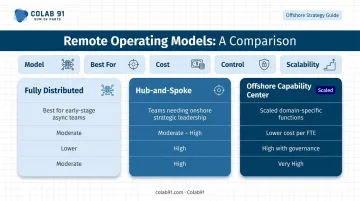
Three primary structural models are available to growing companies, each with distinct trade-offs:
| Model | Best For | Cost | Control | Scalability |
|---|---|---|---|---|
| Fully Distributed | Early-stage, async-native teams | Moderate | Lower | Moderate |
| Hub-and-Spoke | Teams needing onshore strategic leadership | Moderate-High | High | High |
| Offshore Capability Center | Scaled, domain-specific functions | Lower per FTE | High (with governance) | Very High |
What Distinguishes a Capability Center from Traditional Outsourcing
Traditional outsourcing delivers transactional labor. A vendor provides resources, manages them at arm's length, and replaces them when they leave — institutional knowledge evaporates with every departure.
A capability center operates differently. It embeds domain expertise within a dedicated, structured team that functions as a strategic extension of the onshore operation. Culture, process, and intellectual property scale alongside headcount.
India's GCC ecosystem illustrates the scale this model has reached: over 1,700 Global Capability Centers now operate in India, employing 1.9 million professionals and generating $64.6 billion in FY24 revenue. Critically, mid-market firms are now a primary growth driver — 480+ mid-market GCCs with 210,000+ employees, with 45+ new mid-market setups in the past two years alone.
Governance That Doesn't Bottleneck at the CEO
Any hub-and-spoke or capability center model requires four governance elements to function:
- Assign named onshore relationship owners to translate strategy into offshore execution priorities
- Define SLAs with measurable output commitments per function
- Set a regular operating review cadence: weekly for tactical alignment, monthly for performance, quarterly for team health
- Build escalation protocols that resolve at the function level, not the CEO level
Colab91 builds India-based capability centers on this governance structure, blending onshore strategic leadership with offshore domain expertise in procurement and analytics. The leadership team previously scaled a multifunctional organization to 100+ practitioners serving Carlyle Group, TPG, Elliott, and BC Partners through Impendi (later acquired by Accenture).
Time Zone Management as a Design Decision
Treat time zone overlap as an architectural choice, not a scheduling inconvenience:
- Define required overlap hours before hiring (typically 3-4 hours of shared working window)
- Default to async-first for all non-urgent communication
- Reserve synchronous windows for decisions and alignment, not status updates
- Build this into job descriptions and role expectations from day one
Talent Acquisition and Onboarding at Scale
Role profiles for distributed teams must go beyond technical qualifications. For remote work specifically, three traits predict performance better than years of experience:
- Self-direction: Can this person move work forward without constant check-ins?
- Written communication clarity: Can they communicate context and decisions clearly in text?
- Comfort with ambiguity: Can they make reasonable decisions when the answer isn't obvious?
Structured Remote Interviewing
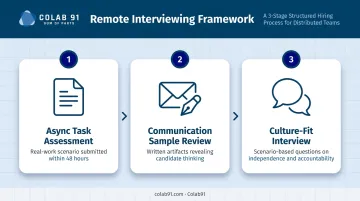
A reliable screening framework for distributed roles includes:
- Async task assessment — a real-work scenario with written instructions, submitted within 48 hours, that tests both domain competence and communication quality
- Communication sample review — written artifacts (emails, memos, analysis summaries) that reveal how the candidate thinks in text
- Structured culture-fit interview — scenario-based questions probing independence, accountability, and how the candidate handles unclear direction
Why India's Talent Pool Changes the Equation
For mid-market companies, onshore hiring for specialized functions like procurement analytics or spend intelligence is often cost-prohibitive. The talent exists, but the market is thin and expensive.
India's professional workforce opens a different market entirely. India's technology workforce reached 5.80 million in FY25, with net new employee growth of 126,000 year-over-year. The country contributes 28% of global STEM talent and 23% of global software engineering talent.
For analytics, finance, and procurement specifically, the depth has expanded well beyond basic accounting. GCC finance roles now span fund accounting, treasury management, and business partnering — domain expertise that was previously only accessible at enterprise scale.
For mid-market companies, offshore hiring for these functions means reaching a talent market that onshore budgets simply cannot unlock.
Onboarding Design for Distributed Teams
Once you've sourced the right people, keeping them comes down to onboarding. Poor onboarding is the most common driver of early attrition in remote teams.
Microsoft's onboarding research found that new hires with more than eight buddy interactions in the first 90 days reported feeling productive at a rate of 97%, compared to just 56% for those with a single interaction.
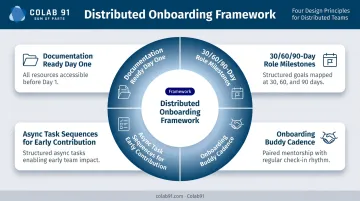
Design onboarding around these principles:
- Documentation available from day one — no hunting for basics, no waiting on a manager
- Role-specific 30/60/90-day milestones so new hires understand what success looks like at each stage
- Onboarding buddies with structured interaction cadences, not ad hoc check-ins
- Async task sequences that produce real contribution in the first two weeks without consuming manager time
Colab91's capability center setup covers talent sourcing, vetting, and onboarding infrastructure for domain-specific roles across procurement, analytics, and operations — developed through 16+ years of scaling offshore organizations for clients like Carlyle Group, TPG, and Pediatric Associates.
Communication Systems and Culture That Scale With You
Async-first architecture is a design decision, not a tool preference. Get it wrong and coordination overhead scales faster than your team does.
Assign communication types to channels deliberately:
- Decisions and documentation → Notion, Confluence, or equivalent shared system
- Urgent exceptions → Chat (Slack, Teams) with defined response windows
- Strategic alignment → Scheduled video calls with pre-read materials distributed 24 hours in advance
The rule is simple: if it's worth communicating, it's worth documenting. Every recurring process, key decision, and lesson learned belongs in a shared, searchable system.
Documentation as a Leadership Behavior
This is where most distributed teams fail. They treat documentation as an administrative task delegated to junior staff — not a leadership behavior.
Documentation culture flows from the top. When senior leaders model it — writing up decisions, capturing context, building searchable knowledge — new hires adopt it. When they don't, the team reverts to Slack and tribal knowledge.
McKinsey's 2022 research found that 80% of executives were reconsidering their meeting structure and cadence, with time savings as the primary motivation. A well-documented async culture is the single most effective way to reclaim that time.
Retention and Psychological Safety at Distributed Scale
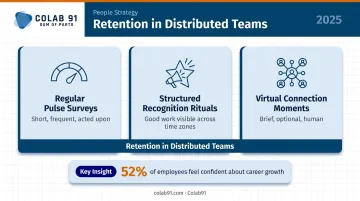
Isolation drives attrition in offshore and remote teams — not compensation alone. Build retention through:
- Regular pulse surveys (short, frequent, and acted upon — not annual)
- Structured recognition rituals that make good work visible across time zones
- Deliberate virtual connection moments — brief, optional, human — not mandatory team-building exercises
Deloitte's workforce research found that only 52% of employees feel confident about career growth at their organization. In distributed teams, that uncertainty amplifies when people feel invisible. Consistent feedback and visible career paths are retention tools, not HR formalities.
Measuring Performance and Adapting as You Grow
Activity-based metrics — hours logged, meetings attended, messages sent — tell you very little about what a distributed team actually produces. Output is the only measure that matters.
Output KPIs for Procurement and Analytics Functions
For procurement teams, track:
- Achieved savings rate: Percentage of targeted savings delivered across active sourcing events
- Spend under management: Share of total procurement spend controlled by the function (a direct measure of team scope and influence)
- SLA adherence: Deliverables completed on time against committed turnaround windows
For analytics teams, track:
- Spend analytics coverage: Percentage of total spend classified and enriched in the spend cube
- Deliverable completion rate: Weekly/monthly analysis packages delivered against schedule
- Insight-to-action rate: Recommendations from the analytics team that result in a documented business decision
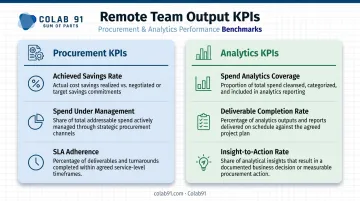
Tracking these metrics keeps performance visible and gives offshore teams clear accountability anchors without defaulting to micromanagement.
Feedback Loop Cadence
Sustain performance at scale through three distinct feedback rhythms:
- Weekly team-level check-ins — tactical alignment on priorities, blockers, and near-term deliverables
- Monthly manager-to-direct-report conversations — development-focused, not status-focused
- Quarterly operating reviews — team-level health assessment covering output quality, attrition signals, and onboarding velocity against growth targets
Feedback cadences surface trends over time. When those trends turn negative, the response has to match the source of the problem.
Recalibration Triggers
Individual performance management is not the right response to systemic problems. These signals should prompt a leadership review of operating model design:
- Rising unplanned attrition concentrated in specific functions or tenure cohorts
- Declining output velocity despite stable headcount
- Repeated escalations on the same categories of issues (handoff gaps, unclear ownership, rework cycles)
When these patterns appear, the operating model needs recalibration. Coaching individuals will not fix a structural design problem.
Frequently Asked Questions
What is the biggest challenge when scaling a remote team?
The most common challenge is the breakdown of informal systems that worked at small scale — undocumented processes, unclear ownership, and over-reliance on senior leader availability. As headcount grows, these gaps compound into misalignment, slower delivery cycles, and rising attrition.
What is the difference between an offshore capability center and a traditional remote team?
A capability center is a dedicated, structured function with embedded domain expertise, defined governance, and institutionalized processes. A traditional remote team is typically a collection of distributed individuals. The former scales culture and knowledge alongside headcount; the latter rarely does.
When is the right time to scale your remote team?
The right time is when the core team is consistently at capacity, key processes are documented, and there is a defined success metric for the new function. Scaling before this baseline is in place amplifies dysfunction, not output.
How do you maintain accountability in a large distributed team?
Accountability in distributed teams comes from output-based KPIs, explicitly documented role ownership, and regular operating reviews that make performance visible. Surveillance and activity tracking are poor substitutes for clarity of ownership.
How do PE-backed companies typically approach remote team scaling?
PE-backed companies prioritise speed-to-scale and cost efficiency, making offshore capability centers a natural fit. India-based centers allow rapid headcount growth in domain-specific functions like analytics and procurement while preserving strategic control onshore. Major PE firms including KKR, Blackstone, and Warburg Pincus are actively pushing portfolio companies to establish India GCCs — with such investments estimated to have grown fourfold over the past five years.