
Introduction
Most procurement leaders will tell you their function is "going digital." Fewer can tell you what that actually means for their organization today — or show a roadmap for getting there.
That gap between ambition and execution is sharpest in mid-market and PE-backed companies. These organizations carry a specific combination of pressures: limited internal resources, a talent gap in procurement analytics, and fragmented legacy processes that slow decision-making.
Sponsors expect measurable ROI within a 3-5 year investment horizon. Building from scratch isn't feasible. Standing still isn't either.
The data confirms what most procurement leaders already sense. According to Deloitte's 2025 Global CPO Survey, the four most commonly cited barriers to procurement value delivery are siloed operations (57%), competing priorities (46%), technology capability gaps (40%), and talent gaps (34%). Each of these is a structural problem — one that technology alone won't fix.
This article introduces a five-pillar framework for digital procurement transformation — an interdependent system designed to be sequenced deliberately, not implemented all at once. The core argument is straightforward: capability sequencing determines outcomes far more than tool selection does.
Key Takeaways
- Unified spend visibility is the non-negotiable foundation — every downstream initiative depends on it
- P2P automation frees procurement teams from transactional work, creating capacity for category strategy and supplier development
- Strategic sourcing and supplier risk management require the analytics foundation to be in place first
- Governance and change management determine outcomes: 70% of digital transformations fail without them
- Mid-market companies can close the talent gap faster by augmenting lean internal teams with specialized offshore expertise
What Is Digital Procurement Transformation?
Digital procurement transformation is the shift from transactional, manual purchasing to technology-enabled, data-driven procurement operations. Routine processes — requisition, approval, matching, payment — become automated. Procurement professionals shift their focus to supplier risk, demand shaping, and business value creation.
The most common misconception is that transformation means collecting platforms. It doesn't. The goal is an environment where business users execute compliant purchases within guardrails, and procurement becomes a strategic advisor rather than a gatekeeper or approver.
Why the Urgency Is Now
Hackett Group research shows 64% of procurement executives expect generative AI to fundamentally change how their teams operate within five years — yet most mid-market organizations are still wrestling with basic spend visibility. The financial divergence is already visible:
- Digital Masters (per Deloitte) allocate up to 24% of procurement budgets to technology — nearly double the 2023 rate
- Those same leaders are achieving 3.2x returns on AI investments, versus just above 1.5x for organizations that lag behind
- The gap widens each year that foundational visibility and automation remain unaddressed
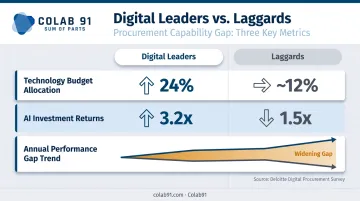
That performance gap is where PE sponsors and executive leadership are focused. Procurement has become a measurable value lever, and boards are demanding proof of it.
The Five Pillars of Digital Procurement Transformation
Before walking through the pillars individually, one structural point matters: these five areas form an interdependent system, not a sequential project plan. Most transformation failures happen because organizations attempt Pillars 3-5 before establishing Pillars 1-2. Strategic sourcing built on dirty data produces flawed negotiations. Supplier risk management without spend context misses concentration exposure. Governance without a functioning foundation has nothing to govern.
The sequence matters.
Pillar 1: Spend Visibility and Analytics Foundation
Clean, categorized spend data is the prerequisite for everything else. Without reliable visibility into what is being spent, with whom, and against what contracts, all downstream automation and sourcing efforts are built on unstable ground.
What a strong analytics foundation looks like:
- Spend classified by category, business unit, and supplier against a consistent taxonomy (UNSPSC or client-specific)
- Supplier consolidation insights identifying fragmentation and concentration risk
- Off-contract spend detection and tail-spend visibility
- Real-time dashboards that surface savings opportunities, compliance gaps, and anomalies
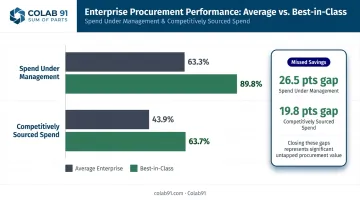
The gap between average and best-in-class is significant here. Ardent Partners reports average enterprise spend under management at 63.3%, while best-in-class procurement organizations manage 89.8% of spend. Best-in-class organizations also competitively source 63.7% of addressable spend versus 43.9% for all others — a gap that translates directly into captured versus missed savings.
The practical shift is moving from spreadsheet-based spend reporting to category-level dashboards that procurement leaders can act on weekly, not quarterly. Colab91's Savings Opportunity Assessment builds this foundation within 4-6 weeks, typically surfacing 5-15% of addressable spend as quantified savings opportunities before any sourcing activity begins.
Pillar 2: Process Automation and Digital Workflows (P2P)
Procure-to-pay (P2P) automation is the operational engine of a digitally transformed procurement function. It covers the full transactional cycle: automated purchase requisitions, approval routing, PO creation, three-way invoice matching, and payment processing.
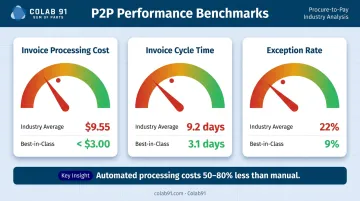
The business case for P2P automation is straightforward. Ardent Partners' 2025 AP benchmarks show the average cost to process a single invoice is $9.55, with an average cycle time of 9.2 days and an exception rate of 22%. Best-in-class organizations process invoices in 3.1 days at a 9% exception rate. Automated invoice processing costs 50-80% less than manual, paper-based approaches.
What P2P automation actually delivers:
- Policy compliance enforced at the point of purchase, not discovered in an audit
- Cycle time compression that improves supplier relationships and early-payment discount capture
- Reduced manual exception handling, freeing analyst time for category work
- Clean transactional data that feeds the spend analytics layer from Pillar 1
The strategic payoff is bandwidth. When procurement teams aren't processing invoices, chasing approvals, or reconciling mismatches, they have capacity for category management, supplier engagement, and strategic sourcing. That shift — from transactional execution to proactive value creation — is precisely what Pillar 3 requires to work.
Pillar 3: Strategic Sourcing Enablement (S2C)
Source-to-Contract (S2C) capabilities cover the upstream side of procurement: digital RFP and e-sourcing events, structured negotiation workflows, supplier evaluation frameworks, and contract lifecycle management. This is where procurement shifts from reactive buying to proactive value creation.
McKinsey notes that external spend typically represents 50-80% of a company's cost base, framing strategic sourcing as one of the highest-leverage interventions available to any management team. Yet most mid-market organizations run sourcing events inconsistently, without structured tools, against spend data they don't fully trust.
Without the analytics foundation from Pillar 1, sourcing decisions become guesswork: which categories to prioritize, which suppliers to challenge, what market benchmarks are actually achievable. Spend visibility is what makes those calls credible rather than approximate.
When properly sequenced, S2C capabilities change procurement's relationship with the business. Category managers run structured events rather than fielding ad-hoc supplier conversations. Contracts get negotiated against benchmarks, not against last year's pricing. Renewal dates get managed proactively rather than discovered after auto-renewals trigger.
Pillar 4: Supplier Relationship and Risk Management
Supplier relationship management (SRM) at its most basic is vendor tracking. Done well, it becomes structured performance management, supplier segmentation by strategic importance, and proactive risk monitoring before disruptions reach operations.
The frequency of supply chain disruptions makes this non-optional. Resilinc's 2024 data shows supply chain disruptions increased 38% year over year, with factory fires remaining the top disruption type for the sixth consecutive year. The Business Continuity Institute found 11.5% of organizations experienced more than 10 disruptions, more than double the pre-pandemic level of 4.8%.
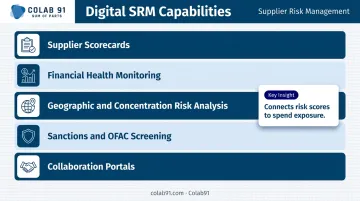
Digital SRM capabilities that address this:
- Supplier scorecards tracking delivery, quality, and compliance performance
- Financial health monitoring (D&B signals, credit scores, public indicators)
- Geographic and concentration risk analysis
- Sanctions and OFAC screening
- Collaboration portals for supplier development conversations
Colab91's Supplier Risk Management platform provides continuous monitoring across all these dimensions, connecting risk scores directly to spend exposure so procurement leaders can prioritize mitigation based on actual financial impact, not just supplier size.
The data trail this builds also creates leverage. Documented supplier performance gives procurement teams a stronger negotiating position at renewal, and it informs the sourcing decisions being made in Pillar 3.
Pillar 5: Governance, Change Management, and User Adoption
This pillar is the most commonly underinvested and the most common cause of transformation failure. Organizations budget heavily on technology and minimally on governance and change management, then find adoption rates low and tools effectively abandoned within 18 months.
The numbers are unambiguous. Prosci and McKinsey both cite a 70% failure rate for digital transformations, with change-management gaps as a leading cause. Gartner's 2024 survey found only 48% of digital initiatives meet or exceed business outcome targets.
What strong governance looks like in practice:
- A cross-functional governance committee — not just procurement — with executive sponsorship
- KPIs tied to business outcomes (cost savings, cycle time, spend under management, compliance rate), reviewed quarterly
- Ongoing fitness-for-purpose reviews of tools, not a set-and-forget technology posture
- A structured change management program focused on how stakeholders think about their role, not just how to click through a new system
The underlying logic: technology changes faster than organizations do. Adoption drives data quality. Data quality drives the insights that justify the transformation investment. When adoption fails, the entire ROI case collapses — not because the technology was wrong, but because the people-side wasn't resourced to match.
Common Pitfalls That Derail Digital Procurement Transformation
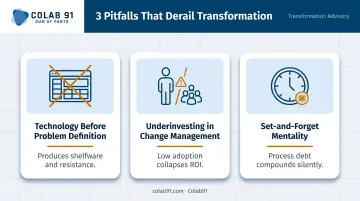
Three patterns appear consistently in failed transformations:
Technology before problem definition. Solution-first thinking produces expensive shelfware and organizational resistance. Starting with a specific pain point — then selecting the right tool — consistently outperforms platform-led approaches. The discipline of scoping the problem first is harder than it sounds when vendors are actively selling.
Underinvesting in change management. The ratio of technology spend to change management spend is often backwards in unsuccessful transformations. Adoption is what converts a platform investment into procurement intelligence — without structured adoption programs, tools become optional, and optional tools get ignored.
The set-and-forget mentality. Digital procurement is dynamic. A platform that was fit-for-purpose two years ago may now be constraining the function rather than enabling it. Without ongoing governance review, organizations keep paying for tools they've outgrown while letting process debt compound quietly in the background.
Building the Right Team and Operating Model
Most mid-market companies sit somewhere between centralized and center-led procurement operating models — and they're stuck there not because the model is wrong, but because they lack the internal talent to advance. Building deep in-house expertise across spend analytics, category management, sourcing execution, and supplier risk management takes years and significant investment.
For PE-backed companies with a 3-5 year investment horizon, that timeline doesn't work.
The Talent Gap Reality
Deloitte's 2025 CPO Survey identifies the talent gap as a major obstacle for 34% of CPOs. The skills in shortest supply — procurement analytics, digital tools fluency, category strategy — are exactly the skills that digital transformation requires most. And they're the hardest to recruit quickly into mid-market organizations competing against larger enterprises for the same talent.
The "Sum of Parts" Alternative
Colab91's model addresses this directly through what the firm calls the "Sum of Parts" approach: augmenting a lean internal procurement leadership team with specialized India-based domain expertise, rather than building everything in-house from scratch.
In practice, this means deploying dedicated offshore practitioners — spend analysts, category managers, strategic sourcing specialists, supplier risk analysts — who function as extensions of the client's procurement team. Internal leadership maintains strategic control and organizational alignment.
Offshore teams handle the execution-intensive work:
- Spend cube construction and ongoing analytics
- RFP management and sourcing execution
- Supplier scorecarding and risk tracking
- Contract management and compliance monitoring
What to look for when building or augmenting a procurement transformation team:
- Domain expertise in the specific spend categories and industries relevant to your business
- Experience operating within PE-backed environments where speed and measurability are non-negotiable
- Practitioners who can move from strategic advice to hands-on execution without losing altitude
- A delivery model that maintains client ownership of strategy and data
That human capability is what separates the leaders from the laggards. Deloitte's research shows Digital Masters outperform followers in cost savings (96% vs. 80%) and innovation enablement (56% vs. 24%). The technology exists across the board — what differs is the team operating it.
Your Digital Procurement Transformation Roadmap: Where to Start
Step 1: Start With an Honest Maturity Assessment
Before selecting any technology or launching any initiative, audit what you have. Map existing workflows for bottlenecks. Assess data quality and completeness. Identify where human effort is being consumed by work that should be automated. This baseline is the foundation for a credible business case — and it prevents you from buying solutions to problems you haven't accurately diagnosed.
Step 2: Pick a Narrow First Use Case
Broad platform rollouts that take 18 months to show value destroy momentum and erode organizational trust. Start narrow. A focused first win builds credibility faster and creates the proof of concept that justifies investment in subsequent pillars.
Good candidates for that first win:
- Automating a specific approval workflow
- Building a spend visibility dashboard for one business unit
- Running a structured sourcing event for one category
Step 3: Build Your Business Case on Measurable Metrics
Metrics worth tracking from the start:
- Spend under management (% of total)
- Invoice cycle time and exception rate
- Compliance rate (on-contract vs. off-contract spend)
- Category-level cost savings versus benchmark
Avoid building ROI cases on optimistic projections. When actuals fall short of inflated promises, trust erodes — and trust is what procurement needs from business stakeholders to sustain adoption and unlock the next phase of investment.
Hackett Group benchmarks show Digital World Class procurement functions operate with 32% fewer FTEs, 23% shorter cycle times, and 21% lower costs than peers. These are realistic targets for what a mature digital procurement function can achieve — not starting-line expectations.
Step 4: Sequence Across the Five Pillars
- Foundation first: Spend analytics and basic P2P workflow automation
- Layer next: Strategic sourcing and supplier relationship management
- Continuous thread: Governance and change management from day one, not as a final step
Step 5: Treat Transformation as an Ongoing Discipline
Set a quarterly governance cadence to review tool fitness, track KPIs against targets, and surface friction from business stakeholders before it becomes resistance. The functions that sustain gains are those that treat this cadence as standing operating procedure, not a one-time check-in.
Frequently Asked Questions
What is digital procurement transformation?
Digital procurement transformation is the shift from manual, transactional purchasing to technology-enabled, data-driven procurement operations. It encompasses people, process, and technology changes — not just software implementation — enabling procurement to act as a strategic business advisor rather than an operational gatekeeper.
What are the main components of digital procurement transformation?
The five core components are spend visibility and analytics, P2P process automation, strategic sourcing enablement (S2C), supplier relationship and risk management, and governance with change management. Successful transformation addresses all five in sequence, with analytics as the non-negotiable foundation.
What's the difference between P2P and S2P in procurement?
P2P (Procure-to-Pay) covers the operational purchasing cycle from requisition through payment. S2P (Source-to-Pay) is the broader end-to-end process that also includes strategic sourcing, supplier selection, and contract management upstream of the buying transaction — effectively combining S2C and P2P into one continuous process.
How long does digital procurement transformation typically take?
Focused first wins from well-scoped use cases can be achieved in 3-6 months. Building a fully mature, technology-enabled procurement function typically unfolds over 2-4 years of phased implementation — there is no fixed finish line.
What are the biggest challenges in digital procurement transformation?
Three failure points account for most stalled transformations:
- Poor change management and low user adoption
- Insufficient investment in data quality and spend visibility as a foundation
- The talent gap in procurement analytics — especially acute for mid-market organizations without large in-house teams
How does AI fit into a digital procurement transformation strategy?
AI works best as a capability layered on top of a solid digital foundation, not pursued as a standalone initiative. It adds real value in spend pattern analysis, risk detection, demand forecasting, and contract intelligence — but only once the underlying data infrastructure and governance from the core five pillars are in place.