Introduction
Most companies launch offshore teams with reasonable expectations: cost savings, added capacity, and access to domain expertise across time zones. What they don't anticipate is how quickly those expectations collide with reality.
The talent is often there. The problem is almost never the people. It's the management architecture around them.
A 2020 study reviewing 117 offshore software outsourcing research papers found that 40% of offshored projects fail to realize expected benefits-with requirements errors, deferred communication, and lack of trust cited as the dominant failure mechanisms. These aren't talent problems. They're structural ones.
For mid-market and PE-backed companies, the stakes are higher. There's less margin for a slow ramp, and offshore teams need to deliver measurable value fast. Poor management doesn't just slow things down. It compounds, quietly, into dysfunction that's expensive to unwind.
This guide covers the foundational decisions, communication rhythms, and accountability structures that separate high-performing offshore teams from underperforming ones. The frameworks here draw on Colab91's direct experience designing and scaling offshore capability centers - including building Impendi's India operations to 100+ practitioners serving clients like Carlyle Group and TPG - across procurement, analytics, and technology.
Key Takeaways
- Offshore team failures trace back to structural problems-unclear ownership, misaligned expectations, poor metrics-not the talent you hired
- Operating model design must happen before hiring, not after
- Structured, proactive communication beats reactive check-ins every time
- KPIs should measure outcomes, not activity
- Culture is built through inclusion, not proximity
What Makes Managing Offshore Teams So Difficult
Distance and time zones get blamed, but they're symptoms, not causes. The real problem runs deeper: misaligned expectations create unclear ownership, unclear ownership produces communication gaps, and those gaps quietly turn small problems into systemic ones.
The Three Most Common Failure Modes
Across procurement, analytics, and technology engagements with mid-market and PE-backed companies, three failure modes appear with striking consistency:
- Treating the offshore team as a vendor - transactional framing that keeps the team at arm's length and prevents the integration needed for real performance
- Delegating tasks without context - the offshore team knows what to do but not why, which means they can't adapt when circumstances change
- Measuring inputs instead of outcomes - tracking hours logged rather than results delivered creates compliance behavior, not performance
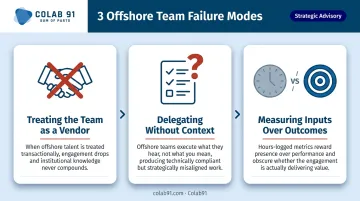
The third failure mode does the most damage. When teams are rewarded for looking busy rather than delivering outcomes, you get exactly that.
Why Mid-Market Companies Feel This More Acutely
PE-backed portfolio companies don't have the runway that large enterprises do. A Fortune 500 firm can absorb 12 months of underperformance while the offshore model matures. A mid-market company with a PE sponsor watching quarterly results cannot.
Most advice on managing offshore teams focuses on tactical tips - which tools to use, how to run standups - while skipping the structural decisions that actually determine whether the team performs. This guide focuses on those structural decisions first.
Design Before You Build: Getting Your Operating Model Right
Most offshore teams struggle not because of talent gaps or time zone friction - but because no one defined the operating model before hiring began. Companies move fast to fill seats and skip the foundational questions: Who owns what? How are decisions made? What's the team's actual mandate?
That ambiguity compounds quickly. It's the root cause of most offshore failures.
Define the Team's Mandate First
There's a fundamental difference between a cost center and a strategic capability hub. One exists to reduce headcount costs. The other exists to build domain expertise and strategic capacity at scale.
Colab91 is built around the latter model - what they call "next-gen capability centers." Rather than filling offshore seats with generalists, the approach recruits domain experts who integrate directly with client functions and operate as a genuine extension of the onshore team. That design choice shapes hiring profiles, governance structure, and how performance gets measured.
India's GCC (Global Capability Center) market reflects this shift broadly. According to Reuters citing a NASSCOM-Zinnov report, India's GCC market reached $64.6B in 2024 and is projected to hit $105B by 2030-driven precisely by companies moving beyond cost arbitrage toward strategic capability building.
Key Operating Model Decisions to Make Upfront
Before recruiting a single person, lock down these decisions:
- Identify which functions belong offshore vs. onshore based on process maturity, IP sensitivity, and real-time collaboration requirements
- Clarify day-to-day management - whether that's an offshore team lead, an onshore counterpart, or a shared structure
- Assign clear performance ownership; accountability gaps between "the offshore manager" and "the client sponsor" are where reviews quietly die
- Map the escalation path before something breaks, not after
Capability Center vs. Traditional Outsourcing
| Dimension | Traditional Outsourcing | Capability Center |
|---|---|---|
| Relationship type | Vendor/client | Embedded team |
| Team mandate | Task execution | Domain expertise + strategy |
| Governance | SLA-driven | Outcome-driven |
| Talent profile | Available, generalist | Specific domain fit |
| Time horizon | Project or contract term | Long-term, scalable |
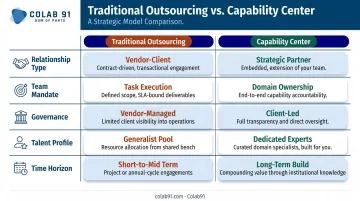
The capability center model produces better outcomes for companies that need more than headcount. Colab91's approach-hiring domain experts in procurement and analytics who integrate with client culture rather than operating separately-reflects this design philosophy in practice.
Hire for Fit, Not Just Availability
Technical skill is table stakes. A cultural or functional mismatch creates drag that compounds over time. The stronger hire isn't the most credentialed candidate - it's the one who understands procurement category management, fits the client's operating tempo, and can work within an embedded model from day one.
Role-specific hiring criteria to define before you recruit:
- Functional depth in the relevant domain (procurement, analytics, technology)
- Familiarity with the client's industry or adjacent sectors
- Communication style and availability overlap with the onshore team
- Capacity to operate with autonomy as the engagement matures
Communication and Collaboration That Actually Works
Communication failures are structural, not personal. The 2020 offshore outsourcing research found deferred replies and lack of informal communication among the most consistent failure patterns-problems that persist not because teams don't want to communicate, but because no one designed how communication should work.
Synchronous vs. Asynchronous: Know When to Use Each
HBR's research on distributed teams makes the case that remote work should be mostly asynchronous-a principle that applies especially to US-India teams where the time zone gap is 9.5–12.5 hours depending on US location.
Use synchronous communication for:
- Weekly team reviews and one-on-ones
- Escalations and blockers that need real-time resolution
- Relationship-building moments (team intros, recognition, strategy discussions)
Use asynchronous communication for:
- Status updates and progress check-ins
- Task assignments with clear briefs
- Decision documentation and feedback loops
Defaulting to synchronous-only creates bottlenecks. If your offshore team can't move on anything without a live call, you've built a dependent team, not an independent one.
Practical Time Zone Management
For US-India teams, a typical overlap window is roughly 8–11 AM IST / late evening US East Coast, or morning US Pacific. Use that window deliberately:
- Schedule standing syncs during overlap hours
- Set explicit response-time expectations for async channels (e.g., within 4 hours during business hours)
- Document anything discussed verbally in a shared system of record. Decisions made on a call that aren't written down effectively disappear by the next morning
Writing Clearly Enough That the Team Doesn't Have to Guess
Offshore team members should never need to interpret intent from a vague brief. A well-structured task assignment includes:
- The objective - what outcome is expected
- The definition of done - what "complete" looks like, specifically
- The context - why this matters and how it fits the larger goal
- The deadline and priority - when it's needed and relative to other work
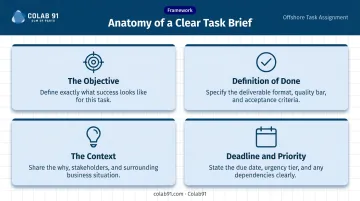
This isn't bureaucracy. It's the difference between a team that executes independently and one that emails for clarification three times per task.
Creating Psychological Safety Across Distance
Clear task briefs solve the mechanics of communication. But there's a subtler problem: some communication cultures default to "yes" to avoid conflict. This masks blockers, delays delivery, and makes problems invisible until they're large.
The fix isn't more check-ins. It's creating conditions where questions and pushback are explicitly welcomed. Leaders can do this by modeling it: ask for feedback on your own decisions, acknowledge when information was unclear, and never penalize someone for raising a problem early. Psychological safety is a performance prerequisite, not a cultural sensitivity program.
Performance Management: KPIs, Governance, and Accountability
Activity metrics are a trap. Hours logged, calls attended, tasks closed-these measure compliance, not performance. An offshore team optimized for activity metrics will look busy and underdeliver.
Outcome-Oriented KPIs: What to Measure Instead
For procurement offshore teams, relevant outcome metrics might include:
- Savings identified per analyst per quarter
- Contract cycle time (days from initiation to execution)
- Supplier risk flags actioned within SLA
For analytics teams:
- Report accuracy rate and revision cycles
- Time from data request to insight delivery
- Stakeholder satisfaction scores on analytical output
The specifics depend on the function and the company's strategic priorities. What matters is that metrics connect to business results the offshore team is actually accountable for-and that baselines are set before targets are imposed.
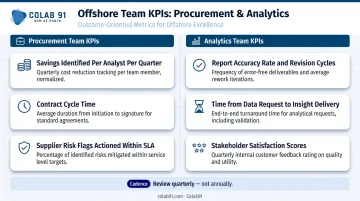
Review KPIs quarterly, not annually. Business context changes, and metrics that made sense at launch may not reflect priorities six months later.
The Governance Layer: Who Reviews What, How Often
Without a governance layer, accountability becomes reactive-issues surface only after they've compounded. For offshore teams to perform consistently, they need:
- A defined reporting structure (who they report to, both on the offshore side and the client side)
- Regular performance reviews with structured agendas-not ad hoc check-ins
- A clear escalation path so issues don't sit unresolved at the team level
Colab91's approach embeds accountability structures and onshore oversight from the start of an engagement, rather than leaving offshore teams to self-govern. A team that operates without onshore visibility tends to optimize for internal comfort, not client outcomes.
Deloitte's 2023 Global Shared Services Survey found that mature business services organizations (7+ years old) report to a designated GBS leader, with CFOs the most common C-suite oversight function. Governance, in other words, is a structural requirement-not an optional layer.
Avoiding the Micromanagement Trap
Governance structures create accountability. Surveillance tools do the opposite. Excessive monitoring signals distrust, and MIT Sloan Management Review research on remote monitoring found that surveillance tools can reduce productivity when employees don't feel trusted.
Once KPIs are set and communication rhythms are established, leaders need to step back. The goal is managing outcomes, not supervising tasks. Teams that feel trusted take initiative. Teams that feel watched ask for permission before every decision-and that friction is exactly what offshore models are designed to eliminate.
Building Team Culture Across Time Zones
Culture is a function of inclusion, not proximity. The practical question for offshore teams isn't how to build culture remotely-it's whether offshore members are genuinely included or simply kept informed after decisions are made.
There's a meaningful difference between looping someone in on decisions after they're made and bringing them into the process where their input can change the outcome. The latter is what builds genuine team membership.
Practical Inclusion Tactics
- Bring offshore team leads into planning discussions, not just execution briefings
- Acknowledge individual contributions publicly in team settings-not just as a group reference
- Align onboarding experiences: offshore and onshore staff should experience the same company context, values, and strategic framing
- Invest in occasional in-person touchpoints where feasible-even one visit per year changes the relationship dynamic
Professional Development as a Retention Signal
Teams that see a career path stay longer and perform better. The Zinnov-NASSCOM mid-market GCC report identifies high-ownership roles, faster career growth, and upskilling investment as the key factors mid-market GCCs use to attract and retain talent in India's competitive hiring environment.
In practice, this means structuring offshore roles with visible growth tracks from day one. Colab91 builds capability centers where offshore professionals take on domain ownership in areas like procurement and analytics-not support roles, but delivery roles with direct client impact. That structural investment in role design is what separates teams that retain talent from those that replace it.
Common Mistakes That Derail Offshore Teams
Most offshore failures are predictable. The patterns repeat across companies and industries:
1. Skipping the operating model design phase Jumping straight to hiring without answering who owns what, how decisions get made, and what the team's mandate is. This creates structural ambiguity that compounds immediately.
2. Over-communicating tactically, under-communicating strategically The team knows their tasks but not the "why." When context changes-a client priority shifts, a deadline moves, a scope expands-they can't adapt because they don't understand what they're working toward.
3. Measuring the wrong things Rewarding activity over outcomes teaches teams to optimize for visibility rather than results. Once this incentive structure takes hold, reversing it requires resetting expectations, redefining metrics, and rebuilding trust in how performance is evaluated.
The "Set and Forget" Failure Mode
Some companies invest heavily in a strong launch-good hiring, clear processes, solid onboarding-and then reduce oversight under the assumption the team will self-sustain. It won't. Not in the first 6–12 months.
Offshore teams in early stages are still building working habits, trust, and communication norms with onshore counterparts. Consistent management attention during this window is what converts a strong launch into durable performance. Pull back too soon and what erodes isn't just output-it's escalation patterns, accountability, and the collaborative muscle the team was just starting to develop.
Watch for these early signals that oversight has thinned too quickly:
- Decisions get delayed because there's no clear escalation path
- Onshore stakeholders start bypassing the offshore team on scope changes
- Output quality holds but context-sharing drops off
- Team members stop flagging risks proactively
Offshore Team Management Is a Leadership Discipline
The companies that get the most from offshore teams are those where senior leaders stay engaged with the team's direction-not just its output. Handing full management to a middle layer cuts the offshore team off from strategic direction - and that gap widens faster than most leaders expect.
The most effective offshore teams operate as informed contributors, not task executors. That shift starts with how senior leaders choose to engage.
Frequently Asked Questions
What are offshore teams?
Offshore teams are groups of employees or professionals based in another country who work as an integrated part of a company's operations. In the context of capability centers-particularly India-based teams-they provide access to domain talent, cost efficiency, and extended operating capacity across time zones.
How do you effectively manage an offshore team?
Design the operating model before hiring, establish outcome-oriented KPIs, build structured communication cadences, and treat the offshore team as an integrated unit rather than an external vendor. Structural decisions made upfront shape long-term team performance.
How should you communicate with offshore teams?
Use both synchronous and asynchronous communication with intention. Reserve live meetings for decisions, blockers, and relationship-building. Use async channels-documented briefs, shared project boards, written updates-for daily progress.
What is the biggest challenge in managing offshore teams?
Misaligned expectations and unclear ownership-not time zones or language. Most offshore team failures trace back to insufficient operating model design: nobody defined the team's mandate, governance structure, or accountability mechanisms clearly enough before work began.
How do you measure the performance of an offshore team?
Track outcome-oriented KPIs tied to business results-turnaround time, accuracy rates, savings identified-rather than activity metrics like hours logged. Set baselines before rolling out targets, then review metrics quarterly to keep performance on track.