Introduction
Procurement used to be a back-office function. That's no longer true.
In a world reshaped by tariff volatility, geopolitical realignment, and supply chain failures, how you source is increasingly how you compete. McKinsey research shows external spend represents 50% to 80% of a company's total cost base - which means procurement decisions aren't operational details. They're strategic levers.
Yet many organizations still conflate "strategic sourcing" with routine purchasing or ad hoc vendor selection. The terms get used interchangeably. The processes stay reactive. And the cost - in missed savings, supply chain fragility, and lost competitive ground - accumulates fast.
This guide clears up the confusion. It covers a precise definition of global strategic sourcing, the 7-step process, key benefits, execution challenges, and the team model required to do it well. If you're a procurement leader or operations executive looking to move beyond reactive buying, this is your starting point.
Key Takeaways
- Global strategic sourcing optimizes total cost of ownership - not just unit price - across international supplier markets
- The 7-step process runs from spend analysis through supplier selection, contracting, and ongoing performance monitoring
- High-performing procurement programs reduce purchasing cost bases by 8–12%, with additional annual savings of 2–3%
- The biggest execution gap isn't the process - it's the capability: most mid-market companies lack the in-house talent to run structured sourcing programs
- Hybrid offshore models are closing that gap for PE-backed and mid-market companies
What Is Global Strategic Sourcing?
Global strategic sourcing is a systematic, data-driven approach to evaluating, selecting, and managing suppliers across international markets. The goal isn't just cost reduction - it's long-term value creation aligned with broader business objectives.
Traditional procurement is transactional - find the lowest price, execute the buy, move on. Strategic sourcing works differently: it starts with total value, builds supplier relationships worth keeping, and refines category strategy over time as market conditions shift.
Sourcing vs. Procurement vs. Outsourcing
These terms get muddled constantly. Here's the clean version:
- Sourcing - finding and evaluating suppliers; deciding who can best meet organizational needs
- Procurement - the broader function and profession that executes buying, including sourcing as one of its activities
- Purchasing - the transactional act of executing the buy once a supplier is selected
- Outsourcing - transferring an entire business function to a third party, not just sourcing the supply of goods or services
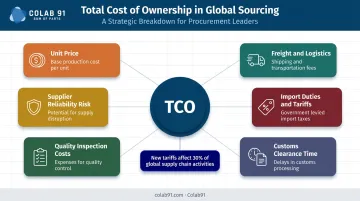
The "global" dimension adds scope: sourcing beyond domestic borders to access cost advantages, specialized capabilities, or innovation that doesn't exist locally. Measuring whether that's actually working requires total cost of ownership (TCO) - a framework that accounts for logistics, customs, tariffs, quality risk, and supplier reliability, not just the unit price on an invoice.
Why It Matters Now
KPMG's 2024 procurement survey found that 83% of respondents ranked inflationary pressures and commodity price increases as the top external procurement challenge, with 77% citing supply disruption risk as critical. In that environment, organizations still running transactional purchasing models are absorbing avoidable cost and risk that more sophisticated peers are systematically managing away.
The industries where this gap shows up most clearly: manufacturing, IT services, professional services (including procurement and analytics), and healthcare - all areas where sourcing decisions made today lock in cost structures for years.
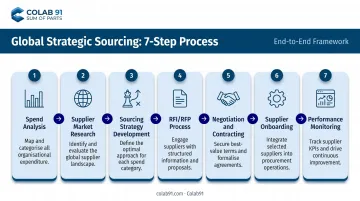
The 7-Step Global Strategic Sourcing Process
The 7-step framework isn't a rigid formula - it's a customizable playbook that procurement teams adapt to their organization's size, category complexity, and risk tolerance.
Step 1: Spend Analysis
Collect and consolidate all procurement data to understand where money is going, with whom, and on what. Identify fragmented supplier relationships, categories ripe for consolidation, and spending patterns that don't reflect strategic intent.
This step is foundational. Without clean spend data, every subsequent decision is guesswork. Many mid-market firms still lack a unified spend database - and that absence is where procurement inefficiency takes hold and compounds.
Step 2: Supplier Market Research
Research the global landscape of potential suppliers, evaluating:
- Financial stability and operational scale
- Geographic location and production capacity
- Quality certifications and compliance track record
- Environmental and labor practices
Building a supplier portfolio at this stage creates optionality. When disruptions hit - and they do - organizations with pre-researched alternatives recover faster than those scrambling to find new vendors under pressure.
Step 3: Sourcing Strategy Development
A cross-functional team uses market research and spend insights to define the sourcing approach for each category. Depending on risk appetite and strategic priorities, this might mean:
- Single-sourcing to deepen a preferred supplier relationship and capture volume leverage
- Dual-sourcing to split volume and reduce concentration risk across two vendors
- Regional diversification to spread supply across geographies and buffer against localized disruptions
- Nearshoring to tighten lead times and reduce logistics exposure
Step 4: RFI and RFP Process
Issue structured information requests and proposal invitations to shortlisted suppliers. Well-constructed RFPs do more than collect data - they signal to suppliers that your organization is serious, organized, and expects accountability. The comparative data generated here drives rigorous evaluation rather than gut-feel selection.
Step 5: Negotiation and Contracting
Negotiate terms that go beyond price. Strategic sourcing contracts should address:
- Delivery timelines and SLAs
- Quality KPIs and defect thresholds
- Innovation commitments
- Payment terms and escalation mechanisms
One-sided contracts that extract maximum price concessions tend to erode supplier relationships over time. The goal is a structure that creates mutual benefit - and a supplier genuinely invested in your success.
Step 6: Supplier Onboarding
Integrate selected suppliers into internal systems and workflows. Effective onboarding establishes communication protocols, defines performance expectations, and creates feedback loops before the first order is placed.
Step 7: Performance Monitoring and Optimization
Track supplier KPIs continuously: on-time delivery, defect rates, cost trends, compliance status. Use this data to refine sourcing strategies, renegotiate where needed, and identify the next category to optimize.
Procurement teams that run quarterly supplier reviews - not annual ones - consistently surface savings and risk exposures that point-in-time assessments miss entirely.
The Benefits of Global Strategic Sourcing
Cost Savings and TCO Reduction
Bain research on world-class procurement organizations shows they reduce purchasing cost bases by an average of 8% to 12%, with additional annual savings of 2% to 3% annually - achieved by consolidating suppliers, leveraging volume, and eliminating costs buried in fragmented buying.
TCO thinking is what separates competent strategic sourcing from naive cost-chasing. A supplier with a 15% lower unit price but unreliable delivery, inconsistent quality, and significant logistics overhead may cost more in total than a domestic supplier at full price.
Supply Chain Resilience
Concentrating supply in a single geography or supplier creates fragility. Spreading sourcing across multiple geographies and suppliers reduces exposure to regional disruptions - geopolitical tensions, natural disasters, or single-supplier failures.
Deloitte's 2025 CPO Survey found that top-performing organizations prioritize two risk strategies above all others:
- 74% of CPOs identify alternative supply sources as their most effective risk mitigation strategy
- 64% prioritize supply chain visibility as a core defense
The organizations that built diversified supplier bases before recent global disruptions recovered faster and with less cost than those that hadn't.
Access to Innovation and Specialized Capability
Global sourcing connects organizations to capabilities that either don't exist domestically or cost multiples of what offshore markets charge. Sourcing analytics and IT services from India, precision manufacturing from Germany, or specialized components from Southeast Asia gives companies access to expertise that purely domestic models can't match.
Those relationships also create a foothold. Supplier networks in key markets frequently open doors to faster market entry - a strategic return beyond the initial cost benefit.
Common Challenges in Global Strategic Sourcing
Logistics, Lead Times, and Tariff Exposure
Crossing borders introduces freight costs, customs clearance delays, and tariff exposure that can erode apparent unit-cost savings when not factored into TCO upfront. McKinsey's 2025 supply chain risk analysis found that new tariffs are currently affecting 30% of global supply chain activities - a figure that demands TCO modeling be treated as non-negotiable, not optional.
A complete TCO model should capture freight, import duties, customs clearance time, and quality inspection costs - all before a contract is signed, not after.
Quality Control and Supplier Visibility
Monitoring supplier performance across geographies is difficult without structured Supplier Relationship Management (SRM) practices and regular audits. KPMG's 2024 survey found 67% of procurement leaders don't rate their organization's third-party risk management as highly mature. Cultural and language differences compound the problem - what looks like a performance gap is sometimes a communication gap in disguise.
Talent Gaps and Execution Risk
This is the most underappreciated barrier. Global strategic sourcing requires skills that many mid-market organizations simply don't have in-house:
- Analytical capability to model TCO, scenario-plan risk, and interpret spend data
- Category expertise that goes beyond traditional purchasing into market dynamics and supplier positioning
- Contract analytics and negotiation skill - KPMG found only 34% of organizations rate their contract analytics capability as strong
McKinsey notes that mid-market firms frequently hire for traditional category experience rather than the strategic mindset and data fluency that modern sourcing demands.
When that capability gap exists internally, mid-market organizations increasingly address it by building dedicated offshore procurement teams - combining domain expertise with cost-efficient delivery.
From Process to Capability: Building a Team That Can Execute
Having a strategic sourcing process is not the same as having a strategic sourcing capability. The process is documented steps. The capability is the people, data infrastructure, and domain expertise to execute those steps consistently, at scale, across multiple categories.
Most guides focus on the process. The capability dimension is where mid-market companies most often fall short - and where the competitive gap is actually won or lost.
What a Mature Sourcing Function Looks Like
A high-performing strategic sourcing team needs four things:
- Category expertise - deep knowledge of specific spend categories and their supplier markets
- Spend analytics fluency - the ability to build, clean, and draw insight from procurement data
- Technology literacy - working knowledge of sourcing platforms, e-procurement tools, and AI-assisted analytics
- Supplier relationship management skills - the interpersonal and process capability to manage supplier performance over time
For large enterprises, this function exists in-house. For mid-market and PE-backed companies, it typically doesn't - and building it from scratch takes time and budget that post-acquisition timelines rarely accommodate.
The Mid-Market and PE-Backed Challenge
These organizations face a specific pressure: deliver procurement savings and supply chain improvements quickly, often in the wake of an acquisition or during an accelerated growth phase. The expectation is clear. The in-house headcount to meet it usually isn't there.
That's the gap Colab91 was specifically built to close. The leadership team spent the prior decade at Impendi - a US-based procurement consultancy later acquired by Accenture - where they designed, built, and scaled an India delivery center to over 100 practitioners, serving PE firms including Carlyle Group, TPG, Elliott, and BC Partners.
The model they bring to Colab91 combines onshore strategic oversight with offshore analytical execution: dedicated India-based teams with genuine domain expertise in strategic sourcing and spend analytics, structured to operate as an extension of a client's in-house function. AI-powered tools - spend analytics, savings opportunity assessment, and supplier risk management - are built into that delivery model, not bolted on separately.
For PE-backed companies that need to stand up procurement capability fast, this approach sidesteps the 12-month hiring cycle entirely.
Building for the Long Term
KPMG found that 70% of procurement leaders have developed a 1–3 year roadmap to improve supplier relationship management. The organizations that will outperform aren't just running better processes - they're investing in durable capability.
That means:
- Spend analytics infrastructure that persists beyond individual projects
- Trained people with category-specific expertise, not generalist consultants
- A sourcing operating model that doesn't reset when an engagement ends
Global Strategic Sourcing Trends to Watch in 2025
AI and Automation in Sourcing Workflows
AI has moved from exploratory to operational in procurement. Deloitte's 2024 GenAI in procurement survey found 92% of CPOs were planning or assessing GenAI capabilities, with 37% already piloting or deploying. The share of organizations spending more than $1M annually on GenAI for sourcing was 11% in 2024 and was expected to double to 22% by 2025.
Current use cases include contract management, supplier discovery, RFP drafting, spend anomaly detection, and pricing trend prediction. Gartner placed GenAI for procurement at the Peak of Inflated Expectations in its 2024 Hype Cycle - projecting it would reach the Plateau of Productivity within two years. Real operational value is arriving faster than most procurement leaders anticipated.
Geopolitical Realignment and Supplier Diversification
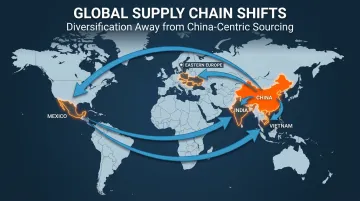
The shift away from China-centric supply chains is accelerating. Tariff pressure and political risk are pushing companies toward India, Vietnam, Mexico, and Eastern Europe as primary or supplementary sourcing markets. Building a diversified global supplier base has become a baseline operational requirement, not an optional hedge against risk.
Procurement teams are responding by mapping supplier concentration, qualifying alternates in growth markets, and building flexibility into contracts. Key priorities in this shift include:
- Qualifying suppliers across two or more geographies per critical category
- Reducing single-country dependency for high-spend or high-risk inputs
- Incorporating geopolitical risk scores into supplier evaluation frameworks
ESG Integration and Compliance Scrutiny
Environmental, Social, and Governance standards are becoming embedded in sourcing decisions - not just as values commitments, but as legal obligations. The EU's Corporate Sustainability Due Diligence Directive (CSDDD), adopted in 2024, requires in-scope companies to address adverse human rights and environmental impacts throughout their supply chains.
Procurement teams are now expected to audit supplier practices and demonstrate supply chain transparency as part of broader corporate governance requirements.
Frequently Asked Questions
What are the 7 steps of strategic sourcing?
The 7 steps are: spend analysis, supplier market assessment, sourcing strategy development, RFI/RFP issuance, negotiation and contracting, supplier onboarding, and ongoing performance monitoring. Each step builds on the previous - see the detailed breakdown above.
What is global strategic sourcing?
It's a data-driven, systematic process of evaluating and managing international suppliers to maximize total value - cost, quality, risk, and reliability - in alignment with long-term business objectives. Companies that do it well turn procurement into a measurable source of competitive advantage.
What's the difference between P2P and S2P?
P2P (Procure-to-Pay) covers the transactional cycle from purchase requisition to supplier payment. S2P (Source-to-Pay) extends this upstream to include sourcing, supplier selection, and contracting - making S2P the broader, more strategic framework.
What are the 4 pillars of strategic sourcing?
Spend analysis, supplier market intelligence, total cost of ownership evaluation, and supplier relationship management. Organizations that apply all four consistently see stronger supplier performance, lower total costs, and fewer supply disruptions.
How is strategic sourcing different from traditional procurement?
Traditional procurement focuses on completing transactions at the lowest unit price. Strategic sourcing takes a longer view - evaluating total cost, supplier risk, quality, and relationship value against broader business objectives.
What is total cost of ownership (TCO) and why does it matter?
TCO goes beyond unit price to include logistics, customs, compliance costs, quality risk, and supplier reliability. Ignoring TCO in favor of headline price is one of the most common, and most expensive, mistakes in global sourcing.