McKinsey research found companies can expect supply chain disruptions lasting one to two months every 3.7 years — with consumer goods companies absorbing financial fallout equivalent to 30% of one year's EBITDA over a decade. For mid-market and PE-backed companies running lean procurement teams, that exposure is especially hard to absorb.
Dual sourcing is one of the most direct responses to this problem. This article covers what it actually means, the three allocation models procurement leaders use, the concrete benefits and risks, implementation best practices, and a decision framework for knowing when it's worth the effort — and when it isn't.
Key Takeaways
- Dual sourcing means qualifying two suppliers for the same item — not just having a backup name on a list
- Adding a second supplier from the same region or upstream source creates concentration risk in disguise
- 81% of supply chain leaders implemented dual sourcing in 2022, nearly double the 55% rate recorded in 2020
- Total cost of ownership — not unit price — is the right lens for evaluating the tradeoff
- Dual sourcing requires governance infrastructure: allocation rules, scorecards, and supplier review cadences
What Is Dual Sourcing?
Defining Dual Sourcing
Dual sourcing is the practice of procuring the same component, raw material, product, or service from two distinct suppliers to eliminate single-point-of-failure risk. While "dual sourcing" technically means two suppliers, practitioners often use it interchangeably with "multi-sourcing," which extends the model beyond two.
The three most common allocation models:
- Primary/secondary split (80/20 or 70/30): Most volume flows to one supplier; the secondary is qualified and active but carries less load. Preserves volume leverage while keeping a qualified backup active.
- Parallel sourcing (50/50): Equal volume split, maximizing competitive tension and capacity flexibility, though at the cost of volume discounts with both suppliers.
- Contingency sourcing: The secondary supplier is only activated during disruption. Lower ongoing cost, but requires deliberate qualification work upfront to ensure the backup can actually perform when needed.
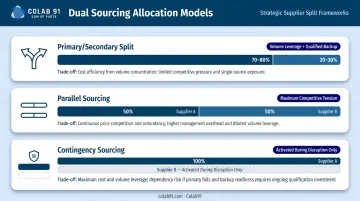
The right model depends on risk tolerance, supplier capabilities, and how much volume discount you're willing to trade for resilience.
Dual Sourcing vs. Single Sourcing
Understanding the tradeoff starts with what single sourcing actually offers. Deliberately concentrating volume with one supplier maximizes discounts, simplifies procurement, and deepens the partnership — but any disruption hits operations immediately, with nothing to absorb the impact.
| Factor | Single Sourcing | Dual Sourcing |
|---|---|---|
| Risk exposure | High | Reduced |
| Cost efficiency | Higher (volume leverage) | Lower (split orders) |
| Supplier relationships | Deeper, simpler | More complex to manage |
| Best fit | Stable supply, low-risk categories | Critical or volatile categories |
Adding a second supplier doesn't automatically reduce concentration risk. If both suppliers share the same geography, draw from the same upstream raw materials, or operate under the same regulatory conditions, the protective benefit is limited. Meaningful dual sourcing requires deliberate diversification across location, production footprint, and supply dependencies — not just a second name on a vendor list.
Key Benefits of a Dual Sourcing Strategy
Supply Chain Resilience and Business Continuity
The numbers reflect how dramatically procurement thinking shifted after COVID. According to McKinsey's supply chain pulse survey, 81% of supply chain leaders implemented dual sourcing in 2022, up from 55% in 2020. Nearly all — 97% — combined dual sourcing with inventory increases and regionalization.
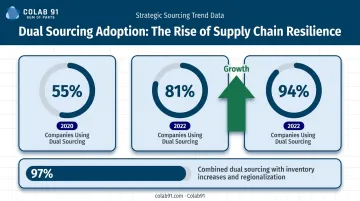
A qualified secondary supplier functions as operational insurance. When the primary faces a factory shutdown, labor dispute, or financial distress, the secondary can absorb volume immediately — rather than leaving procurement scrambling to qualify a new vendor mid-crisis.
Toyota's response after the 2011 Japan earthquake illustrates this well: the company set a target to recover production within two weeks of a major disaster by standardizing parts for multi-site production and qualifying alternative suppliers in advance.
Cost and Negotiation Leverage
Suppliers who know they share volume with a competitor tend to sharpen their pricing and service levels. That competitive tension — without needing to issue a formal RFP every cycle — can improve unit costs, payment terms, and responsiveness from both suppliers.
The important caveat: splitting orders can reduce the volume discounts each supplier offers. Procurement teams need to evaluate total cost of ownership (TCO), not just unit price, before assuming dual sourcing saves money. When factoring in reduced disruption costs, negotiation leverage, and administrative overhead, dual sourcing typically comes out ahead for critical categories — provided TCO is modeled properly before the decision is made.
Capacity Flexibility and Lead Time Reduction
Two qualified suppliers give procurement teams options that a single source can't provide:
- Stagger shipments to receive product more frequently, reducing safety stock requirements
- Surge the secondary supplier during demand spikes without renegotiating with a single provider
- Maintain JIT production schedules when one supplier hits a capacity constraint or equipment issue
For businesses with seasonal demand or rapid growth trajectories, this operational flexibility directly reduces the cost of stockouts and expedited freight — benefits that don't always show up in unit-price comparisons but add up quickly on the P&L.

Geographic Diversification and Healthy Competition
Sourcing from geographically distinct suppliers reduces exposure to localized disruptions — weather events, port closures, political instability, or tariff shifts. McKinsey's 2025 supply chain survey found 82% of companies said their supply chains were affected by tariffs, with new tariffs touching 30% of global supply chain activity. Regional suppliers can also cut shipping distances, reduce logistics costs, and simplify regulatory compliance for global businesses.
Geographic spread also changes supplier behavior. When a supplier isn't the sole source, delivery commitments and service levels tend to sharpen — there's a visible competitor to lose volume to. Performance benchmarking becomes more objective too: with two suppliers delivering comparable products, you have a live reference point rather than relying solely on one supplier's historical data.
Risks and Challenges of Dual Sourcing
Quality Consistency and Administrative Complexity
Even with identical specifications, two suppliers may differ in materials, tolerances, or quality control processes. Variation can range from cosmetic inconsistencies to functional performance failures. ISO 9001:2015 Clause 8.4 requires organizations to define selection and monitoring criteria for externally provided products and services — dual sourcing effectively doubles that obligation.
Managing two suppliers also means more contracts, more invoices, more logistics coordination, and more relationships to sustain. The overhead is real and often underestimated. Before assuming dual sourcing saves money, procurement teams need to calculate the full management cost against the resilience benefit.
Supplier Relationship Strain
Introducing a secondary supplier can signal a loss of confidence to an existing primary, particularly if the transition isn't handled thoughtfully. Three practices reduce that friction:
- Communicate the strategic rationale early — frame it as resilience, not dissatisfaction
- Maintain fair, consistent order allocations between both suppliers
- Keep both engaged with regular performance reviews; letting the secondary go dormant is the most common failure mode
Forecasting Complexity
Two suppliers with different lead times, capacities, and reliability profiles add variables that complicate inventory planning. Without integrated, real-time visibility across both sources, procurement teams risk stock imbalances, unfulfilled orders, and misaligned production schedules. Unified data visibility needs to be built into the model from the start — not retrofitted after problems surface.
Regulatory and Compliance Exposure
Multiple suppliers operating in different jurisdictions introduce distinct requirements around tax compliance, labor standards, data protection, and product certifications. The compliance management workload effectively doubles. Teams must extend due diligence, ongoing monitoring, and risk assessment to cover both sources from day one — not phase it in gradually.
How to Implement Dual Sourcing: Best Practices
1. Segment before acting. Dual sourcing shouldn't apply uniformly across all spend. Start with a risk-impact segmentation — similar to Kraljic Matrix logic — to identify categories with both high criticality and viable alternative suppliers. Bottleneck and strategic categories are the right targets. Low-risk commodities rarely justify the overhead.
2. Build genuine diversification into the design. The secondary supplier must differ meaningfully from the primary: different geography, different upstream raw material sources, different regulatory environment. Standardize product specifications, quality criteria, and order processes across both suppliers to minimize switching friction.
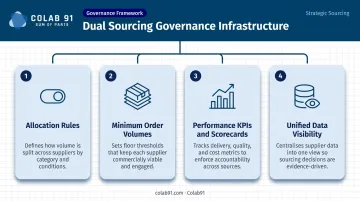
3. Build the governance infrastructure to sustain it. Dual sourcing fails without structure. That means:
- Defined allocation rules with clear triggers for shifting volume
- Consistent minimum order volumes for the secondary supplier to keep them capable
- Performance KPIs tracked via scorecard, reviewed on a regular cadence
- Unified data visibility across both sources for forecasting and compliance
For mid-market and PE-backed companies running lean procurement teams, this governance layer is where execution typically breaks down. Without dedicated capacity for ongoing monitoring, category reviews, and allocation tracking, the strategy exists on paper but not in practice.
Colab91 builds dedicated offshore strategic sourcing and spend analytics teams specifically for these organizations — covering category management, supplier performance monitoring, and allocation tracking. Colab91's spend analytics platform flags supplier concentration risk and tracks spend distribution across multiple suppliers within the same category, so procurement leaders can act on their sourcing strategy rather than revisit it from scratch each quarter.
When Dual Sourcing Makes Sense — And When It Doesn't
Scenarios Where It's Clearly Justified
- Supply disruption would materially impact revenue or service delivery
- Components have long or volatile lead times
- Demand is highly variable or subject to seasonal spikes
- The primary supplier shows signs of financial instability
- Regulations require backup sources
- The company is scaling faster than a single supplier can reliably support
- Tariff or geopolitical risk threatens existing supply routes
Scenarios Where It May Not Be the Right Answer
- Highly specialized or proprietary components with no comparable alternative
- Categories too small to justify managing two relationships
- The "second" supplier is in the same geographic or upstream risk zone as the first
- Commoditized categories where total management cost outweighs risk benefit
A Quick Decision Checklist
The scenarios above tell you where the risk is. This checklist tells you what to do about it. Before applying dual sourcing to a category, work through these five questions:
- Would a two-month supply disruption materially affect revenue, operations, or customer service?
- Are there viable, qualified alternative suppliers for this category?
- Can volume be shifted between suppliers without significant re-qualification or retooling?
- Do both potential suppliers share the same geography, raw material source, or regulatory environment?
- Is the primary supplier financially stable, or are there signals of liquidity pressure?
If questions 1–3 return yes and 4–5 return no, dual sourcing is the right call — commit to it.
Dual Sourcing in Practice: Real-World Examples
Apple shows how semiconductor dual sourcing evolves over time. Reuters reported in 2011 that Samsung was the sole supplier of Apple's A5 chips, and that Apple was already testing TSMC as it sought diversification. By 2025, Apple was shifting US-market iPhone production toward India — reducing exposure to potential tariffs on Chinese manufacturing and expanding its geographic footprint simultaneously.
After the 2011 Japan earthquake severely disrupted production, Toyota set a concrete target: recover within two weeks of any major supply disruption. The approach combined standardized parts designed for multi-site production with pre-qualified alternate suppliers for critical components. When semiconductor shortages hit in 2020–2021, Toyota applied the same framework to chips — requiring key suppliers to hold two to six months of inventory for critical semiconductors.
IKEA manages over 800 direct home-furnishing suppliers globally and has faced increasing pressure from tariffs and logistics costs in recent years. Its multi-supplier model distributes sourcing across multiple regions, positioning supply closer to customer markets and creating flexibility to shift volume as trade conditions shift.
The pattern across all three cases is consistent:
| Company | Dual Sourcing Trigger | Structural Outcome |
|---|---|---|
| Apple | Supplier concentration risk; tariff exposure | Multi-foundry chip supply; India production ramp |
| Toyota | Earthquake disruption; semiconductor shortages | Two-week recovery target; tiered inventory buffers |
| IKEA | Tariff pressure; logistics cost volatility | Regional supplier distribution; volume flexibility |
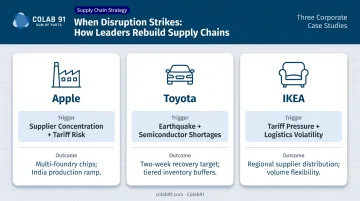
In each case, dual sourcing addressed an immediate disruption while building a durable operational capability — one that continues to support cost management and geographic growth well after the original crisis passed.
Frequently Asked Questions
What is the difference between single sourcing and dual sourcing?
Single sourcing selects one supplier for a given product or component to maximize volume leverage and simplicity. Dual sourcing uses two suppliers for the same item to reduce dependency and supply risk — at the cost of some administrative complexity and potential reduction in volume discounts from either supplier.
What are the 4 sourcing approaches?
The four main models are: sole sourcing (only one possible supplier exists), single sourcing (one chosen from several available options), dual sourcing (two suppliers for the same item), and multi-sourcing (three or more suppliers). Each represents a different tradeoff between cost efficiency, risk exposure, and operational complexity.
What are the main risks of dual sourcing?
The most common risks are:
- Quality inconsistency across suppliers
- Higher administrative and logistics overhead
- Loss of volume discounts from splitting spend
- Supplier relationship strain when adding a secondary source
Managing these requires clear procurement policies and reliable performance data.
Is dual sourcing more expensive than single sourcing?
It depends on what you measure. Dual sourcing can reduce unit costs through supplier competition but may increase costs by splitting volume and adding management overhead. In volatile markets, the cost of a supply disruption — measured against EBITDA impact — often exceeds the premium of maintaining a secondary supplier.
When should a company consider switching to dual sourcing?
Consider dual sourcing when:
- A disruption would have significant revenue or EBITDA impact
- Lead times are long, volatile, or geopolitically exposed
- A single supplier can't keep pace with your growth
- You're seeing persistent quality or delivery failures
- Your primary supplier is showing financial instability signals