A procurement improvement action plan isn't a wishlist of changes or a strategy deck that lives in SharePoint. It's a time-bound, sequenced roadmap with named owners, measurable targets, and a clear line between where procurement performs today and where it needs to perform next quarter, next year.
For mid-market and PE-backed companies, the stakes are specific. These organizations face pressure to generate procurement value fast — often with lean internal teams, limited process maturity, and a PE sponsor tracking savings against a value creation plan. Ad hoc fixes don't compound. A structured action plan does.
This article covers what a procurement improvement action plan actually entails, why it matters for your context, a practical five-step framework to build one, the factors that determine whether it succeeds, and the most common mistakes to avoid.
Key Takeaways
- A procurement action plan is executable, not directional — it defines who does what, by when, and how success is measured
- The diagnostic is essential: without spend visibility, improvement initiatives are built on assumptions
- Stakeholder alignment is a hard dependency — without cross-functional buy-in, plans stall before they deliver
- Sequence quick wins first, then structural changes — both are required, and order matters
- KPIs must be defined and baselined before initiatives launch, not after
What Is a Procurement Improvement Action Plan?
A procurement improvement action plan is a time-bound, prioritized document that maps the gap between current procurement performance and a defined future state. It covers processes, technology, supplier relationships, team capabilities, and governance — and it answers not just what to improve, but who owns it, by when, and how success is measured.
This distinguishes it from two things it's often confused with:
- A procurement strategy sets category-level direction and sourcing philosophy — it tells you where to go
- A process redesign exercise focuses on workflow engineering — it tells you how tasks should flow
- An action plan sits between the two: it translates strategic priorities into implementable initiatives with defined owners, timelines, and measurable milestones
When Organizations Typically Build One
Procurement improvement plans are almost always triggered by a specific event or pressure point:
- Post-merger integration requiring rapid procurement consolidation
- PE ownership transition with a 100-day value creation mandate
- Cost pressure that exposes how little visibility exists over third-party spend
- Organic growth that has outpaced process maturity, leaving visible inefficiencies with no clear owner
Each scenario shares one underlying reality: individual fixes don't accumulate into structural improvement. A formal action plan is what converts reactive firefighting into a repeatable performance baseline.
Why Procurement Improvement Plans Are Essential
Maverick spend grows as categories go unmanaged. Contract leakage widens when supplier agreements age without compliance monitoring. And sourcing cycles slow as processes stay informal.
The cost is measurable. According to APQC, organizations with 2% or more maverick purchasing require 16 more hours at the median to issue a purchase order and incur $2.58 higher procurement cost per $1,000 in purchases compared to organizations with less than 1% maverick spend. That's not a rounding error — it's a structural drag on operating cost.
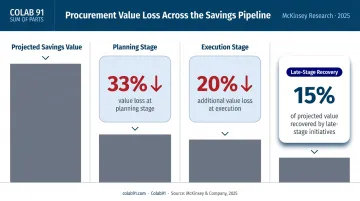
The savings opportunity is equally concrete. McKinsey's 2025 procurement transformation research found that average procurement savings pipelines lose 33% of estimated value during planning and another 20% during execution — meaning most organizations that identify savings don't capture them. Late-stage initiatives recover only 15% of projected value.
The Mid-Market Urgency Gap
Large enterprises can absorb procurement inefficiency longer. They have dedicated transformation teams, deeper bench strength, and the institutional capacity to run multi-year programs.
Mid-market and PE-backed companies don't have that buffer. They need to generate procurement impact quickly with lean internal teams, limited institutional process maturity, and a PE sponsor or CFO expecting measurable results against a defined timeline.
Without a formal improvement plan, procurement teams default to reacting to immediate needs. The downstream effects compound fast:
- Categories go unmanaged as daily firefighting takes priority
- Supplier relationships drift without structured performance oversight
- Process improvements get deprioritized until the next audit or budget cycle
By the time leadership acts, the performance gap has widened — and so has the cost of closing it.
How to Build a Procurement Improvement Action Plan: The 5-Step Process
This is a sequential but iterative framework. Early steps inform later ones, and execution feedback should loop back to refine the plan. The goal is a living document, not a static report that gets filed after the initial engagement.
Step 1: Conduct a Procurement Diagnostic
The diagnostic is the non-negotiable foundation. Without it, improvement initiatives are based on perception rather than evidence.
A thorough diagnostic covers:
- Spend analysis — by category, supplier, business unit, and geography; data cleansed, classified to a taxonomy (UNSPSC or client-specific), and enriched with contract terms and addressable spend percentages
- Process mapping — of the current procure-to-pay cycle, identifying where approvals stall, where compliance breaks down, and where manual workarounds have become standard practice
- Contract coverage and compliance review — quantifying off-contract spend, contract leakage, and gaps between negotiated terms and actual purchasing behavior
- Capability assessment — evaluating the procurement team against role requirements and identifying where bandwidth constraints or expertise gaps limit execution
Colab91's diagnostic engagements with mid-market and PE-backed companies consistently surface the same three inefficiency categories:
- Fragmented spend visibility — off-contract spend, misclassified tail spend, contract leakage
- Process compliance gaps — absent category strategies, informal sourcing execution
- Team capability limitations — bandwidth constraints, missing analytics capacity
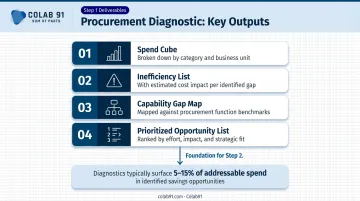
Structured diagnostics typically identify 5–15% of addressable spend in quantified savings opportunities.
The diagnostic should produce four outputs that become the raw material for Step 2:
- A spend cube broken down by category and business unit
- A list of identified inefficiencies with estimated cost impact
- A capability gap map
- A prioritized list of addressable opportunities
Step 2: Define Objectives and Prioritize Initiatives
Not all identified opportunities should be pursued simultaneously. Evaluate initiatives on two dimensions:
- Potential value — cost savings, risk reduction, speed improvement, working capital impact
- Feasibility — resource requirements, complexity, stakeholder sensitivity, timeline
A simple 2×2 matrix placing initiatives on these axes helps leadership agree on where to focus first. High-impact, low-complexity opportunities become quick wins. High-impact, high-complexity initiatives get sequenced for later phases once organizational capability and confidence have been built.
Objectives must be specific and business-aligned. "Reduce third-party indirect spend by 12% within 12 months" creates accountability. "Improve sourcing outcomes" doesn't.
For PE-backed companies, connecting procurement objectives directly to the value creation plan — with named savings targets and timelines that align to hold-period milestones — is what secures executive sponsorship and keeps procurement priorities from being deprioritized when operational demands compete for attention.
McKinsey's research found that the fastest-quartile companies captured at least 16% of their financial target within the first three months — and that no program in the slowest quartile achieved its two-year savings target. The sequencing decision made in Step 2 directly determines which quartile a program lands in.
Step 3: Align Stakeholders and Secure Buy-In
Resistance from key functions can stall execution even when the plan itself is technically sound. The stakeholders who need active alignment — not just notification — include:
- Finance — budget alignment and savings validation methodology
- Business unit leaders — operational requirements and policy compliance expectations
- Legal — contract terms, risk allocation, and policy governance
- Senior leadership or PE sponsor — prioritization authority and cross-functional conflict resolution
Knowing who to align is the easier part. The harder work is structuring the alignment process so it holds under execution pressure. Tactics that work in practice:
- A steering committee with cross-functional representation that meets at a defined cadence
- A shared definition of "success" that accounts for both procurement savings and operational continuity — not just procurement's perspective
- Early wins communicated explicitly to build momentum before structural improvements take hold
Step 4: Design the Improvement Roadmap
The roadmap translates prioritized initiatives into a sequenced execution plan across three parallel lanes:
| Lane | Examples |
|---|---|
| Process improvements | Standardizing approval hierarchies, supplier onboarding, sourcing event workflows |
| Technology enablement | Spend analytics, contract management, eProcurement platform deployment |
| Talent and capability | Training, role redesign, offshore capability augmentation |
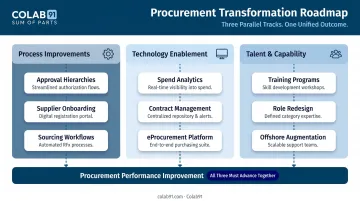
All three lanes must advance together. Technology without process clarity creates confusion. Process redesign without capable people reverts within months.
Talent is consistently the most underestimated lane. Mid-market companies frequently discover during execution that their internal procurement team lacks the category expertise, analytics capacity, or bandwidth to drive the plan forward alongside day-to-day operations.
This is where offshore procurement capability closes the gap. Colab91's India-based domain practitioners embed directly into the client's procurement function — covering category management, sourcing execution, and spend analytics — without the overhead or lead time of full-time permanent hires.
Step 5: Execute, Measure, and Refine
Quick wins in the first 90 days — low-complexity sourcing events, maverick spend clean-up, supplier rationalization in fragmented categories — build organizational confidence and generate early savings that fund longer-term structural work. These wins must be communicated visibly to sustain stakeholder support between phases.
Measurement infrastructure must be in place before initiatives launch, not built afterward. A KPI dashboard should cover:
- Operational metrics — requisition-to-order cycle time, spend under management, contract compliance rate
- Outcome metrics — verified savings, cost avoidance, supplier performance scores, maverick spend percentage
Baselines need to be established before initiatives begin so improvements can be attributed to the plan rather than external factors. Without baselines, savings claims are unverifiable — a problem particularly acute when reporting to PE sponsors or a CFO who will validate every number.
Key Success Factors for Your Procurement Action Plan
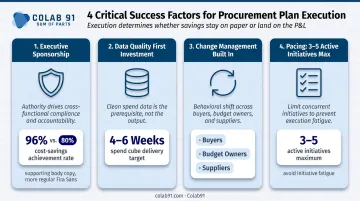
Building the plan is step one. Delivering on it depends on four factors that separate procurement programs that stick from those that stall:
Executive sponsorship with real authority. The action plan needs a named executive owner who can resolve cross-functional conflicts when business unit leaders resist compliance requirements or finance disputes savings attribution. Deloitte's 2025 CPO survey found that procurement leaders with senior sponsorship met or exceeded cost-savings plans at 96% vs. 80% for those without it. That gap compounds over a multi-year program.
Data quality as a first investment. The best-structured action plan fails on incomplete or inconsistently categorized spend data. Investing in data hygiene upfront — through a spend analytics tool or a structured cleansing effort — pays back across every downstream initiative. Colab91's AI-powered Spend Analytics platform delivers a cleansed, classified spend cube within a 4–6 week diagnostic window, giving the plan a defensible foundation from day one.
Change management built in, not appended. Procurement improvement requires behavior change from buyers, budget owners, and suppliers. Without training, clear policy communication, and feedback loops, well-designed process changes revert to old habits. This is the primary reason structural improvements fail after early quick wins.
Pacing — three to five active initiatives maximum. Organizations that address all identified opportunities simultaneously spread resources too thin, create initiative fatigue, and achieve partial results across everything rather than full results on high-value priorities. Sequence deliberately. Finish before starting the next wave.
Common Pitfalls to Avoid
Treating the Plan as a One-Time Deliverable
Market conditions, organizational priorities, and supply dynamics shift. A plan that isn't reviewed quarterly becomes outdated and loses organizational relevance.
Minimum cadence: quarterly reviews, a formal annual refresh, and an immediate review when triggered by a significant business event — merger, leadership change, or major supply disruption.
Optimizing Exclusively for Cost Savings
Plans focused only on price reduction often generate short-term savings while creating downstream costs through supplier quality failures, delivery disruptions, and eroded relationships. Total cost of ownership, supply continuity, and risk mitigation belong in the plan alongside direct savings targets — not as afterthoughts.
Underestimating Technology Implementation Complexity
Many organizations include a procurement technology upgrade in their action plan and significantly underestimate integration effort, data migration requirements, and user adoption challenges. PwC's 2024 Digital Procurement Survey identified user take-up as one of the most limiting factors in procurement digitalization, with 71% of companies citing clear process definition as a critical success factor for digital transformation.
Technology should follow process clarity, not precede it. Deploying an eProcurement platform before standardizing the workflows it's meant to support creates confusion, not efficiency.
Frequently Asked Questions
What is the action plan for procurement?
A procurement action plan is a structured roadmap that defines specific initiatives, owners, timelines, and KPIs to close the gap between current procurement performance and desired outcomes. It covers processes, supplier management, technology, and team capabilities — translating strategic direction into time-bound, assignable work.
How do you prioritize initiatives in a procurement improvement action plan?
Evaluate initiatives on two dimensions: potential impact (savings, risk reduction, speed) and feasibility (resource requirements and complexity). Highest-impact, lowest-complexity items become quick wins executed first. More complex structural changes are sequenced for later phases, once early momentum is in place.
How long does it typically take to implement a procurement improvement plan?
Most organizations structure plans in phases: a diagnostic and design phase of 4–8 weeks, a quick-win execution phase of 60–90 days, and a structural improvement phase of 6–18 months — with continuous measurement and refinement afterward.
What KPIs should be included in a procurement improvement action plan?
Core KPIs span four categories — all must be baselined before initiatives begin:
- Efficiency: Requisition-to-order cycle time, spend under management
- Cost performance: Savings achieved, cost avoidance, price variance
- Compliance: Contract compliance rate, maverick spend percentage
- Supplier performance: On-time delivery, quality rates
What are the most common reasons procurement improvement plans fail?
Most failures trace back to four root causes:
- Lack of executive sponsorship
- Poor data quality that undermines the diagnostic foundation
- Insufficient change management
- Too many initiatives running simultaneously
Each is addressable through deliberate plan design, staged execution, and governance structures with real decision-making authority.
How does a procurement improvement action plan differ from a procurement strategy?
A procurement strategy sets medium-to-long-term direction — category priorities, sourcing philosophy, supplier relationship vision. An action plan is the operational translation of that strategy into specific, time-bound initiatives with assigned owners and measurable outcomes. The action plan is how strategy gets executed, not how it gets defined.