Introduction
CFOs and CPOs are caught in a widening gap. Hackett Group's 2025 Procurement Agenda projects procurement workload rising 9.8% this year while staffing grows just 1.0% and budgets just 0.9% - an 8.8-point productivity gap that ad hoc cost management cannot close.
Most organizations know they should be managing spend more strategically. Few actually do. Siloed ERP data, disconnected expense tools, manual approval processes, and category teams operating without visibility into what others are buying all conspire to keep spend fragmented.
This article explains what intelligent spend management (ISM) delivers in practice: measurable operational advantages across cost, compliance, risk, and strategic decision-making. Organizations that treat it as an ongoing discipline - rather than a one-time cost exercise - consistently capture more savings and maintain tighter control over supplier exposure.
Key Takeaways
- ISM gives finance and procurement leaders a unified view of all organizational spend - across every source, category, and buying channel
- Its three core pillars are spend visibility, internal controls and compliance, and operational efficiency through data-driven decisions
- Key advantages include proactive risk and compliance control, faster sourcing decisions, and measurable cost reduction
- Without structured ISM, organizations face rising third-party costs, audit exposure, and manual work that crowds out strategic priorities
- ISM returns the most when applied consistently, backed by skilled practitioners, and tracked against clear KPIs
What Is Intelligent Spend Management?
Intelligent spend management is a comprehensive, data-driven approach to capturing and controlling all organizational spend in one place - travel, invoices, contingent labor, direct purchasing, marketing, IT, facilities - regardless of which department is buying or which system is recording the transaction.
It sits at the intersection of procurement, finance, and analytics. Its value is most evident in organizations with complex, multi-category spend across multiple vendors, departments, or geographies - exactly the profile of mid-market and PE-backed companies managing third-party spend across a portfolio or scaling across new markets.
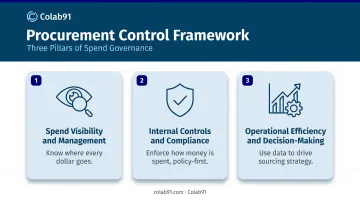
Three pillars underpin ISM:
- Spend visibility and management - knowing where every dollar goes across every category
- Internal controls and compliance - enforcing how money is spent, with policy embedded into the process rather than audited after the fact
- Operational efficiency and decision-making - using spend data to drive sourcing strategy, not just report on history
ISM is not a technology project. The platforms matter, but organizations that extract the most value pair the right tools with skilled practitioners who can interpret spend patterns and translate data into negotiation leverage or supplier consolidation opportunities.
Without domain expertise, even the best tools surface patterns that no one acts on. Data becomes a reporting exercise rather than a foundation for sourcing decisions.
Key Advantages of Intelligent Spend Management
The three advantages below map directly to outcomes organizations track: cost reduction, risk exposure, compliance rate, and strategic agility. They also compound - the longer ISM runs, the sharper the benchmarks become and the faster teams can act on what the data reveals.
Advantage 1: Complete Spend Visibility Across Every Category
Most organizations manage spend by category in isolation - one team tracking IT, another managing facilities, another handling contingent labor - with no unified view across all three. The result is duplicate vendor relationships, off-contract purchasing that nobody catches, and volume discounts that go uncaptured because no one sees the consolidated picture.
ISM consolidates spend data from disconnected systems - ERP, procurement platforms, expense tools, contract databases - into a single harmonized view. With that view, leaders can:
- Identify maverick spend before it becomes a budget variance
- Consolidate suppliers and negotiate on total volume rather than category-by-category
- Benchmark pricing across categories and geographies
- Spot purchasing patterns that would be invisible in a siloed environment
The visibility gap is measurable: Ardent Partners CPO Rising data puts average spend under management at 71% in 2025 - meaning nearly a third of organizational spend remains outside structured oversight. EY's research adds useful context: typically, 20% of suppliers account for roughly 80% of third-party spend, which means targeted consolidation efforts can move the needle quickly once visibility exists.
KPIs this affects: Spend under management (%), supplier consolidation rate, cost savings vs. baseline, invoice exception rate
When it matters most: PE-backed companies under a value creation mandate, post-merger integration scenarios where spend data is fragmented across acquired entities, and organizations scaling rapidly into new categories or geographies.
Advantage 2: Proactive Compliance and Risk Control
Traditional procurement audits problems after they happen. ISM embeds policy enforcement at the point of purchase - routing approvals based on defined rules, flagging non-compliant purchases before they clear, and producing clean audit trails without manual intervention.
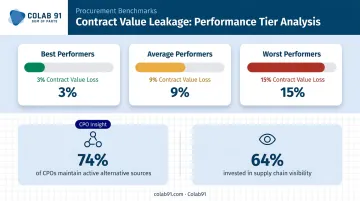
The financial stakes are real. World Commerce & Contracting reports that the average business loses almost 9% of contract value annually through poor contract management. Best performers lose about 3%; worst performers lose around 15%. That gap between the best and worst is entirely recoverable - and it starts with visibility into contract compliance at scale.
Beyond leakage, ISM creates a structured risk layer that traditional procurement cannot replicate. Organizations that have invested in supplier risk monitoring are already acting on it: Deloitte's 2025 CPO survey found 74% of CPOs now maintain active alternative sources, and 64% have invested in greater supply chain visibility - responses to supplier risk that require the underlying data infrastructure ISM provides.
KPIs this affects: Policy compliance rate, audit findings per period, contract leakage (%), supplier risk incidents, payment accuracy rate
Most relevant for: Healthcare organizations, regulated industries, and PE portfolio companies where compliance and auditability are directly tied to valuation and investor confidence. Colab91's advisor Erika Jung, who served as CPO at Pediatric Associates (a TPG portfolio company), has led exactly these kinds of enterprise-wide compliance and cost transformation programs - environments where procurement audit readiness is non-negotiable.
Advantage 3: Data-Driven Decision-Making and Operational Efficiency
ISM's third advantage is where spend control converts to spend improvement. Analytics applied to unified data give category managers decisions grounded in supplier performance, commodity trends, demand patterns, and contract terms - not incomplete reports pulled from three different systems.
EY's total spend management research puts the savings potential at 10–15% of the addressable spend baseline, broken into immediate initiatives (2–3%), medium-term programs (3–5%), and strategic initiatives (6–8%). The progression matters: the strategic tier alone (6–8%) represents more than twice the value of immediate wins - organizations that stop after quick wins forgo the largest share of the opportunity.
Automation compounds these gains by freeing skilled practitioners for higher-value work. Ardent Partners' 2024 ePayables data illustrates the efficiency gap starkly:
| Metric | Best-in-Class | Average | All Others |
|---|---|---|---|
| Invoice processing cost | $2.78 | $9.40 | $12.88 |
| Invoice processing time | 3.1 days | 9.15 days | 17.4 days |
| Invoice exception rate | 9.0% | 14.0% | 22.0% |
| Straight-through processing | 49.2% | 32.6% | 23.4% |
Best-in-Class performance reflects the combination of automation, structured data, and practitioners who can act on what the output reveals. For mid-market companies without the headcount to run complex spend analytics in-house, a dedicated offshore analytics capability - like Colab91's India-based sourcing and analytics teams - cuts weeks off the time between data capture and sourcing decisions.
KPIs this affects: Cost reduction vs. addressable spend baseline, % of procurement tasks automated, CPO-reported EBITDA contribution, sourcing cycle time, time-to-insight on spend data
When it matters most: Private equity sponsors driving EBITDA improvement across portfolio companies, organizations scaling procurement functions rapidly, and mid-market businesses without the internal headcount to sustain complex analytics programs.
What Happens When ISM Is Missing
The consequences of fragmented spend management are predictable, and they compound over time.
Escalating third-party costs. Without consolidated spend visibility, off-contract purchasing goes undetected, volume discounts slip by, and supplier contracts quietly auto-renew at unfavorable rates. There's no single owner enforcing compliance across categories.
Audit vulnerability. Organizations relying on manual approval processes and disconnected systems cannot produce the clean, complete audit trails that PE due diligence or regulatory review demands. Compliance failures surface at the worst possible time.
Operational overload. Without automation, procurement teams spend their time processing invoices, chasing approvals, and managing supplier inquiries rather than doing the strategic sourcing work that actually drives savings. Ardent Partners reports that AP staff alone spend nearly 22% of their time managing supplier inquiries, a share that grows sharply in organizations running fully manual processes.
The scaling problem is particularly acute. As organizations grow through acquisition, market expansion, or headcount increases, unmanaged spend doesn't scale linearly - it scales exponentially. Each new entity, vendor, or geography adds complexity without adding visibility. The longer ISM is deferred, the harder it becomes to establish control without significant disruption.
How to Get the Most Value from Intelligent Spend Management
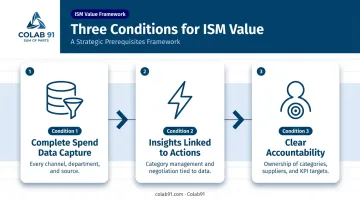
ISM delivers its greatest return when three conditions are consistently met:
Spend data is captured completely - not just from the categories that are easy to track, but from every buying channel, department, and data source. Partial visibility produces partial insights.
Insights are linked to specific actions - reports that sit unread generate no value. The disciplines of category management, supplier negotiation, and contract management need to be structured around what the data reveals, not what the team already planned to do.
Accountability is clear - someone owns each spend category, each supplier relationship, and each KPI target. Without accountability, even the best analytics infrastructure produces activity without results.
Technology is a necessary but insufficient condition. The organizations that extract the most from ISM pair platforms with domain-expert practitioners who understand procurement context, can interpret spend patterns in their industry-specific meaning, and know how to turn a category analysis into negotiation preparation.
Colab91 is built around exactly this model: establishing dedicated India-based procurement and analytics teams for mid-market and PE-backed clients, structured around their specific spend categories and staffed with practitioners who act as an extension of the in-house function.
Sustaining that value requires treating ISM as an ongoing discipline, not a one-time initiative. Dedicated teams make this cadence easier to hold:
- Review KPIs quarterly against actual spend outcomes
- Assess supplier relationships on performance data, not habit
- Adjust savings targets as the spend base evolves
The benchmarks sharpest at year three are rarely the ones that made sense at year one.
Conclusion
Intelligent spend management's core value rests on three compounding capabilities: visibility into where every dollar goes, control over how it's spent, and analytics to decide where it should go next. None of these works in isolation.
Each capability strengthens the others:
- Better visibility improves compliance enforcement
- Better compliance data sharpens supplier risk assessment
- Sharper analytics surface savings faster and accelerate sourcing decisions
As data accumulates and procurement teams build the operational muscle to act on it, these advantages compound. That's what makes ISM worth building systematically - the returns grow over time, not just at go-live.
For mid-market and PE-backed organizations in particular, the ability to manage third-party spend intelligently is a direct lever on profitability, risk posture, and enterprise value. Treating it as a strategic priority - rather than a back-office task - is often what separates organizations that find consistent savings from those that leave them on the table.
Frequently Asked Questions
What is intelligent spend management?
ISM is a data-driven approach to capturing and controlling all organizational spend - across every source, category, and buying channel - in a unified view. It enables finance and procurement leaders to reduce costs, enforce compliance, and make better sourcing decisions across the entire organization.
What are the three pillars of spend management?
The three pillars are:
- Spend visibility and management - knowing where money goes across every category and channel
- Internal controls and compliance - enforcing how it's spent through policy embedded into the process
- Operational efficiency and strategic decision-making - using spend data to drive better outcomes across sourcing, negotiation, and supplier management
How does intelligent spend management differ from traditional procurement?
Traditional procurement typically manages spend by category in isolation using manual processes. ISM unifies all spend data into a single view, applies automation and analytics, and proactively surfaces cost reduction and risk opportunities across the entire organization rather than within individual category silos.
What are the biggest challenges in implementing intelligent spend management?
The most common barriers are fragmented data across disconnected systems and a shortage of practitioners who can interpret spend analytics in context. Difficulty sustaining consistent policy enforcement across departments compounds both problems. Closing these gaps requires pairing the right technology foundation with experienced domain talent - whether built in-house or through dedicated offshore procurement teams.
How does AI improve spend management processes?
AI automates high-volume, low-value tasks like invoice matching and spend categorization, while machine learning detects anomalies and policy violations in real time. The result: procurement teams spend less time processing transactions and more time on sourcing decisions that move the needle.
What KPIs should businesses track for spend management effectiveness?
Core metrics to track include:
- Spend under management (%)
- Policy compliance rate
- Cost savings vs. addressable spend baseline
- Supplier consolidation rate
- Invoice exception rate
- Procurement cycle time
Review these at minimum quarterly, tied to targets that evolve as the spend base changes.