For mid-market and PE-backed healthcare organizations operating with lean procurement teams, the margin for error is even smaller. These organizations rarely have the luxury of dedicated category managers for every device class — yet they face the same regulatory complexity and supply chain risks as large health systems.
A strong medical device procurement strategy addresses five interconnected pillars: structured needs assessment and category planning, supplier qualification and compliance, cost management through total cost of ownership, risk mitigation, and data-driven spend optimization. This article covers each in practical terms.
Key Takeaways
- Medical device procurement demands structured category planning — not reactive purchasing triggered by clinical shortages.
- Regulatory compliance (FDA, ISO 13485, UDI) must be built into the procurement process from the start, not added as an afterthought.
- Total Cost of Ownership, not purchase price alone, is the correct foundation for cost decisions.
- Single-source dependency is a controllable risk — multi-supplier architecture and safety stock buffers are the answer.
- Spend analytics converts procurement from a cost center into a source of strategic intelligence.
What Makes Medical Device Procurement Uniquely Complex
Medical device procurement isn't general procurement with a compliance layer on top. It operates under structural constraints that require purpose-built processes.
Category Breadth and Regulatory Depth
The device landscape spans radically different procurement categories — capital equipment like imaging systems and surgical robots, single-use consumables like catheters and gloves, implantables, and diagnostic equipment. Each carries different lead times, vendor concentration, replacement cycles, and clinical criticality.
The regulatory burden compounds this complexity. The FDA classifies approximately 1,700 different generic device types across 16 medical specialty panels, with three risk-based classes determining the applicable review pathway. Class II devices generally require 510(k) premarket notification — and in FY2024, FDA received 3,744 such submissions with an average time to decision of 147 days against a 108-day target.
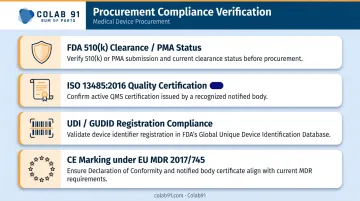
Procurement teams must also verify:
- FDA 510(k) clearance or Premarket Approval status for each device purchased
- ISO 13485:2016 quality management certification across the supplier base
- UDI (Unique Device Identification) compliance, with device information traceable through FDA's GUDID database
- CE marking under EU MDR 2017/745 for any devices sourced from or sold into European markets
Supply Chain Fragility
The pandemic exposed how thin the medical device supply chain actually is. GAO documented that federal agencies executed 43 Defense Production Act contracts valued at $3.9 billion between March and September 2020 — delivering 181,000 ventilators and 166.5 million respirators — just to cover gaps left by concentrated, fragile supplier networks.
The global semiconductor shortage later pushed FDA to add AEDs to its Medical Device Shortages List, demonstrating that even seemingly stable device categories carry hidden supply risk.
Limited supplier pools for specialized equipment, long lead times for custom components, and the direct link between device availability and clinical operations all concentrate risk in one place. When that supply chain breaks down, the consequences extend directly to patient care.
Building a Strategic Foundation: Needs Assessment and Category Planning
Most procurement dysfunction in healthcare traces back to an absent or inadequate planning foundation. Without it, purchasing becomes reactive — driven by clinical urgency rather than strategic intent.
Start With a Cross-Functional Needs Assessment
The first step is a formal needs assessment that brings together clinical staff, biomedical engineers, supply chain managers, and finance. The output should document:
- Device requirements by clinical department
- Usage volumes and consumption patterns
- Current lifecycle stages and replacement timelines
- Compliance requirements by device category
This cross-functional input matters. A 2022 systematic review of high-cost medical device purchasing found that multidisciplinary teams — including clinical engineers and physicians — are a recurring feature of effective device procurement, particularly for capital equipment and implantables where clinical preference significantly influences selection.
Segment Your Spend Into Categories
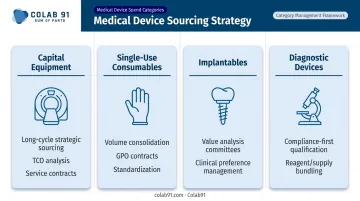
Not all device spend should be managed the same way. Effective organizations segment their medical device spend into distinct categories and apply differentiated sourcing strategies to each:
| Category | Sourcing Approach |
|---|---|
| Capital equipment (imaging, surgical systems) | Long-cycle strategic sourcing, TCO analysis, service contracts |
| Single-use consumables (gloves, catheters) | Volume consolidation, GPO contracts, standardization |
| Implantables (orthopedic, cardiovascular) | Value analysis committees, clinical preference management |
| Diagnostic devices | Compliance-first qualification, reagent/supply bundling |
Conduct a Spend Baseline Before Drafting Strategy
A full spend baseline analysis — built from historical PO data, contract terms, and vendor spend distribution — should precede any category strategy. This analysis surfaces:
- Redundant suppliers across categories
- Off-contract purchases bypassing negotiated pricing
- Consolidation opportunities within device subcategories
- Spend concentration risk with single-source vendors
For organizations that lack the internal bandwidth to run this analysis, Colab91's Savings Opportunity Assessment delivers this baseline within 4-6 weeks. The output is a category-by-category savings roadmap with quantified opportunity, typically representing 5-15% of addressable spend, designed specifically for mid-market and PE-backed healthcare organizations.
Set Objectives and Build a Phased Roadmap
Procurement objectives should align with organizational priorities and translate into measurable KPIs from day one. Depending on where the organization sits, those priorities typically fall into one of four areas:
- Cost reduction through consolidated purchasing and contract discipline
- Supply resilience by reducing single-source dependency
- Compliance improvement across device categories with regulatory exposure
- Innovation access for high-value clinical technology
A phased procurement roadmap then sequences category initiatives by impact and feasibility. For lean teams, this prevents the common mistake of trying to overhaul all categories simultaneously while making progress on none.
Supplier Qualification, Compliance, and Risk Management
Building a Qualification Framework
Supplier qualification in medical device procurement is not a one-time gate. It's an ongoing process covering:
- Technical capability and manufacturing capacity
- Quality certifications: ISO 13485:2016 registration and FDA facility registration
- Financial stability — financial distress at a supplier translates directly into supply disruption for you
- Delivery track record: on-time performance history and past quality incidents
Standard documentation requirements should include Device History Records (DHRs) and material certifications as baseline. The 2024 FDA QMSR final rule — which harmonized 21 CFR Part 820 with ISO 13485 — reinforced that manufacturers must maintain robust quality records, complaint records, and UDI tracking throughout their supply chain.
Procurement teams should verify supplier audit rights within contracts and conduct periodic documented audits: on-site where criticality warrants it, documented otherwise.
Compliance as a Non-Negotiable Criterion
Regulatory certification status should be a hard filter in supplier selection, not a negotiating point. Key compliance requirements to verify at qualification and on an ongoing basis:
- Current FDA registration for the device category
- Active ISO 13485 certification with valid scope
- 510(k) clearance number for Class II devices (or PMA for Class III)
- UDI labeling and GUDID registration compliance
- CE marking currency for EU-sourced products under MDR transition timelines
Verifying the right suppliers is only half the equation. The other half is making sure you're not entirely dependent on any one of them.
Addressing Single-Source Dependency
Over-reliance on a single supplier for critical devices creates unacceptable supply risk. The COVID-era experience — where concentrated ventilator and respirator supply chains collapsed under demand pressure — illustrates what happens at scale when there's no alternative sourcing architecture in place.
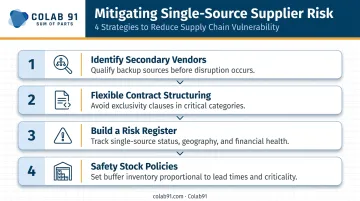
Mitigation strategies include:
- Identifying secondary or backup vendors for high-criticality SKUs before a disruption forces the search
- Structuring contracts that permit flexible sourcing and don't lock in exclusivity for critical categories
- Building a risk register that categorizes suppliers by single-source status, geographic concentration, and financial health
- Setting safety stock policies proportional to lead times and clinical criticality
Key Contract Terms for Risk Management
Medical device supplier agreements should include:
- Quality guarantee clauses tied to regulatory certification maintenance
- Audit rights (for on-site and document-based reviews)
- Change notification requirements for manufacturing process or component changes
- Force majeure provisions that define obligations during supply disruptions
Cost Management: From Purchase Price to Total Cost of Ownership
Why Purchase Price Is the Wrong Metric
Buying on purchase price alone is one of the most common and costly mistakes in medical device procurement. The real cost of a device includes installation, operator training, calibration, maintenance contracts, consumable replenishment throughout the device lifecycle, and eventual decommissioning.
For capital equipment, this lifecycle cost perspective is critical. A lower-priced imaging system with a more expensive service contract and higher consumable requirements will often cost more over a five-year horizon than a premium device with bundled service and standardized supplies.
Value-based procurement — evaluating price alongside clinical outcomes data, total lifecycle cost, and patient impact — is the framework adopted by leading health systems and PE-backed provider groups. A 2021 scoping review confirmed that this approach uses outcomes, quality, and cost control together in purchasing decisions, rather than optimizing for initial price alone.
Practical Cost Management Levers
Volume consolidation is one of the highest-return levers available. A 2019 JAMA Network Open cohort study of 1,373 lumbar-fusion patients found that single-vendor procurement of spinal implants was associated with a 21% cost reduction versus dual-vendor procurement, with similar 12-month revision rates — demonstrating that consolidation savings don't require clinical quality trade-offs.
Additional levers include:
- Device standardization across facilities to reduce training overhead and spare parts complexity
- GPO contract optimization through Vizient, Premier, or HealthTrust to access pre-negotiated pricing tiers
- Contract benchmarking at renewal — using current market rate data to renegotiate terms before auto-renewal locks in outdated pricing
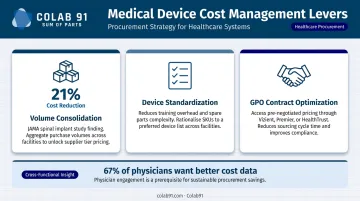
None of these levers work in isolation from the clinical side. McKinsey data shows 67% of physicians surveyed in late 2024 wanted better cost data — a direct opening for procurement teams to build the cross-functional partnerships that make value-based decisions stick.
Leveraging Technology and Spend Analytics to Drive Procurement Intelligence
What Procurement Technology Actually Delivers
E-procurement platforms, contract management software, and ERP integrations address a specific problem: without centralized systems, purchase orders are fragmented, approval workflows are inconsistent, and spend visibility is essentially impossible. Vizient benchmarks suggest that optimizing procurement processes can improve productivity by 2-3x, with best-in-class operations processing more than 1,500 purchase orders per FTE per month.
The operational impact is real. Centralized systems eliminate the manual purchase order processing and data reconciliation that consumes disproportionate time in lean procurement teams — freeing analysts to focus on category strategy rather than data hygiene.
Spend Analytics as a Strategy Tool
Spend analytics moves procurement from institutional memory to evidence-based decision-making. Analyzing spend data by vendor, category, facility, and time period enables teams to:
- Identify savings opportunities from supplier consolidation and volume leverage
- Track contract compliance and detect off-contract purchases before they accumulate
- Spot pricing discrepancies across facilities purchasing identical devices at different rates
- Monitor vendor concentration risk across the device portfolio
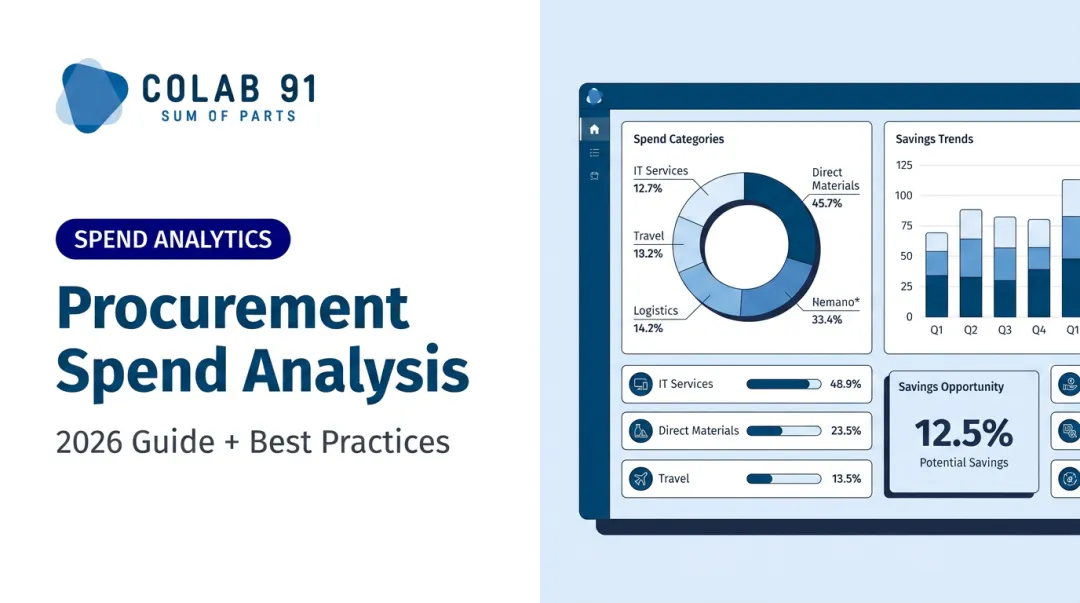
McKinsey estimates that supplies and services represent 30-40% of a typical health system's cost base, with spend optimization opportunities yielding 5-15% in savings. Without visibility into that spend base, those savings opportunities go unidentified — and uncaptured.
AI-Powered Tools and Continuous Intelligence
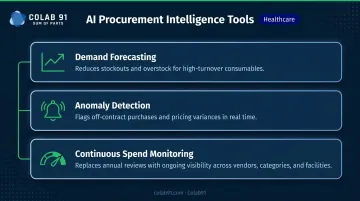
For lean procurement teams, the most relevant AI capabilities tend to be practical rather than experimental:
- Demand forecasting reduces stockout and overstock scenarios for high-turnover consumables
- Anomaly detection flags off-contract purchases or pricing variances before they accumulate into material waste
- Continuous spend monitoring replaces annual snapshot reviews with ongoing visibility across vendors, categories, and facilities
Mid-market organizations can access these tools through platform partnerships rather than internal build — no large engineering investment required.
For PE-backed healthcare organizations in particular, Colab91's model combines AI-powered spend intelligence with dedicated India-based procurement domain experts — delivering ongoing category monitoring rather than periodic reporting. Clients including Pediatric Associates and Kindred Healthcare use this model to maintain continuous visibility into vendor concentration, off-contract spend, and emerging savings opportunities.
The analyst teams work as an extension of internal procurement, not a replacement for it.
Monitoring, Optimizing, and Scaling Your Strategy
The KPI Framework
Procurement strategy without performance measurement defaults back to reactive purchasing. Key metrics for medical device procurement, reviewed on a quarterly cadence:
- Supplier on-time delivery rate (AHRMM targets 93-98% for internal requisition fill rates)
- Contract compliance percentage — what share of purchases are on-contract vs. off-contract
- Cost savings realized vs. target across active category initiatives
- Quality incidents and device recalls attributed to the supplier base
- Procurement cycle time from requisition to delivery for key device categories
For recall management specifically, AHRMM's KEYS framework targets 100% closure rate for Class I recalls — a standard that procurement teams should track against their own supplier base.
Continuous Improvement and Scaling
Annual strategy reviews — or reviews triggered by major market or regulatory changes — should incorporate:
- Stakeholder feedback from clinical teams, finance, and operations
- Benchmarking against industry standards (AHRMM, ISM, CAPS)
- Lessons learned from supply disruptions or compliance incidents
That review cadence becomes especially critical when organizations grow through acquisition. Integrating new facilities into an existing device formulary, harmonizing supplier contracts across entities, and standardizing device categories are common challenges in PE-backed healthcare roll-ups.
Studies of merged health systems show that procurement integration is frequently delayed — with overlapping contracts persisting for years post-acquisition — creating duplicated cost structures that erode the financial gains that justified the deal. Colab91's 100-day procurement plan and M&A integration support services are built to close this gap for PE-backed healthcare portfolios.
Frequently Asked Questions
What is a medical device procurement strategy?
A medical device procurement strategy is a structured plan covering needs assessment, supplier qualification, compliance management, cost optimization, and risk mitigation — designed to ensure reliable access to devices that meet clinical and regulatory requirements without compromising supply continuity.
How does medical device procurement differ from general healthcare procurement?
Medical device procurement adds several layers of complexity: device-specific regulatory requirements (FDA clearance, ISO 13485, UDI tracking), longer procurement cycles for capital equipment, highly specialized supplier pools with limited alternatives, and a direct link between device availability and patient care delivery that general procurement categories don't carry.
What regulatory standards must medical device procurement teams comply with?
Core compliance requirements span four areas:
- FDA device classification and 510(k) clearance
- ISO 13485:2016 quality management systems across the supplier base
- UDI labeling and GUDID registration
- CE marking under EU MDR 2017/745 (with transition timelines through 2027–2028 for legacy devices)
How can healthcare organizations reduce costs in medical device procurement without compromising quality?
TCO analysis, volume consolidation, device standardization, and renegotiating contracts using market benchmarking all deliver cost reduction without quality trade-offs. The JAMA Network Open spinal implant study showed 21% cost reduction through vendor consolidation with equivalent clinical outcomes — demonstrating that clinical outcomes don't have to suffer when procurement teams pursue cost discipline.
What are the biggest supply chain risks in medical device procurement?
Single-source dependency, geopolitical disruptions to component supply (particularly semiconductors), regulatory changes affecting product availability, and demand surge scenarios. Addressing these risks requires multi-supplier sourcing, safety stock policies, and a risk register with defined mitigation actions for each exposure.
How does spend analytics improve medical device procurement decisions?
Spend analytics surfaces vendor concentration risk, off-contract purchasing, and pricing variances across facilities. With that visibility, procurement teams can enforce contract compliance, identify savings opportunities, and get ahead of shortages before they affect patient care.